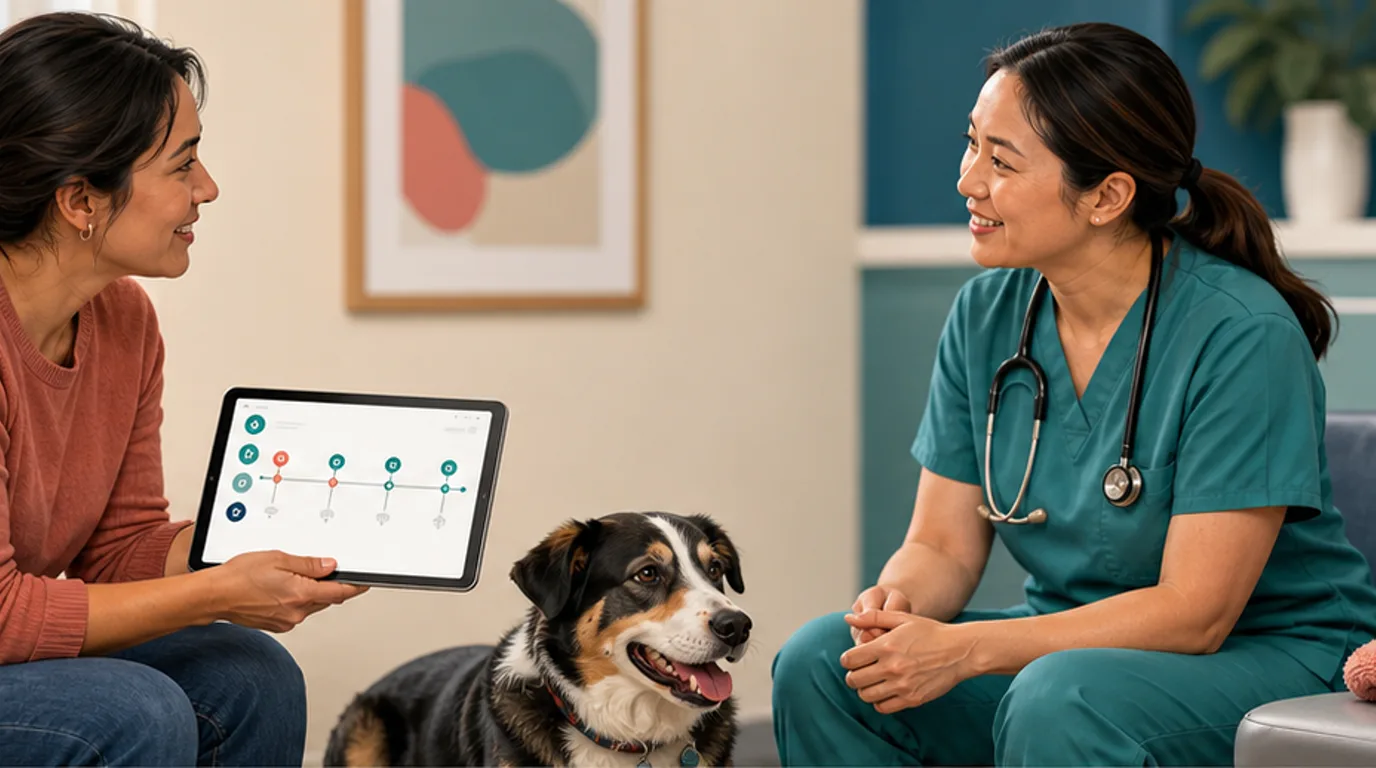
A pet behavior report for your vet should make a pattern easier to investigate. It should not try to diagnose the pet.
The most useful report says what changed, when it began, how often it happens, what occurs immediately before and after it, and whether appetite, movement, sleep, elimination or medication changed too. A short timeline and two representative videos usually communicate more than several pages of conclusions about what the pet “must be feeling.”
Start with the question you need answered
Put one sentence at the top:
Since July 12, Milo has growled and moved away when his lower back is touched. This now happens most days. Could pain or another medical problem be contributing?
That sentence gives the veterinarian a presenting concern, an onset, a frequency and a medical question. Compare it with “Milo has become aggressive,” which removes the context and turns a behavior into a character judgment.
If there are several concerns, rank them. Lead with the change that creates the greatest safety, welfare or medical risk. Routine barking and a new inability to urinate do not belong at the same priority.
The information a veterinarian can use
Veterinary behavior histories are detailed because behavior can change with pain, neurologic disease, urinary or gastrointestinal problems, endocrine disease, sensory loss, medication, learning and changes in the home. A report cannot sort those causes by itself, but it can preserve details that are easy to forget during an appointment.
Record these fields:
| Field | What to write | Example |
|---|---|---|
| Onset and course | First known date and whether it was sudden or gradual | First noticed July 12; daily by July 20 |
| Frequency | Episodes per hour, day, week or month | Three times in the past seven days |
| Duration | Seconds or minutes, including recovery | Barking lasted 25 seconds; settled after four minutes |
| Intensity | A consistent factual scale | Air snap, no contact; person was 2 m away |
| Antecedent | What happened immediately before | Visitor stood and reached toward collar |
| Behavior | Visible movement, posture and sound | Weight shifted back, head turned, growled, retreated |
| Consequence | What happened immediately after | Visitor stopped; dog moved behind sofa |
| Pattern changes | More frequent, longer, stronger or new contexts | Previously only at night; now also after walks |
| Interventions | What you tried and what followed | Added distance; dog resumed eating within one minute |
| Health and routine | Appetite, water, toilet habits, sleep, mobility, grooming, medication and household changes | Hesitates before stairs; new medication began July 10 |
The antecedent-behavior-consequence structure is often called an ABC record. “Consequence” means the immediate event after the behavior, not punishment. It helps the clinician see the sequence and what may be maintaining or ending it.
Describe the body, not an assumed motive
Observation and interpretation can sit beside each other, but label them.
| Interpretation | More useful observation |
|---|---|
| “She was jealous.” | “When I petted the other cat, she approached, blocked the space and swatted once.” |
| “He knew he was guilty.” | “He lowered his body, turned his head away and left when I entered.” |
| “She attacked for no reason.” | “She froze for about two seconds, pupils appeared enlarged, ears rotated sideways, then she lunged when the hand moved closer.” |
| “He is stubborn on walks.” | “At the junction he stopped, leaned backward and would not take chicken for 40 seconds.” |
This does not mean emotion is irrelevant. It means the veterinarian gets the original evidence before your interpretation. The same visible action can have different causes in different contexts.
For help learning the distinction, use the pet behavior photo-analysis checklist. Dog owners can review the AI dog body-language analyzer guide, and cat owners can use the AI cat body-language analyzer guide.
Add the health context, even when the problem looks behavioral
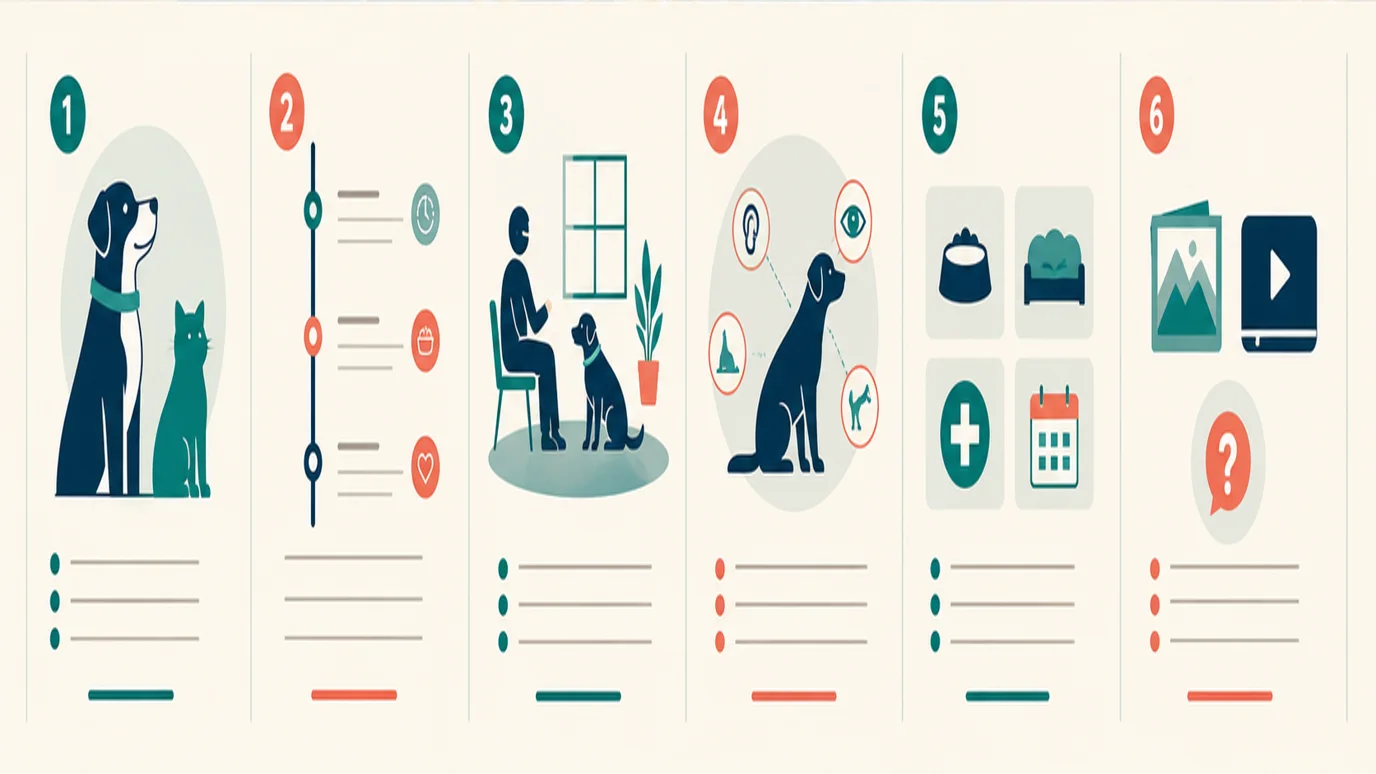
For the same date range, note changes in:
- eating, drinking and weight
- urination and stool frequency, location and appearance
- vomiting, coughing, breathing or vocalization
- sleep timing and nighttime waking
- jumping, stairs, gait, stiffness and tolerance of touch
- grooming, scratching, skin and coat
- play, social contact and time spent hiding
- current medication, supplements, dose changes and missed doses
- diet, visitors, work schedule, travel, boarding, moving or a new animal
Write “no observed change” when you actively checked a category. Do not write “normal” if you did not observe it.
Bring the clinic's medication list and previous medical records separately. Your behavior summary supports the medical history; it does not replace the clinic's official record.
Record natural video safely
A useful clip begins before the event, keeps the whole body in frame and continues through recovery. Preserve the original file and date. Add one line explaining the context and distance.
Never provoke a bite, fight, panic response, chase or handling conflict for the camera. Do not remove a cat from hiding, crowd a dog who is freezing, repeat a painful movement or place animals together to demonstrate conflict. Existing doorbell-camera footage or a stationary camera can capture naturally occurring patterns without adding pressure.
If filming changes the situation or puts anyone at risk, skip it and write the sequence instead. University veterinary behavior services explicitly advise recording only when it can be done safely without approaching or escalating the pet.
A one-page report template
Copy this into a note, document or email. Keep the summary to one page and attach the detailed log separately.
Pet and visit
- Pet: name, species, breed or type, age, sex and neuter status
- Visit date and primary concern
- First observed date and progression
- Current diagnoses, medications and supplements
- People and animals in the home
- Recent health, schedule or environment changes
Pattern summary
- Frequency and typical duration
- Places and times it occurs
- Consistent antecedents
- Exact observable behavior
- What happens afterward and recovery time
- What has helped, had no effect or made it worse
- Any bite, scratch, fall, escape or other injury risk
Three representative events
| Date/time | Before | Visible behavior | After/recovery | Health or routine note |
|---|---|---|---|---|
Attachments and questions
- File names of up to three representative photos or videos
- Questions you want answered
- What outcome would improve daily life for the pet and household
Send it before the appointment if the clinic accepts documents. Ask which file types and video-sharing method they prefer. A specialist may also provide an intake form; complete that form even if your summary covers similar ground.
When not to wait for a report
Sudden aggression, confusion, hiding, touch sensitivity, house soiling, reduced movement or a major sleep change also deserves veterinary assessment. The urgency depends on the whole clinical picture, which an online guide cannot determine.
If a behavior creates immediate bite or conflict risk, use distance, doors, gates or separate rooms without confrontation. Do not test whether the pet will repeat it. Tell the clinic about safety concerns before arrival so staff can plan lower-stress handling.
Where a PetTranslator PDF fits
PetTranslator.ai separates visible markers from interpretation, includes a confidence level and provides Do/Avoid guidance from a submitted photo or short video. Pro accounts can export an analysis as a PDF.
That PDF can support a veterinary conversation by preserving what was visible in one submitted moment. It is not a veterinary medical record, physical examination, pain assessment, diagnosis or complete behavior history. Attach it to your timeline rather than treating it as the timeline.
Use original media too. A veterinarian may interpret the clip differently, notice movement outside the selected frame or need clinical information the analysis never received. Check the current plan details before relying on PDF export, and review how uploads and account data are handled in the privacy policy.
What happens after the first vet visit?
The veterinarian may examine the pet, recommend diagnostics, adjust treatment, ask you to continue tracking or refer the case. Keep using the same definitions so before-and-after comparisons remain meaningful. “Two episodes this week, each under 10 seconds” is easier to compare than “much better.”
For a complex case, an online or in-person behavior professional may request a longer history. Compare service levels in the online dog behavior assessment guide or online cat behavior assessment guide. The credential guide explains when to look for a veterinary behaviorist or another qualified professional.
Sources
- Merck Veterinary Manual: diagnosis of behavior problems in animals: medical evaluation, ABC history, onset, frequency, duration, intensity, schedule and environment.
- AAHA: incorporating behavioral assessments into every examination: standardized history and tracking change over time.
- Cornell Canine Behavioral History Form: example specialist intake structure.
- NC State Canine Behavioral History Form: chronology, body language, aftermath, goals and veterinary coordination.
- Tufts: preparing for your behavior appointment: intake, environment, prior interventions and medical records.
- Virginia Tech Clinical Behavior Service: safe natural video without approaching or escalating the pet.
Khabir Mughal is the founder of PetTranslator.ai. This guide was checked against veterinary manuals, university behavior-clinic intake guidance and AAHA recommendations on August 18, 2026.