A pet stress tracker can record possible indicators of stress. It cannot directly read a dog or cat's internal emotional state.
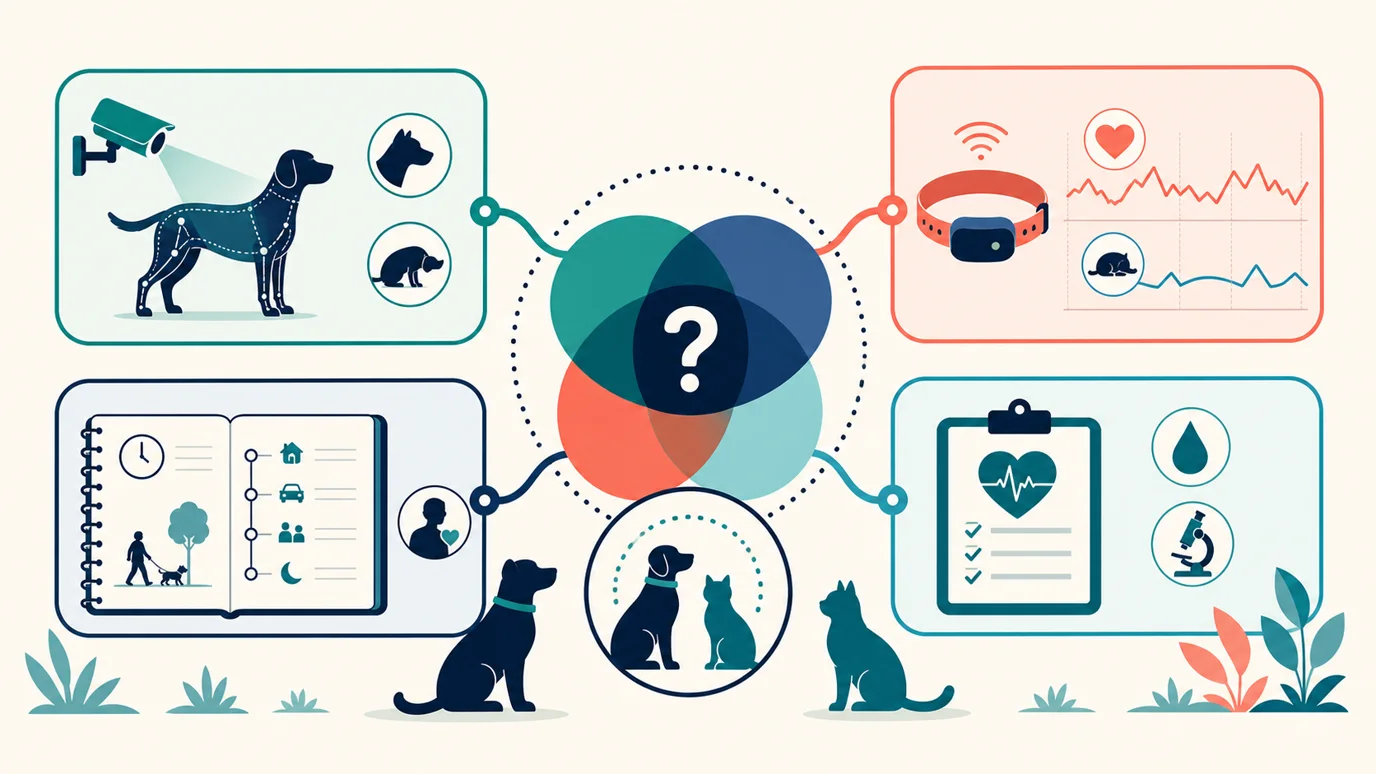
That distinction matters. A camera can capture posture. A journal can preserve context. A collar can estimate activity, rest or heart-rate patterns. A veterinarian can combine history, examination and testing. Each adds evidence, but none turns one number into a diagnosis of stress or anxiety.
The best tracker is therefore not the one with the most confident score. It is the one that shows its underlying observations, compares the pet with their own baseline, preserves uncertainty and makes it easy to act on meaningful change.
Four types of pet stress tracker
| Tracker type | What it records | Best use | Main limit |
|---|---|---|---|
| Manual behavior log | Time, context, visible behavior, duration and recovery | Identifying triggers and change over days or weeks | Owner attention and interpretation bias |
| Photo or video analysis | Markers visible in selected media plus supplied context | Reviewing posture and creating consistent observation records | Selected moment, camera angle and missing off-frame context |
| Wearable or home sensor | Activity, rest, location and sometimes physiologic estimates | Detecting deviations from an individual routine | Arousal and movement are not the same as negative stress |
| Veterinary assessment | History, examination, validated scales and tests when indicated | Investigating medical and behavioral causes | Not continuous; findings still require context |
A useful system can combine these. A collar may flag less nighttime activity; a journal may show the dog now hesitates before stairs; video may preserve the altered movement; the veterinarian can examine for pain. The sensor did not diagnose pain. It prompted a better observation.
Stress, arousal and anxiety are not synonyms
Arousal describes activation. It can rise during fear, frustration, play, anticipation or vigorous exercise.
Stress response refers to behavioral and physiological changes when demands challenge the animal's ability to cope. Short-lived activation is not automatically harmful. Persistent, intense or poorly recovering responses are more concerning.
Anxiety is anticipation of possible threat and is a clinical concern when it is excessive or impairs normal function. An app cannot diagnose an anxiety disorder from a photo or activity graph.
This is why heart rate, heart-rate variability or activity alone cannot tell you whether an animal is distressed. Research reviews note that HRV can change during positive events such as reward or familiar petting as well as challenging events. It indicates physiological activation that needs behavioral and situational context.
What to track instead of one mood score
Use a small dashboard built around change:
Exposure
- what happened before the response
- distance or intensity of the event
- time, place and people or animals present
- whether the event was expected or controllable
Visible response
- posture, movement, facial markers and vocalization
- approach, avoidance, hiding, freezing, pacing or escape attempts
- eating, drinking, grooming, elimination and social contact
- frequency, duration and intensity using stable definitions
Recovery
- time until normal movement, exploration, rest, eating or play returns
- whether the pet responds to familiar cues or takes ordinary food
- whether the response carries into the next activity or day
Baseline and health
- ordinary sleep and activity rhythm
- appetite, water, urine and stool
- mobility, jumping and tolerance of touch
- medication, illness, travel and household changes
AAHA's list of nonspecific distress signs spans all these domains. It also shows why a single gesture cannot provide a verdict: increased or decreased activity, increased or decreased social closeness, and increased or decreased grooming may all matter when they represent a change for that animal.
How to read an app's stress score
Before relying on a number, ask:
- What inputs create the score?
- Can I see the raw observations or measurements?
- Is the score compared with this pet's baseline or a generic population?
- Was the model or scale validated for this species, setting and purpose?
- How does motion, posture, breed, coat, lighting or camera angle affect it?
- Does the app distinguish arousal from negative emotional valence?
- How does it display low confidence or missing data?
- What action does an alert recommend, and when does it advise veterinary care?
“AI-powered” is not a validation method. A proprietary score may still be useful as a prompt to look closer, but the company should explain what changed. Avoid tools that claim to read thoughts, guarantee emotion detection, diagnose anxiety or rule out pain.
A note on cat stress scales
The Kessler and Turner Cat Stress Score is a seven-level posture and behavior scale developed for cats in confined housing. Research reviews report reasonable agreement between trained observers in that context, alongside limits: short observation windows, omitted grooming or social behavior, subjectivity and effects of setting.
An app displaying a “cat stress score” is not automatically using that scale, and a shelter observation scale is not automatically validated for a pet cat photographed on a sofa. Ask which scale is used and whether the context matches.
What wearables add
Wearables are strongest at repeated passive measurement. They may detect a change in:
- activity or inactivity
- rest timing and fragmentation
- location or distance traveled
- scratching, grooming or drinking when supported by the device
- heart rate or HRV on devices designed to measure them
Their weakness is meaning. Less movement could reflect relaxed sleep, hot weather, a quiet day, pain, illness or sensor fit. More activity could reflect play, visitors, pacing or a loose device. Compare the signal with the pet's behavior, environment and health rather than an average for “similar pets.”
Check fit, weight and habituation. If the device changes how the pet moves, scratches at the collar or causes skin irritation, its data and welfare cost both become problems.
What cameras and AI add
Photo and video tools can slow down an interaction that passed too quickly in real time. They can point to combinations such as lowered posture, backward weight shift, head turn, ear position, facial tension, tail carriage, freezing or repeated scanning.
Media selection creates bias. Owners tend to submit unusual moments, while the pet's ordinary relaxed baseline stays off camera. A tight portrait may omit feet, tail, trigger and escape route. Review the pet behavior photo checklist before comparing images over time.
For dogs, the stress ladder shows why clusters and escalation matter more than one sign. The cat stress guide covers acute versus chronic patterns and household resources.
A seven-day tracking protocol
Day 1: Define the purpose. Choose one question, such as recovery after visitors or hiding after household noise. Do not track “overall stress” without a defined outcome.
Days 1 to 3: Establish baseline. Record ordinary rest, movement, eating, social behavior and recovery in comparable time windows.
Days 4 to 7: Log natural events. Capture what already occurs. Do not present a trigger to generate data. Use the same event definition and note quiet days.
Day 7: Compare four dimensions. Look at frequency, duration, intensity and recovery. Then check whether health and routine changed at the same time.
Use the pet behavior journal app guide for a 30-second entry format. If you need to share the result, the vet-report guide turns the log into a concise summary.
Do not provoke stress to test the tracker
Never corner, restrain, startle or repeatedly expose a pet to see whether the score rises. Do not force contact between animals, approach a hiding cat, touch a possibly painful area or move closer to a freezing dog for a clearer image.
If a management change is safe and already recommended, track the pet under the ordinary plan. For example, measure recovery with more distance from visitors instead of running an unprotected “before” trial.
The same rule applies to trigger stacking: repeated exposures can change the animal while you are trying to measure them.
When tracking should stop and care should start
Arrange veterinary assessment for sudden aggression, hiding or withdrawal; a major appetite, thirst, elimination, sleep or grooming change; reduced jumping or movement; new touch sensitivity; confusion; or a response that is becoming more frequent, intense or slow to recover.
Pain and disease can look behavioral. Stress can also worsen a medical problem. A tracker helps describe the timeline; it cannot safely separate those possibilities.
Where PetTranslator fits
PetTranslator.ai analyzes visible body-language markers in an uploaded photo or short video, keeps interpretation separate, reports confidence and offers Do/Avoid guidance. Paid plans add behavioral trends and a journal across analyses.
It is an observation tracker, not a wearable or continuous monitor. It does not directly measure stress hormones, heart rate, pain or anxiety, and it does not diagnose. Its useful role is turning selected moments into structured, reviewable entries that you can compare with context and baseline.
Check current plan details and the privacy policy before uploading household media.
Sources
- AAHA: common signs of anxiety and distress: nonspecific behavioral and physical indicators in dogs and cats.
- Assessing the welfare of kennelled dogs: review of behavior, heart rate, HRV and the need to establish emotional valence through additional evidence.
- Psychogenic stress in hospitalized dogs: variability, context and limits of behavioral and cortisol measures.
- Stress measures in single- and multi-cat housing: Cat Stress Score uses and methodological limitations.
- Methods of assessing shelter-cat welfare: observer training, brief observation and validity limits of feline stress scoring.
- AAHA signs of pain in dogs and cats: medical overlap in behavior, movement, grooming, sleep and handling response.
Khabir Mughal is the founder of PetTranslator.ai. This guide was checked against current animal-welfare reviews, AAHA guidance and the pet-tracker market on August 18, 2026.