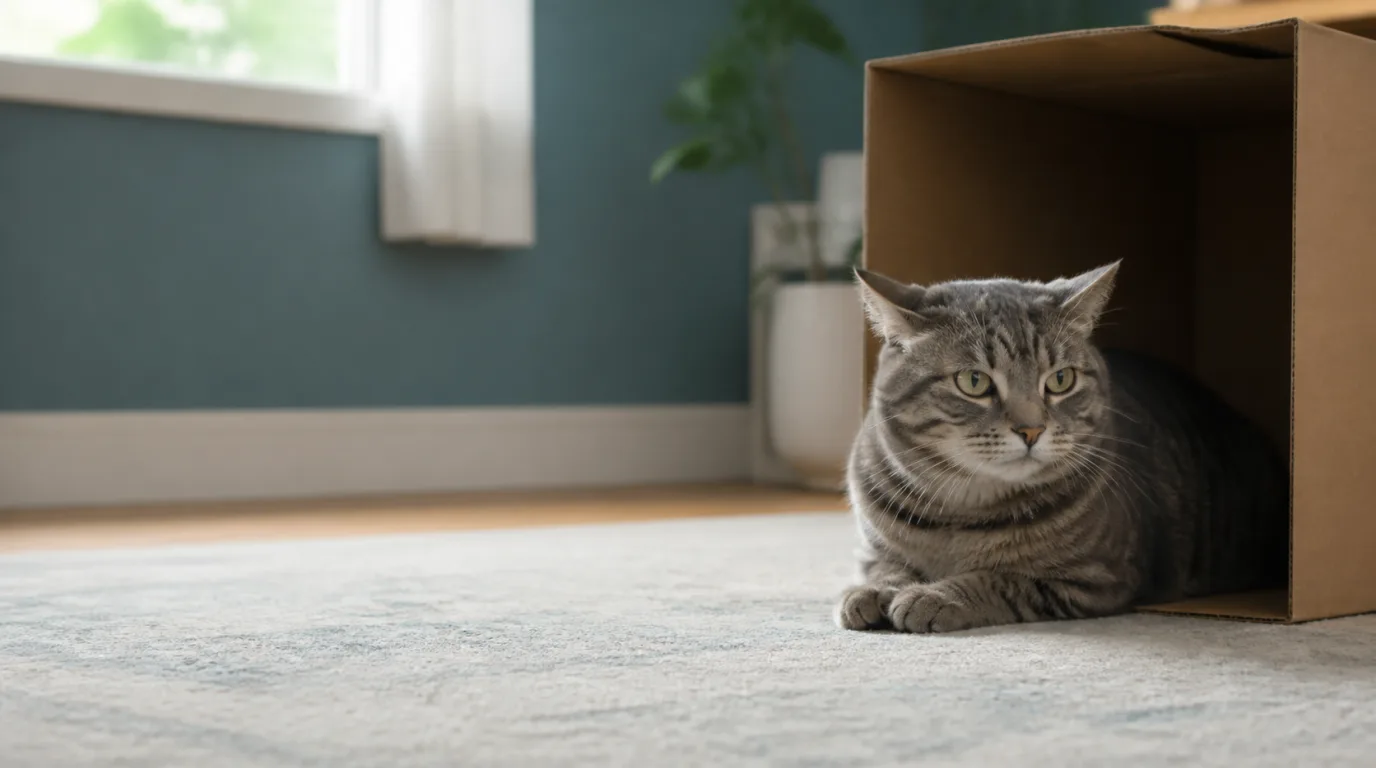
Cat stress signs can be immediate body-language changes or slower changes in routine. An acutely stressed cat may crouch, freeze, turn the ears sideways, hold the tail close, hide or try to escape. Chronic distress may appear as prolonged hiding, hypervigilance, reduced play, changed social contact, overgrooming, appetite changes, spraying or avoiding the litter box.
When the trigger is relocation, use the safe-room plan for a cat hiding after a move alongside this broader stress checklist.
Those signs also occur with pain and disease. Stress should not become a reason to delay veterinary care, especially when the change is sudden, persistent or affects eating, urination, breathing or mobility.
Two patterns need their own checks: repeated tail chasing may involve itch or pain, and resource guarding can restrict another cat's access without an obvious fight.
Acute versus chronic cat stress
| Pattern | Time scale | What you may notice | First response |
|---|---|---|---|
| Acute stress | Seconds to hours around an event | Low tense body, ears sideways or back, wide or narrowed eyes, tail close or lashing, freezing, hiding, escape attempts, hiss or growl | Stop pressure, add distance, provide cover and an exit |
| Incomplete recovery | Hours after the event | Continued scanning, reluctance to emerge, reduced appetite, altered grooming, inability to settle | Keep the environment quiet and predictable; monitor basic functions |
| Chronic distress | Repeated or persistent change over days or weeks | Restricted use of the home, social withdrawal, changed sleep, play, grooming, eating, scratching, spraying or litter-box use | Veterinary assessment plus an environmental and social review |
The categories overlap. A frightening event can produce an acute response and a longer recovery. Repeated conflict can create a chronic pattern with occasional acute episodes.
Acute cat stress signs
Posture and movement
A cat may lower the body, tuck the feet, shift weight away, lean from an approach or become still. Crouching also appears during hunting, and loafing can be ordinary rest, so muscle tension and context matter. A stressed cat often looks ready to flee but unable or unwilling to move yet.
Ears, eyes and whiskers
The ears may rotate sideways into airplane ears or flatten back. Eyes can open wide, narrow or track a trigger while the head turns away. Pupil size changes with light as well as arousal. Whiskers may retract toward the cheeks or move forward with intense attention. No single face part gives a verdict.
Tail
The tail may wrap close, hold low, tuck or lash. A twitching tip can reflect focused hunting or rising irritation. Use the cat tail guide to compare position and motion with the rest of the cat.
Avoidance and defensive behavior
Hiding, retreating, refusing contact, hissing, growling, swatting and biting can all increase distance. The behavior describes the cat's response in that setting, not a bad temperament. Do not reach into a hiding place or punish a warning.
The complete cat body-language guide helps separate stress from play, predatory focus and ordinary alertness.
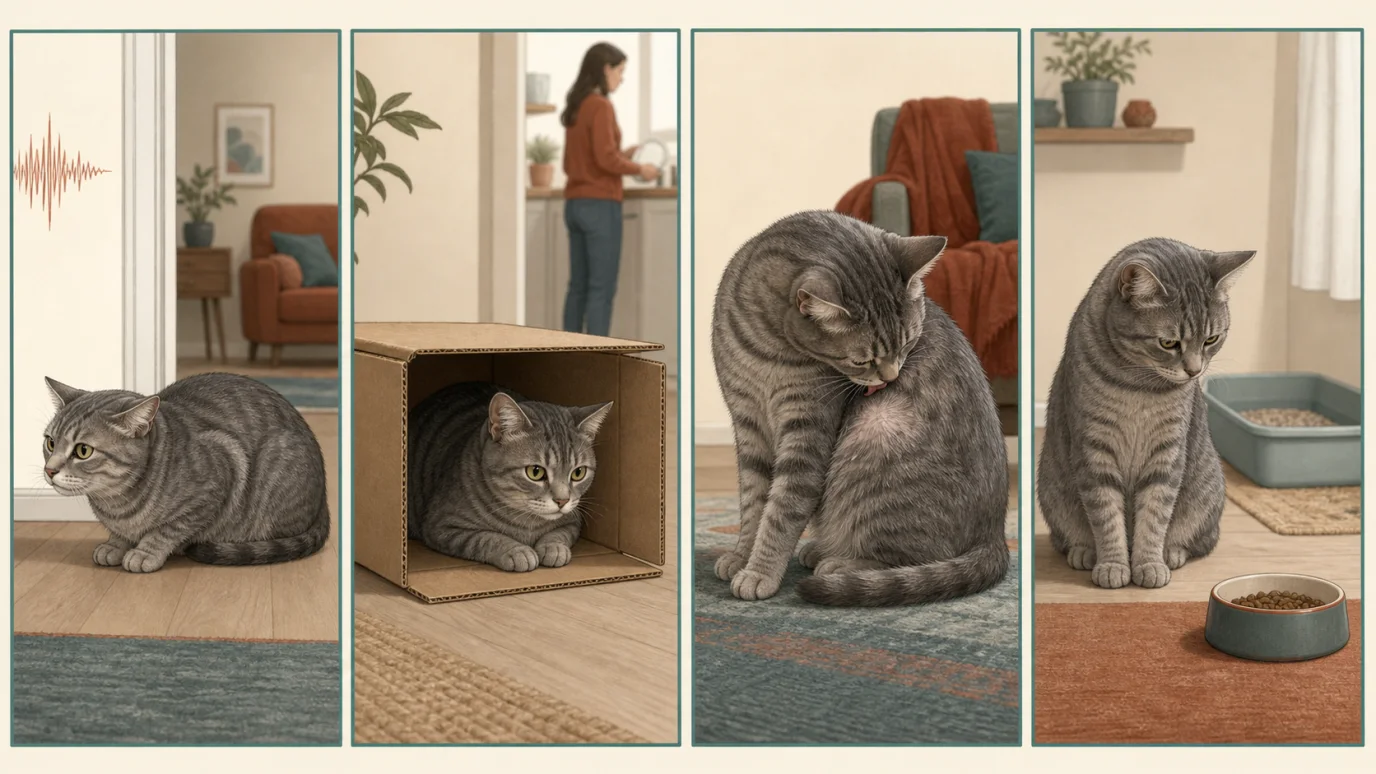
Stress may show in the body during one event or in routines across days. From left: acute tension, persistent hiding, repeated grooming and changed use of food or litter resources. Each also has medical differentials.
Chronic stress signs in cats
Chronic distress is often visible in where the cat goes and what they stop doing.
Hiding or living in one small area
Hiding is a normal coping option. Concern rises when the duration changes, the cat no longer uses ordinary routes or resources, or another animal controls access. The cat hiding guide explains how duration, eating and recovery separate a useful retreat from a larger problem.
Hypervigilance
The cat may scan doors and windows, startle easily, rest lightly or wait until the home is quiet to eat and use the litter box. A cat can appear inactive while remaining unable to relax.
Social change
Some cats withdraw from people or other animals. Others become unusually clingy, irritable or demanding. The meaningful sign is a change from that cat's ordinary pattern.
Grooming change
Repeated licking can thin the coat, but allergy, parasites and pain are common causes. Reduced grooming can accompany pain, dental disease, obesity or systemic illness. “Psychogenic” overgrooming should not be assumed before a medical workup.
Appetite, vomiting or weight change
Stress can alter eating and gastrointestinal function, yet appetite loss, overeating, vomiting and weight change have many medical causes. Record what the cat actually consumes rather than relying on whether food was offered.
Litter-box and marking changes
Urinating outside the box, straining, spraying and defecation changes may relate to resource access, social conflict or environmental stress. They can also signal urinary, gastrointestinal, orthopedic or neurological disease. The house-soiling guide starts with medical triage.
Reduced play and exploration
A cat who stops playing, climbing, scratching or visiting favored areas may be avoiding conflict or conserving movement because of pain. Quietness alone is not proof of calm.
Stress, pain and illness overlap
Veterinary reviews emphasize that physical and emotional health cannot be separated neatly. Chronic disease can cause distress, and an unpredictable or socially difficult environment can affect health and behavior. Both can be present at once.
Use “stress” as a working observation, not a diagnosis. Arrange a veterinary examination when behavior changes without a clear short-lived event, when a routine change persists, or when eating, drinking, urination, defecation, movement or grooming is affected.
The guide to why a cat is acting differently lists common medical and behavioral differentials.
Common sources of feline stress
- unfamiliar people, animals, smells or handling
- moving, renovation, visitors or schedule disruption
- lack of hiding, climbing, scratching or hunting opportunities
- litter boxes or food placed where the cat feels exposed
- unpredictable noise or punishment
- outdoor cats visible through windows
- pain, itching, nausea or chronic disease
- conflict between cats sharing a home
The trigger may not be dramatic. A covered route blocked by another cat or a litter box beside a noisy appliance can affect daily resource use.
Quiet conflict in multi-cat homes
Cats do not need to fight for conflict to matter. One cat may stare, follow, block a doorway or occupy a resource while the other waits, detours or retreats. Watch whether every cat can reach food, water, litter boxes, resting sites and high places without passing another cat at close range.
The guide to cats playing or fighting includes a household audit for chasing, hiding and route use. If one cat changes routine, assess relationships rather than assuming all cats who share a sofa are bonded.
A five-pillar home stress audit
AAFP and ISFM environmental-needs guidance organizes feline welfare into five practical areas.
1. Safe place
Provide quiet hiding and elevated resting options. A safe place works only if people, children and animals leave the cat alone there.
2. Separate key resources
Distribute food, water, litter boxes, scratching surfaces, resting places and play areas so one route or cat cannot control all access. In multi-cat homes, separation is often more important than adding several bowls side by side.
3. Play and predatory outlets
Offer short interactive play that lets the cat stalk, chase and catch an appropriate toy. Match intensity to age, health and preference.
4. Predictable, cat-led interaction
Let the cat initiate and leave social contact. Use brief petting around preferred head and cheek areas, with pauses. Avoid forced holding and punishment.
5. Respect smell
Cats use scent to assess familiarity and territory. Avoid strong fragrances around key resources, keep familiar bedding during change, and clean marked areas with an appropriate enzymatic product without punishing the cat.
Synthetic pheromone products may help some cats in some settings, but they do not replace adequate resources, pain treatment or conflict management.
Keep a seven-day baseline log
Record observable routines rather than writing only “stressed.”
| Area | What to record |
|---|---|
| Eating and drinking | Amount, time, location and whether another animal was nearby |
| Litter box | Urine and stool frequency, straining, location and access problems |
| Rest and hiding | Places used, duration and whether the cat emerges for normal activities |
| Grooming | Normal, increased, reduced or focused on one body area |
| Movement and play | Jumping, stairs, scratching, toy interest and route changes |
| Social behavior | Approach, avoidance, conflict, following and blocked access |
| Trigger and recovery | What changed first and when behavior returned to baseline |
Share the log, photos and videos with your veterinarian. Improvement means ordinary activities and resource use returning, not simply fewer visible protests.
When to call a veterinarian
Contact a veterinarian promptly for:
- reduced or absent food intake, especially approaching 24 hours
- straining to urinate, frequent unproductive box visits, crying in the box or little to no urine
- repeated vomiting or diarrhea
- rapid weight change, marked lethargy or weakness
- overgrooming with damaged skin
- sudden aggression or touch sensitivity
- persistent hiding with reduced basic activity
- any new behavior change in a senior cat
Urinary obstruction is an emergency, particularly in male cats. If a cat strains and produces little or no urine, seek emergency care rather than treating it as stress-related house soiling.
After medical causes are assessed, persistent fear, conflict or avoidance may need a qualified feline behavior professional. The credential guide explains what to look for.
What a photo or video can show
A clear image may capture posture, ear angle, eye openness, whisker position and tail placement. Chronic stress is a pattern across time, so one image cannot show changed appetite, route use, grooming frequency or recovery.
Short videos and a routine log provide better context. PetTranslator.ai separates visible observations from possible interpretations and reports uncertainty. It cannot diagnose stress, pain, urinary disease or social conflict from a photo.
Frequently asked questions
How can I tell if my cat is stressed?
Compare current body language and routines with the cat's baseline. Look for clusters involving tension, hiding, vigilance, changed social contact, grooming, appetite, play or litter-box use. Persistent change needs veterinary assessment.
Do cats purr when stressed?
Cats can purr during comfort, pain, illness or distress. Purring does not cancel a tense posture, appetite change or other concern. Read the context and whole cat.
How long does cat stress last?
There is no fixed recovery time. A brief startle may resolve quickly, while moving, pain or ongoing social conflict can affect behavior much longer. Track whether ordinary routines return.
Should I bring a hiding cat out?
Usually, no. Provide food, water and litter access without forcing contact. Veterinary advice is needed when hiding persists, basic functions change or illness is possible.
Can stress make a cat pee outside the litter box?
Environmental and social stress can contribute, but urinary pain, bladder disease, kidney disease, diabetes, arthritis and box-related problems can look identical. Start with veterinary assessment.
Sources
- Rodan et al. Behavioral awareness in the feline consultation: understanding physical and emotional health.
- Amat et al. Dealing with stress in cats: what is new about the olfactory strategy?.
- AAFP Feline Behavior Guidelines.
- Ellis et al. AAFP and ISFM Feline Environmental Needs Guidelines.
- Rodan et al. 2022 AAFP/ISFM Cat Friendly Veterinary Interaction Guidelines.
- PDSA. Preventing stress in cats.
Khabir Mughal is the founder of PetTranslator.ai. This article was researched against peer-reviewed feline health and behavior reviews and current veterinary guidance. It was last reviewed on August 18, 2026.