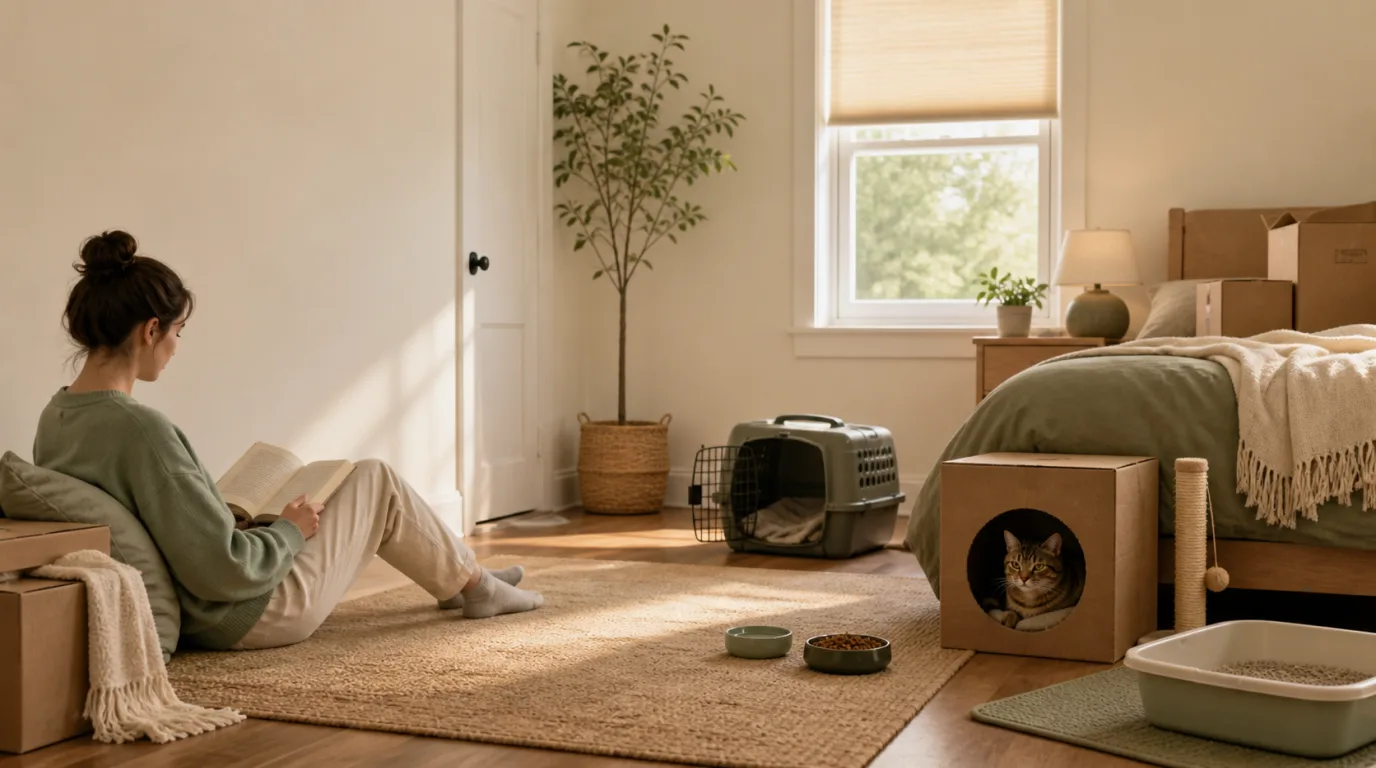
A cat hiding after moving house is usually trying to make an unfamiliar place smaller and more predictable. The rooms, routes, sounds and smells that marked home have disappeared. A covered box, open carrier or space under furniture gives the cat a position from which nothing can approach unseen.
Hiding for hours or several days can be part of normal adjustment. The important question is not, "Has my cat come out yet?" It is, "Is my cat eating, drinking, urinating, using the litter tray and gradually becoming more comfortable?"
If the cat starts pawing, splashing or spending unusually long at the bowl, use the cat water-play guide to separate a changed setup from increased thirst.
What to do right now
If your cat is already hidden in the new home:
- Secure every exterior door, window, balcony and cat flap.
- Keep children, visitors and other animals away from the room.
- Put food, water and a litter tray within a short, unobstructed route, with food and water separated from the tray.
- Offer a better hide, such as a cardboard box on its side or the cat's open carrier with familiar bedding.
- Do not reach in, drag the cat out or block the current hiding place while the cat is using it.
- Track what is eaten, drunk and deposited in the litter tray.
If the hiding location is genuinely dangerous, such as inside an appliance, wall void or unstable furniture, close off further access and contact a veterinarian or local rescue for safe extraction advice. Otherwise, quiet management is usually more useful than removal.
Why moving affects cats so strongly
Cats map safety through familiar scent, stable routes and control over distance. Moving changes all three at once. There may also be movers, open doors, unfamiliar animals outside, building noise and a carrier journey layered onto the territorial disruption.
Hiding reduces incoming information. It is a coping behavior, not stubbornness and not a verdict on the new home. A cat may wait until the household is asleep to eat, use the litter tray and inspect the room. That still counts as progress.
The same posture can also occur with pain or illness, so context does not cancel medical risk. Our guide to a cat hiding under the bed covers the broader differential. After a move, monitor function as carefully as location.
Build a safe room, even if the move already happened
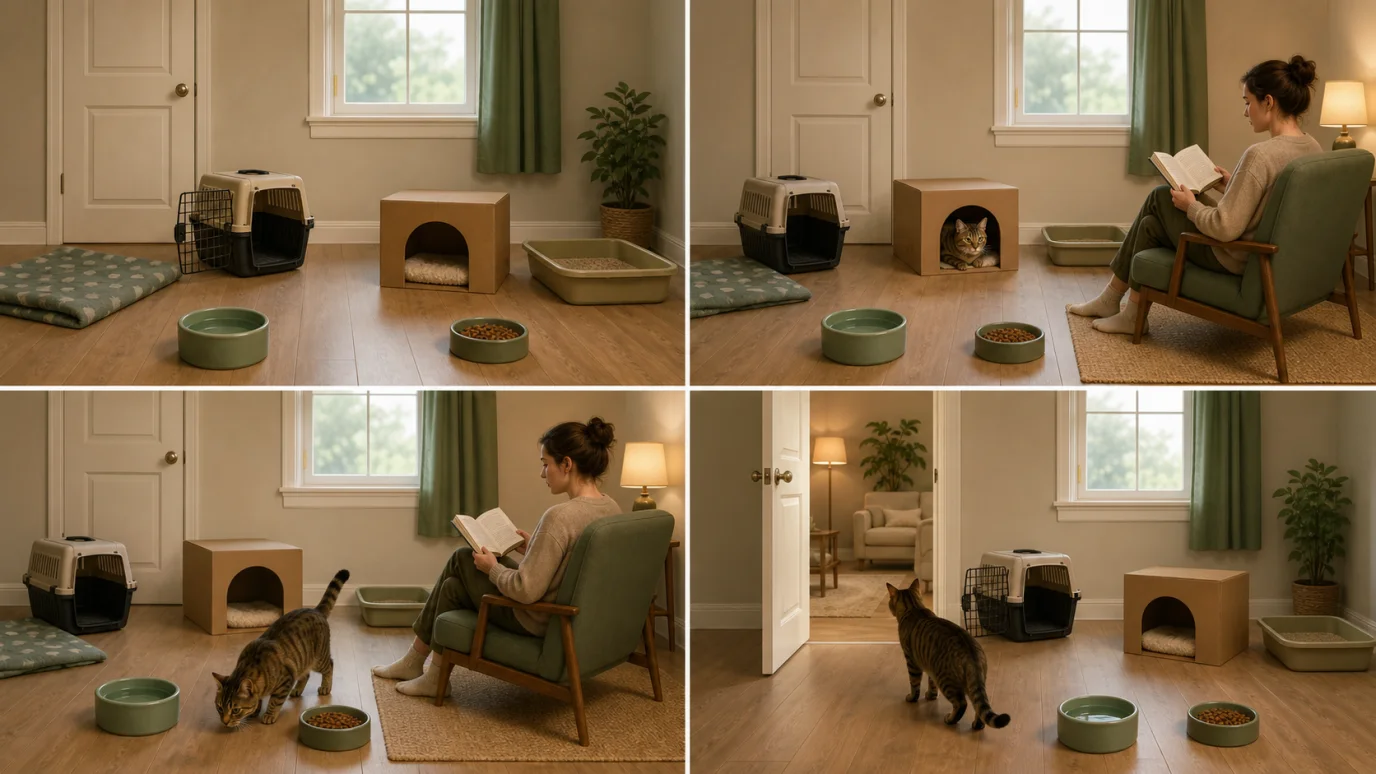
A safe room is a temporary home base, not confinement as punishment. Choose a quiet room with a door that closes securely and few impossible-to-access gaps.
Include:
- at least one covered hide plus the open carrier
- familiar, unwashed bedding or a safe item carrying household scent
- food and water in separate bowls
- a litter tray placed away from food and water
- a stable scratching surface
- a perch or low vertical option if the cat uses one confidently
- one or two familiar toys
Keep the layout stable. Repeatedly moving bowls, litter and hiding places forces the cat to remap the room. Clean accidents with an appropriate enzymatic cleaner, but avoid strong fragrances and avoid washing every familiar item at once.
In a multi-cat household, bonded cats may settle together, but do not assume every pair wants to share a small room. Provide separate resources and watch for blocking, staring or one cat controlling access. Cats with a tense relationship may need separate safe rooms.
How long will a cat hide after moving?
There is no reliable countdown. One cat may explore on the first evening. Another may remain mostly concealed for several days and investigate only at night. Temperament, age, health, previous moves, travel stress, household noise and the size of the new territory all matter.
Use checkpoints instead of a deadline:
| Checkpoint | Reassuring signs | Concerning signs |
|---|---|---|
| Food and water | Some intake, even when alone | No food intake, repeated vomiting or deterioration |
| Urination | Urine appears in the tray | Repeated trips, straining, crying, tiny amounts or no urine |
| Defecation | May be delayed briefly, then resumes | Straining, pain, vomiting or prolonged absence with discomfort |
| Posture | Resting, grooming, ears neutral at times | Persistent compression, breathing change or obvious pain |
| Exploration | Sniffing, changing resting spots, checking the room at night | No improving trend or increasing withdrawal |
| Interaction | Watching calmly, eating with you at distance, optional approach | Panic, defensive escalation or inability to settle |
Cats should not go for extended periods without eating. If your cat has eaten nothing for about 24 hours, call a veterinarian for advice sooner if the cat is a kitten, senior, has a medical condition, is overweight, or shows other symptoms. Do not wait several days for hunger to force the cat out.
How to help without forcing contact
Sit in the room at a comfortable distance and do something quiet. Read, work with headphones or speak softly. Avoid staring into the hiding place. The goal is to become predictable background, not to conduct an interaction.
You can place a small amount of familiar food near the hide and then move away. If the cat will eat only when alone, allow that. Over time, food can return to its normal safe-room location. Do not withhold food to make the cat approach you.
Keep feeding and household routines as close to their old timing as practical. Predictability helps the cat learn what happens next. Gentle play can be offered if the cat shows interest, but moving a wand into the hide or crowding the entrance removes the cat's choice.
Synthetic feline pheromone products may help some cats, but they are an optional support, not a replacement for a secure room, accessible resources or medical care.
When to open the safe-room door
Do not expand territory because a fixed number of days has passed. Look for readiness:
- normal or near-normal eating and litter use
- regular grooming and resting rather than constant vigilance
- voluntary movement around the safe room
- curiosity at the door
- ability to recover after a normal household sound
- relaxed exploration when people are present or absent
When those signs are consistent, open access to one quiet adjacent area during a calm period. Secure the home first. Let the cat cross the threshold voluntarily and keep the safe room available as a retreat. Do not carry the cat into the center of the new space.
If the cat freezes, bolts back, stops eating or hides more deeply after expansion, reduce the territory and try again later. This is information, not failure.
Common mistakes after a move
Giving the whole house immediately. More space can mean more unknown routes, noises and hiding hazards. Start small and expand with confidence.
Removing every hiding place. A cat without a retreat does not become brave. The cat may become more vigilant or choose a less safe location. Offer accessible hides you can monitor.
Pulling the cat out for reassurance. Being held is not reassuring when the cat is seeking distance. Let contact be voluntary.
Inviting everyone to meet the cat. Delay visitors. One quiet, predictable caregiver is easier to process than repeated introductions.
Changing food or litter during the move. Unless medically necessary, keep familiar products while the environment is changing. Introduce changes later and gradually.
Punishing an accident. Stress, poor tray placement and medical issues can all contribute. Punishment adds another threat and does not teach safe elimination. See cat spraying versus urinating for help identifying the pattern.
Preventing escape
An unfamiliar home creates a high escape risk. Check window screens, vents, balcony access and gaps around appliances before opening the carrier. Put a clear sign on the safe-room door while movers or tradespeople are present.
Update microchip registration and contact details, and identify a local veterinary clinic. Even indoor cats benefit from current identification because moves involve doors opening repeatedly.
Outdoor access requires a separate safety plan. Recommendations vary with location, housing, local hazards and the individual cat, so ask your veterinarian or a reputable local welfare organization before allowing access. A cat should first be settled indoors and reliably treating the new property as home. Never test readiness by simply opening the door.
When hiding needs professional help
Contact a veterinarian when hiding is paired with appetite loss, urinary change, vomiting, diarrhea, altered breathing, weakness, pain, reduced mobility or a marked personality change. Also call when the trend is flat or worsening rather than gradually improving.
Once medical causes are excluded, a qualified feline behavior professional can help with persistent fear, multi-cat tension or a home layout that makes safe expansion difficult. Keep a simple daily log of food, water, litter use, hiding location and voluntary exploration. Video taken without approaching the cat can also show changes that memory misses.
Frequently asked questions
How long will a cat hide after moving?
Some cats emerge within hours; others need several days or longer. The trend matters more than a fixed deadline. Eating, drinking, urinating, grooming and gradually exploring are better progress measures than whether the cat greets people.
Should I pull my cat out of hiding?
No, unless the location is immediately dangerous. Forced removal can increase fear and remove the cat's main coping option. Offer a safer covered hide nearby and let the cat choose when to move.
When should I call a veterinarian?
Call when hiding comes with appetite loss, urinary change, repeated vomiting, breathing difficulty, weakness, pain, reduced mobility, or worsening alertness. A move can coincide with illness, so do not assume every change is stress.
Read progress, not performance
A cat does not need to greet you, play or sleep in the open to prove the move is going well. Early progress may be a used litter tray, food eaten overnight, grooming inside the hide, or a brief investigation when the room is quiet.
Those small choices show that the cat is starting to predict the new environment. Preserve the conditions that made them possible, then let the territory grow at the cat's pace.
PetTranslator.ai can organize visible posture markers from a clear photo or short video, helping you compare body tension and confidence over time. It cannot determine whether a cat is medically well, so appetite, urination and veterinary assessment remain the priority when something changes.
Sources
- Cats Protection: Moving home with your cat: safe-room preparation, familiar scent, gradual exploration and escape prevention.
- Cats Protection: Cats hiding: hiding as coping behavior and the effect of busy environments.
- AAFP and ISFM Feline Environmental Needs Guidelines: safe places, separated resources, predictable interaction and environmental choice.
- Battersea: Settling your cat into a new home: cat-proofing, safe-room setup and voluntary emergence.
- ASPCA: Moving with your pet: moving-day confinement and gradual relocation of home-base resources.
Khabir Mughal is the founder of PetTranslator.ai. This guide was checked against feline environmental-needs and established cat-welfare guidance before publication.