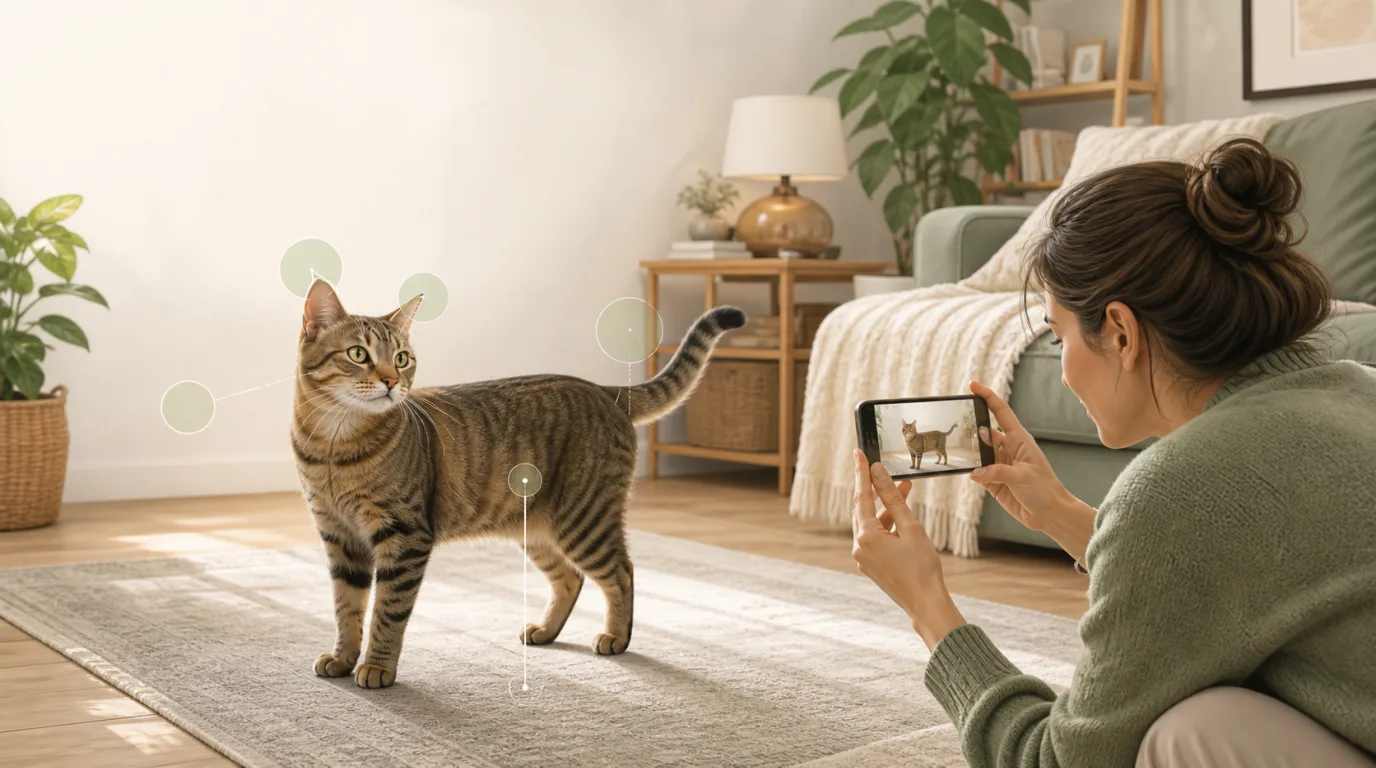
An AI cat body language analyzer can slow down a moment that passed too quickly. It can inspect visible ear rotation, eye shape, whisker position, body height, muscular tension and tail carriage, then organize those markers into a cautious interpretation. If you are still selecting an image, use the species-neutral pet behavior photo analysis checklist first.
It cannot read a cat's mind. It cannot decide that one tail flick means irritation in every context, diagnose pain from a face, or guarantee what the cat will do next. PetTranslator.ai is built to show the observations behind its interpretation and make uncertainty visible.
What a cat analyzer can observe
Feline signals are distributed across the whole body. A useful analysis may consider:
- ears forward, neutral, rotated sideways or flattened
- eyes soft, narrowed or held wide, with pupil size interpreted against light
- whiskers resting, drawn back, pushed forward or changing asymmetrically
- head and neck extended, neutral or pulled toward the body
- body loose, upright, crouched, flattened or arched
- feet visible and relaxed or tucked firmly beneath a compressed body
- tail height, curve, piloerection and movement when visible
- weight and orientation toward or away from a person, animal, object or exit
No single marker settles the question. Dilated pupils can reflect low light, play, fear, excitement, medication or disease. Whiskers forward may appear in interested investigation and hunting focus. Ears rotated sideways become more informative when paired with a low body, tension and an exit-oriented stance.
Use the full cat body language guide to learn the vocabulary. The analyzer applies that cluster-based method to a specific image or clip.
How the analysis works
1. Capture the real moment safely
Upload one clear photo or a short clip. Do not pull a cat from a hiding place, restrain them, move closer after a warning or recreate a conflict for the camera. Existing media is enough.
2. Add factual context
State what happened immediately before and after. "A delivery person entered; Juniper crouched behind the chair and stopped eating treats for two minutes" is useful. "Juniper looked angry" supplies a conclusion rather than evidence.
3. Review the visible markers
The report lists what can be seen before it offers a behavioral interpretation. If the tail is outside the frame or the eyes are hidden, that missing information should remain missing.
4. Use the confidence and action boundaries
PetTranslator returns observed markers, a possible interpretation, confidence, and a Do/Avoid plan. Ambiguous signals, poor lighting and incomplete framing should reduce confidence. Sudden medical changes and serious safety concerns should lead to professional referral.
What the report includes
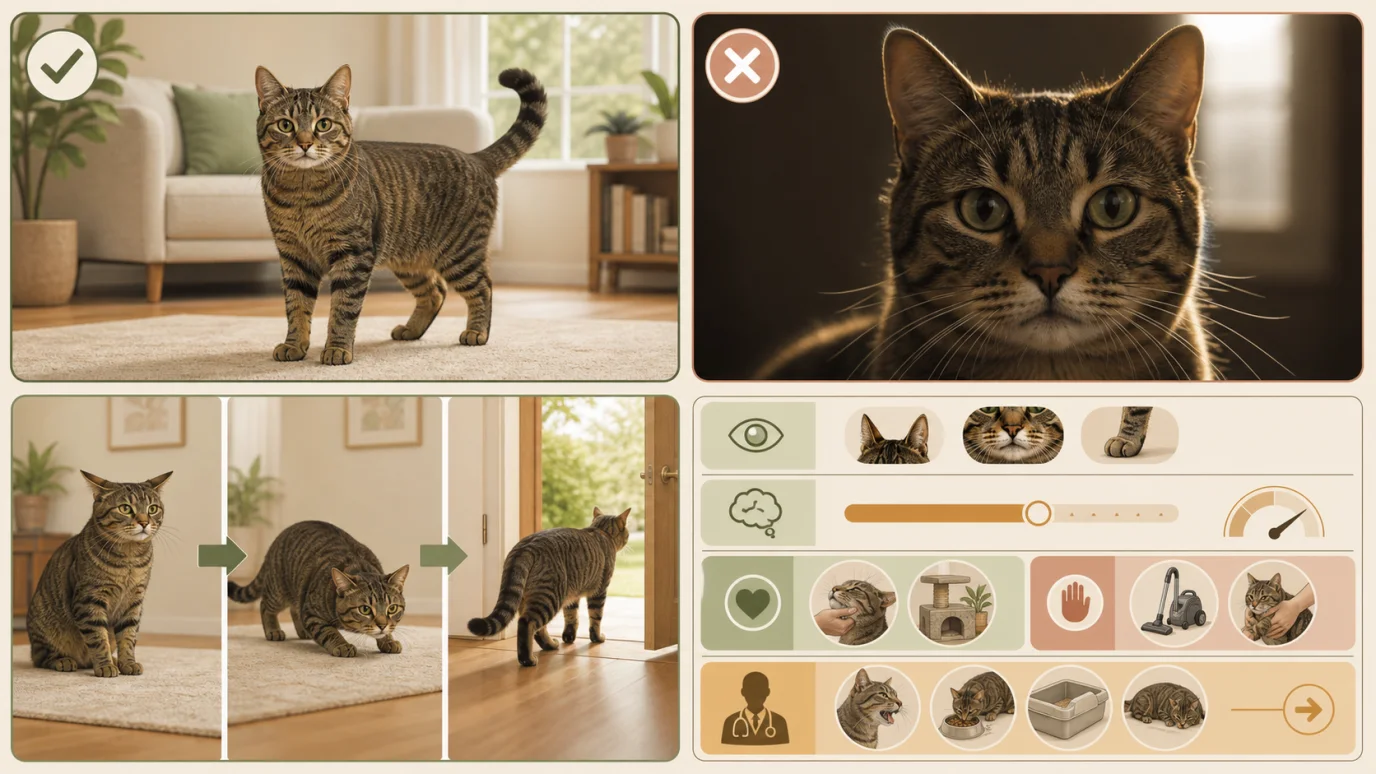
Observation layer. The visible ear, eye, whisker, posture, orientation and tail markers that can be checked against the upload.
Interpretation layer. A plain-language explanation of patterns the visible cluster may support, without claiming access to exact thoughts.
Confidence. An indication of signal agreement and input limitations. Confidence in image visibility is not the same as medical accuracy or certainty about emotion.
Do/Avoid plan. Low-risk, force-free next steps, such as preserving a hiding option, pausing touch, adding distance, lowering stimulation or gathering a better comparison.
Referral boundary. A reminder to seek veterinary or qualified behavior help where behavior changes suddenly, welfare is deteriorating or people and animals are at risk.
Premium users can export a PDF to organize observations for their records or a veterinary conversation. It remains an owner-generated AI observation report, not a clinical diagnosis.
How to take a useful cat photo
Include the whole body
A face-only portrait hides the tail, feet, body compression and orientation. Step back or use an existing wider image. Keep the cat's escape route open.
Use even, natural light
Backlighting hides eye and whisker detail. Flash can startle a cat and distort the eyes, so avoid it. Pupil size is especially unreliable when the lighting context is unclear.
Keep ears, whiskers and tail in frame
Long fur can obscure muscle tension and leg position. A side or three-quarter angle often shows more than a straight-on portrait. For a tailless cat or a breed with unusual facial structure, state that context rather than treating the missing marker as behavioral.
Show the environment when safe
A doorway, carrier, unfamiliar person, other cat or food bowl can explain what the cat is oriented toward. Context should never come at the cost of approaching a distressed cat.
Compare with baseline
One calm photo and one concern photo can be more informative than either alone. The useful question is often what changed in the same cat: ear angle, body height, resting location, appetite or willingness to approach.
When a short video is better
Video helps when meaning lives in the sequence:
- the tail changes from still to flicking during touch
- ears rotate before a cat retreats
- a crouch loosens after a visitor sits down
- two cats pause, exchange roles or continue a one-way chase
- the cat repeatedly enters and leaves a litter tray
- gait, jumping or transitions appear different
Recent research on human recognition of feline stress used clear full-body videos and still found that distinguishing relaxed, tense and fearful states was difficult. That supports a modest conclusion: good media and explicit markers can help, but visual information alone remains limited.
Never record a dangerous interaction instead of interrupting it safely. Never delay veterinary care to capture a better clip.
What AI cannot determine from a cat image
Exact emotion or intention
Posture can narrow possibilities without revealing a private sentence. A cat facing away may be resting, monitoring a sound, avoiding interaction or preparing to leave. The event sequence and baseline matter.
Whether purring means contentment
Cats can purr during affiliative contact, self-soothing, stress and illness. A photo cannot assess sound, and sound alone does not settle emotional state.
Whether the cat is in pain
Facial and postural changes can be reasons to seek veterinary assessment. They cannot identify the cause or rule pain in or out. Pain tools developed for clinical use have specific protocols and are not interchangeable with a general mood label.
Whether an interaction is safe
No report can certify that a frightened, cornered or highly aroused cat will not scratch or bite. Give distance, preserve exits and use a barrier rather than hands when separation is necessary.
Why behavior changed suddenly
Hiding, aggression, altered grooming, appetite loss and litter-box changes can have behavioral and medical causes at the same time. A veterinary history and physical examination provide information an upload cannot.
How to compare cat-analyzer apps
| Question | More credible | Red flag |
|---|---|---|
| What is analyzed? | Multiple visible regions and context | One facial expression becomes one exact mood |
| What supports the result? | Observable markers are displayed | Only a cartoon caption or emotion badge |
| Are limits visible? | Missing markers and uncertainty are stated | Every upload receives certainty |
| Is pain handled carefully? | Possible concerns prompt veterinary referral | The app diagnoses or clears pain |
| What actions follow? | Choice, distance and force-free handling | Restraint, punishment or confrontation |
| Is privacy clear? | Storage and model-training use are stated | Upload use is difficult to find |
The wider category review in do pet translator apps work? explains why observation is defensible while sentence-level translation is not.
Privacy, access and cost
PetTranslator processes your photo, short video and context to generate a report. The current privacy policy states that uploads are not used to train AI models and are not sold or published in marketing without explicit written permission. Users can delete their analyses.
Three analyses are available to start without a credit card. Paid plans provide higher usage and features including PDF export; check current pricing for the latest limits.
Use AI to inspect, not declare
The strongest result is not "your cat is angry." It is a transparent chain: these ears, whiskers, eyes, posture and tail are visible; this context makes several interpretations more or less likely; this low-risk response preserves the cat's choice; this uncertainty requires more observation or professional help.
That turns an AI cat body language analyzer into a documentation and learning aid. It can make subtle signals easier to compare. It cannot replace living with the cat, tracking their baseline, or asking a veterinarian to examine a sudden change. The guide to a cat behavior assessment online explains when to use Fe-BARQ, a feline consultant or a veterinary behaviorist.
Sources
- Human recognition of feline stress-related behavioral states from visual cues depends on observer characteristics: large study of human recognition of relaxed, tense and fearful cats from full-body video.
- Recognising and assessing feline emotions during the consultation: clinical review integrating history, posture, face and behavior while describing evidence limits.
- Purr-ceiving feelings: domestic cats respond to intraspecific cues of emotion: evidence on visual, auditory and olfactory feline emotion cues and the importance of valence and arousal.
- AAFP and ISFM Feline Environmental Needs Guidelines: professional guidance on safe places, choice, resources and predictable human interaction.
Khabir Mughal is the founder of PetTranslator.ai. This page describes the current product and was checked against feline emotion and welfare research on August 18, 2026.