
A pet behavior photo analysis can make a fast posture easier to inspect. A still image may preserve the ear shift, closed mouth, low body, forward weight or tail position you barely noticed in real time. It can also hide the movement before and after that posture.
The image is evidence, not a verdict. A useful analysis identifies what is visible, explains several plausible interpretations, weighs the context you provide and says what the frame cannot show.
PetTranslator.ai currently supports dogs and cats. Upload a photo or short video to receive observed markers, a behavioral interpretation, confidence and a force-free Do/Avoid plan.
What one pet photo can show
A clear frame can preserve:
- body height, shape, tension and orientation
- weight carried forward, centered or back
- ear direction and tension at the base
- eye openness and gaze direction
- mouth, lips or whisker position where visible
- tail height, shape and still position
- distance from and orientation toward people, animals, objects and exits
- environmental context within the frame
Those observations can support a behavioral hypothesis. A dog leaning away with a tight mouth and back-rotated ears may be uncomfortable with an approach. A cat compressed close to the ground with lateral ears and feet planted beneath the body may be preparing to retreat.
The word may matters. A still frame does not show duration, movement, sound, the previous event, recovery or the animal's baseline. Posture can also change with anatomy, pain, footing, heat and camera angle.
Choose the species-specific route
Dogs and cats share some broad arousal patterns, but they should not be read as interchangeable.
For a dog photo
Include the mouth, ear bases, torso, legs and tail. Weight distribution and stillness often carry more information than a smiling-looking face. Breed conformation, cropped ears, docked tails and heavy coats can hide or alter markers.
Use the AI dog body language analyzer guide for canine capture details, report limits and whole-body examples.
For a cat photo
Include ears, eyes, whiskers, feet, body shape and tail. Record lighting because pupil size changes with illumination. Long fur, a flattened facial structure, a hidden tail and a tight crop can remove important evidence.
Use the AI cat body language analyzer guide for feline-specific interpretation and medical boundaries.
The six-part photo check
Before uploading, inspect the image as if you had never seen the pet before.
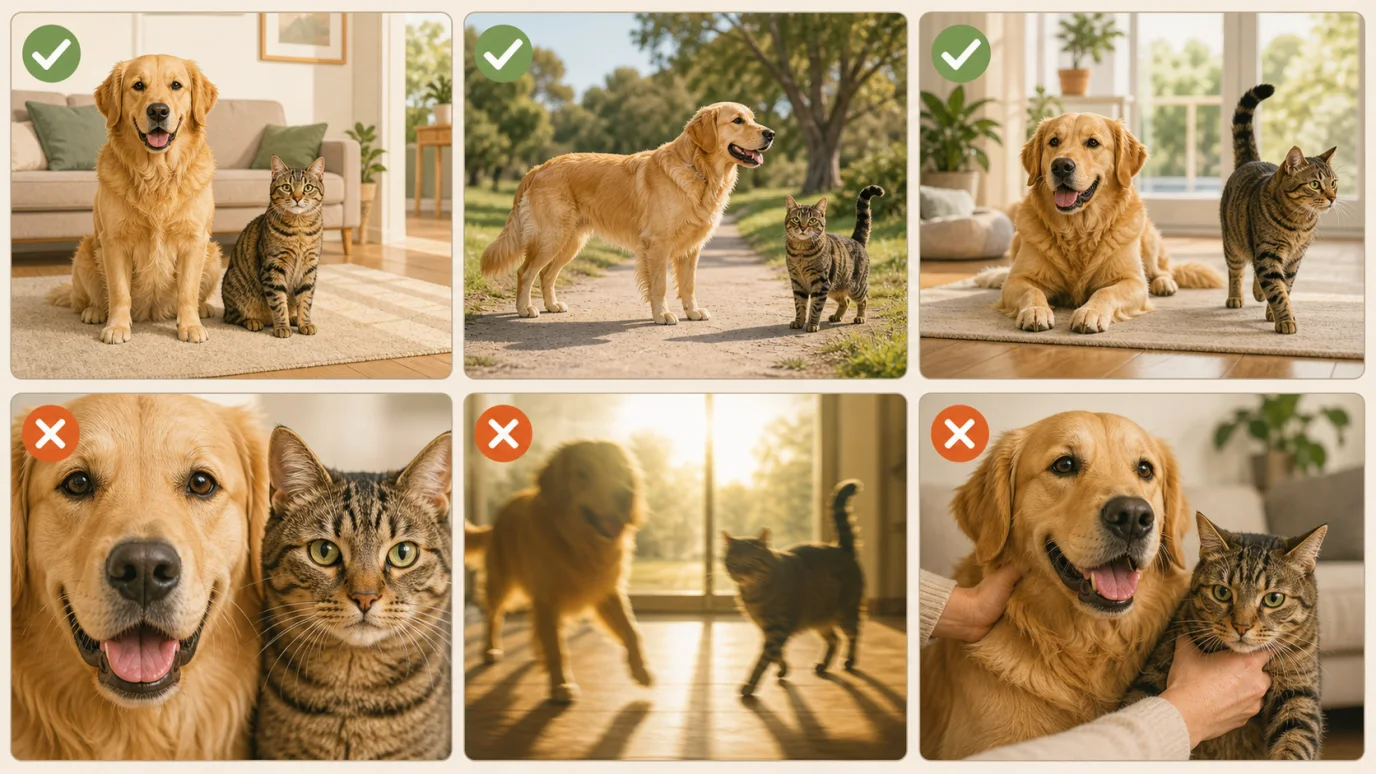
1. Is the whole animal visible?
A face-only crop can be useful for a facial detail, but it cannot support claims about posture, weight or tail. Choose a wider frame whenever the question is about the animal's overall state.
2. Is the angle informative?
A side or three-quarter view usually shows body shape, leg position and direction of weight. A straight-on view may work for facial symmetry but can compress the torso and hide retreat or forward lean.
3. Is the light even?
Deep shade, backlight and motion blur remove evidence. Avoid flash if taking a new photo because it may startle the animal and changes how the eyes appear.
4. Is the relevant context visible?
When safe, retain the carrier, doorway, visitor, other animal, food bowl or object the pet is responding to. Cropping everything except the pet can erase the most important part of the scene.
5. Is the behavior naturally occurring?
Never recreate a stressful interaction, approach a guarding animal, crowd a hiding cat or restrain a pet to make a clearer image. Use existing media or record from a safe distance only when the situation is already happening and nobody needs immediate help.
6. Can you describe the sequence?
The best photo becomes more useful with a factual note: what happened immediately before, how long the posture lasted and what the pet did afterward.
How to write context without deciding the answer
Avoid emotion labels in the input. "Scared," "jealous" and "guilty" tell the analyzer your theory. Describe events instead.
Less useful: "My dog was guilty after stealing food."
More useful: "I entered the kitchen and raised my voice. The dog lowered his body, turned his head away and moved behind the table. This photo was taken about five seconds later."
Less useful: "My cat hates the new kitten."
More useful: "The kitten approached within one meter. The adult cat stopped eating, stared for six seconds, moved under the chair and did not return to the bowl for ten minutes."
Good context includes location, recent event, distance, duration, changes from baseline, eating or play, and what happened next. It should not pressure the system to agree with a conclusion.
When a photo is the wrong format
Choose a short video when the question depends on motion or sequence:
- tail wag, twitch or lashing pattern
- approach, pause, retreat or chase
- repeated lip licking, blinking, grooming or yawning
- freezing and release from freezing
- gait, rising, jumping or weight transfer
- vocalization paired with body change
- play with role changes and pauses
A photo freezes one point inside that sequence and may make a normal transition look like a sustained posture. Video still does not supply a diagnosis, but it preserves timing and recovery.
For behavior that occurs when nobody is present, a stationary camera may be more informative than filming after you return. Do not leave equipment where it creates a hazard or invades another person's privacy.
What a responsible analysis should return
Observations that can be checked
The output should identify visible features before naming a possible state. "Tail below the spine, mouth closed, weight shifted back" is auditable. "Sad" alone is not.
Interpretation stated as a possibility
Several signals pointing in the same direction can support a stronger interpretation. Conflicting or missing markers require wider possibilities and lower confidence.
Missing information
If the tail is cropped, the output should not invent it. If the image contains two pets, it should not silently attribute one animal's posture to the other.
Low-risk actions
Advice should preserve distance, exits and choice. Punishment, forced exposure and dominance framing are not supported responses to uncertainty or stress.
A professional boundary
Sudden change, possible pain, breathing problems, urinary difficulty, collapse, repeated vomiting, severe distress, bites and serious aggression require veterinary or qualified behavior help. A photo-analysis product should route those cases onward.
What photo analysis cannot prove
It cannot translate thoughts or sentences. It cannot identify one exact emotion from every posture. It cannot diagnose disease, clear pain, predict a bite, establish the cause of a behavior or replace a complete history and examination.
It also cannot supply a validated universal accuracy figure unless the exact task, dataset, species, conditions and comparison standard were tested independently. A broad "98% accurate" claim about pet emotion from any photo is not meaningful without those details.
Research illustrates the problem. Humans often focus on dog faces even though whole-body attention is associated with better emotion categorization. In a recent large feline study, people found relaxed, tense and fearful states difficult to distinguish even from clear full-body video. If trained research conditions remain challenging, a consumer tool should display uncertainty rather than promise mind reading.
Compare tools before uploading
Ask:
- Does it show the visible evidence behind the label?
- Does it distinguish dogs from cats rather than use one generic rule set?
- Does it accept factual context and acknowledge missing context?
- Does it lower confidence for poor media?
- Does it avoid diagnostic and exact-thought claims?
- Are recommendations force-free and low risk?
- Does the privacy policy explain storage, deletion and model-training use?
- Is pricing visible before a trial converts to payment?
Our review of whether pet translator apps work explains the difference between behavioral observation and entertainment captions.
Privacy and PetTranslator access
PetTranslator processes photos, short clips and context to generate the requested report. The current privacy policy states that uploads are not used to train AI models, are not sold and are not published in marketing without explicit written permission. Users can delete analyses.
You can start with three free analyses without a credit card. Paid plans add higher usage and features such as PDF export; verify current limits on the pricing page.
Treat the photo as the start of an observation
A useful photo analysis does not finish the question. It gives you a clearer set of things to watch next: does the posture change with distance, does the pet take an exit, what happens before the tail movement, and is this different from baseline?
That is the practical value of the tool. It turns a vague impression into visible markers, a bounded interpretation and a safer next observation. It does not turn one frame into certainty.
Sources
- Bodily emotional expressions are a primary source of information for dogs, but not for humans: evidence that whole-body inspection matters in dog-emotion categorization.
- Context and prediction matter for the interpretation of social interactions across species: evidence on context dependence and observer disagreement.
- Human recognition of feline stress-related behavioral states from visual cues: large study showing difficulty distinguishing feline stress states from clear full-body video.
- Dogs recognize dog and human emotions: research on integrating visual and auditory emotional information.
- AVSAB position statements: current professional guidance supporting reward-based dog training.
- AAFP and ISFM Feline Environmental Needs Guidelines: feline guidance on safe places, choice and predictable interaction.
Khabir Mughal is the founder of PetTranslator.ai. This guide was checked against current canine and feline visual-communication research on August 18, 2026.