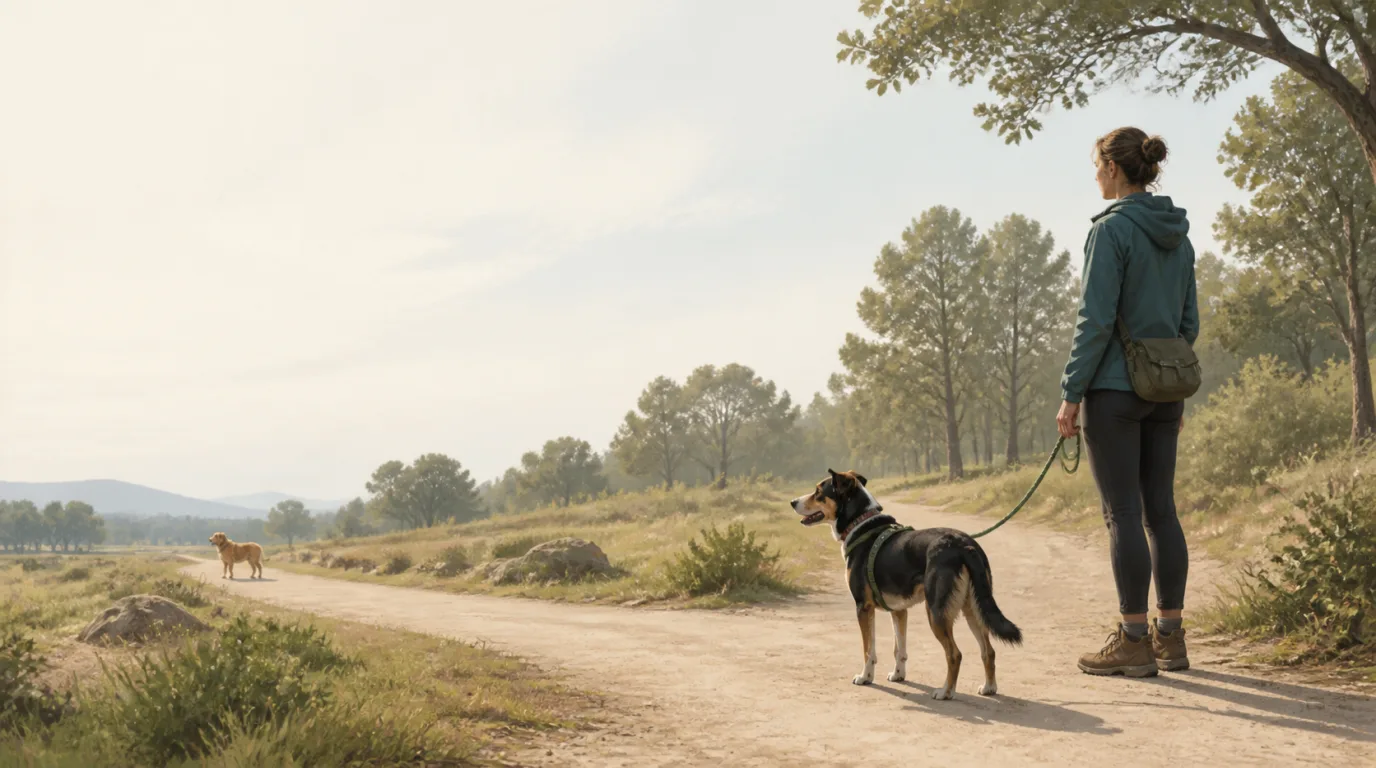
In dog training, threshold is the point where a trigger has enough intensity that the dog's flexible behavior begins to narrow. Under threshold, the dog can notice the trigger and still move, investigate, disengage or perform familiar actions. Near threshold, attention sticks and tension rises. Over threshold, barking, lunging, fleeing, freezing or shutting down may replace those options.
Threshold is a practical estimate, not a visible switch in the brain. It changes with distance, duration, movement, environment, health and what happened earlier that day. The useful question is not “What is my dog's threshold?” but “What can my dog do in this setup, right now?”
Under, near and over threshold
| Zone | Observable pattern | Training decision |
|---|---|---|
| Under threshold | Notices trigger, body remains relatively loose, can change direction and recover promptly | Work briefly at this intensity |
| Near threshold | Longer stare, mouth closes, movement slows or surges, response latency increases | Add distance or lower difficulty now |
| Over threshold | Barking, lunging, escape, sustained freeze, frantic scanning or inability to disengage | Stop training and leave safely |
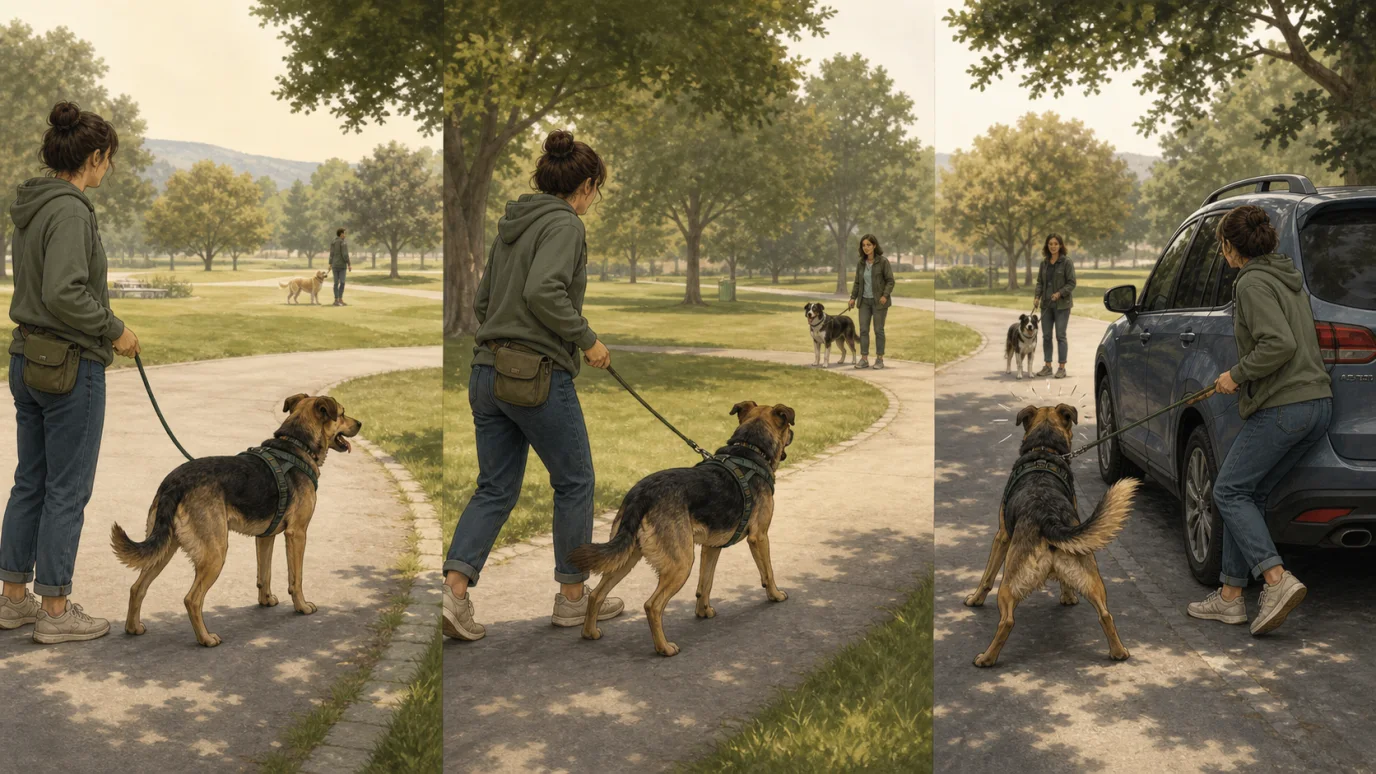
Threshold is better treated as a changing zone than a razor-thin line. Act on early loss of flexibility rather than waiting for an outburst.
Quiet behavior can be over threshold. A dog who becomes immobile, stops exploring and cannot move away may be overwhelmed even without barking. The guides to dog freezing and the dog stress ladder cover those less obvious patterns.
Threshold of what?
The word is incomplete without a trigger and response. A dog can be below their barking threshold around a person while already too worried to approach, play or learn a new task. They may tolerate a stationary dog at 30 metres but react when that dog runs.
Write the setup precisely:
- trigger: adult dog, child, bicycle, handling, noise or absence
- intensity: size, volume, speed and direction
- distance: physical space and access to escape
- duration: how long exposure continues
- environment: familiar room, narrow path, clinic or busy street
- target response: relaxed observation, eating, cue response or voluntary approach
This prevents “under threshold” from becoming shorthand for merely not barking.
Food is information, not a pass/fail test
Refusing a normally valued treat can indicate high arousal, nausea, pain, satiation or an unappealing food. Eating does not prove comfort. Some dogs take food rapidly while rigid, and others stop eating well before visible escalation.
Use food response with:
- speed and force of taking it
- ability to orient away from the trigger
- softness of body and movement
- response to a well-practiced cue
- voluntary sniffing or environmental exploration
- recovery after the trigger leaves
A cue also is not a neurological test. Failure may reflect poor training history, competing reinforcement or a changed environment. What matters is the overall narrowing of behavior compared with the same dog's baseline.
What moves a dog's threshold?
Distance
Greater distance often lowers trigger intensity, especially when the dog has room to move in a curve. Visual barriers can work when physical distance is limited.
Duration
A dog may cope for five seconds and struggle after 30. Longer exposure is harder even when distance stays fixed.
Movement and direction
A still person is different from one approaching directly. A walking dog is different from one running or staring. Do not record distance without recording movement.
Environment and constraint
Narrow paths, tight leashes, slippery floors and blocked exits reduce choice. The same trigger may be manageable in an open field and difficult in a hallway.
Accumulated state
Poor sleep, repeated surprises, excitement and earlier stressors can reduce flexibility. This is dog trigger stacking: the current reaction reflects more than the current trigger.
Health
Pain, gastrointestinal illness, skin discomfort, sensory change and medication effects can alter tolerance. A suddenly smaller threshold deserves veterinary attention.
Finding a workable starting point
- Choose an environment with room to retreat and a predictable trigger.
- Start farther away or at lower intensity than you think necessary.
- Let the dog notice without forcing prolonged staring.
- Watch posture, movement, orientation, food response and recovery.
- If attention sticks or tension rises, add distance immediately.
- Work in a short session and finish while behavior remains flexible.
Do not move closer within every repetition. Progress can be staying at the same distance with softer movement, quicker recovery or greater choice. The leash-reactivity guide gives a condition-specific setup for dogs reacting on walks.
What training below threshold does
Graduated exposure presents a trigger at an intensity the dog can handle, then changes one variable in small steps. Counterconditioning pairs that trigger with something valuable. Veterinary-fear and noise-fear research supports individualized, low-intensity progression, though outcomes vary and protocols must fit the problem.
Training below threshold is not keeping the dog unaware of the trigger. The dog usually needs to detect it for learning about it to change. The exposure should be noticeable without producing the response you are trying to avoid.
It is also not a guarantee of zero stress. Mild changes can occur before a handler recognizes them. The aim is an intensity at which the dog retains options and recovers, not perfect stillness or obedience.
What to do when the dog goes over threshold
- stop asking for cues
- turn away or move in a curve
- use a parked car, hedge or solid barrier
- keep hands away from the collar and face if the dog may redirect
- avoid scolding, leash corrections or forced proximity
- leave the area and allow recovery
If food can be scattered safely behind the dog to support movement away, it may help. Do not hold food at the dog's nose to lure them closer to the trigger.
One reaction does not erase prior learning. Repeated unavoidable exposure, however, rehearses the behavior and can strengthen the negative association. Management is part of treatment, not a failure to train.
Tracking threshold without chasing a number
Record:
| Field | Example |
|---|---|
| Trigger | Medium dog walking sideways |
| Distance and setting | About 35 metres, open park |
| Duration | 12 seconds visible |
| Earliest change | Mouth closed, gaze held for three seconds |
| What the dog could do | Turned away and followed handler |
| Recovery | Loose sniffing within 20 seconds |
Distance estimates help with planning, but they are not scores. A closer distance is not success if the dog is rigid. Better recovery, softer posture and voluntary disengagement are meaningful progress even when distance stays the same.
Threshold in separation and handling work
The same principle applies beyond leash reactivity. In separation-anxiety training, duration rather than distance may be the key variable. In veterinary handling, touch pressure, body area, restraint and time all affect intensity.
Essential care cannot always remain below threshold. A veterinarian may recommend pre-visit medication, analgesia, environmental changes or sedation. That is safer than repeatedly forcing a dog through panic.
When to get professional help
Get veterinary and qualified behavior support for bites, redirected aggression, self-injury, escape attempts, reactions at every visible distance, sudden change, or a household that cannot maintain safety. The guide to finding a credentialed behaviorist explains trainer and veterinary behavior credentials.
What a photo or video can show
A photo can show tension, weight, gaze, mouth and trigger distance. It cannot establish the transition into threshold or recovery afterward. Short video is better, but do not prolong exposure for the camera.
PetTranslator.ai can organize visible markers and compare frames. It cannot calculate a universal threshold distance, measure internal emotion or certify that a setup is safe.
Frequently asked questions
What does over threshold mean for a dog?
It means trigger intensity has narrowed the dog's flexible behavior enough that their usual options are difficult or unavailable. The result may be loud reactivity, escape or quiet shutdown.
Can a dog take treats while over threshold?
Yes. Some highly aroused dogs still eat. Treat response is one clue, so read it with posture, movement, fixation, cue latency and recovery.
How far is a dog's threshold distance?
There is no fixed distance. Trigger movement, environment, duration, health and earlier events change it. Start generously far away and observe the individual dog.
Does staying under threshold mean avoiding triggers forever?
No. Planned training exposes the dog at manageable intensity and progresses gradually. Management prevents uncontrolled exposure between sessions.
Is threshold training the same as teaching a dog to wait at a door?
No. “Door threshold training” teaches behavior at a physical doorway. Emotional threshold describes the point where a trigger changes behavioral flexibility.
Sources
- Stellato et al. Desensitization and counterconditioning for veterinary fear.
- Lloyd. Mitigating fear and aggression in dogs and cats in veterinary settings.
- Riemer. Therapy and prevention of noise fears in dogs.
- AVSAB. Humane dog training position statement.
- AKC. Trigger stacking and over-threshold behavior.
- East Bay SPCA. Look at That reactivity exercise.
Khabir Mughal is the founder of PetTranslator.ai. This article was researched against veterinary fear, noise-fear and graduated-exposure guidance. It was last reviewed on August 18, 2026.