
Trigger stacking happens when a dog encounters several stressful or highly arousing events before fully recovering from the earlier ones. The dog may cope with each event on a quiet day, yet react strongly to the last one when their tolerance is already reduced.
The last trigger is not necessarily the biggest or most important. It may simply arrive when the dog has less capacity left. That is why an ordinary doorbell, passing dog or handling request can seem to cause a reaction “out of nowhere.”
A trigger-stacking example
Imagine a dog who sleeps poorly during a thunderstorm. In the morning, road work starts outside. On the first walk, a loose dog runs toward them. They recover enough to continue, but their movement stays faster and their mouth remains tense. A skateboard then passes close behind.
Near home, the dog sees a familiar neighbor they usually tolerate and begins barking and lunging. If you examine only the neighbor, the response looks disproportionate. If you include the night, noise, close dog and startle, the pattern makes more sense.
Trigger stacking can unfold in ten minutes or across a longer stretch. The relevant question is not “How many triggers?” It is whether each event leaves a change that is still present when the next one arrives.
What counts as a trigger?
A trigger is anything that changes the dog's arousal or sense of safety. It does not have to be frightening.
- another dog, stranger, child, cyclist or animal
- traffic, construction, fireworks or household noise
- restraint, grooming, a veterinary visit or unwanted touch
- frustration at a barrier or inaccessible toy
- intense play, visitors or an exciting outing
- pain, itch, nausea, heat, fatigue or poor sleep
- a change in routine, location or caregiver
Positive excitement and fear are not identical emotional states, but both can leave a dog less able to settle for the next demand. Pain and illness can also lower tolerance. A new pattern therefore belongs in a veterinary conversation, not only a training plan.
The stress-bucket metaphor: useful but incomplete
Many explanations compare stress with water filling a bucket. Each event adds water; recovery lets some drain away; a reaction occurs when the bucket overflows. The picture is easy to remember and captures the central management lesson: yesterday's or this morning's events can affect the next interaction.
It is still a metaphor. Dogs do not have a visible stress gauge, and triggers do not add in fixed units. One event can make a later event feel safer through learning, while another can increase sensitivity. Temperament, health, sleep, predictability, control and previous experience all change the response.
Cortisol is often used to make the bucket sound measurable. Cortisol is one part of the stress response, but a single hormone reading does not describe the dog's full emotional state. Studies of canine stress have found that behavioral and physiological measures do not always move together. You cannot calculate a dog's “cortisol load” from lip licks or barking.
Signs a stack may be building
Look for a change from baseline after each event:
- slower recovery of ordinary breathing
- a mouth that remains closed or tense
- repeated scanning or difficulty looking away
- ears that stay back or fixed toward the environment
- faster movement, pulling or inability to sniff normally
- repeated yawning, lip licking, shaking off or sudden ground sniffing
- taking food roughly, taking it with delay or refusing it
- less response to familiar cues
- freezing, hiding, barking, lunging or redirected grabbing
One action is not proof. A dog can refuse food because they are full or sniff because the ground is interesting. Timing and sequence matter. The guides to dog stress signs, calming signals and displacement behaviors explain the individual clues.
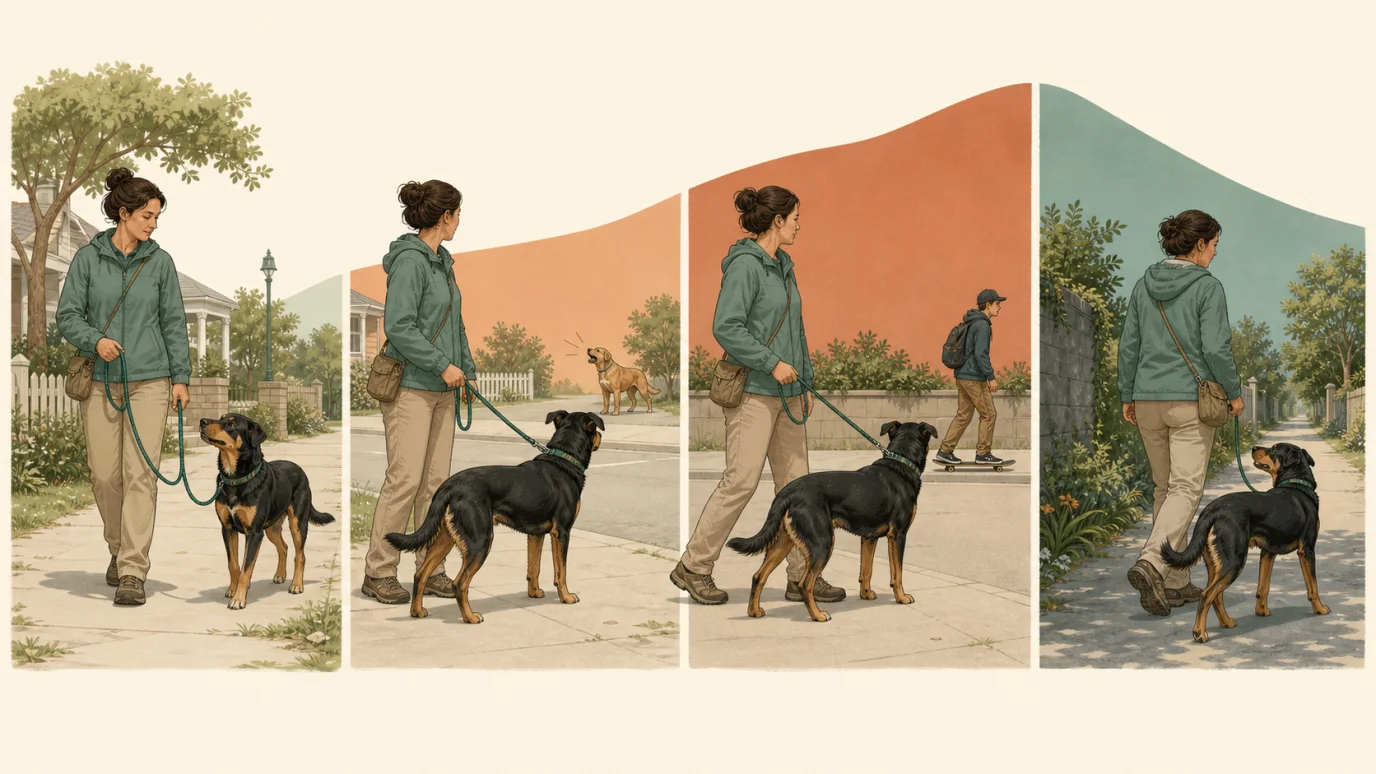
A possible same-walk stack. The rising color field represents observed load, not a hormone measurement. The final scene shows management before a larger reaction: more distance, fewer demands and a quieter route.
A traffic-light response plan
| Current pattern | What you may see | What to do now |
|---|---|---|
| Green: near baseline | Loose movement, flexible attention, normal sniffing, ordinary food response | Keep distance comfortable and allow choice |
| Amber: recovery is incomplete | Tension persists, scanning increases, disengagement slows, several small stress signals appear | End the training goal, add distance and choose a quieter route |
| Red: over threshold or unsafe | Freeze, frantic escape, barking, lunging, growling, snapping or inability to disengage | Leave without testing cues; use barriers and prioritize safety |
“Over threshold” does not always look loud. Shutdown, immobility and refusal to move can indicate a dog who cannot cope. The detailed dog stress ladder covers escalation within one interaction, while trigger stacking explains why the starting point may already be elevated.
What to do during trigger stacking
Create distance first
Cross the street, turn down a side road, step behind a visual barrier or leave the setting. Distance reduces input immediately. Do not wait for the dog to prove they can handle one more encounter.
Drop optional demands
This is not the moment to drill heelwork, greetings or prolonged stays. Use the simplest safe movement needed to leave. A familiar scatter of food may help some dogs orient away if they can eat safely, but food refusal is not a reason to move closer or repeat cues.
Prevent the next avoidable trigger
Choose a quiet toilet break instead of another busy walk. Cancel a nonessential visitor or grooming session. Close curtains if outside activity is keeping the dog vigilant. Management protects learning; it is not failure.
Keep hands away from an aroused dog's collar
A dog focused on a trigger may redirect toward the nearest hand when grabbed. Guide with distance and barriers where possible. Serious reactivity or a bite history needs an individualized safety plan.
How long does recovery take?
There is no scientifically established rule that every dog needs exactly 24, 48 or 72 hours after a stressful event. Recovery depends on the dog, event, environment, health and what happens next. Repeating a universal “cortisol takes 72 hours” claim gives false precision.
Use behavior and routine as your guide. The dog is moving toward baseline when sleep, appetite, toileting, breathing, movement, play and ability to disengage look normal for that individual. After a difficult event, reduce avoidable intensity and reassess over the next outings rather than following a stopwatch.
A quiet day does not require sensory deprivation. Comfortable sleep, predictable routines, self-paced sniffing in a low-traffic place, chewing or foraging may suit the dog. Choose activities they already enjoy and can leave.
Keep a trigger and recovery log
A short log is more useful than guessing which event “caused” a reaction.
| Record | Example |
|---|---|
| Background load | Poor sleep; hot weather; sore after exercise |
| Event | Dog barked behind a fence at 8:10 a.m. |
| Distance and duration | About 8 metres; five seconds |
| First visible change | Mouth closed, ears forward, stopped sniffing |
| Recovery | Looked away after 40 seconds; body stayed fast for ten minutes |
| Management | Crossed road and ended walk early |
Track patterns for one or two weeks without deliberately exposing the dog. You may find that time of day, route, pain, visitors or back-to-back activities matter more than one named trigger. Share the log and original videos with your veterinarian or behavior professional.
Trigger stacking versus related ideas
Threshold
Threshold is the point at which the dog can no longer respond flexibly in a given setup. Trigger stacking can lower the apparent threshold temporarily. The leash-reactivity guide explains distance-based training below that point.
Flooding
Flooding is prolonged or intense exposure without a workable escape, often intended to force habituation. Trigger stacking can occur accidentally during ordinary life. Neither is a sound reason to keep a distressed dog in place.
Sensitization
Sensitization is an increased response after exposure. A trigger stack may produce a short-term change, while repeated difficult exposures can contribute to a longer-lasting pattern. A professional must assess the history rather than infer the mechanism from one walk.
Aggression and reactivity
Trigger stacking can precede barking, lunging, growling or biting, but it is not a diagnosis of aggression. Fear, frustration, guarding, pain and predatory behavior require different plans. See reactivity versus aggression for that distinction.
When to get professional help
Start with a veterinarian when the change is sudden, pain is possible, sleep or appetite has changed, or tolerance continues to fall. Pain signs in older dogs can be especially quiet.
Seek qualified behavior support when the dog has growled, snapped or bitten; redirects onto the leash or handler; cannot use ordinary routes safely; or lives with children or vulnerable adults. The guide to finding a credentialed behaviorist explains which credentials match higher-risk cases.
Do not punish warnings or intentionally recreate a stack for assessment. Humane behavior work changes distance, prediction and choice while keeping everyone safe.
What a photo or video can show
A photo can capture posture, ear position, gaze and mouth tension at one point in the day. Trigger stacking is about history and recovery, so a single image cannot establish it. Short video plus a written event log is more informative.
PetTranslator.ai separates visible observations from possible interpretations and states uncertainty. It can help organize body-language changes in a recording, but it cannot measure hormones, know what happened earlier or predict whether a dog will bite.
Frequently asked questions
Can positive excitement cause trigger stacking?
High excitement can leave some dogs less settled for the next event, even when the activity was enjoyable. Do not assume every energetic behavior is harmful. Watch whether the dog returns to their normal breathing, movement and flexible attention.
Is trigger stacking only a problem for reactive dogs?
No. Any dog can have reduced tolerance after several difficult or arousing events. Dogs with fear, pain or an established reactivity pattern may reach their limit sooner.
Should I skip walks after a reaction?
Avoid another busy or demanding outing while the dog remains changed. A quiet toilet break or self-paced sniff in a low-trigger area may be appropriate. Match the plan to the individual rather than applying a fixed ban on walks.
Does trigger stacking last 72 hours?
There is no universal 72-hour rule. Some dogs appear back at baseline quickly; others need longer. Observe recovery and consult a veterinarian when behavior remains altered or the pattern worsens.
How do I prevent trigger stacking on walks?
Choose quieter times and routes, keep enough distance for flexible behavior, leave after recovery starts slowing, and avoid adding optional greetings. A log can identify combinations that repeatedly cause trouble.
Sources
- Battersea Dogs & Cats Home. Trigger stacking in dogs.
- American Kennel Club. What is trigger stacking?.
- Bremhorst et al. Audience effect on domestic dogs' behavioural displays and facial expressions.
- Hekman et al. Psychogenic stress in hospitalized dogs: challenges of evaluation.
- Bray et al. Methods of behavioral testing in dogs: a scoping review and analysis of test stimuli.
- American Veterinary Society of Animal Behavior. Position statements.
Khabir Mughal is the founder of PetTranslator.ai. This article was researched against canine-behavior studies and current veterinary and animal-welfare guidance. It was last reviewed on August 18, 2026.