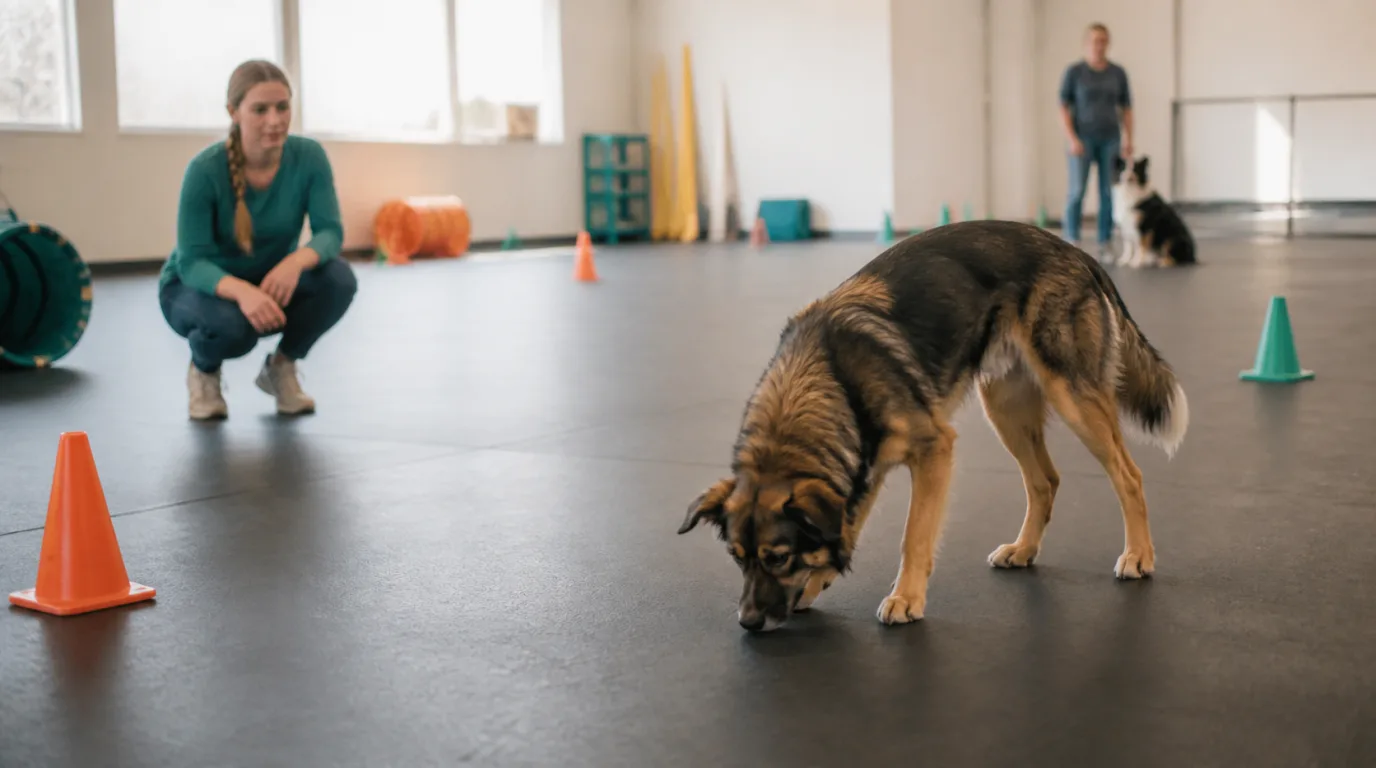
Dog displacement behaviors are ordinary actions that appear at a moment when they do not serve their usual purpose. A dog may suddenly sniff, scratch, groom, yawn or shake off when uncertain, frustrated, highly aroused or pulled between competing responses. The action is observable. Its function is an interpretation that depends on context.
A dog sniffing through grass on a walk is gathering scent information. A dog who abruptly drops their nose when a stranger approaches head-on may be investigating a real odor, buying time, coping with uncertainty or communicating non-engagement. You need the sequence around the sniff to tell those possibilities apart.
The focused guide to ground sniffing as normal exploration or a possible stress signal applies that sequence to walks, greetings and training.
What is displacement behavior?
Ethologists use "displacement activity" for behavior that appears unrelated to the immediate situation, often when an animal faces competing motivations. A dog may want to approach a person and avoid them at the same time. Instead of choosing either response immediately, the dog scratches or sniffs.
The Merck Veterinary Manual describes stress displacement behaviors as normal behaviors occurring out of context during heightened stress or frustration. Common examples include:
- sniffing the ground
- scratching without an obvious itch
- licking the nose or lips without food
- yawning when the dog is not tired
- sudden self-grooming
- drinking when the dog does not appear thirsty
- a full-body shake when the coat is dry
- lifting a front paw
- turning the head or body away
- marking or urinating during a social interaction
These actions are not a codebook. Scratching still may mean an itch. Drinking still may mean thirst. The displacement label becomes reasonable only when timing, context, body language and repetition support it.
Ordinary action or displacement? Compare the context
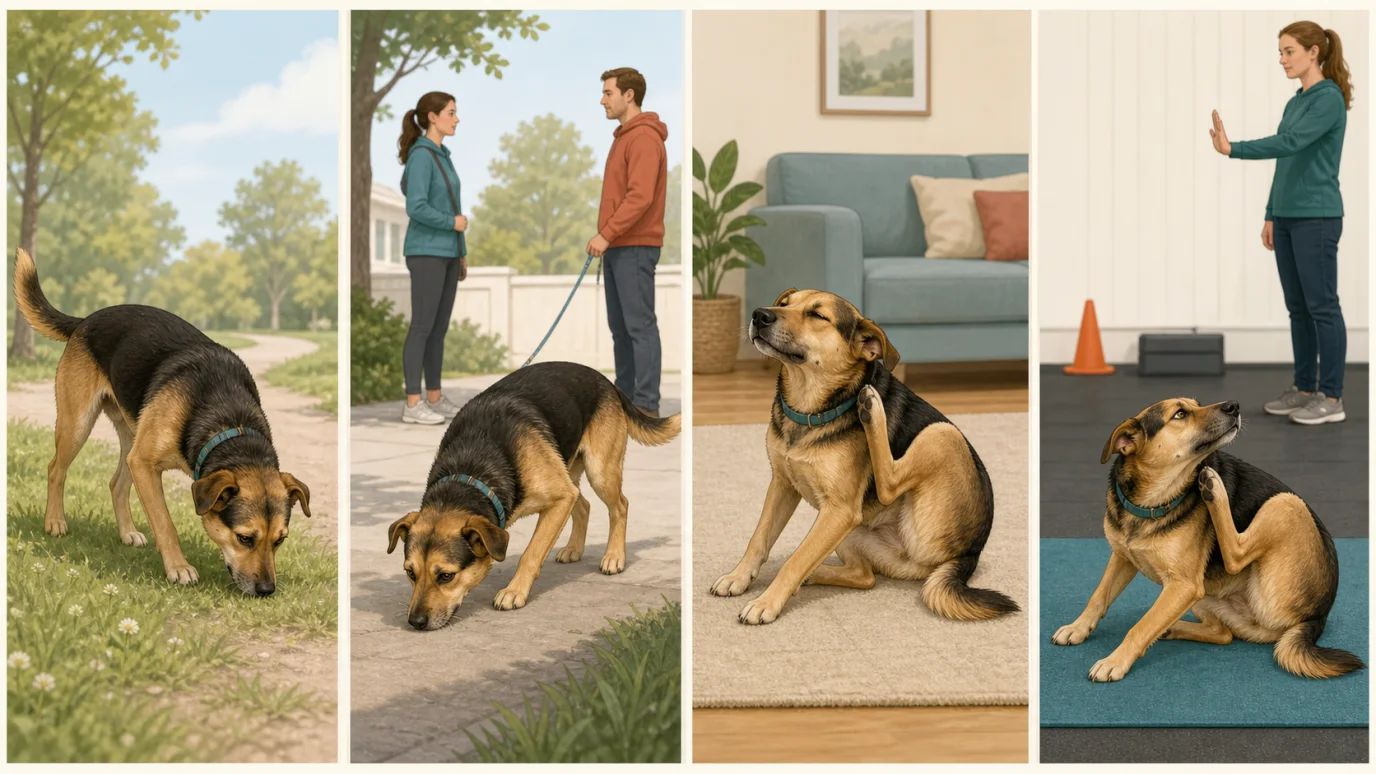
The action alone does not settle the interpretation. Compare what happened immediately before it, the dog's posture while it happens, and how quickly the dog recovers afterward.
| Behavior | Ordinary context | Possible displacement context |
|---|---|---|
| Sniffing | Loose exploration that follows scent across an area | Begins abruptly as social pressure rises and may stop when the trigger moves away |
| Scratching | Repeated attention to an itchy area across settings | A brief scratch appears during a difficult request or uncertain greeting |
| Lip licking | Food, grooming, dry mouth or nausea | No food is present; a lick follows handling, approach or social pressure |
| Yawning | Waking, tiredness or normal transition | Appears during restraint, waiting, frustration or a demanding session |
| Shake-off | Wet coat, waking or skin irritation | A dry dog shakes immediately after a tense interaction ends |
| Grooming | Routine coat care during rest | Sudden licking begins in the middle of conflict or frustration |
| Drinking | Thirst after heat, food or exercise | The dog repeatedly leaves a difficult interaction to visit the bowl |
The comparison is more reliable than counting a fixed number of signals. There is no evidence-based rule that two gestures within a certain number of seconds proves stress.
Why dogs show displacement behavior
Competing motivations
Approach-avoidance conflict is common. A dog may want the treat held by a stranger while feeling unsure about the stranger's body position. A puppy may want to play with another dog but find the other dog's speed overwhelming. The seemingly unrelated action appears while the dog works through that conflict.
Uncertainty
Novel environments and unpredictable interactions create information gaps. A dog entering a first training class may sniff more than usual. That does not prove the dog is refusing to work. The room, surfaces, people, dogs and reinforcement history are all new.
Frustration or high arousal
A dog who cannot reach a desired person, dog or object may redirect activity into scratching, grabbing a toy, mounting or repetitive sniffing. High arousal can be pleasant, unpleasant or mixed. The displacement behavior tells you the dog is having difficulty organizing a direct response; it does not name the emotion by itself.
A possible social function
Some displacement behaviors overlap with what trainers call dog calming signals. Research suggests that head turning, nose licking and other behaviors can carry information during dog-dog or dog-human interaction. The evidence does not show that every out-of-context action is a deliberate message or that it always de-escalates the receiver.
A 2023 study of 53 dogs found that blinking, nose licking and lip wiping were associated with a non-reactive attitude toward approaching strangers, while head turning was associated with a non-reactive attitude in the mildly threatening condition. The behaviors were not limited to conflict. That result supports cautious, contextual interpretation.
Three scenes owners often misread
"My dog is ignoring me in class"
The handler repeats a cue while the dog sniffs, scratches and looks away. The dog may be distracted, but the sequence can also indicate that the task or environment is too difficult. Move farther from other dogs, shorten the session and reinforce an easier response. Repeating the cue more forcefully adds pressure without fixing the setup.
"My dog suddenly needed a scratch during the greeting"
A stranger approaches, reaches over the dog's head and the dog sits to scratch. If the dog stops scratching when the person backs away, the timing matters. Pause the greeting and allow the dog to choose whether to approach. Check for a real itch later rather than assuming either explanation.
"My dog shakes after every hug"
A full-body shake immediately after release can mark a transition out of tension. The useful change is not to stop the shake. Stop restraining the dog for hugs and offer contact the dog can leave. The existing dog body language guide covers the posture changes that may appear before release.
Record the sequence, not just the gesture
A short trigger-behavior-recovery log is more useful than a list of labels.
| Field | What to record |
|---|---|
| Before | Who approached, what changed, what was requested, distance and environment |
| Behavior | Exact visible action without emotion words: "sniffed floor for six seconds" |
| Other signals | Ears, eyes, mouth, tail, posture, movement and vocalization |
| Response | What you changed: paused, added distance, ended touch, reduced difficulty |
| Recovery | Whether the dog loosened, re-engaged, took food, explored or remained tense |
Video can help because it preserves order and timing. Film only when doing so does not prolong or recreate a stressful situation.
What to do when you notice displacement behavior
- Pause the interaction or request.
- Check for an obvious practical cause such as thirst, heat, an itch or a strong odor.
- Scan the whole body for tension, avoidance, weight shift or changes in the eyes and mouth.
- Reduce difficulty, add distance or provide a route away.
- Give the dog time to finish the action and recover.
- Note recurring triggers so you can change future setups.
Do not correct sniffing, scratching or looking away simply because it interrupts training. Suppressing the visible behavior can leave the underlying conflict unchanged. A dog who cannot sniff may freeze, pull away or escalate instead.
Food and toys can help change the situation, but do not use them to lure a worried dog closer to something they are trying to avoid. Place reinforcement where the dog can remain at a comfortable distance.
When displacement becomes a larger concern
An occasional out-of-context action is not a disorder. Concern rises when the behavior:
- happens across many ordinary situations
- lasts after the trigger is gone
- becomes difficult to interrupt
- interferes with eating, sleep, walks or social contact
- causes skin damage or self-injury
- progresses to freezing, lunging, snapping or biting
Some repetitive behaviors can begin in conflict or frustration and develop into persistent patterns. That does not mean every dog who chases a tail or licks a paw has a compulsive disorder. Veterinary assessment is needed to exclude pain, allergy, gastrointestinal disease, neurological problems and other medical causes.
For recurring anxiety, reactivity or handling difficulty, work with a qualified force-free professional. The guide to finding a credentialed behaviorist explains the differences between trainers, consultants and veterinary behaviorists.
What a photo can and cannot show
A still image can capture posture, head direction, paw position, facial tension and environmental context. It cannot show whether sniffing began before or after an approach, how long a scratch lasted or whether the dog relaxed when pressure decreased. Short video is usually more informative for displacement behavior.
PetTranslator.ai separates visible markers from interpretation and reports confidence. Use the report to organize observations and identify patterns, not to declare that one gesture proves stress or a specific intention.
Frequently asked questions
Is displacement behavior bad?
No. It is a normal part of behavior and may help a dog cope with conflict or uncertainty. It becomes useful information about the situation. Frequent, escalating or self-damaging patterns deserve veterinary or behavior support.
Should I interrupt displacement behavior?
Usually, change the trigger or reduce pressure instead of stopping the action itself. Interrupt gently when safety requires it or when a veterinarian or behavior professional has provided a plan for a repetitive behavior.
Is sniffing always a sign of stress?
No. Sniffing is a central part of how dogs investigate the world. Sudden onset during social pressure, accompanying tension and relief when distance increases make displacement more plausible.
Are displacement behaviors the same as calming signals?
They overlap. Displacement describes an action appearing outside its ordinary context. "Calming signal" suggests a possible regulatory or communicative function. Observation alone may not prove that function.
Is mounting a displacement behavior?
Mounting can occur with arousal, play, stress, frustration, social interaction or learned reinforcement. It can function as displacement in some contexts, but the label should not be assigned without the full sequence and medical history.
Sources
- Cavalli C, et al. Appeasement function of displacement behaviours? Dogs' behavioural displays exhibited towards threatening and neutral humans. Animal Cognition. 2023.
- Mariti C, et al. Analysis of the intraspecific visual communication in the domestic dog. Journal of Veterinary Behavior. 2017;18:49-55.
- Beerda B, et al. Manifestations of chronic and acute stress in dogs. Applied Animal Behaviour Science. 1997;52:307-319.
- Merck Veterinary Manual. Behavior problems of dogs.
- Dogs Trust. How to understand your dog's body language.
Khabir Mughal is the founder of PetTranslator.ai. This article was researched against peer-reviewed canine behavior studies and current veterinary guidance. It was last reviewed on August 18, 2026.