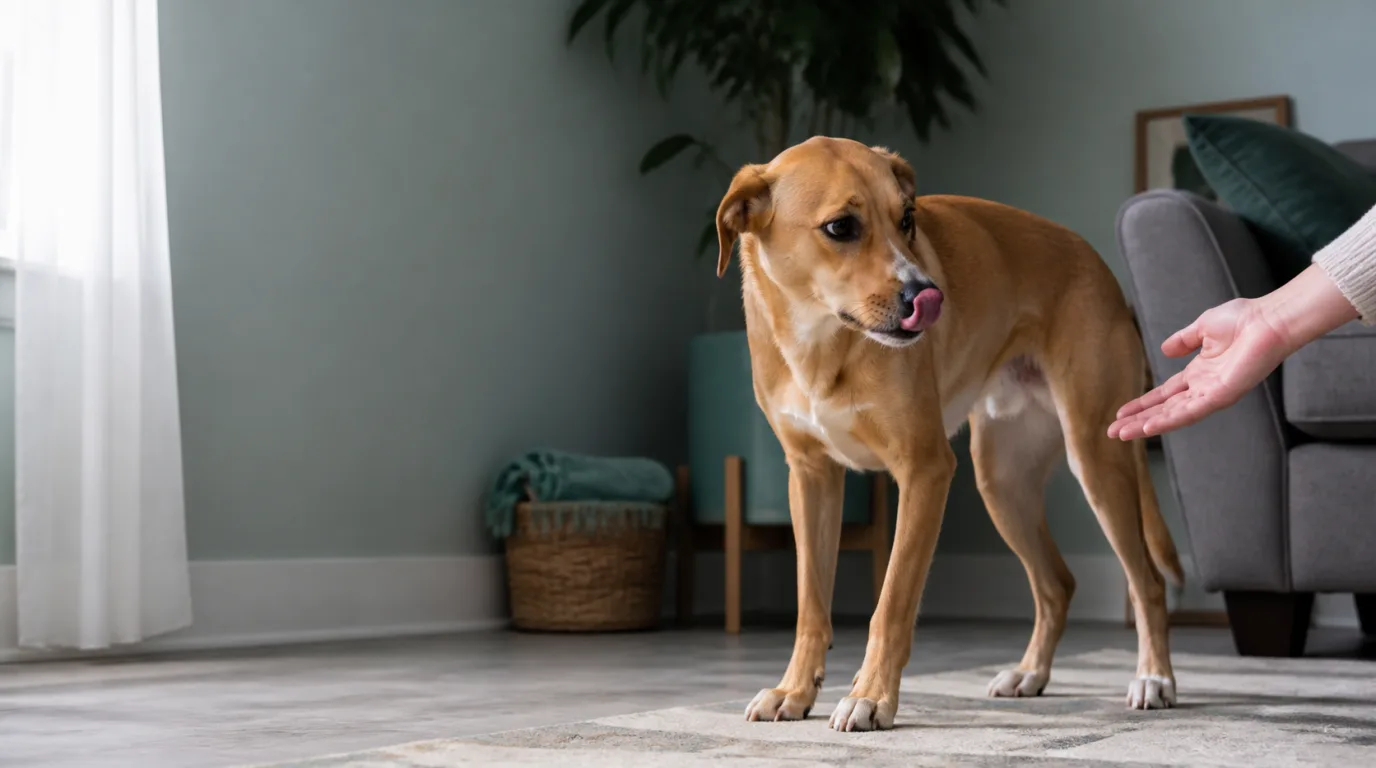
A dog stress ladder is a teaching model that arranges possible signs of discomfort from subtle to urgent. Low-level signs can include looking away, blinking, nose licking or yawning. Avoidance, a lowered body and retreat may follow. A tense freeze, hard stare, growl, snap or bite signals much greater risk.
The ladder is not a script. Dogs can skip signals, show several at once or bite without displaying every pictured rung. Use it to notice change early and reduce pressure, not to predict exactly what a dog will do next.
What is the dog stress ladder?
Veterinary behaviorist Kendal Shepherd developed the widely shared Ladder of Aggression to illustrate how canine responses may intensify when a perceived threat continues. Welfare organizations often call it the canine ladder of communication because the lower behaviors are not aggression. They may be attempts to avoid conflict or cope with pressure.
The useful idea is simple: a bite is not the first moment that matters. A dog may have turned away, moved back, stiffened or growled before using teeth. If a person responds to the quieter change, the dog may not need a louder response.
Calling the model a “stress ladder” also needs care. A nose lick can follow a meal. A yawn can mean tiredness. Freezing can occur during hunting, fear or pain. The visible action becomes informative when it appears after a trigger, differs from the dog's baseline and occurs with other changes.
For detailed definitions of individual behaviors, use the guides to dog stress signs and dog calming signals. This page focuses on the changing sequence.
Why dogs do not climb every rung
The classic ladder is drawn as one upward path. Real behavior is less tidy.
- One dog may move away early and never growl.
- Another may freeze before showing the smaller movements an observer expected.
- A dog prevented from retreating may escalate faster.
- Pain, surprise or a very close threat can shorten the sequence.
- Previous learning can change which signals are useful. If growling has been punished, the growl may disappear while the discomfort remains.
- Breed anatomy, coat and tail shape can hide some visual changes.
Research supports an association between stressful situations and behaviors such as lip licking, yawning, looking away and body shaking. It does not support treating each action as a precise stress meter. Physiological findings, including cortisol measurements, do not map neatly onto every visible behavior. Observe the whole dog over time.
A practical five-zone dog stress ladder
| Zone | What you may see | What it suggests | Best immediate response |
|---|---|---|---|
| 1. Loose baseline | Soft face, ordinary breathing, normal movement, ability to eat and disengage | The dog appears able to cope in this setting | Preserve choice and keep watching |
| 2. Subtle concern | Head turn, blink, nose lick, yawn, sudden sniffing, paw lift, ears shifting back | Uncertainty, conflict or rising pressure is possible | Pause, soften the approach and offer distance |
| 3. Active avoidance | Leaning away, walking off, hiding, low posture, tucked tail, repeated displacement behavior | The dog is trying to change or leave the situation | End the interaction and protect the exit route |
| 4. High tension | Closed tense mouth, still body, hard stare, weight held forward or back, raised hackles | The dog has fewer comfortable options and risk is increasing | Stop movement, do not touch, add a barrier or distance |
| 5. Overt warning or contact | Growl, teeth display, air snap, lunge or bite | Immediate safety risk | Separate without punishment and seek qualified help |
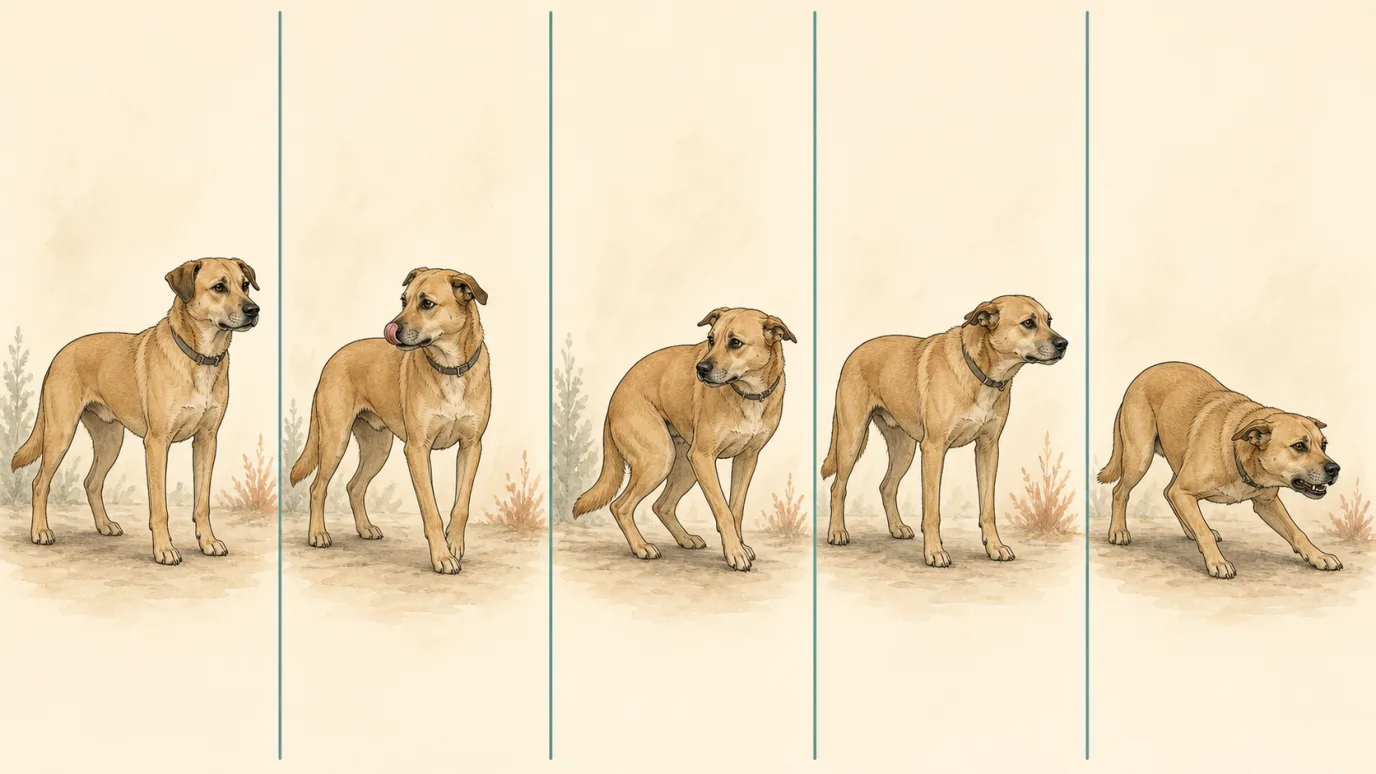
A possible progression from loose to urgent. Dogs do not always show these stages in order, and a single image cannot predict a bite. Respond to the earliest change you can identify.
Zone 1: know what loose looks like
You cannot recognize a meaningful change without a baseline. Watch the dog in a familiar place when nothing is approaching or restraining them. Note their ordinary ear carriage, tail position, mouth shape and movement.
A loose dog can still be excited. The key is flexible movement and choice: the body bends, attention shifts, and the dog can approach or leave. Eating a treat is useful information but not proof of comfort. Some dogs eat while tense.
Zone 2: pause at the small changes
Early behaviors are easy to dismiss because they also occur in everyday life. Look for timing. A quick lip lick just after a hand reaches over the head means more than a lick after food. Sudden sniffing as another dog approaches differs from relaxed exploration along a path.
These actions overlap with displacement behaviors. They are a prompt to check the situation, not a diagnosis. Pause the approach or handling. Turn slightly sideways, reduce direct eye contact and let the dog choose the next movement.
Zone 3: respect attempts to leave
Walking away is successful communication. Do not follow a dog into a bed, crate or corner to finish the interaction. Blocking retreat removes one of the safest options and can speed escalation.
A worried dog may crouch, tuck the tail, hold the ears back or roll partly onto the back. That posture is not necessarily an invitation for a belly rub. Loose, wiggly movement differs from a still, compact dog trying to reduce social pressure.
Zone 4: a freeze is not calm
The transition from movement to sudden stillness is one of the most important changes on the ladder. The mouth may close, breathing may appear to pause and the eyes may fix on the trigger. Whale eye can appear if the head turns away while the eyes continue to monitor.
Do not reach toward a frozen dog to see whether they are friendly. Stop, create space without abrupt movement and keep children away. In a conflict between dogs, do not put hands between them.
Zone 5: do not punish the warning
A growl or air snap is information about immediate risk. Punishment may stop the sound without making the dog feel safer. That can leave people with less warning in the future.
Move people and animals apart using distance, doors, gates or other safe barriers. Do not grab a collar near the dog's face. After everyone is safe, document the trigger and arrange veterinary and behavior support. A resource-guarding pattern, for example, needs management and a structured plan rather than repeated tests.
Build your dog's individual ladder
The most useful ladder is based on your dog, not a generic poster.
- Choose ordinary situations you can observe without provoking discomfort.
- Record what happened immediately before the first visible change.
- Note the order of head, mouth, ear, eye, tail, posture and movement changes.
- Record the distance from the trigger and whether the dog could leave.
- Note what helped the dog recover and how long recovery took.
- Compare several events before deciding a pattern is reliable.
A short video can reveal a sequence that memory compresses into “suddenly.” Review it only after the situation is safe. If children, guarding or a bite history are involved, have a qualified professional review the case instead of collecting more exposures.
What de-escalation looks like
Recovery is not simply the ladder played backward. A dog may turn away, shake off, sniff, drink, rest or seek distance after pressure ends. Look for breathing returning toward baseline, muscles softening and attention becoming flexible again.
Do not use a fixed timer. A dog who takes food but remains stiff has not necessarily recovered. Resume an optional activity only when the dog is loose and freely re-engages. Veterinary handling and essential care may require a planned low-stress protocol rather than waiting for consent in the moment.
Mistakes that make the ladder less useful
Treating every yawn as stress
Context still applies. One sign may be ordinary behavior. Look for change, sequence and clusters without inventing a rigid “three-signal rule.”
Waiting for a growl
Growling is already an urgent request for distance. Intervention is easier at the head turn or retreat stage.
Testing the threshold
Moving closer until a dog reacts rehearses the unwanted sequence and can be unsafe. Controlled desensitization and counterconditioning keep exposure below the level that produces intense distress.
Calling all escalation aggression
Avoidance and appeasement are not attacks. Even a defensive display describes behavior in a specific context, not a permanent personality. The distinction between reactivity and aggression matters for safe planning.
When to involve a veterinarian or behavior professional
Arrange a veterinary examination when the pattern is new, worsens suddenly, occurs around touch or movement, or comes with appetite, sleep, mobility, digestive or neurological changes. Pain and illness can reduce tolerance.
Seek qualified behavior help after a growl, snap or bite; when children or vulnerable adults are involved; when triggers cannot be avoided; or when the dog struggles to recover. The guide to finding a credentialed behaviorist explains veterinary behaviorist and consultant credentials.
For a bite that breaks skin, wash the wound and seek medical advice. Report and vaccination requirements vary by location.
What a photo or video can show
A photo can capture ear position, gaze, mouth tension, tail carriage and posture. It cannot show the order of events or prove what caused the expression. Video is better for a ladder because the subject is change over time.
PetTranslator.ai separates visible observations from possible interpretations and includes uncertainty. Use it to organize a non-provoked recording, not to predict a bite or replace a veterinary or behavior assessment.
Frequently asked questions
What are the first signs on a dog stress ladder?
Common early changes include looking away, blinking, a quick nose lick, yawning, sudden sniffing, slowing down and shifting weight away. Each can occur for other reasons, so check timing and the rest of the body.
Do dogs always growl before biting?
No. Some dogs growl, while others freeze, snap or bite with little warning an observer recognizes. Pain, surprise, distance, previous learning and blocked escape can change the sequence.
What should I do when my dog moves up the ladder?
Stop adding pressure and create distance. Do not touch, corner or punish the dog. Use safe barriers if risk is high, then identify the trigger and arrange professional help when warning or contact behaviors have occurred.
Is the ladder of aggression scientifically proven?
It is a useful clinical and educational model, not a validated instrument that predicts a fixed order. Research supports contextual links between stress and many listed behaviors, while also showing that individual actions and physiological stress measures do not align perfectly.
Can a dog move down the stress ladder?
Yes, but recovery varies. Distance, choice and removal of the trigger may help. Watch for loose muscles, flexible attention and ordinary breathing rather than relying only on silence or food taking.
Sources
- PDSA. Canine ladder of communication.
- National Animal Welfare Trust. Understanding dog body language.
- Cavalli et al. Appeasement function of displacement behaviours? Dogs' behavioural displays toward threatening and neutral humans.
- Bremhorst et al. Audience effect on domestic dogs' behavioural displays and facial expressions.
- Hekman et al. Psychogenic stress in hospitalized dogs: challenges of evaluation.
- American Veterinary Society of Animal Behavior. Position statements.
Khabir Mughal is the founder of PetTranslator.ai. This article was researched against peer-reviewed canine-behavior studies and current veterinary and animal-welfare guidance. It was last reviewed on August 18, 2026.