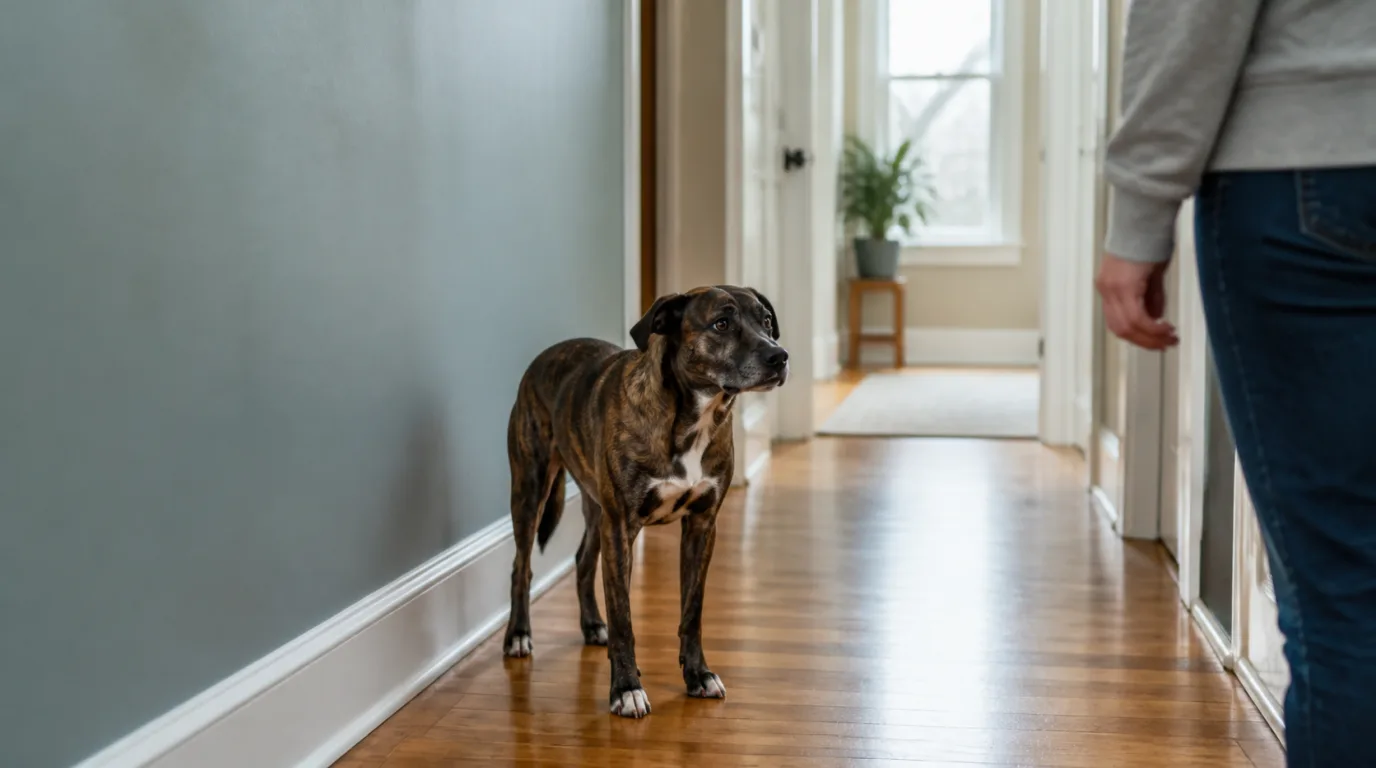
A behavioral freeze is a sudden change from movement to tense stillness. The dog's mouth may close, muscles become rigid, breathing look shallow and gaze fix on or monitor something. In a pressured interaction, that change is a reason to stop and create space. It can precede escape, a growl, snap or bite, but it does not guarantee any one next action.
Dogs also stand still to listen, locate a scent, wait for a cue or stalk. The difference is not movement alone. Look at muscle tone, weight distribution, face, trigger and what happens when pressure decreases.
What does a dog freeze look like?
Researchers coding canine fear behavior define freezing as stopping movement or sound while the body remains still and visibly tense, sometimes lowered or rigid. At home, the transition is often more useful than the pose. A dog may be panting or shifting, then close the mouth and become statue-like when a hand reaches toward them or another dog approaches.
Possible details include:
- movement stopping abruptly, sometimes in the middle of a wag
- a closed or tightened mouth
- reduced blinking or a fixed gaze
- eyes tracking a person while the head turns away
- weight anchored, shifted back or held forward
- ears pinned back or directed intensely toward a target
- a tail that stops, lowers or holds high and rigid
- a brief pause in ordinary sniffing or breathing rhythm
Not every feature appears, and breed anatomy can hide ears, eyes or tail position. Compare the dog with their own loose baseline and read the whole body.
Tense freezing versus other kinds of stillness
| Type of stillness | Body and face | Typical context | Safer interpretation |
|---|---|---|---|
| Relaxed rest | Weight supported comfortably, soft eyes, loose mouth and changing position | Bed, sofa or familiar resting place | Resting unless other health signs appear |
| Alert orienting | Ears and nose point toward a sound, body remains flexible, attention can shift | Distant noise, scent or movement | Gathering information |
| Trained stillness | Dog holds a sit, down or stand with ordinary muscle tone and can end on a release cue | Cooperative care, stay exercise or sport | Learned behavior if it remains voluntary and fluent |
| Predatory stillness | Gaze locks on moving target, body lowers or leans forward, movement becomes controlled | Wildlife, toy or fast-moving animal | Hunting-related focus; manage access and safety |
| Fear or conflict freeze | Sudden rigid posture, tight mouth, monitoring eyes, weight away or trapped | Approach, restraint, touch, unfamiliar person or dog | Stop pressure and create distance |
| Pain or mobility hesitation | Stops before stairs, jumping, rising or touch; may shift weight or guard an area | Movement or contact | Veterinary assessment, especially if new |
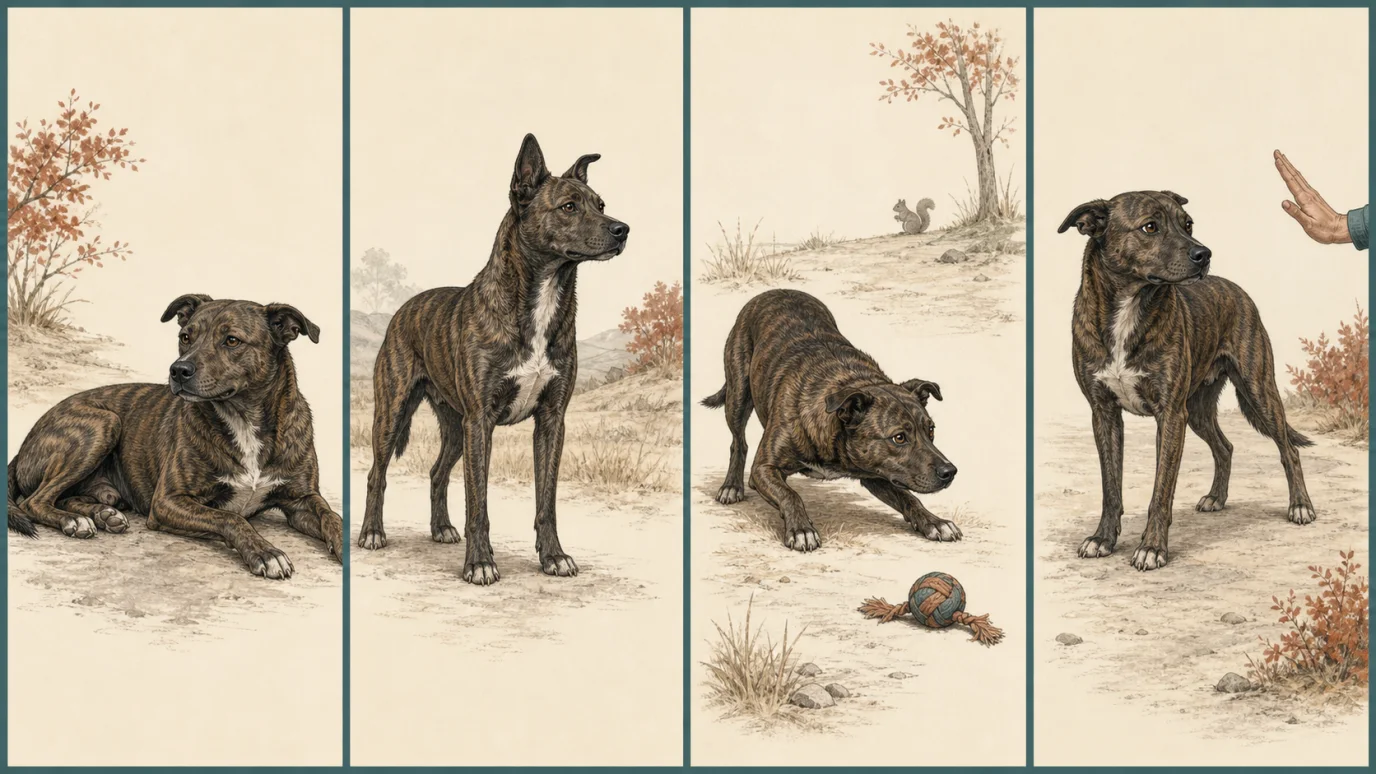
Stillness is not one emotion. From left: loose rest, alert listening, predatory focus and a tense social freeze. The transition, trigger and full body separate these patterns better than a frozen frame.
Fear-related freezing
Freezing is one possible defensive response to a perceived threat. A dog may stop to avoid attracting attention, gather information or prepare for the next action. Some dogs freeze low to the ground with the tail tucked. Others stand tall and rigid.
Look for an approach, restraint, looming posture, unfamiliar setting or blocked escape immediately before the change. Ears back, weight away, lip licking, lowered posture and whale eye make discomfort more plausible.
Do not describe the dog as stubborn. They may be unable to move comfortably in that moment. Pulling the leash, repeating a cue or reaching closer adds pressure without resolving the cause.
A tense freeze as a warning
During a close social interaction, sudden stillness deserves a conservative response. A dog who was moving and then becomes rigid with a tight mouth and hard stare may be near a more overt distance-increasing behavior.
The freeze is not always the “last warning,” and a bite cannot be predicted from one cue. Some dogs move away after freezing; others resume normal behavior when the trigger stops. Risk increases when the dog is cornered, guarding something, in pain, facing a child or already showing escalation on the dog stress ladder.
Stop moving toward the dog. Do not stare, touch the head, grab the collar or test the response. Shift sideways and increase distance slowly if it is safe. Make sure children and other animals do not approach.
Predatory stillness and alert focus
A dog may freeze while watching a squirrel, cat, bird, livestock animal or moving toy. The body often points toward the target, weight shifts forward and the next movement may be a stalk or chase. The face may be quiet rather than fearful.
Predatory behavior is not the same as defensive aggression, but it can still be dangerous to the target animal. Use a secure leash, fencing and distance. Do not rely on calling the dog after the chase has started. A qualified professional can help with management around household animals or wildlife.
Alert orienting is usually more flexible. The dog pauses, moves the ears or nose toward a distant sound, then returns to sniffing or checks in with the handler. If attention remains locked and the body grows tighter, treat that as a change rather than assuming the dog is calmly observing.
Freezing from pain or physical difficulty
Stopping before stairs, doorways, a jump into the car or rising from the floor can reflect anticipated discomfort. A dog may also freeze or stiffen when one area is touched. New irritability around handling is a medical question before it is a training problem.
Look for limping, shortened steps, weight shifting, difficulty settling, altered sleep, licking one area or reluctance to do an activity the dog previously chose. The guide to pain signs in older dogs covers subtle mobility changes, but young dogs can hurt too.
Do not lure a painful dog repeatedly over the difficult movement to prove they can do it. Record the pattern without staging it and arrange a veterinary examination.
What to do in common freezing situations
During petting or handling
Stop the hand and then withdraw without a sudden grab. Let the dog leave. If the dog voluntarily returns, do not assume they want the same handling repeated; use shorter contact and a pause test. Veterinary procedures may need cooperative-care training and clinical support.
On a walk
First identify what the dog is watching. Increase distance in an arc or make a quiet U-turn before pulling forward. A frozen dog may be too close to a trigger for training. The leash-reactivity guide explains sub-threshold distance work.
Around another dog
Stillness and staring can increase social pressure. Do not force a nose-to-nose greeting. Move away in a curve and use a visual barrier. If both dogs live together and freezing recurs, prevent unsupervised conflict around food, doorways, resting places and people while seeking help.
Near food, toys or a resting place
Freezing over a possession can be an early resource-guarding signal. Do not reach for the item or punish the dog. Manage access and get a qualified plan, especially with children in the home.
How to tell whether the dog recovered
Recovery looks like flexibility returning. The dog may turn away, resume ordinary sniffing, soften the mouth, blink, shake off or choose to move. One stress-related gesture does not prove recovery, and taking food while rigid does not make close contact safe.
When the main change is a sudden nose drop rather than stillness, compare the full sequence in the ground-sniffing context guide.
Give the dog time and space without immediately repeating the trigger. If freezes recur after several events, trigger stacking may be reducing tolerance. Keep notes on the setting, distance, duration and recovery rather than testing the same situation.
When freezing needs urgent veterinary care
Behavioral stillness must be distinguished from a medical event. Seek urgent veterinary help if the dog:
- collapses or cannot stand
- seems unaware or unresponsive
- has rhythmic jerking, facial twitching or loss of bladder or bowel control
- develops sudden weakness, imbalance or a head tilt
- has pale or blue gums, breathing difficulty or a swollen abdomen
- cries out, cannot bear weight or shows severe pain
- remains disoriented after the episode
A video can help a veterinarian distinguish a behavioral pause from seizure activity, fainting, pain or movement impairment. Do not delay emergency care to obtain a better recording.
For non-urgent but repeated fear-related freezes, start with a veterinary check and then use a force-free professional. The guide to finding a credentialed behaviorist explains when to look for a veterinary behaviorist, behavior consultant or trainer.
What a photo or video can show
A photo can show posture, gaze, ear position, mouth shape and weight distribution. It cannot show the most important feature of a freeze: the sudden transition from movement to stillness. It also cannot reveal an off-camera trigger or prove what happens next.
Video is usually better. Capture the whole body and environment from a safe distance without recreating the event. PetTranslator.ai can separate visible markers from possible interpretations and state uncertainty. It cannot predict a bite, diagnose fear or rule out pain and neurological disease.
Frequently asked questions
Why does my dog suddenly freeze and stare?
They may be locating a sound, watching prey, feeling uncertain, guarding something or anticipating discomfort. Check what changed immediately before the freeze and whether the body is flexible or rigid.
Does a dog always freeze before biting?
No. Some dogs freeze before a defensive action, while others retreat, vocalize or react with little visible warning. Treat tense stillness during close interaction seriously, but do not use it as a certain bite prediction.
Why does my dog freeze when I pet them?
The dog may be uncomfortable with the touch, worried about restraint or painful in that area. Stop petting and allow them to move away. A new or location-specific response needs veterinary assessment.
Should I pull a dog that freezes on walks?
Avoid dragging them toward the trigger. Identify what they are watching, add distance and encourage movement away in an arc if possible. Repeated freezing calls for a veterinary and behavior assessment.
Is freezing a calming signal?
The term appears in some calming-signal lists, but appearance alone does not establish a function. Freezing can occur with fear, social conflict, predation, pain or focused listening. Context and the rest of the body decide the response.
Sources
- ASPCApro. Canine body language tips.
- VCA Animal Hospitals. Fears, phobias and anxiety.
- Tufts Collaborative for Shelter Dogs. Dog communication and body language.
- University of Pennsylvania Behavior Medicine. Dog body language basics.
- Barnard et al. Socialization in commercial breeding kennels: novel stimuli to measure social and non-social fear in dogs.
- Bremhorst et al. Audience effect on domestic dogs' behavioural displays and facial expressions.
Khabir Mughal is the founder of PetTranslator.ai. This article was researched against canine-behavior studies and current veterinary and animal-welfare guidance. It was last reviewed on August 18, 2026.