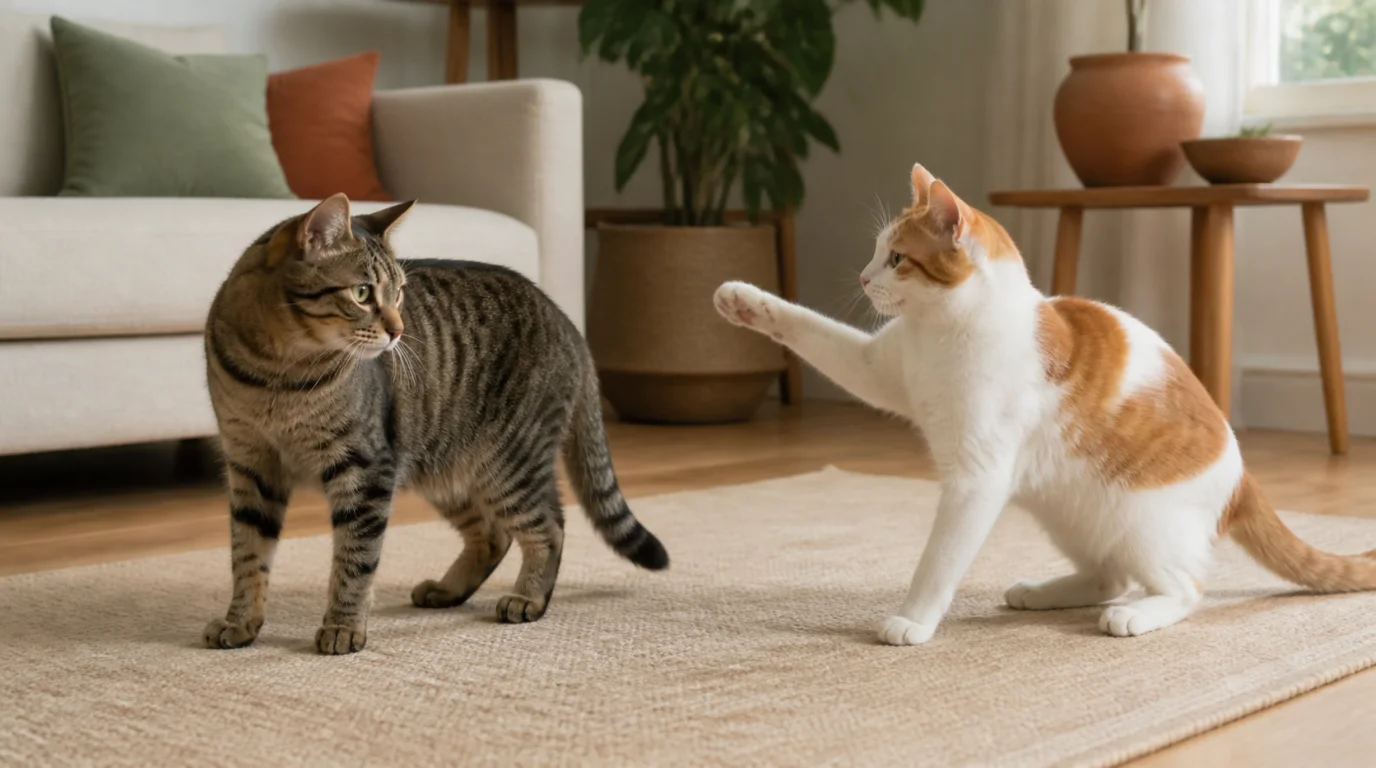
Cats slap with a front paw to interact without committing their whole body. A soft tap at a toy, a quick swat when petting continues, and a clawed strike during a fight may look related, but they do not carry the same meaning.
Start with four questions: What was the target? What happened immediately before the paw moved? Was the rest of the body loose or tense? What did the cat do next?
What kind of slap did you see?
| Context | Other visible clues | What the paw may be doing | Safer response |
|---|---|---|---|
| Toy, insect or unfamiliar object | Focused gaze, forward ears, repeated light taps, pouncing | Testing movement or playing | Offer safe play and remove hazardous objects |
| Person touching or handling | Tail movement, skin ripple, head turn, ears rotating back, body tension | Ending contact or increasing distance | Stop touching and let the cat leave |
| Person nearby without touch | Cat approaches, taps, waits, then looks toward food, door or toy | A learned request for attention or access | Check the context; reward a calm alternative if needed |
| Another cat | Staring, blocking, crouching, chasing, vocalizing or one cat withdrawing | Boundary-setting, play, tension or fighting | Add space and assess the full interaction |
| Sudden noise, outdoor cat or frightening event | Dilated pupils, fixed attention, fast tail, inability to settle | Defensive or redirected arousal | Do not approach; separate safely and allow recovery |
| New sensitivity around one body area | Flinch, guarding, hiding, reduced movement, grooming change | Protection from possible pain | Arrange a veterinary examination |
A single frame can show the raised paw but miss the trigger and recovery. That is why a “cat slap meaning” chart should be treated as a set of possibilities, not a translation key.
Playful slapping and investigation
Cats use their paws to test movement, reach prey-like objects and begin play. A kitten may pat a toy, another cat's tail or a moving shoelace, then bounce away and return. The body usually remains flexible, and the roles may change when two cats are playing.
Do not use your fingers as prey. A cat that learns to grab hands during play may repeat the same pattern with more force as arousal rises. Use a wand toy or another object that keeps teeth and claws away from skin. Let the cat stalk, chase and catch it, then allow a pause.
Sheathed claws support a playful interpretation, but they do not prove it. A frightened or annoyed cat may first use an inhibited, claw-free swat. A playful cat can also expose claws by accident. Read claw position alongside speed, tension, vocalization and what follows.
The cat play aggression guide covers stalking, ankle attacks and hand-directed play in more detail.
A slap during petting is usually a stop signal
When a cat slaps the hand that is touching them, the most useful response is to stop. The cat may have reached their touch limit, disliked the body area, become tense for another reason, or felt pain. You do not need to know which explanation is correct before respecting the request.
Early changes can include a twitching tail tip, skin rippling, ears turning outward, a sudden still body, wider eyes, or a quick look toward the hand. If petting continues, the cat may raise a paw, swat or bite. The cat overstimulation guide shows that sequence and a brief pause test.
Do not hold the cat still, tap the paw, spray water or continue touching to “teach tolerance.” Punishment can add fear and make earlier warnings less safe to use. Pause, keep an exit open and let the cat decide whether to return.
Tapping for attention can be learned
A loose cat may place or tap a paw on a person, then look toward the food cupboard, door or toy. If that tap reliably produces conversation, food or play, it can become a request.
That does not mean the cat is manipulating you. It means behavior followed by a useful result is likely to happen again. Decide what you want to reinforce. You might respond to a gentle tap, or wait for four paws on the floor before opening a door. Keep the alternative simple and avoid scolding.
Repeated hard swats are different from a soft attention tap. Check whether the cat is frustrated, over-aroused, unable to access a normal need, or reacting to movement as play.
Fear, surprise and defensive distance
A cornered or startled cat may swat because a paw creates space faster than retreating. The body may sit low or lean back. Ears may flatten, pupils may enlarge, and the cat may hiss, growl or look for an exit.
Move away rather than reaching over the cat. Reduce noise and visual pressure. If the cat is hiding, do not pull them out. A safe place works only when the cat controls access to it.
If defensive swatting is new, happens during ordinary handling, or centers on one part of the body, pain moves higher on the list. Dental disease, arthritis, wounds and skin problems can all change tolerance. A veterinary examination should come before a training plan for a sudden behavior change.
Redirected swatting can arrive after a different trigger
A cat watching an unfamiliar cat through a window may become highly aroused but unable to reach the trigger. The nearest person or pet can then receive the swat. The target of the strike is not always the cause of the arousal.
Clues include a fixed stare, lashing tail, dilated pupils, growling, pacing or a recent frightening sound. Do not pick up or pet the cat in that state. Block the view if you can do so without approaching, move other pets away, and wait for full recovery. The redirected aggression guide explains why reintroductions may be needed after a serious episode.
When one cat slaps another
A swat between cats can be part of play, a brief boundary, competition over access, or a fight. Avoid calling it dominance. That label does not tell you who can reach the litter box, who is blocking a doorway, or whether one cat is consistently withdrawing.
Look at the exchange:
- More consistent with play: loose bodies, pauses, quiet movement, role changes and both cats returning.
- More consistent with a boundary: one quick swat, the other cat increases distance, and both settle.
- More consistent with tension: prolonged staring, stalking, blocking, one-sided chasing, growling, repeated swats or one cat avoiding rooms and resources.
- More consistent with a fight: rigid bodies, loud vocalization, claws, biting, fur flying and no natural pauses.
The guide to cats playing or fighting gives a fuller comparison. If a cat is guarding access to food, water, resting spots or litter boxes, use the cat resource-guarding guide.
When these encounters reliably happen after bedtime, the nighttime cat-fighting guide covers activity peaks, enrichment and safe separation.
What to do immediately after a swat
- Stop the movement or contact that was happening.
- Give the cat a clear route away.
- Do not grab, chase, stare at or punish the cat.
- Move children and other animals away without crowding the cat.
- Note the trigger, target, body posture and recovery time.
- Check for pain, skin changes or altered movement once the cat is calm and safe to observe.
Do not deliberately recreate the scene for a better video. If it happens naturally again, a short clip from a safe distance can capture the sequence.
When to call a veterinarian or behavior professional
Contact a veterinarian when swatting starts suddenly, becomes more frequent, occurs at the first touch, focuses on one body area, or appears with hiding, appetite change, altered grooming, limping or reluctance to jump.
Seek qualified behavior help when attacks cause injury, the cat cannot settle after a trigger, household cats are restricting one another's movement, or people are afraid to complete routine care. Start with the guide to finding a credentialed behaviorist.
What a photo or video can show
A photo may capture ear angle, pupil size, paw position, claws and weight distribution. Video is better for showing the trigger, speed, tail movement, contact, retreat and recovery.
PetTranslator.ai can organize those visible markers and separate observation from interpretation. It cannot prove why a cat swatted, diagnose pain or decide that two cats are safe from a single image.
Frequently asked questions
Why does my cat slap me and then run away?
That pattern often appears in play or an attention-seeking sequence, but a startled cat may also strike and retreat. Check whether the body was bouncy and loose or low and tense, and what happened just before the slap.
Why does my cat slap me without claws?
An inhibited slap may be a warning, a request to stop, playful contact or a learned tap. No claws reduces injury risk but does not erase the rest of the cat's body language.
Should I slap my cat's paw back?
No. Retaliation can create fear, escalate the encounter and make handling less safe. Stop the interaction, provide space and address the trigger.
Sources
- Merck Veterinary Manual. Behavior problems of cats.
- FelineVMA. Training techniques for addressing undesirable behaviors.
- FelineVMA. 2024 Intercat Tension Guidelines.
- FelineVMA. Setting up for success.
Khabir Mughal is the founder of PetTranslator.ai. This article was researched against current feline veterinary and behavior guidance. It was last reviewed on September 1, 2026.