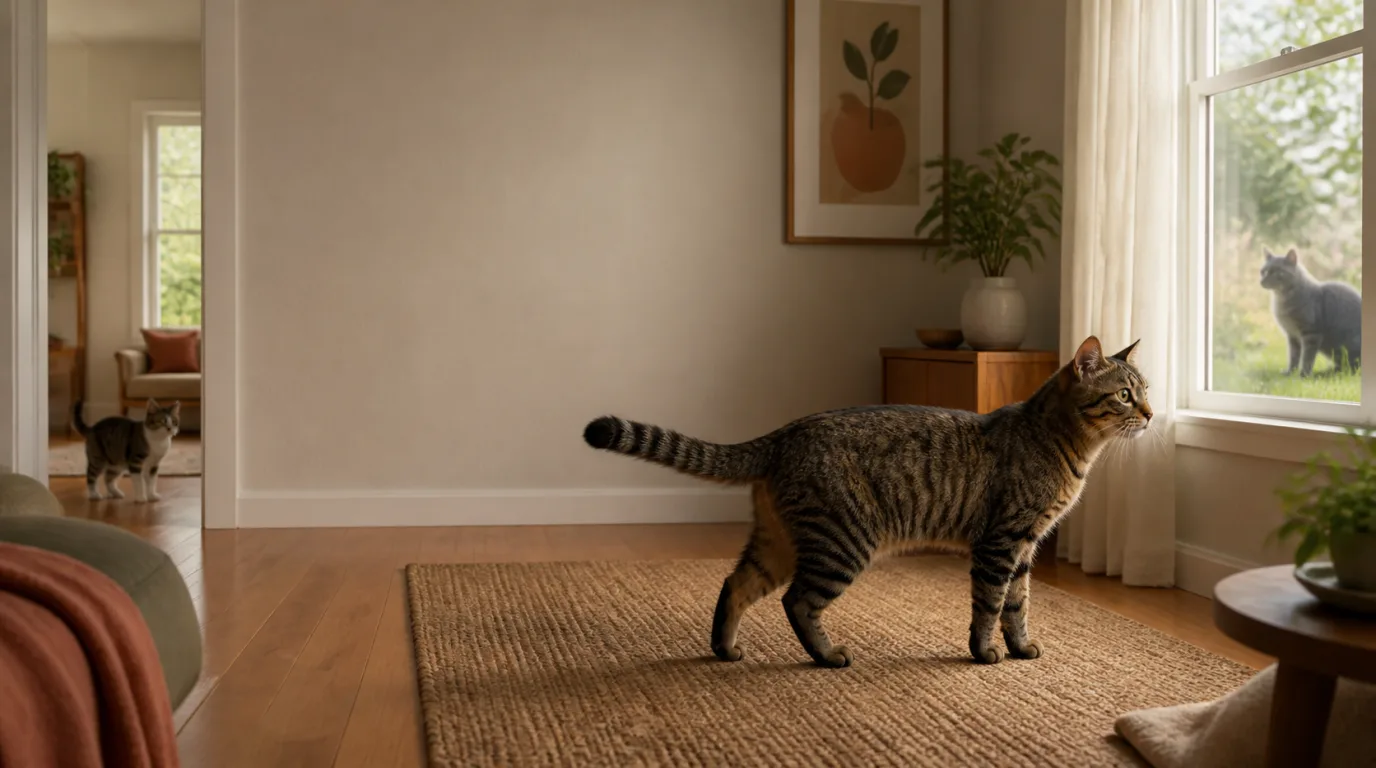
Redirected aggression happens when a highly aroused cat cannot reach the original trigger and attacks an accessible person or animal instead. If it is happening now, do not touch, pick up or corner the cat. Move people and pets away, use a solid visual barrier only if you can do so from a safe distance, and let the cat recover alone in a quiet space.
An outdoor cat at a window is a classic trigger, but a loud noise, frightening smell, dog, visitor or conflict elsewhere can produce the same chain. The nearby target did not necessarily cause the reaction.
What redirected aggression looks like
The sequence matters more than the attack alone:
- Something creates intense fear, frustration or predatory arousal.
- The cat cannot reach or safely act on that stimulus.
- A person or animal moves nearby while arousal remains high.
- The cat swats, chases, bites or attacks that available target.
When the pattern instead repeats around food, litter boxes, resting places or a doorway, compare it with resource guarding in cats. The original trigger and the resource pattern require different management.
A cat may stay reactive after the original stimulus disappears. That is why approaching to comfort the cat can result in a bite, and why two cats who were previously friendly may continue fighting.
This behavior is not revenge or a calculated decision to punish the victim. It is a dangerous overflow of arousal that calls for distance, not discipline.
Warning signs before an attack
Possible signs include:
- fixed staring at a window, door or sound source
- enlarged pupils and rapid scanning
- ears turned sideways or flattened
- whiskers pushed forward or pulled tightly back
- a low, rigid or side-on posture
- tail lashing, bottle-brush fur or a stiff tail
- growling, yowling, hissing or sudden silence
- inability to disengage when called
- striking at glass or rushing between windows
No single sign proves aggression. Look at the change from the cat's normal body language and the trigger. The guides to cat stress signs and cat body language provide broader context.
What to do during the incident
- Keep hands and faces away. Do not grab collars, scruffs or tails. Do not pick up either cat.
- Remove bystanders. Guide children, dogs and uninvolved cats behind a closed door if their route does not pass the aroused cat.
- Block sight safely. From a distance, a large piece of cardboard, laundry basket or closed door can interrupt visual contact. Do not press a barrier onto the cat.
- Create separate zones. Each cat needs a quiet room with water, litter, a hiding place and a comfortable resting area.
- Reduce stimulation. Close blinds, dim the room and stop loud conversation. Leave the cat alone.
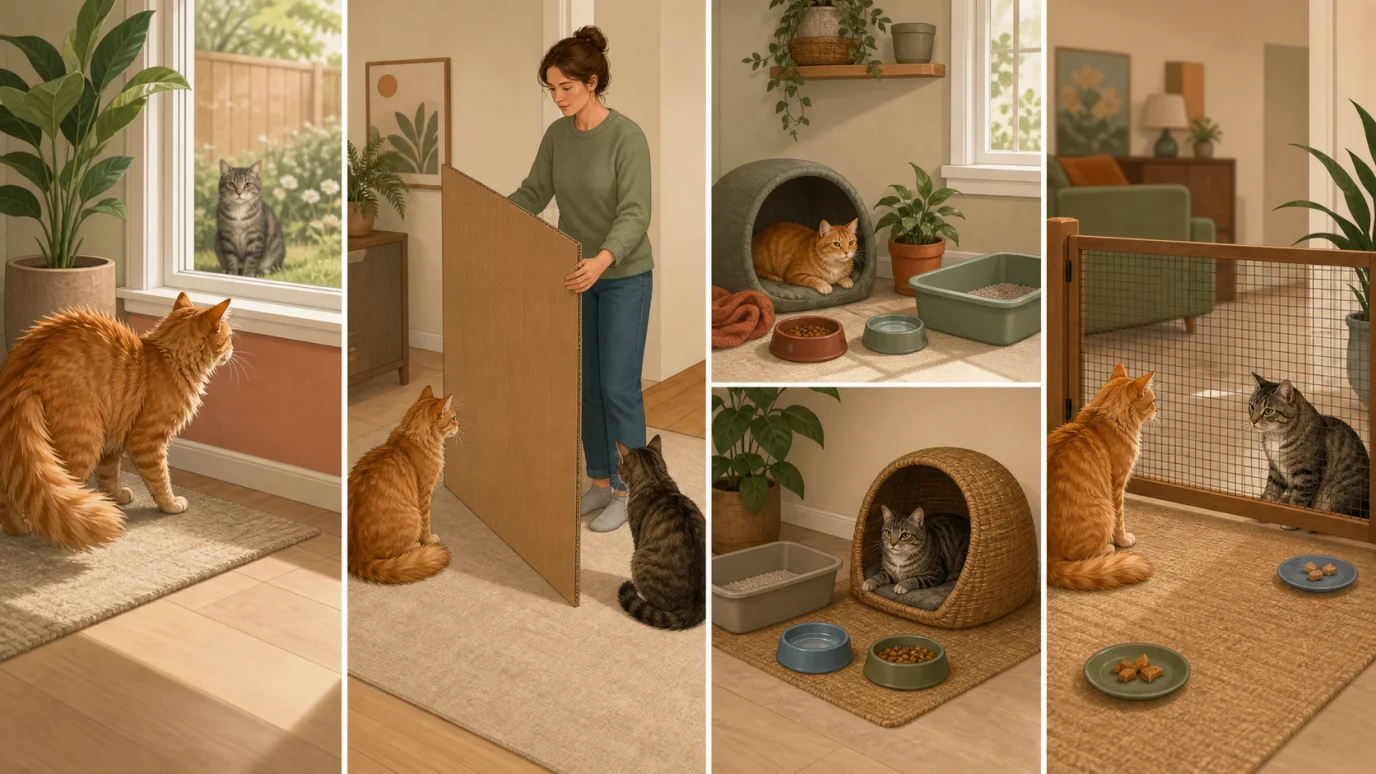
Separate first. Reintroduction begins only after both cats have returned to their own relaxed baseline.
If cats are already fighting, do not reach between them. A barrier placed from a safe distance is preferable. Throwing water, shouting or punishment can add fear and may link the other cat with an even worse experience.
How long should cats stay separated?
There is no reliable one-hour or 24-hour rule. Use behavior, not the clock. Some cats settle in hours; others remain vigilant for a day or longer after a severe event.
Wait until each cat is eating, resting, grooming and moving normally in their separate area. Pupils, posture, vocalization and response to ordinary household sounds should be close to that cat's baseline. A cat who camps at the door, growls at scent or startles repeatedly is not ready.
Do not crack the door open as a test. A failed reunion can strengthen fear and restart the process.
Reintroducing cats after redirected aggression
If the cats show no tension after a mild incident, a careful reunion may be simple. If either cat hisses, hides, patrols the door or charges, use a gradual reintroduction:
- Keep complete visual separation while both cats recover.
- Swap bedding or use a clean cloth to move familiar cheek scent between rooms. Stop if scent causes distress.
- Feed or play on opposite sides of a closed door at whatever distance keeps both cats relaxed.
- Allow brief visual access through a secure screen or tall gate, with escape routes and resources on both sides.
- Progress to short supervised sessions only while bodies stay loose and both cats can disengage.
- Return to the previous step if staring, blocking, stalking, growling or chasing appears.
Do not force nose-to-nose contact or hold one cat in a carrier while the other circles closely. The process resembles a new introduction because the victim may now associate the other cat with danger. Our resident-cat introduction guide gives a detailed staged setup.
Severe injury, repeated charging or inability to progress warrants veterinary and qualified behavior support. Long-term separation may be necessary while a plan is built.
Preventing the trigger from returning
First reconstruct the minutes before the event. Note where each cat was, what they could see or hear, whether a visitor arrived, and what changed outside.
For outdoor-cat triggers:
- apply removable frosted film at cat height
- close curtains during predictable visiting times
- move climbing furniture away from problem windows
- use humane motion-activated sprinklers outdoors where appropriate
- remove outdoor food that attracts roaming cats
- provide alternative elevated perches away from the trigger
Do not trap or harm the outdoor cat. Blocking only one window may shift patrol behavior to another, so check doors and scent-marking locations too.
Inside, reduce competition with separated food and water stations, multiple resting and hiding areas, vertical routes and well-distributed litter boxes. In a multi-cat home, resources should not sit in one narrow area where one cat can block another.
Redirected aggression or something else?
| Pattern | What happens first | Useful distinction |
|---|---|---|
| Redirected aggression | A separate trigger sharply raises arousal | Nearest target receives the reaction |
| Petting-related aggression | Touch continues before the bite or grab | Skin twitching, tail movement or avoidance may build during contact |
| Play aggression | Stalking and grabbing occur in a play sequence | Often lacks defensive vocalization and follows moving targets |
| Non-recognition aggression | A familiar cat returns smelling or looking different | Often follows a vet, groomer or absence |
| Pain-related aggression | Approach or touch near a painful area | May appear with gait, appetite or routine changes |
The cat overstimulation guide separates touch sensitivity from redirected arousal. The playing-or-fighting guide helps assess reciprocal play versus one-sided pursuit.
When to call a veterinarian
Sudden aggression needs a veterinary assessment, especially if there was no clear trigger or the behavior recurs. Pain, neurological disease, sensory changes, hyperthyroidism and other medical problems can change tolerance and arousal. A medical problem can also lower the threshold for a genuine redirected event.
Seek urgent veterinary care for either cat after a bite or fight if you see punctures, bleeding, limping, breathing difficulty, marked pain, eye injury, weakness or collapse. Cat punctures can close over and form an abscess later.
Ask for behavior support when attacks are severe, people are at risk, the cats cannot be safely separated, or reintroduction stalls. The guide to finding a credentialed behaviorist explains veterinary behavior and training credentials.
What a photo or video can show
A photo can show pupils, ears, tail, muscle tension and orientation. It usually cannot establish redirected aggression because the diagnosis depends on the event sequence and original trigger.
A short video from before an incident may reveal fixation or patrol patterns, but never keep filming instead of creating safety. PetTranslator.ai can list visible markers and possible contexts. It cannot determine intent, predict an attack or rule out pain.
Frequently asked questions
Why did my cat attack me after seeing another cat?
The outside cat may have created intense arousal that could not be directed through the window. Your movement nearby then became the accessible target. Give space and prevent renewed window access while the cat settles.
Will redirected aggression go away on its own?
The acute arousal can fade, but conflict may persist if a housemate was attacked or the trigger returns. Management and a gradual reintroduction may be needed.
Should I comfort my cat after an incident?
Offer quiet, distance and necessary resources. Do not approach or touch a cat who remains tense, watchful or reactive. Comfort does not require physical contact.
Can cats stay angry for days?
“Angry” is not precise, but heightened vigilance and a learned fear association can last beyond the original event. Wait for relaxed baseline behavior rather than using a fixed deadline.
Do pheromone diffusers stop redirected aggression?
They may be one supportive environmental measure, but they do not replace separation, trigger control, veterinary assessment or careful reintroduction. Evidence and individual response vary.
Sources
- Cornell Feline Health Center. Feline behavior problems: aggression.
- ASPCA. Aggression in cats.
- VCA Animal Hospitals. Redirected aggression in cats.
- Rodan et al. AAFP and ISFM feline-friendly handling guidelines.
- Ramos. Aggression in multi-cat households.
- Ramos and Mills. Owner-directed aggression.
Khabir Mughal is the founder of PetTranslator.ai. This article was researched against feline veterinary, handling and welfare guidance. It was last reviewed on August 18, 2026.