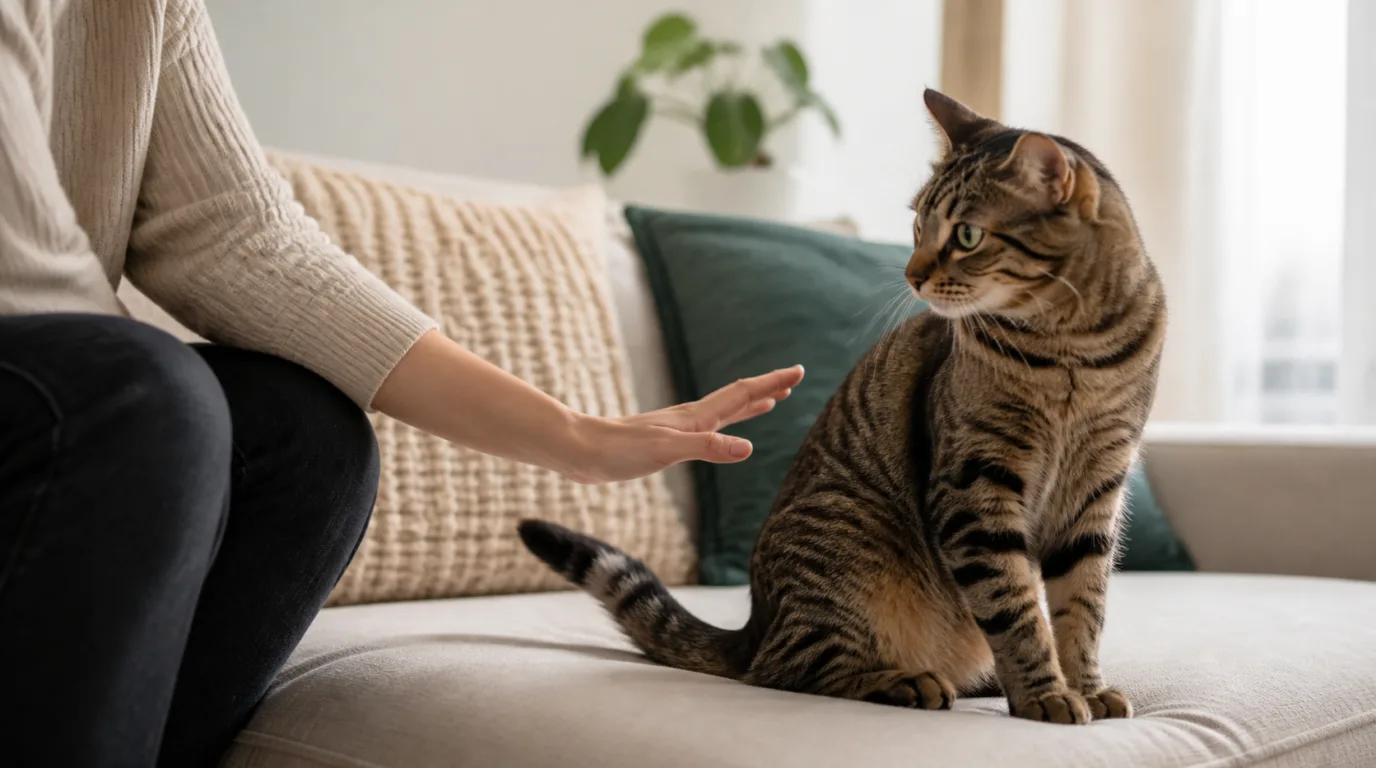
Cat petting aggression often follows a twitching tail tip, rippling skin, ears rotating outward, sudden body tension or a quick turn to watch your hand. If touch continues, the cat may flatten their ears, lash the tail, growl, swat or bite. Stop at the first change and let the cat decide whether to return.
If the interaction began outside petting, use the broader guide to why cats slap with their paws to compare play, fear, redirected arousal and intercat conflict.
The bite often feels sudden because the earliest signs are small and fast. Learning your cat's sequence is more useful than waiting for a universal warning sign.
What does cat overstimulation mean?
Overstimulation describes a point at which an interaction has become too intense, repetitive or difficult for a cat to tolerate. It most often comes up during petting, but handling, grooming, energetic play, noise, visitors, another animal or a busy environment can also raise arousal.
Petting-induced aggression is the term commonly used when a cat nips, scratches or bites during touch. It is a description of the situation, not proof of one cause. Repeated contact may become irritating, the cat may want control over when the interaction ends, or pain, fear, play and earlier arousal may be involved. Calling every petting bite "overstimulation" can hide those differences.
A clinical review reports that petting-related aggression accounts for up to 40% of feline aggression cases seen by referral services. That does not mean 40% of all cats show it. It means the pattern is common among families already seeking specialist help.
A cat can approach you, purr and enjoy the first few strokes, then decide they have had enough. Starting an interaction is not permission for it to continue indefinitely.
The warning sequence
Signs do not always appear in the same order, but they often move from subtle changes to clear attempts to stop contact.
Early signs
- The tail tip starts to twitch or tap.
- Skin along the back ripples beneath your hand.
- The ears rotate outward or begin moving back and forth.
- The cat stops leaning into touch.
- The body becomes still or slightly tense.
- The eyes open wider or the pupils enlarge.
- The cat glances toward your hand.
Clear stop signals
- The head turns quickly to track or confront the hand.
- The tail lashes from side to side.
- The ears flatten or hold sideways.
- The cat shifts away, gets up or tries to leave.
- A low growl, grumble or sharp vocalization appears.
- The cat raises a paw or makes a warning nip.
Escalation
Swatting, scratching, biting, chasing or repeated attacks mean the interaction has gone well past the cat's limit. At that point, focus on distance and safety. Do not reach back toward the cat to test whether they have calmed down.
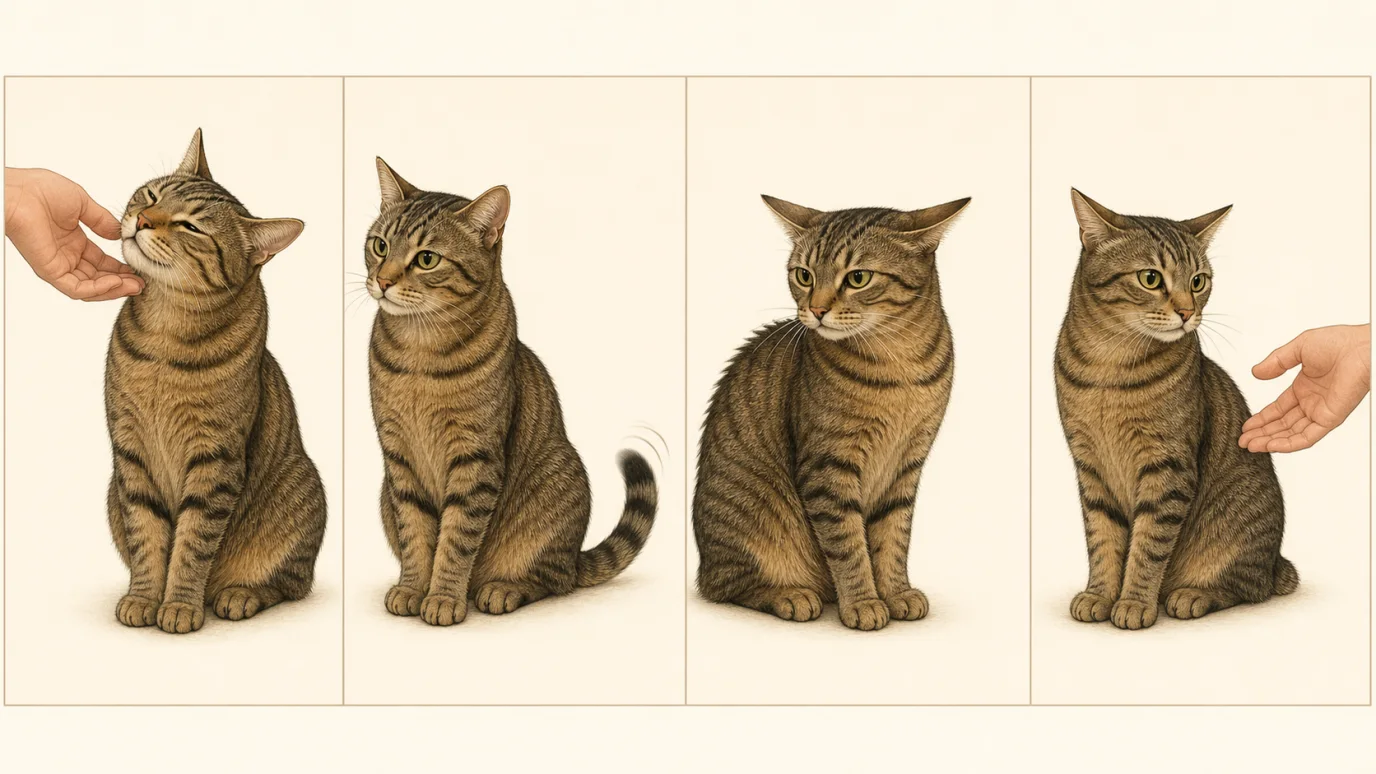
A possible early sequence, not a universal script. From left: relaxed contact, tail-tip movement, ear and back tension, then a turn toward the hand. The useful moment to pause is before the cat needs to swat or bite.
Purring does not cancel the other signals
Purring can occur during pleasant contact, but it is not a guarantee that every stroke still feels welcome. Read the whole cat. A purring cat with a loose body, softly positioned ears and a still tail differs from a purring cat whose tail is lashing while the head follows your hand.
The same applies to rolling over. Belly exposure may occur in a relaxed social interaction without being an invitation to rub the abdomen. The broader cat body language guide explains how posture, eyes, ears, whiskers and tail position work together.
Use Choice, Attention and Touch
A controlled study tested practical CAT interaction guidelines with cats housed at Battersea. CAT stands for Choice and control, Attention to body language, and Touch in cat-preferred areas. Cats handled by people trained in the guidelines showed more affiliative behavior and less aggression and conflict than during the comparison condition.
The framework is useful at home:
- Choice and control: stay at the cat's level, offer a relaxed hand and let the cat make contact. Do not follow if they leave.
- Attention: watch for head turns, ear rotation, skin rippling, sudden grooming, stillness, tail movement or a sharp look at the hand.
- Touch: begin around the cheeks, base of the ears or under the chin. Treat the belly, legs, tail, flank and lower back cautiously unless the individual cat repeatedly requests and enjoys contact there.
The study supports a method, not a universal map of every cat. Individual preferences still decide where and how long touch remains welcome.
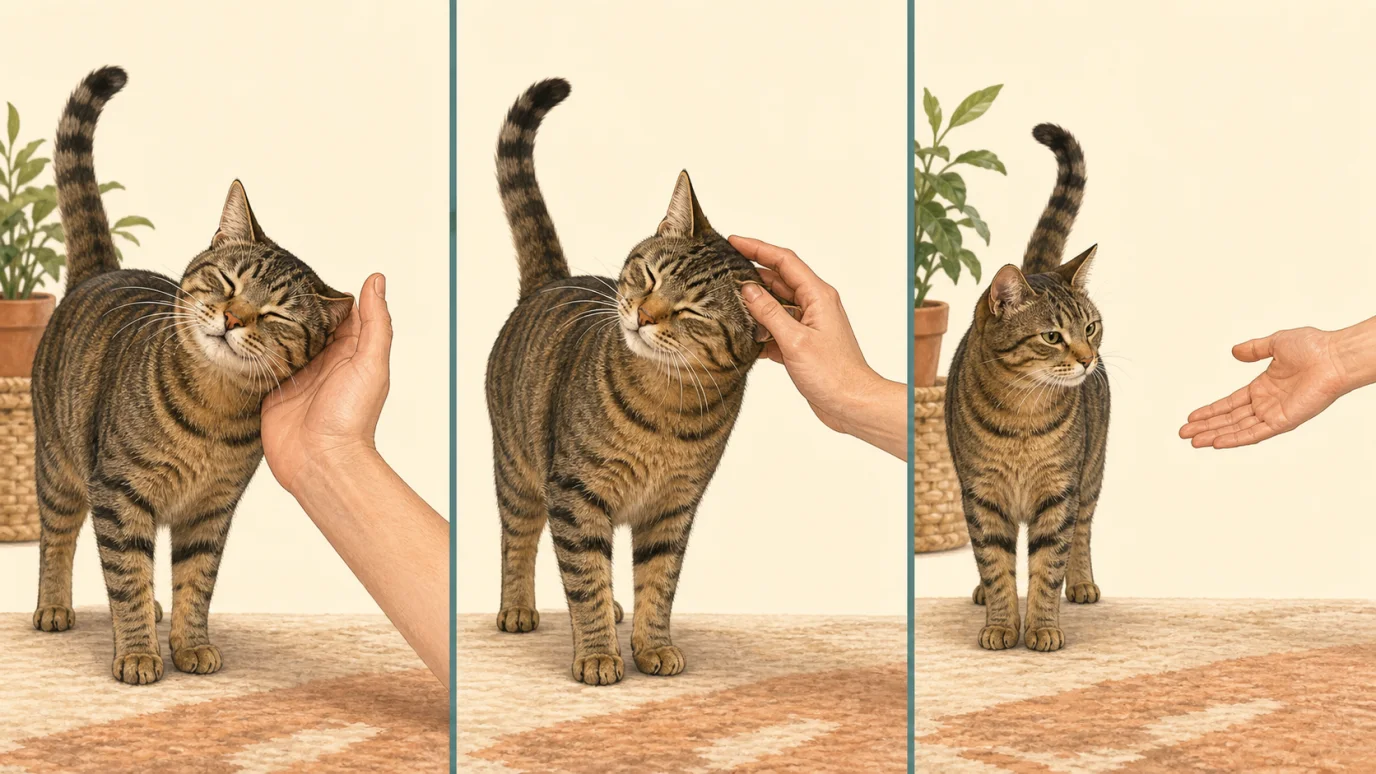
A choice-based sequence: let the cat approach, keep touch brief and pause. Continue only if the cat clearly reinitiates. Standing nearby or looking at the hand is not automatic permission.
A simple petting pause test
Use short pauses before warning signs become obvious.
- Pet the cat briefly in an area they usually choose, such as the cheek or side of the head. A pause every 3 to 5 seconds is a useful starting rhythm.
- Stop moving your hand and hold it nearby without reaching.
- Watch what the cat does next.
If the cat rubs into the stationary hand, repositions for contact or clearly approaches again, offer another short round. If they look away, remain still, move off, groom, flick the tail or watch the hand with tension, end the session.
The test is not perfect mind reading. It simply gives the cat a practical way to continue or leave. If the cat reapproaches after declining touch, begin with less contact rather than repeating the same long stroke.
Why does a cat become aggressive during petting?
Repetition or loss of control
An interaction can begin pleasantly and become unwanted. The point may depend on stroke count, pressure, body area, the person's movement and what happened earlier that day. A cat soliciting social contact does not necessarily want prolonged full-body stroking.
Pain or skin sensitivity
Arthritis, dental disease, wounds, dermatitis and other painful conditions can make touch harder to tolerate. Pain is more likely when the reaction is new, happens at the first touch, centers on one body area or accompanies movement and routine changes.
Fear or handling history
A cat who cannot leave, is picked up, approached from above or handled by an unfamiliar person may use defensive behavior to end the contact. Shorter petting alone will not solve an interaction that still feels inescapable.
Play or redirected arousal
Young cats may grab a moving hand as prey-like play. A cat already aroused by an outdoor animal, noise or conflict may react to the nearest person. In redirected aggression, do not approach or touch the cat until they have fully settled.
Common triggers and how to adjust them
Repetitive full-body petting
Long strokes down the back can become uncomfortable for some cats. Start with brief touch around the cheeks, chin or head if those are known preferences. Do not assume every cat likes the base of the tail or belly.
Intense play
Fast play can shift into chasing hands or ankles when arousal remains high. Use toys that keep teeth and claws away from skin, allow pauses and give the cat something appropriate to catch. Hands are not prey toys.
Grooming and handling
Brushing, nail care, medication and being picked up add restraint as well as touch. Break the task into shorter steps and stop before the cat struggles. A veterinary team or qualified behavior professional can help with cooperative-care training.
Environmental overload
Visitors, construction, loud appliances, outdoor cats at the window or conflict between household cats can lower tolerance for touch. A cat who normally enjoys petting may need more distance and control on a difficult day.
What to do when signs appear
- Stop moving your hand. Pulling away sharply can invite a chase or defensive grab.
- Allow the cat to leave without following, lifting or restraining them.
- Reduce noise, movement and nearby social pressure when possible.
- If the cat is on your lap, rise slowly only if you can do so safely and let the cat step or slide away.
- Wait for loose body language and a new voluntary approach before considering contact again.
Do not punish a growl, swat or bite. Punishment can add fear to an interaction the cat already found difficult. It also does not teach you which earlier signals you missed.
Overstimulation, play, pain or redirected aggression?
| Pattern | Clues in the sequence | Safer next step |
|---|---|---|
| Petting overstimulation | Warning signs begin during repeated touch and ease after touch stops | Shorter, cat-led sessions and earlier pauses |
| Play arousal | Stalking, pouncing and grabbing occur around movement or toys | End hand play and use distance toys with pauses |
| Pain-related aggression | New sensitivity, one body area, mobility change or reluctance to be handled | Veterinary examination |
| Redirected aggression | Another cat, animal, sound or frightening event raised arousal first | Do not approach; separate safely and allow full recovery |
The existing cat love bites guide covers gentle mouthing and how it differs from a tense warning bite. If the behavior changed suddenly, do not rely on an online label.
When to call a veterinarian
Arrange a veterinary examination when touch sensitivity is new, worsening or focused on one part of the body. Arthritis, dental disease, wounds, skin problems and other painful conditions can change a cat's tolerance.
Skin rippling by itself can occur during ordinary arousal or irritation. Repeated rippling combined with frantic running, tail chasing, self-biting, excessive grooming or intense vocalization needs veterinary assessment. The cat skin-twitching guide compares touch sensitivity, skin disease, pain and feline hyperesthesia-like episodes; a photo cannot diagnose the cause.
Seek professional behavior support when bites break skin, attacks continue after contact stops, household members are afraid, children are involved or the cat cannot safely receive routine care. The guide to finding a credentialed behaviorist explains the qualifications to check.
What a photo or video can show
A clear photo may capture pupil size, ear angle, whisker position, body tension and tail placement. Overstimulation is a sequence, though. Short video is usually better for showing tail motion, skin rippling, the timing of touch and whether the cat tries to disengage.
PetTranslator.ai separates visible observations from interpretation and reports uncertainty. Use the result to review the interaction and identify questions for your veterinarian or behavior professional, not to diagnose aggression, pain or feline hyperesthesia.
Frequently asked questions
Why does my cat ask for petting and then bite?
The cat may enjoy initial contact but reach their limit quickly. Watch for a tail-tip twitch, skin movement, ear rotation, tension or a turn toward the hand. Medical pain and play behavior can look similar, especially when the pattern is new.
How long should I wait before petting again?
There is no fixed recovery time. Wait for the cat to leave, settle and voluntarily approach with loose body language. Some cats recover quickly; others need much longer after intense arousal.
Can I train my cat to tolerate more petting?
Some cats become more comfortable with short, predictable, voluntary interactions, but increasing tolerance should not be the only goal. Respecting the cat's existing preference is a valid outcome. Pain or severe reactions need professional assessment first.
Are zoomies a sign of overstimulation?
Normal bursts of running can occur without distress. Look at what happened before the run and what accompanies it. Hiding, defensive posture, repeated self-biting, vocal distress or inability to settle changes the concern.
Sources
- Cornell Feline Health Center. Feline behavior problems: aggression.
- Ramos D. Common feline problem behaviours: owner-directed aggression.
- Haywood et al. Providing humans with practical handling guidelines increases cats' affiliative behaviour and reduces aggression and conflict.
- Rodan et al. 2022 AAFP/ISFM Cat Friendly Veterinary Interaction Guidelines.
- Merck Veterinary Manual. Behavior problems of cats.
- ASPCA. Aggression in cats.
- BC SPCA. Why does my cat suddenly bite and scratch me while I'm petting her?.
- San Francisco SPCA. Overstimulation.
- PetMD. 11 signs of an overstimulated cat and how to calm them.
Khabir Mughal is the founder of PetTranslator.ai. This article was researched against peer-reviewed feline interaction studies and current veterinary and animal-welfare guidance. It was last reviewed on August 18, 2026.