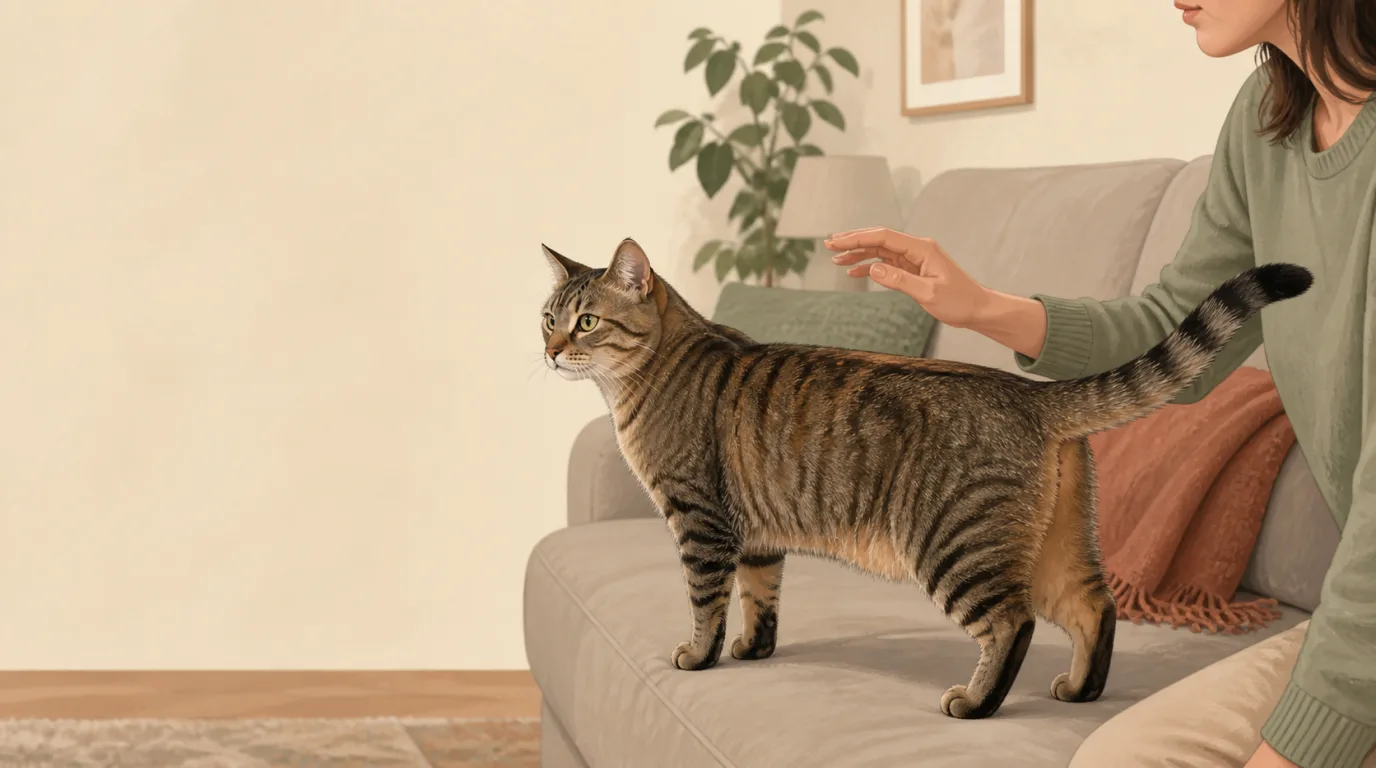
A brief ripple of a cat's back skin during touch can be a normal reflex or an early request to stop petting. Repeated episodes, marked sensitivity, frantic running, tail chasing, intense grooming, vocalization or self-biting need veterinary evaluation. Skin rippling alone does not diagnose feline hyperesthesia syndrome.
The guide to why cats chase their tails compares light play with itch, injury, compulsive patterns and a larger hyperesthesia-like sign cluster.
When you notice a twitch, remove your hand and observe. Do not repeatedly stroke or press the area to reproduce it. What happens without further touch is more useful than another test.
What does skin twitching look like?
The thin muscle beneath the skin can create a quick local flick or a wave along the back. Owners describe it as rippling, rolling, shivering or twitching. It often appears over the lower back near the tail base, but location and pattern vary.
Record:
- exact location and direction of the movement
- whether touch triggered it or it began spontaneously
- one brief ripple versus a cluster lasting seconds or minutes
- tail, ears, pupils, posture and vocalization
- licking, scratching, biting or running afterward
- skin changes, fleas, dandruff, hair loss or wounds
- frequency and change over time
A still photo rarely captures the movement. Short video filmed without provoking another episode is usually more helpful.
Four common contexts
| Pattern | Other clues | Possible explanation | Next step |
|---|---|---|---|
| One brief ripple | Cat remains loose and resumes normal activity | Touch reflex or momentary sensitivity | Pause and avoid repeatedly testing |
| Ripple during longer petting | Tail starts moving, ears rotate, cat watches hand or leaves | Petting overstimulation or touch preference | Stop and shorten future contact |
| Repeated twitch with itch signs | Scratching, licking, hair loss, crusts or flea dirt | Parasites, allergy, infection or other skin disease | Veterinary skin assessment |
| Episodic ripple with behavior change | Enlarged pupils, vocalizing, sudden running, tail chasing, self-biting | Pain, neurologic problem or FHS-like episode | Record safely and arrange veterinary evaluation |
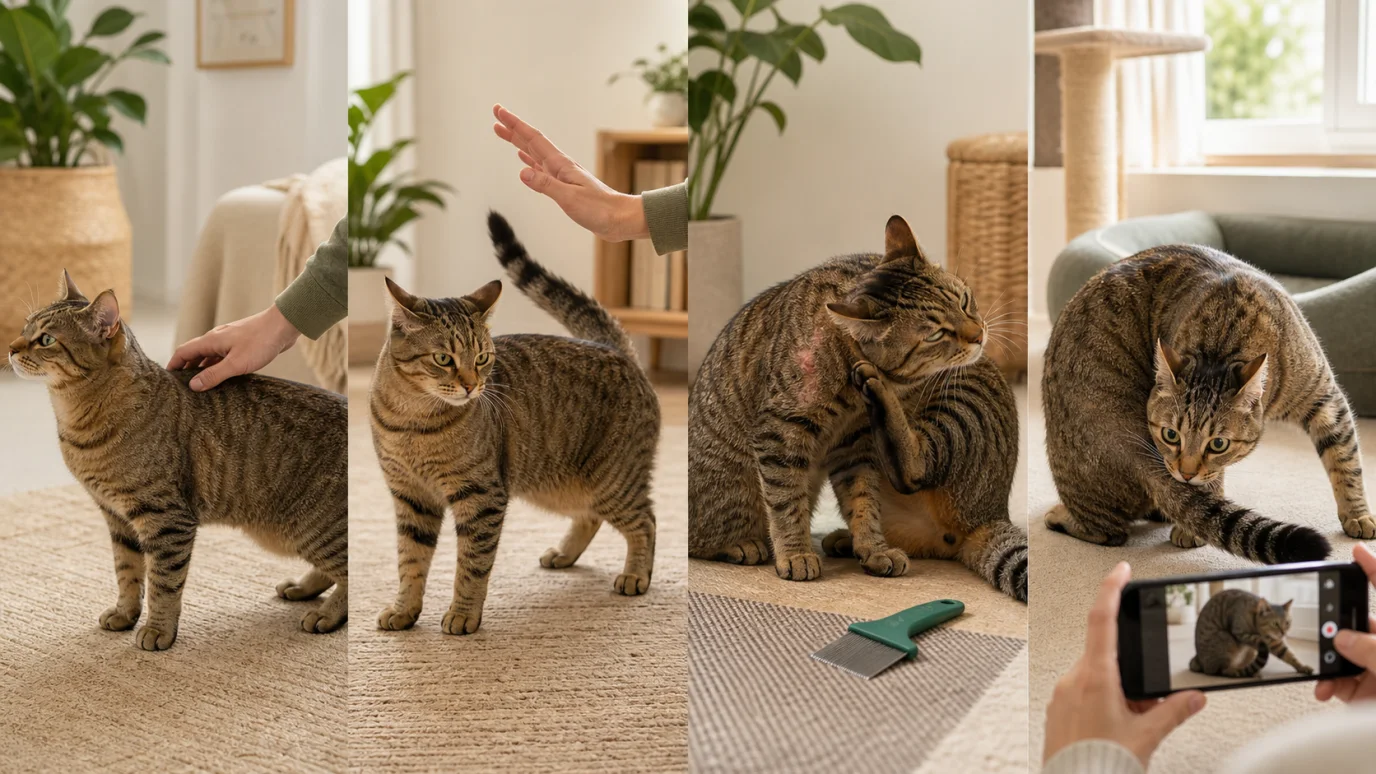
The ripple is one observation. Frequency, trigger, skin condition and the behavior that follows determine the next question.
Petting overstimulation
Skin rippling can appear within a sequence of decreasing touch tolerance. A tail-tip flick may become a swish, ears turn outward, the body tightens and the cat looks sharply toward the hand. If contact continues, the cat may leave, groom suddenly, swat or bite.
Stop at the first change. Let the cat leave and do not follow. On future interactions, use shorter strokes around areas the cat has previously chosen, often the cheeks or head, and pause frequently. The full cat overstimulation guide explains the interaction sequence and a choice-based petting check.
Do not label the cat aggressive for reacting after repeated warning signals. Do not punish or restrain them. A preference against lower-back touch is information, not a behavior to train away.
Skin irritation, allergy and parasites
Fleas and flea-allergy dermatitis commonly affect the lower back and tail base. A cat may twitch, scratch, chew or overgroom even when live fleas are difficult to find. Other possibilities include mites, bacterial or fungal disease, environmental or food-related allergy, wounds and irritation from topical products.
Look for broken hair, thinning, redness, crusts, scaling, odor, swelling or dark flea debris. Check all household animals because exposure can affect more than one pet.
Do not apply dog flea products to a cat. Some canine ingredients, including concentrated permethrin products, are dangerous to cats. Ask a veterinarian for species-appropriate parasite control and a skin workup. Essential oils and home remedies can irritate skin or be toxic.
Pain and touch sensitivity
Back, hip, tail-base, abdominal or skin pain can make ordinary touch feel unpleasant. Concern rises when twitching is new and the cat also:
- avoids jumping or uses stairs differently
- resists touch in one repeatable location
- hides, crouches or moves stiffly
- grooms less or overgrooms one area
- changes sleep, appetite or litter-box habits
- becomes irritable when picked up
- carries the tail differently
Do not press along the spine to locate pain. Video natural movement and tell the veterinarian exactly where touch occurred. The cat crouching guide and senior-cat behavior guide cover posture and mobility clues.
What is feline hyperesthesia syndrome?
Feline hyperesthesia syndrome, sometimes called rolling-skin or twitchy-cat syndrome, describes recurring episodes of unusual sensitivity and behavior. Reported signs include rippling over the lower back, enlarged pupils, vocalization, sudden running or jumping, intense grooming, tail chasing and biting at the back, flank or tail.
It is a syndrome, not one simple disease with one confirmed cause. Proposed or overlapping mechanisms include skin disease, pain, neuropathic pain, seizure-related activity, compulsive behavior and environmental stress. Evidence remains limited, and similar signs occur with other conditions.
That is why a veterinarian first evaluates more common or identifiable causes. One twitch after petting is not enough. Even a dramatic episode should be described rather than self-diagnosed, because treatment depends on the differential.
What a veterinary workup may include
The examination and testing depend on history, age and signs. A veterinarian may consider:
- skin and coat examination, flea combing and parasite control history
- cytology, fungal testing or other dermatology tests
- orthopedic, spinal and pain assessment
- neurological examination
- blood and urine testing where systemic disease is possible
- medication and toxin exposure review
- video review and an episode diary
- referral to dermatology, neurology or veterinary behavior
Do not start anticonvulsants, pain medication, supplements or psychoactive products without veterinary direction. Human pain medicines can be toxic to cats, and an unstructured medication trial can obscure the diagnosis.
Make an episode log
For each event, record:
| Field | What to note |
|---|---|
| Before | Sleeping, playing, petting, noise, conflict or no obvious trigger |
| Start | Body area and first visible change |
| Sequence | Ripple, pupils, ears, vocalization, running, grooming or biting |
| Duration | Start and stop time |
| Contact | Whether anyone touched the cat and where |
| Recovery | Immediate normal activity, hiding, sleep or continued agitation |
| Environment | Time, location, new products, visitors and household changes |
Film from a safe distance if the episode is already happening. Do not touch the back, block the cat or introduce a suspected trigger for documentation.
When is it urgent?
A brief isolated ripple in an otherwise normal cat is rarely an emergency. New repeated episodes, increasing frequency, skin damage or a clear painful reaction should still be assessed promptly.
What a photo or video can show
Video can show ripple direction, duration, pupil and tail changes, self-directed behavior and recovery. It cannot distinguish itch, pain, seizure activity or compulsive behavior by itself.
PetTranslator.ai can organize visible markers and the event sequence. It cannot diagnose feline hyperesthesia, identify a skin parasite or rule out pain. Pair any analysis with the history and veterinary examination.
Frequently asked questions
Is it normal for a cat's back to twitch when touched?
One brief ripple can occur as a touch reflex. Stop and observe. Repeated rippling, distress, intense grooming, pain or spontaneous episodes warrant veterinary evaluation.
Does skin rippling mean my cat has hyperesthesia?
No. Feline hyperesthesia is a recurring syndrome with a broader episode pattern and overlapping differentials. Skin disease, fleas, pain and petting intolerance can also cause twitching.
Why does my cat bite after their back twitches?
Touch may have exceeded their tolerance or contacted an itchy or painful area. Stop petting and avoid that location. A new, strong or location-specific reaction needs veterinary assessment.
Should I film an episode?
Yes, if you can do so without touching, cornering or prolonging it. Capture the whole cat, the seconds before recovery and a time reference.
Can stress cause a cat's skin to ripple?
Stress may accompany or intensify some episodes, but it should not be assumed to be the sole cause. Medical and dermatologic differentials need evaluation first.
Sources
- Cornell Feline Health Center. Hyperesthesia syndrome.
- Ciribassi. Overgrooming and feline hyperesthesia differential.
- Diagnostic investigation in 13 cats with suspected feline hyperesthesia syndrome.
- Pakozdy et al. Epilepsy in cats: theory and practice.
- AAHA/AAFP pain management guidelines for dogs and cats.
- Amat et al. Stress in owned cats: behavioral changes and welfare implications.
Khabir Mughal is the founder of PetTranslator.ai. This article was researched against feline neurology, dermatology, pain and behavior sources. It was last reviewed on August 18, 2026.