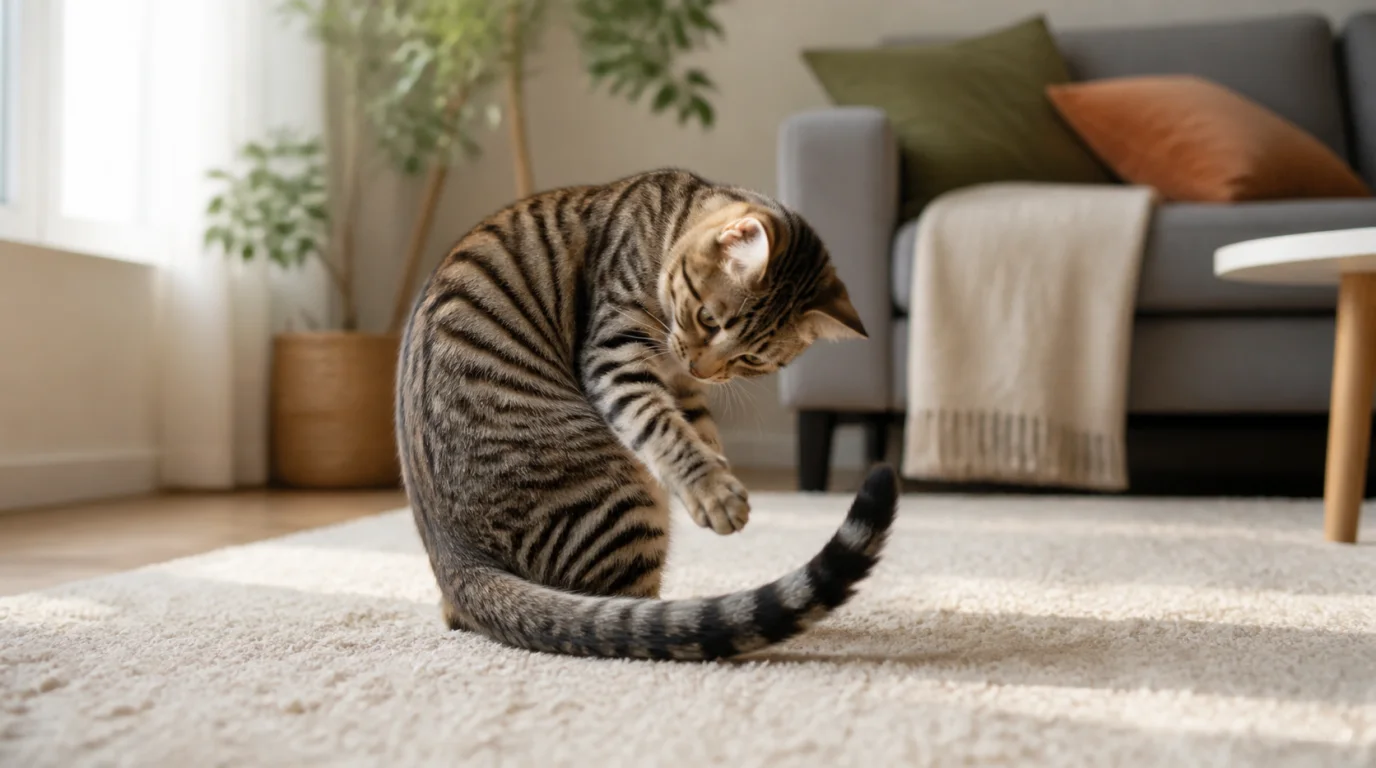
Cats chase their tails during play, but the same movement can appear with itch, pain, skin disease, compulsive behavior or a feline hyperesthesia-like episode. Age matters less than the pattern: intensity, frequency, injury, accompanying signs and recovery tell you more than the spin itself.
A kitten who pounces once and wanders off differs from an adult who suddenly growls, bites the tail hard and cannot settle.
Tail chasing patterns compared
| Pattern | Clues around the episode | Next step |
|---|---|---|
| Brief play | Loose body, quiet, pauses, easy redirection, no skin damage | Offer appropriate play and keep observing |
| Itch or skin irritation | Licking, scratching, hair loss, redness, debris or focus near tail base | Arrange veterinary assessment; use parasite care only as directed |
| Pain or injury | Sudden onset, guarded tail, flinch, reluctance to jump, wound or swelling | Do not manipulate the tail; contact a veterinarian |
| Repetitive or compulsive pattern | Frequent episodes, difficult to interrupt, interferes with rest or normal activity | Veterinary examination plus behavior history |
| Hyperesthesia-like episode | Skin rippling over the back, dilated pupils, vocalizing, frantic running, self-biting or extreme sensitivity | Record safely and seek veterinary assessment |
This comparison cannot diagnose the cause. Several patterns can overlap, and feline hyperesthesia is not confirmed from tail chasing alone.
Why kittens chase their tails
Kittens practice stalking, pouncing, grabbing and biting with anything that moves. Their own tail is available, unpredictable and attached to a body they are still learning to coordinate. A brief chase within otherwise varied play can be ordinary.
Healthy play has pauses. The kitten can shift to a toy, eat, rest and move normally. The tail and skin remain intact. The cat is not screaming, growling continuously or acting trapped by the movement.
Use wand toys and small tossable toys rather than encouraging attacks on hands or pulling the tail. Several short play sessions can offer a more useful outlet. The cat play-aggression guide explains how to keep claws and teeth away from skin.
Why an adult cat may chase the tail
An adult can still play with their tail, especially during a short burst of arousal. New or escalating behavior deserves a closer look because physical discomfort becomes more plausible when the pattern changes.
Fleas, allergy and skin irritation
Fleas and other skin problems can cause intense itch near the lower back and tail base. Watch for excessive grooming, scratching, scabs, redness, hair loss or dark debris. Do not rely on seeing a live flea; cats may remove evidence while grooming.
Use veterinary parasite products made for cats and follow the label or veterinary direction. Some dog flea products are dangerous to cats. Skin disease, allergy and infection can look similar at home.
Tail, back or nerve pain
A wound, bite, abscess, tail injury, arthritis or spinal pain can make a cat turn suddenly toward the rear of the body. A painful cat may also hide, resist touch, stop jumping, walk differently or groom less.
Do not bend, pull or squeeze the tail to find the sore spot. A cat in pain may bite, and manipulation can worsen an injury.
Stress and repetitive behavior
Stress can alter play, grooming and arousal, but “boredom” should not become the default answer to a medical-looking episode. Review household changes, outdoor animals, intercat tension and access to resting and play resources after health problems are considered.
The cat stress-signs guide covers hiding, vigilance, appetite and grooming changes that may accompany a broader pattern.
Feline hyperesthesia is a diagnosis of exclusion
Feline hyperesthesia syndrome is associated with extreme sensitivity, often over the back near the tail. Reported signs can include skin rippling, scratching or biting at the back and tail, dilated pupils, drooling, vocalization, sudden running and aggression.
Those signs are not unique to the syndrome. Cornell's feline guidance notes that pain, spinal arthritis, parasites, allergy and fungal disease need to be ruled out. A video may help a veterinarian see the episode, but it cannot perform that workup.
The cat skin-twitching guide compares ordinary skin movement, touch sensitivity and hyperesthesia-like clusters without treating one sign as a diagnosis.
What to do during an episode
- Keep hands away from the tail and mouth.
- Reduce noise and movement around the cat.
- Move children and other animals away without cornering the cat.
- Do not restrain, punish or spray the cat.
- If safe, record from a distance and note the start and stop time.
- Afterward, look without touching for blood, swelling, hair loss or debris.
Do not wave a toy directly into a frantic episode. A highly aroused or painful cat may redirect toward the nearest moving target. Let the cat settle in a safe space.
What to record
A useful episode record includes:
- date, time and duration
- activity immediately before the chase
- whether the cat was resting, being touched or watching another animal
- skin rippling, pupil change, ear and tail position
- vocalization, running, biting or scratching
- whether the cat responded to their name or ordinary environmental change
- recovery time and behavior afterward
- visible skin, coat, appetite, litter-box or movement changes
Record naturally occurring behavior only. Do not touch the lower back or recreate a trigger for footage.
When to call a veterinarian
Arrange an examination when tail chasing is new in an adult, increases in frequency, appears difficult to interrupt, wakes the cat, or comes with pain, skin changes, excessive grooming, wounds, altered movement or behavior change.
A kitten also needs care if play causes injury, the tail looks painful, or episodes are intense and repetitive. “Young and playful” does not rule out parasites or injury.
If medical causes are treated or excluded but a repetitive pattern continues, a veterinarian may recommend a qualified feline behavior professional. Environmental changes should be based on the cat's actual triggers and needs, not punishment.
What a photo or video can show
A photo can show coat condition, pupil size, ears and the cat's position relative to the tail. Video is much better for the spin, skin movement, biting intensity, response to the environment and recovery.
PetTranslator.ai can help list visible markers and uncertainty. It cannot diagnose parasites, pain, neurologic disease or feline hyperesthesia.
Frequently asked questions
Is it normal for a kitten to chase its tail?
Brief tail chasing can be normal play when the kitten stays loose, stops easily and has no skin or tail injury. Repeated distress, pain, hair loss or self-biting needs veterinary attention at any age.
Why does my cat attack the tail and growl?
Growling and a hard attack raise concern beyond light play. Pain, itch, injury and a hyperesthesia-like episode are among the possibilities. Keep hands away, record safely and contact a veterinarian.
Can boredom cause tail chasing?
Low stimulation may contribute to repetitive play in some cats, but it should not be assumed when the behavior is new, intense or physically damaging. Check health and the full context first.
Sources
- Cornell Feline Health Center. Hyperesthesia syndrome.
- Cornell Feline Health Center. What to expect when adopting a cat.
- Merck Veterinary Manual. Behavior problems of cats.
- FelineVMA. Environmental needs guidelines.
- FelineVMA. Training techniques for addressing undesirable behaviors.
Khabir Mughal is the founder of PetTranslator.ai. This article was researched against current feline veterinary and environmental-needs guidance. It was last reviewed on September 1, 2026.