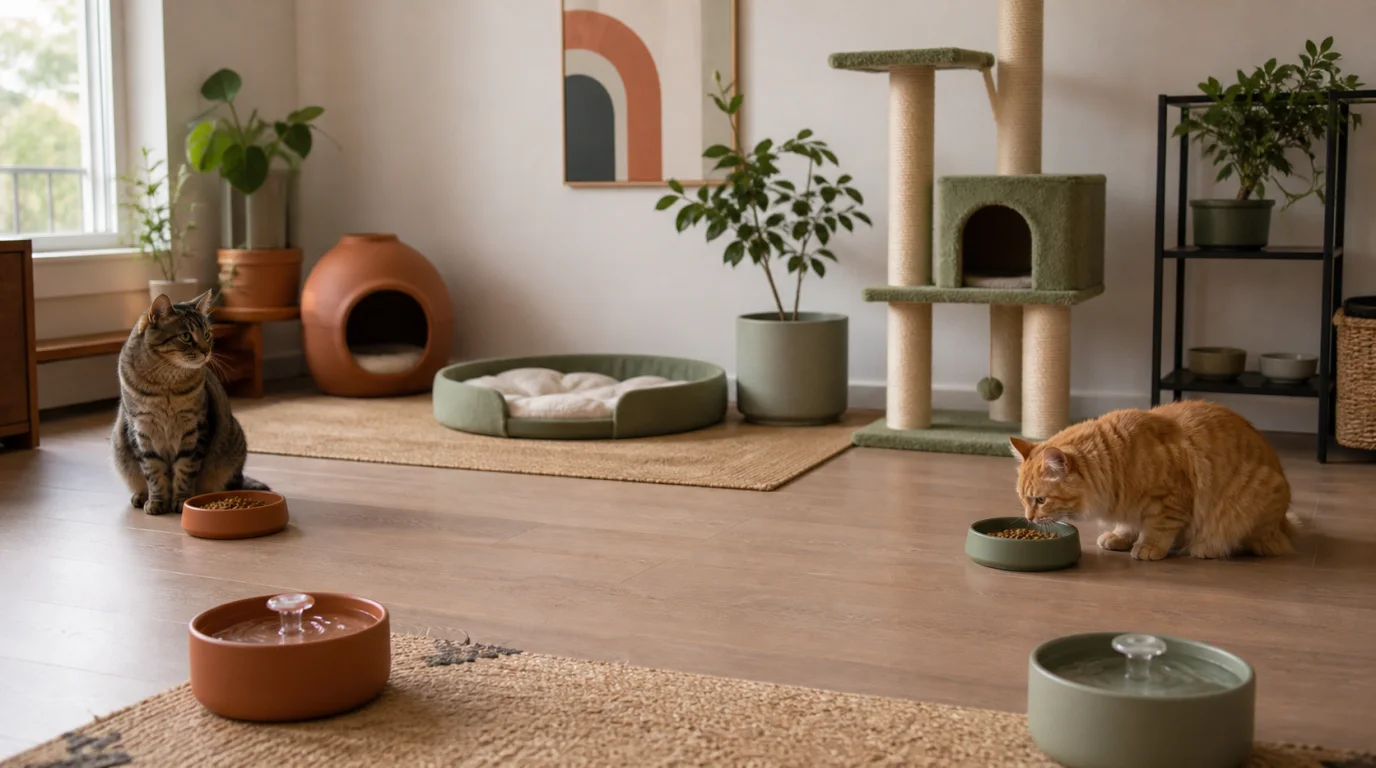
Resource guarding in cats is behavior that controls access to something valuable. The guarded item may be food, water, a litter box, a resting place, a toy, a doorway, a whole room or a person. The cat does not need to growl or fight; quiet blocking can be enough to make another cat stop trying.
Think in terms of access, distance and routes rather than a “dominant cat” and a “submissive cat.”
What cats may guard
| Resource | Overt guarding | Quiet guarding or effect on the other cat |
|---|---|---|
| Food | Growling, swatting, rushing another bowl | Watching from nearby, finishing fast and following, causing a grazer to leave |
| Water | Chasing at a bowl or fountain | Occupying the only route or resting beside the station |
| Litter box | Ambushing or attacking near the box | Staring at the entrance, waiting in the hallway, causing delayed use or accidents |
| Resting place | Swatting when another cat approaches | Taking a doorway, shelf or route that controls several beds |
| Toys | Growling, gripping or striking | Hovering near high-value toys so the other cat will not approach |
| Person | Swatting another pet on approach | Sitting between the person and another cat, following or displacing them |
| Room or doorway | Charging, chasing or cornering | Occupying a bottleneck and making the other cat wait or turn back |
The effect on the displaced cat matters as much as the guarder's visible behavior.
Signs in the guarding cat
Watch for patterns around a specific item, location or approach:
- body becoming still or low over the resource
- eating faster when another animal appears
- turning the body to cover the item
- hard staring or tracking the other cat
- ears rotating back and tail movement increasing
- growling, hissing, swatting or chasing
- carrying food or toys away
- returning to guard the location after the item is gone
- repeatedly occupying a doorway, stair top or narrow route
One behavior does not prove guarding. A cat may rest near a bowl because that location is comfortable. Repetition tied to another cat's approach and loss of access makes the interpretation stronger.
Signs in the cat being displaced
The quieter cat may show the clearest evidence:
- waits for the other cat to leave before eating or toileting
- takes a long route through the home
- stops at doorways and scans before moving
- eats too little or only when supervised
- urinates or defecates outside the litter box
- hides more or gives up preferred resting places
- startles, crouches or runs when the other cat looks at them
- becomes less playful or socially available
Household cats can sleep near each other and still have meaningful tension around one resource. The cats playing-or-fighting guide helps assess overt interactions, while the access map below catches quieter pressure.
Resource guarding or another pattern?
Resource guarding describes behavior connected to access. Intercat tension is broader and may involve territory, familiarity, arousal and social mismatch across many contexts. Redirected aggression begins with a separate trigger, such as an outdoor cat or frightening sound, then lands on a nearby animal.
A cat can show more than one pattern. Do not force a single label if the sequence changes. The redirected aggression guide covers high-arousal episodes that may require temporary separation and gradual reintroduction.
Sudden growling or guarding also warrants a veterinary check. Pain, illness, appetite change and other physical conditions can alter tolerance or increase the value of food and rest.
First steps: prevent confrontation
Do not take a bowl away to test the cat, put your hand in the food, force two cats to eat side by side, or punish a growl. Those actions add threat around a resource and can escalate aggression.
Instead:
- Feed cats in separate, calm areas where they cannot rush one another.
- Close a door during meals if both cats remain comfortable eating that way.
- Pick up high-value toys when supervision is not possible.
- Add escape routes and avoid cornered stations.
- Separate cats safely after a serious fight and seek guidance before reintroducing them.
- Protect the displaced cat's access immediately; do not wait for training to work.
If a cat has injured another cat or person, involve a veterinarian and qualified behavior professional. Safety management comes before behavior exercises.
Map resources room by room
Count is only the beginning. Several bowls lined up in one kitchen are one controllable area. Three litter boxes in one basement room can all be blocked from the top of the stairs.
Draw a simple floor plan and mark:
- food and water stations
- litter boxes
- beds, shelves and hiding spaces
- cat trees and elevated routes
- doorways, narrow halls and stairs
- windows that reveal outdoor cats
- places where one cat regularly stops or turns back
Then spread resources so one cat cannot control several from a single position. Use different rooms and, in multi-level homes, different floors. Provide more than one route where possible.
The multi-cat litter-box guide explains the one-box-per-cat-plus-one starting point and why placement matters as much as number.
Feeding a fast eater and a grazer
This is a common difficult pairing. The fast eater finishes, approaches the grazer and gains more food. The grazer learns to leave or eat too quickly.
Use physically separate feeding spaces. If the grazer will not eat behind a closed door, work gradually and ask a feline behavior professional to review the setup. A properly introduced microchip feeder may protect access, but its location still matters. A guarding cat can wait outside the feeder or control the route to it.
Do not restrict a cat's total food without veterinary guidance. Sudden hunger, weight change or a new drive to steal food needs a health assessment.
Spread the full resource system
Feline environmental guidance recommends multiple, separated resources, including food, water, toileting, scratching, resting, play and safe places. “Separated” means the cat does not have to pass a competitor to use them.
Useful changes can include:
- water on more than one floor
- litter boxes in separate rooms with more than one exit route
- beds at different heights and orientations
- visual barriers that break long staring lines
- several scratching and play locations
- individual daily play and social time
- shelving or furniture that creates alternate routes
More items in one choke point will not solve access. Watch the cats use the layout and adjust it.
Reintroduction and behavior work
If cats are fighting or one cannot move safely through the home, temporary separation may be necessary. Each area needs complete resources. Reintroduction should proceed gradually based on calm behavior, not a calendar deadline.
If conflict concentrates after dark, use the nighttime cat-fighting guide to separate normal activity and reciprocal play from one-sided aggression. After relocation, a safe-room plan can preserve access and reduce the size of the unfamiliar territory.
Do not make cats share a bowl or rest face to face to “get used to it.” Build positive associations at a distance where both can eat, play or rest without staring, crouching or rushing. Increase difficulty in small steps.
The new-cat introduction guide gives the room-swap and barrier sequence. A qualified professional can adapt it when guarding centers on a safe room or doorway.
What a photo or video can show
A photo may capture who occupies a route, body tension, ear and tail position, and the spacing of resources. Video can show the approach, stare, block, retreat and whether one cat changes course.
PetTranslator.ai can organize visible markers and uncertainty. It cannot establish a social hierarchy, diagnose pain or guarantee that two cats are safe together.
Frequently asked questions
Can a cat resource guard a person?
Yes, access to a person or lap can become valuable. Look for blocking, staring, following or displacing another animal when they approach. Avoid rewarding conflict and provide separate positive interactions.
Does my cat have to growl for it to be resource guarding?
No. Quiet staring, route blocking or occupying a doorway can be enough if another cat consistently loses access. Watch both cats.
Should I remove food when my cat guards it?
Do not confront the cat or take the bowl by force. Feed in a protected area, manage access and get professional help for aggression toward people or other animals.
Sources
- FelineVMA. Environmental needs guidelines.
- FelineVMA. Setting up for success.
- FelineVMA. 2024 Intercat Tension Guidelines.
- FelineVMA. Training techniques for addressing undesirable behaviors.
- Merck Veterinary Manual. Behavior problems of cats.
Khabir Mughal is the founder of PetTranslator.ai. This article was researched against current feline environmental-needs and intercat-tension guidance. It was last reviewed on September 1, 2026.