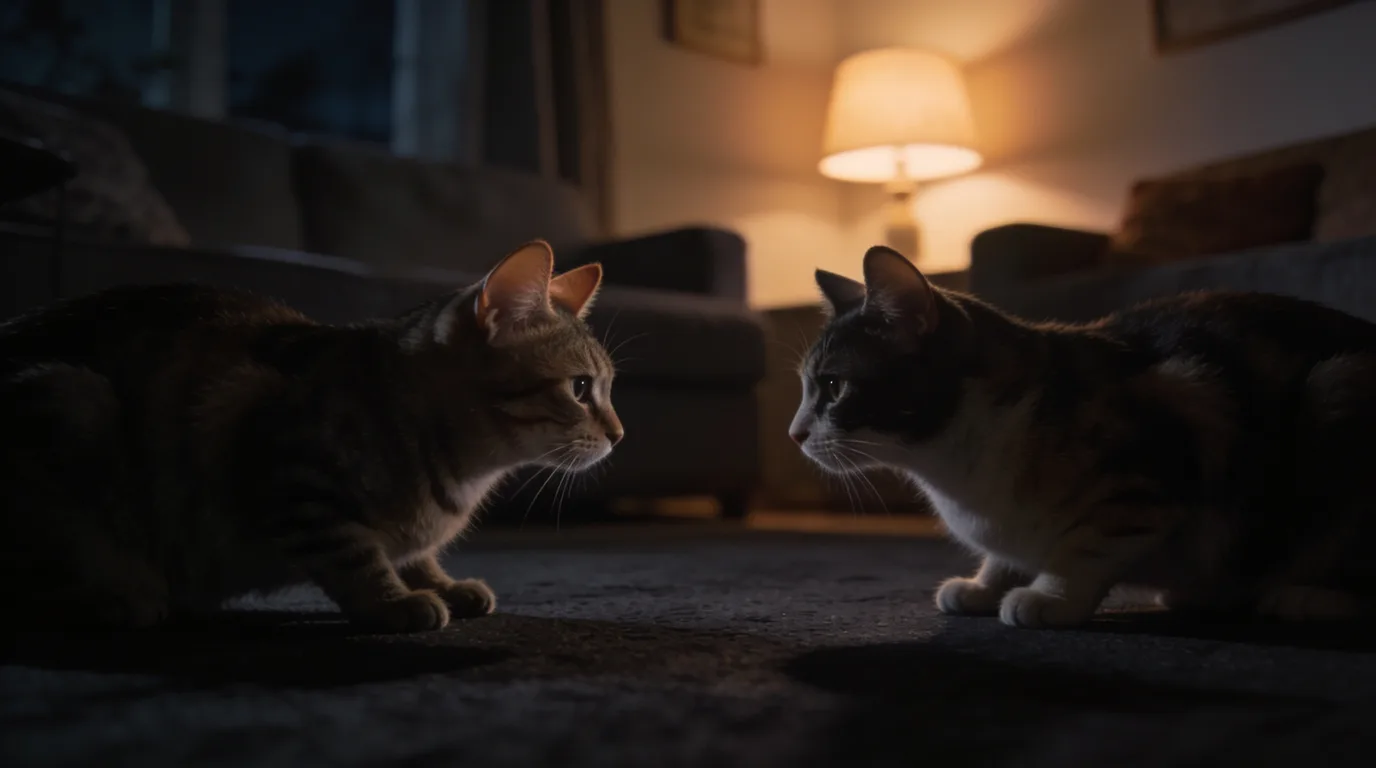
At two in the morning something hits the floor, a cat screams, and both animals thunder down the hallway. By the time you get there they're sitting three feet apart, grooming, pretending nothing happened. This is one of the most common complaints in multi-cat households, and it has three separate causes that require completely different responses.
The first job is diagnostic, not behavioral: most nighttime "fighting" is play, some of it is normal crepuscular activity colliding with human sleep, and a smaller fraction is genuine aggression that will get worse without intervention. Treating play as aggression wastes months. Treating aggression as play lets a relationship deteriorate past the point where it's easy to repair.
Why night, specifically
Cats are crepuscular — their activity peaks at dawn and dusk rather than being spread across the day or concentrated at night. This is an ancestral hunting pattern inherited from Felis lybica, the African wildcat, whose primary prey species are also most active in those low-light windows.
A domestic cat with no hunting to do still runs that program. The activity peak arrives whether or not there's anything to do with it. In a house where the humans sleep from 11pm to 7am, the dawn peak lands squarely inside human sleep — which is why "my cats fight at 4am" is so much more common a complaint than "my cats fight at 4pm," even when the 4pm episodes are just as frequent and simply go unwitnessed.
Two things follow from this:
- The timing is not the problem. The energy is. Nothing you do will move a cat's circadian activity peak by eight hours, and attempting to enforce a human sleep schedule on a cat fails. What you can do is give the peak somewhere to go.
- You are only seeing a fraction of the interactions. Owners routinely describe conflict as "only at night" when daytime video shows the same dynamic playing out repeatedly. Before concluding the problem is nocturnal, put a camera on the main shared space for two days.
Play or aggression? The diagnostic
This is the single most important distinction in the article, and it is not subtle once you know what to look for. Play fighting and real fighting look superficially similar — two cats grappling, chasing, rolling — but they differ on almost every measurable dimension.
| Dimension | Play | Real aggression |
|---|---|---|
| Reciprocity | Roles swap. Both cats take turns chasing and being chased, on top and underneath | One-directional. The same cat always chases, the same cat always flees |
| Vocalization | Silent or near-silent. Occasional chirp | Yowling, growling, hissing, screaming |
| Ears | Forward or neutral | Flattened sideways or back against the skull |
| Claws | Usually sheathed | Unsheathed |
| Body tension | Loose, bouncy, exaggerated movements | Rigid; piloerection along the spine and tail |
| Pauses | Frequent. They stop, reset, re-engage | Continuous until one cat escapes |
| Bite inhibition | Present. Bites are held, not driven | Absent. Puncture wounds, pulled fur |
| Aftermath | Both cats settle nearby, may groom | The loser avoids the space, hides, or stops using shared resources |
| Injuries | None | Scratches, scabs, abscesses, missing fur |
The aftermath row is the most reliable single test. Play has no losers. If, an hour later, both cats are relaxed in the same room, what you saw was play regardless of how loud it sounded. If one cat is under the bed, skipping the litter box, or eating only when the other cat is elsewhere, what you saw was aggression regardless of how brief it looked.
The ambiguous middle. Some pairs — particularly two young males, or a young cat with an older one — engage in play that is genuinely one-sided. The younger cat wants to play; the older cat does not. This isn't aggression in the clinical sense, but it isn't mutual play either, and it produces real chronic stress in the recipient. Read it by the older cat's signals: if they are consistently disengaging, hiding, or hissing to end the interaction, the play is not consensual and needs managing.
The five causes
Once you've established that the interaction is genuinely aggressive — or is non-consensual play — the cause is almost always one of five things.
1. Under-stimulation during the day
The most common cause and the easiest to fix. An indoor cat with no hunting outlet accumulates unexpended predatory motivation across the day. When the crepuscular activity peak arrives, that motivation has to go somewhere, and the only moving object in the house is the other cat.
The signature: conflict that is worse on days when the humans were out longer, better after an active evening, and concentrated in the hour before dawn.
2. Resource competition
Cats are not obligately social. They form social groups where resources permit, but they do not have the conflict-resolution machinery that group-living species like dogs have. A cat that cannot access a resource without passing a cat it dislikes will simply not access the resource — or will fight over it.
The rule most owners know is n+1: for a household with n cats, provide n+1 litter boxes. The multi-cat litter-box guide covers the full setup. The rule most owners miss is that distribution matters more than count. Three litter boxes in one utility room is functionally one resource, because a single cat can block the doorway and control all three. Three boxes on three different floors, in three separate rooms with two exits each, is three resources.
Apply the same logic to every contested resource:
| Resource | Common mistake | Better |
|---|---|---|
| Litter boxes | All in one room | Distributed across floors and zones, each with two escape routes |
| Food | Shared bowl or bowls side by side | Separate stations out of sight of each other |
| Water | One bowl next to the food | Multiple sources, away from food and litter |
| Resting spots | Floor-level beds only | Vertical territory — shelves, cat trees, window perches at varied heights |
| Exits | Rooms with one doorway | No cat should ever be cornered |
Vertical space is the most underrated intervention in multi-cat conflict. Cats resolve a great deal of social tension by occupying different heights rather than different rooms. A household with sufficient vertical territory can support more cats in less floor area than one without it.
3. Redirected aggression
A cat sees something arousing it cannot reach — most often another cat outside a window — and cannot discharge that arousal at the actual target. The nearest available target is the housemate.
This is the cause most often missed, because the trigger is invisible from indoors and the attack looks unprovoked. The signature: sudden intense aggression between cats that normally coexist fine, often near a window or a door, frequently at dawn or dusk when outdoor cats are most active.
The fix is environmental, not behavioral: block visual access to the trigger at cat height with removable window film, close off the room during peak outdoor-cat hours, and deter outdoor cats from the yard. Trying to train the cat out of redirected aggression while the trigger keeps recurring does not work.
If an attack has already happened, use the redirected aggression safety and reintroduction guide before putting the cats back together.
4. A rushed or absent introduction
Cats introduced to each other abruptly frequently never establish a stable relationship. The behavior stabilizes into tolerance at best and low-grade chronic conflict at worst, and it can persist for years.
If the cats were introduced by putting them in a room together and hoping, and the relationship has never been good, the underlying problem is the introduction — and the fix is a full re-introduction from scratch, treating them as strangers. See our guide to introducing a new cat to a resident cat for the staged protocol.
5. Social maturity
This one blindsides people. Cats reach social maturity between roughly two and four years old — well after sexual maturity and well after most owners consider them settled adults. Relationships that were stable through the first two years can renegotiate at this point, and previously peaceful pairs can begin genuine conflict for the first time.
The signature: two cats who lived together happily for two or three years and are now fighting, with no environmental change to explain it. This is not the cats "turning on each other." It is a normal developmental transition, and it responds to the same resource and enrichment interventions as any other territorial conflict — but it often needs a partial re-introduction as well.
What to do about it
The protocol below is ordered. Do the earlier steps first; several households never need the later ones.
Step 1 — Rule out medical
Pain makes cats less tolerant. A cat with dental disease, arthritis, or early hyperthyroidism has a shorter fuse and less capacity to walk away from a conflict. Any new aggression between cats who previously coexisted warrants a veterinary exam for both animals — the aggressor and the target — before any behavioral work begins.
Hyperthyroidism in particular presents as increased activity, restlessness, night-time vocalization, and irritability in middle-aged and older cats. It is common, it is easily tested, and it is treatable.
Step 2 — Restructure the day's energy
The goal is to move the predatory motivation out of the 4am window by discharging it deliberately in the evening.
Use the hunt–catch–eat–groom–sleep sequence. This is the natural behavioral chain a cat runs after a successful hunt, and it terminates in sleep. You can exploit it directly:
- Hunt — 10–15 minutes of active wand-toy play per cat, played separately if they compete. Move the toy like prey: away from the cat, into cover, with pauses. Not overhead like a helicopter.
- Catch — let the cat actually catch the toy at the end. A hunt that never succeeds is frustrating rather than satisfying.
- Eat — feed the largest meal of the day immediately after play.
- Groom and sleep — this follows on its own.
Run this as late in the evening as your schedule allows. Two sessions — early evening and just before bed — outperform one.
Add food puzzles and scatter feeding. Free-feeding from a bowl removes the entire foraging component of a cat's day. Puzzle feeders and hidden food portions restore some of it and consume time and mental energy that would otherwise be available at 4am.
Add novelty on a rotation. Cats habituate to toys quickly. Ten toys rotated weekly outperform thirty toys permanently available.
Step 3 — Redistribute resources
Work through the resource table above. In practice the highest-yield changes are usually:
- Adding vertical territory — shelves, trees, window perches
- Separating feeding stations so cats can eat without visual contact
- Adding a litter box on a different floor
- Creating a second exit from any room a cat gets cornered in
Step 4 — Manage the environment at night
If the conflict is dangerous or sleep-destroying, separate the cats overnight while you work on the underlying causes. This is management, not a cure, but it stops the relationship from degrading further while the other interventions take effect.
Each cat needs their own space with all resources — food, water, litter, bed, enrichment. Rotate which cat gets which room if space allows, so neither is being isolated as punishment.
Step 5 — Re-introduce if needed
If the relationship is genuinely hostile — sustained fighting, injuries, one cat living under a bed — the pair needs a full re-introduction on the same protocol you'd use for two strangers: complete separation, scent exchange, visual contact through a barrier, then supervised shared time, advancing only when both cats stay relaxed at the current stage.
This takes weeks. Rushing it is the reason most re-introductions fail.
What not to do
Do not use a spray bottle. It suppresses the visible behavior in your presence, teaches the cat that you are unpredictable and aversive, and does nothing about the underlying conflict. It also frequently increases the arousal that produced the fighting. Punishment-based interventions in cats are associated with worse behavioral outcomes and damaged human–animal relationships, and they are explicitly rejected in feline-friendly veterinary practice guidelines.
Do not scruff. Adult cats do not experience scruffing as calming. It is a restraint that produces fear.
Do not "let them work it out." This advice is common and wrong. Cats do not have the reconciliation behaviors that group-living species use to repair relationships after conflict. Repeated fighting does not converge on a stable hierarchy — it sensitizes both animals and makes the next encounter worse.
Do not break up a fight with your hands. Redirected aggression toward the intervening human is a genuine and common injury mechanism, and cat bites carry a high infection risk. Interrupt with a barrier — a piece of cardboard, a cushion, a towel dropped between them — or a sudden noise from a distance, then separate the cats into different rooms and let both fully de-arouse before any further contact. That can take several hours.
Do not add another cat to fix it. A third cat rarely resolves a two-cat conflict and frequently compounds it.
Common misreads
"They're fine, they groom each other afterward." Allogrooming does indicate an affiliative bond, but cats in genuinely conflicted relationships also groom — and displacement grooming immediately after a confrontation is a stress behavior, not reconciliation. Judge the relationship on shared space use over days, not on one grooming episode.
"One of them is dominant." Cats do not maintain linear dominance hierarchies the way the popular framing suggests. What looks like a stable hierarchy is usually time-sharing and space-sharing — the same two cats can have entirely different priority relationships in different rooms and at different times of day. Framing the conflict as a dominance problem leads to interventions that don't help.
"It started when we got the new couch / moved the litter box / had a visitor." This one is usually correct and worth taking seriously. Cats respond strongly to changes in their territory. If you can identify a change that coincided with the onset, reversing or mitigating it is often the fastest fix available.
"He's doing it out of spite." Cats do not have the future-directed, attributional cognition that spite requires. The behavior has a proximate cause — arousal, competition, fear, or pain — and identifying which one is what makes it solvable.
When to bring in a professional
Work with a credentialed feline behavior professional if:
- There have been injuries requiring veterinary treatment
- One cat is consistently unable to access food, water, or a litter box
- One cat is house-soiling outside the box as a consequence of the conflict
- The aggression is redirected onto humans
- Eight weeks of the interventions above have produced no improvement
Look for a CCBC (Certified Cat Behavior Consultant) or CABC through the IAABC, or a DACVB (Diplomate, American College of Veterinary Behaviorists) — a veterinarian with board certification in behavior, who can also assess whether medication is appropriate as an adjunct to the behavioral plan. Fear Free certified practitioners are trained in low-stress handling.
Anti-anxiety medication has a legitimate place in severe inter-cat aggression. It does not replace the environmental and behavioral work, but it can lower arousal enough for that work to become possible.
Frequently asked questions
Is it normal for cats to fight at night?
Noisy wrestling can be normal play when roles switch, bodies stay loose, both cats return voluntarily and neither is injured or blocked from resources. One-sided pursuit, hiding, growling, fur loss or wounds point to real conflict.
Should I separate cats overnight?
Separate them if encounters are dangerous, one cat cannot disengage, or the household cannot supervise safely. Give each cat a complete room with food, water, litter, rest and enrichment. Treat overnight separation as management while you address the cause.
Why would cats suddenly start fighting at night?
Pain, illness, a household change, a new scent, an outdoor cat at the window or competition around resources can alter a previously stable relationship. Sudden aggression warrants a veterinary check before it is treated as a training problem.
Reading the signals in the moment
Most of this article is about causes and protocols. The skill underneath all of it is reading feline body language accurately in the moment — because that's what tells you whether an interaction is escalating or resolving, and whether a given intervention is working.
The signals that matter most in inter-cat conflict are ear position (forward, sideways-flattened, or back), pupil dilation, tail posture and piloerection, body height, and whisker position. Our guides to cat body language, cat tail meanings, and airplane ears cover each of these in depth.
PetTranslator.ai runs the same framework. Upload a clear photo of either cat and it returns a structured report: the observed body-language markers, a behavioral interpretation, a confidence score with its reasoning, an explicit list of what couldn't be assessed from a single frame, and a Do/Avoid plan. For a household in the middle of a conflict, the most useful application is photographing both cats during a calm shared moment and again during a tense one, and comparing what changes.
It is not a substitute for a behavior consultant on a case with injuries. It says so when a case looks serious.
Sources
- AAFP and ISFM Feline Environmental Needs Guidelines — the five pillars of a healthy feline environment, including the resource-distribution principles this article applies.
- AAFP Feline-Friendly Handling Guidelines — the professional basis for rejecting scruffing and punishment-based restraint.
- Karen Overall, Manual of Clinical Behavioral Medicine for Dogs and Cats (Elsevier, 2013) — clinical reference for inter-cat aggression assessment and treatment.
- John Bradshaw, Cat Sense (Basic Books, 2013) — for the social structure of domestic cats and why they lack conflict-resolution behaviors.
- The Ohio State University Indoor Pet Initiative — practical environmental-enrichment protocols for indoor cats, and the link between environmental stress and feline health.
- AVSAB Position Statement on Humane Dog Training — the general professional standard rejecting aversive methods, applied here to feline work.
Khabir Mughal is the founder of PetTranslator.ai. This article is not veterinary advice — new or escalating aggression between cats warrants a veterinary exam for both animals before behavioral work begins.