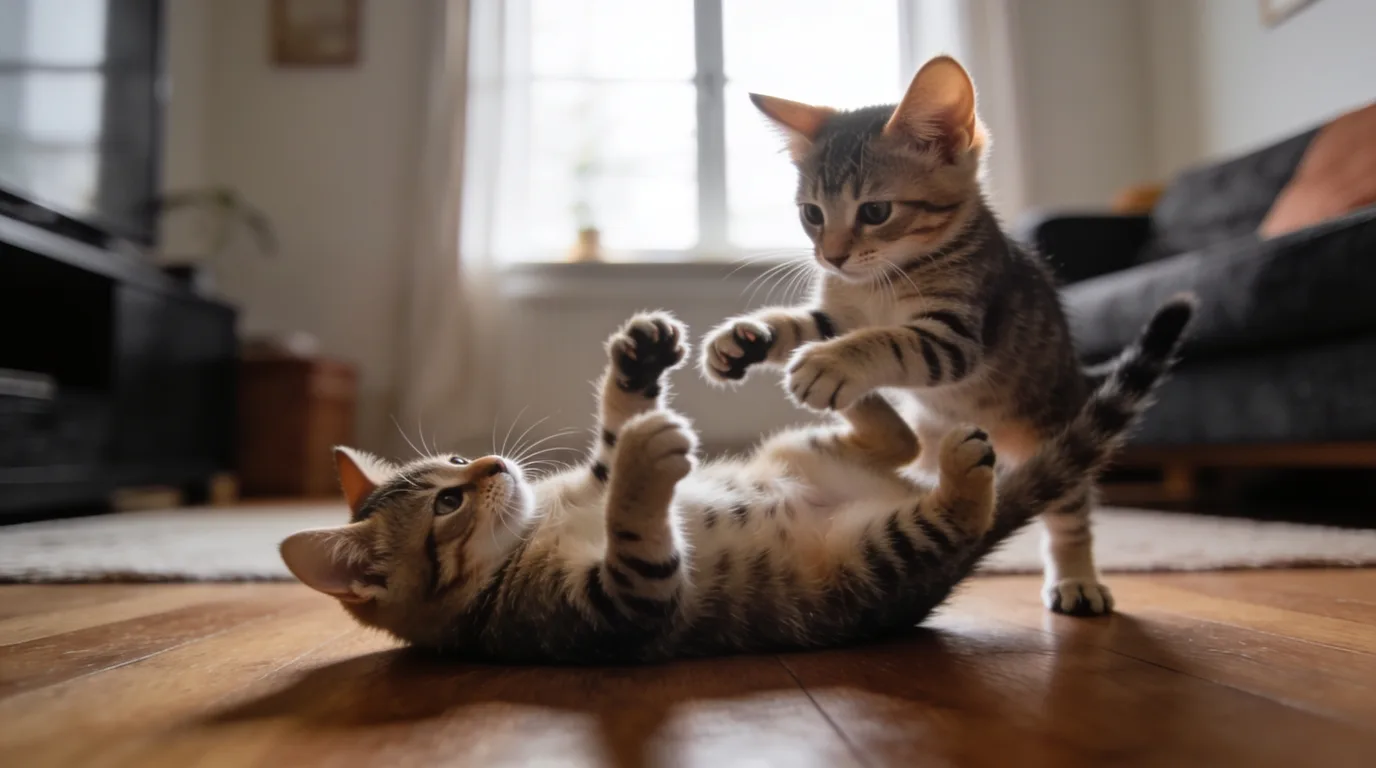
No single signal answers this question, and the attempt to find one is why households get it wrong in both directions for months. A hiss does not settle it. A scream does not settle it. Two cats rolling across the floor with hind claws working does not settle it, because that exact motor pattern appears in social play and in genuine fights. What settles it is reading several independent channels at once, weighting them by how reliable each actually is, and then checking the single highest-value piece of evidence — which is not in the encounter at all. It is in the twenty-four hours afterward.
If the cat is stalking or biting people rather than wrestling with another cat, use the separate guide to cat play aggression. It covers ankle ambushes, hand biting and safer toy strategy.
Here is the short version, stated up front. Play is reciprocal, quiet, loose, punctuated by pauses, and leaves no residue: an hour later both cats are in the same room behaving normally. Aggression is one-directional, loud, rigid, continuous until one animal escapes, and leaves a behavioral trace that persists — one cat avoids a space, stops using a resource, or changes where it sleeps. Everything below is the detailed version of that, channel by channel, with an explicit reliability rating for each so you know which observations to trust when they conflict. This article is the diagnostic. If you have already established that what you are seeing is genuine conflict, the causes and the intervention protocol are in why do my cats fight at night, and that is where to go next.
For narrower sequences, see what a single cat slap can mean and how resource guarding in cats may quietly restrict food, litter or doorway access without a visible fight.
Why single-signal reading fails
Three specific traps account for most misreadings.
The loudness trap. Households assume noise equals danger and silence equals safety. The direction is broadly right — silence favours play — but the inference runs one way only. A cat that has frozen under social pressure is also silent, and frozen stillness is a high-grade stress signal rather than a good sign. Silence plus movement favours play. Silence plus immobility does not.
The motor-pattern trap. Grappling, nape-biting, belly-raking with the hind feet, chasing and pinning all appear in both categories. Play in mammals is largely built from the motor patterns of predation and fighting, run at reduced intensity with the outcomes removed. Trying to classify an interaction by which movements occur is therefore close to useless. Classify it by how the movements are performed and how they are distributed between the two animals.
The single-frame trap. A photograph, or a two-second glance from a doorway, captures one posture. Cats change state fast, and the diagnostic information is in the sequence — who initiates, who disengages, whether roles swap, whether there are pauses. Watch a full bout from beginning to end, and preferably record it.
One more thing worth saying plainly: feline social behavior is less thoroughly studied than canine social behavior, and there is no feline equivalent of the well-described canine play bow — a single, unambiguous, near-universal signal that marks what follows as play. Cats do use play signals, including a sideways bounce, an exaggerated approach, and a distinctive open-mouthed relaxed face, but they are subtler, more variable between individuals, and less well catalogued. That absence is exactly why the multi-channel approach is necessary in cats and why it can be shortcut in dogs.
The nine channels
1. Reciprocity and role reversal
The most theoretically important channel, and the one to weight most heavily during the encounter itself.
Play in social mammals is characterised by role reversal and self-handicapping. The animal with the physical advantage voluntarily gives it up: the larger cat rolls onto its back, the faster cat lets itself be caught, the one that was chasing becomes the one being chased. Over a bout of two or three minutes, both animals should occupy both positions. Aggression does not work this way. The same animal chases, the same animal flees, and the animal underneath stays underneath until it escapes.
Two feline-specific caveats. Cats show less overt, less exaggerated role reversal than dogs do, and it can be genuinely hard to see in a fast bout — this is a channel that often needs video and a second viewing. And role reversal in cats is frequently distributed across a session rather than within a single grapple, so judging thirty seconds is not enough.
Reliability: high, when you can actually observe a full bout.
2. Vocalization
Cats playing are quiet. This is not incidental. Play has nothing to communicate — the participants are already in agreement about what is happening, and in a predatory context noise is costly. Occasional chirps, chattering or a brief trill are compatible with play.
Cats in conflict are loud, and the vocalization is doing specific work. Growls, yowls, prolonged wails and screams are distance-increasing signals whose entire function is to end the encounter without physical damage, because damage is expensive for both animals. A cat that yowls is trying to avoid a fight, not enjoying one. Hissing and spitting are defensive and indicate that at least one animal is not consenting.
Read a single hiss carefully. In an otherwise loose, reciprocal bout, one hiss usually marks a boundary — the recipient signalling that something went too far — and the interaction commonly resumes. That is normal social regulation, not a fight. Repeated hissing, escalating growls, or any scream moves the assessment decisively.
Reliability: high for sustained vocalization; moderate for a single isolated hiss.
3. Ear position
Ears are among the fastest-moving and most informative structures on a cat, and unlike vocalization they are continuously available.
Forward or neutral ears are compatible with play and with confident interest. Ears rotated laterally so the openings face outward — the position usually described as airplane ears — indicate conflict, arousal and ambivalence, and mark an interaction that is at or past the boundary. Ears flattened tightly back against the skull are defensive and indicate a cat expecting contact. Full breakdown of the intermediate positions in airplane ears.
The valuable observation is asymmetry between the two cats. If one cat has forward ears and the other has ears rotated back, the interaction is not mutual, whatever the motor patterns look like.
Reliability: high, and it is the channel that most often reveals a one-sided interaction early.
4. Claw state
Play bites and play swats are delivered with claws largely sheathed. Aggressive swats are not.
Direct observation of claws in a fast bout is difficult, so use the indirect indicators. Listen for claws catching on flooring or upholstery. Look for tufts of fur pulled loose and left on the floor. Check the cats afterward for scratches, particularly on the face, ears and forelimbs. Bites on the neck, shoulders and base of the tail are the ones that most often become abscesses several days later.
Reliability: high when it can be assessed, but frequently unobservable in real time — treat the physical evidence afterward as the more usable form of this channel.
5. Body tension, posture and piloerection
Play bodies are loose. The movements are exaggerated, bouncy, and often inefficient — a cat that is playing wastes motion in a way a cat that is fighting does not. Sideways hops, arched exaggerated approaches, and rolling with the limbs relaxed all fit here.
Fighting bodies are rigid, economical and low. Weight is distributed for stability. Movement is direct.
Piloerection deserves separate emphasis because it is the closest thing to an objective marker on this list. Raised hair along the spine and a bottle-brush tail are produced by autonomic arousal and are not under voluntary control. A cat cannot bluff piloerection into existence for social effect the way a cat can adjust posture. Its presence indicates high sympathetic arousal — fear, threat, or in occasional cases very intense play in young cats. The full arched, sideways, piloerect display is defensive threat, not play.
Reliability: high for piloerection; moderate for body tension, which is easy to misjudge without a baseline for the individual cats.
6. Bite inhibition and bite targets
In play, bites are held rather than driven. The jaw closes and stops. A cat can hold a housemate's neck for several seconds and release it with no mark. Nape holds during play are normal and are not evidence of aggression in themselves.
In a fight, bites are driven, repeated, and aimed. They puncture. The relevant evidence is usually retrospective: puncture wounds, scabs, and abscesses that present three to seven days later as a painful swelling, sometimes with fever and lethargy.
Belly-raking with the hind feet — often called bunny-kicking — is deliberately listed here as ambiguous. It appears in play and in serious fights, and treating it as diagnostic in either direction is a common error. Judge it by the surrounding channels: relaxed hind limbs and sheathed claws in a reciprocal bout is play; driven, clawed raking against a cat trying to break contact is not.
Reliability: high retrospectively via wounds; low in real time.
7. Pauses and resets
Play has punctuation. The cats stop, sit up, look away, groom briefly, then re-engage. Those pauses are the clearest available evidence that both animals are choosing to continue, and re-initiation by the animal that was underneath a moment ago is close to conclusive for play.
Fights are continuous. There are no rest points, because stopping is dangerous. The encounter ends when one animal escapes or when a human intervenes, and the ending is abrupt rather than gradual.
Reliability: high, and it is the easiest channel for an untrained observer to use.
8. Chase directionality and the escape test
Watch what the chased cat does with an available exit.
In play, the chased cat frequently runs past open doorways, doubles back, stops, and re-initiates. It is not trying to leave. The chase runs in both directions across a session.
In aggression the chased cat takes the first exit available, heads for cover or height, and does not return. The chase is one-directional. Worse, if the chased cat is repeatedly cornered — driven into a room with a single doorway, under furniture with no second exit, or into a litter box tray — the interaction is not only aggressive, it is escalating, because a cat with no escape route has only one remaining option.
The escape test has a useful active version. If you can safely and calmly open a route — stepping back from a doorway, opening a door — watch whether the pursued cat takes it. Play stops for a moment and then resumes. Aggression resolves into flight.
Reliability: high.
9. Face and whiskers
The finest-grained channel and the one that needs a still image or slow-motion playback.
Whiskers held forward and fanned indicate focused interest and arousal, and appear in both play and predation. Whiskers flattened back against the cheeks indicate defence and are not compatible with mutual play. Pupil dilation is real but ambiguous — it accompanies arousal of any valence, and it also tracks ambient light, so treat it as supporting evidence only. A relaxed, slightly open mouth with the tongue not tensed occurs in play; a fully open mouth with retracted lips and visible canines does not.
Reliability: moderate, and highly dependent on image quality.
The channel table
| Channel | In play | In aggression | Reliability |
|---|---|---|---|
| Reciprocity and role reversal | Both cats occupy both positions across the session | Fixed roles: same chaser, same fleer | High |
| Vocalization | Silent, or brief chirps and trills | Growling, yowling, sustained hissing, screaming | High |
| Ear position | Forward or neutral on both cats | Rotated laterally or flattened back; often asymmetric between cats | High |
| Claw state | Sheathed; no fur pulled | Unsheathed; loose fur, scratches, later abscesses | High retrospectively, low live |
| Piloerection | Absent, or brief in very young cats | Raised spine hair, bottle-brush tail — autonomic, not voluntary | High |
| Body tension | Loose, bouncy, exaggerated, wasteful of motion | Rigid, low, economical, direct | Moderate |
| Bite inhibition | Bites held and released; no marks | Bites driven and repeated; punctures | High retrospectively, low live |
| Pauses and resets | Frequent; the underdog re-initiates | Continuous until escape | High |
| Chase directionality | Bidirectional; exits ignored; doubling back | One-directional; exits taken; cornering | High |
| Whiskers and face | Forward, fanned; relaxed mouth | Flattened back; retracted lips, visible canines | Moderate |
| Bunny-kicking | Present | Present | Not diagnostic — ignore it |
| Aftermath at 1 and 24 hours | Both cats settle nearby and resume normal resource use | One cat avoids space, hides, or stops using resources | Highest |
The aftermath test
This is the most reliable single assessment available to an owner, it requires no skill at reading body language, and it is the one most households skip because it happens after the drama.
The logic is simple. Play has no losers. If an interaction was mutual and consensual, it leaves no behavioral residue. If it was aggressive, at least one cat updates its behavior in ways that are easy to observe if you know what to look for. The encounter itself can be ambiguous; the residue rarely is.
Run it as a structured 24-hour audit rather than an impression.
| Check | Timing | Play result | Aggression result |
|---|---|---|---|
| Shared room occupancy | 1 hour after | Both cats in the same room, unremarkable | One cat absent from shared space |
| Resting distance | 1 hour, then evening | Within a few metres, relaxed postures | One cat resting only in a closed or elevated refuge |
| Litter box use | Over 24 hours | Normal frequency for both | One cat delays, or eliminates outside the box |
| Eating in each other's presence | Next two meals | Both eat normally with the other visible | One cat waits until the other has left, or eats less |
| Movement through the house | Over 24 hours | Both use all normal routes | One cat takes detours, avoids a corridor, or waits at thresholds |
| Height and hiding | Over 24 hours | Normal perch use | New or increased hiding; see why cats hide under the bed |
| Grooming | Over 24 hours | Normal self-grooming; possibly allogrooming | Reduced grooming, or intense displacement grooming immediately after the encounter |
| Greeting behavior | Whenever the cats meet | Relaxed passing, tail up, occasional head rub | Freezing, staring, wide detours, or one cat backing off |
| Body check | 24 to 72 hours | Nothing | Scratches, scabs, missing fur; watch for abscess swelling at 3 to 7 days |
A tail-up approach between the two cats is one of the more useful positive findings. The vertical tail is a well-described feline affiliative signal used on approach between cats with a positive relationship, and its presence between two cats after a wrestling bout is good evidence that the relationship is intact. Its disappearance from a pair that previously used it is a meaningful negative. More on the vocabulary in cat tail meanings.
Putting it together
Do not average the channels. Weight them.
Step one: check the aftermath. If the 24-hour audit is clean on every row, the interaction was play. Stop here. This resolves most cases and it is the cheapest assessment available.
Step two: if the aftermath is not clean, count the high-reliability channels. Reciprocity, sustained vocalization, ear position, piloerection, pauses, and chase directionality. Two or more of those pointing at aggression means treat it as aggression, even if the cats have never drawn blood. Absence of injury is not evidence of absence of conflict; it usually means the loser is deferring effectively, which has its own welfare cost.
Step three: use the moderate and low-reliability channels only to break ties, never to override a high-reliability finding. A relaxed-looking body does not overrule one-directional chasing.
Step four: sample more than one bout. A single encounter is a data point. Relationships are judged across days. Put a camera on the main shared space for forty-eight hours before concluding anything, because households consistently over-report night-time conflict and under-report the daytime interactions they do not witness.
One practical note on video: most people watch it at normal speed and learn very little. Step through the first ten seconds frame by frame, or at quarter speed. Ear rotation, whisker position and the moment of role reversal are visible there and invisible at full speed.
The ambiguous middle: asymmetric play
There is a third category, it is common, and it fits neither label. A young cat wants to play. An older cat, or a less playful cat, does not. The young cat initiates repeatedly. The older cat disengages, walks away, hisses to end it, or simply tolerates it while showing every sign of not enjoying it.
This is not clinical aggression. The initiator's motivation is play, the bites are inhibited, and there is no intent to drive the other animal out. It is also not mutual play, because one participant is not consenting. And it produces genuine chronic stress in the recipient, which is why calling it "just play" and moving on is the wrong answer.
How to identify it. Look at the recipient rather than the initiator. Does the recipient ever initiate? If the answer is never, across weeks, the interaction is one-sided by definition. Does the recipient disengage — turning away, walking off, jumping to height, hissing — and does the initiator respect that? Where has the recipient started sleeping? A cat that has relocated from the sofa to the top of a bookcase has made a territorial decision, and that decision is data.
What to do with it. Three things, none of which involve punishing the young cat, whose motivation is entirely normal and whose problem is a shortage of appropriate outlets.
Give the initiator somewhere else to put the behavior: structured interactive play in the hunt, catch, eat, groom, sleep sequence, run to actual completion rather than left as an unresolved chase, twice a day and heaviest in the evening. Give the recipient escape architecture: vertical routes, high perches, enclosed refuges, and no room with only one exit. And check the recipient medically, because a cat that has recently stopped tolerating play is often a cat in pain. Degenerative joint disease is present radiographically in a majority of cats over about ten and presents as reduced tolerance, reduced jumping and increased irritability rather than as a limp. Relevant patterns in behavior change in senior cats.
How to interrupt safely
The single most important rule: never use your hands, and never put your body between two aroused cats.
Redirected aggression toward an intervening human is a common injury mechanism, not a rare one. A cat in a high arousal state that cannot reach its target will direct the behavior at whatever is closest, and cat bites carry a high infection risk because the puncture is deep and narrow and seals over. Hand and wrist bites in particular frequently need medical attention.
What to use instead, in order of preference:
A visual barrier. A large piece of cardboard, a cushion, a laundry basket, or a folded towel dropped between the cats. Breaking the line of sight is more effective than making noise, because staring is part of the escalation.
A sudden noise from a distance. A clap or a hand on a hard surface, delivered from across the room, not aimed at either cat. Use this only if a barrier is not available; noise raises arousal in both animals, which is the opposite of what you want.
Then separate, and separate properly. Move each cat into a different room with the door closed. This is where most households under-do it. De-arousal in cats takes hours, not minutes, and putting two cats back together after ten minutes because they "seem fine" frequently produces a second, worse encounter. Several hours is a reasonable minimum, and overnight is better after a serious incident. Each cat needs food, water, a litter box and a resting place in its space.
What never belongs on this list: spray bottles, compressed air, shouting, throwing objects, scruffing, or physically pulling a cat away by the body. All of these increase arousal at the exact moment arousal is the problem. All of them associate the aversive event with the person delivering it. Punishment-based intervention in cats is associated with worse behavioral outcomes and damaged human–animal relationships, and it is explicitly rejected in feline-friendly veterinary practice guidelines. Scruffing an aroused cat is also an efficient way to get bitten.
What escalation looks like
Escalation in cats has two forms, and households reliably spot one and miss the other.
The overt ladder, in rough order: staring and orienting; posturing and blocking; a low growl; a yowl; a swat with claws; a lunge; a chase; a contact fight; injury. The early rungs are the useful ones. Two cats staring at each other across a room, one blocking a doorway while the other waits, are already in a conflict — the fight three days later is not the start of the problem.
The covert version, which is more common and does far more cumulative damage. There is no noise at all. One cat controls access: sitting in the corridor to the litter box, occupying the top of the stairs, positioning itself between the other cat and the food. The other cat responds by using resources at different times, sleeping in a refuge, eliminating outside the box, grooming less, and gradually withdrawing from shared space. Nothing looks like a fight. The welfare cost is substantial, and this is the pattern that produces house-soiling and stress-associated illness in the quieter cat. If one cat in a household has quietly reduced its territory over months, that is a conflict finding even if you have never once heard a growl.
What people get wrong
"They groomed each other afterward, so they are fine." Allogrooming does indicate an affiliative bond in general, but cats in conflicted relationships also groom, and intense self-grooming immediately after a confrontation is displacement behavior — a stress response, not reconciliation. Judge the relationship on shared space use across days.
"One of them is establishing dominance." Cats do not maintain the linear dominance hierarchies the popular framing assumes. What looks like a hierarchy is usually time-sharing and space-sharing, and the same two cats can have different priority relationships in different rooms and at different times of day. Framing the problem as dominance leads directly to interventions that make it worse.
"Let them work it out." Cats lack the reconciliation behaviors that group-living species use to repair relationships after conflict. Repeated fighting does not converge on stability; it sensitizes both animals.
"It was silent, so it was play." Usually true, with one important exception. A cat that freezes under pressure is silent, and immobility in a socially pressured cat is a high-grade signal rather than a good one. Silence plus fluid movement favours play. Silence plus stillness in one cat does not.
"No blood, no problem." Most of the cost of chronic inter-cat conflict is not injury. It is a cat that stops using half the house. And puncture wounds frequently produce no visible blood at the time, presenting three to seven days later as an abscess.
"They are littermates, so they will always get on." Cats reach social maturity between roughly two and four years old, well after most owners consider them settled. Relationships that were stable through the first two years can renegotiate at that point.
"I watched the video and it looked fine." At full speed, almost everything looks fine. The information is in the first ten seconds, at quarter speed, in the ears and the whiskers.
When to see a vet
Same day, without waiting:
- Straining in the litter box with little or no urine produced — in a male cat, assume urethral obstruction; untreated it is fatal within roughly 24 to 48 hours
- Crying or vocalizing while urinating
- No food intake for 24 hours; 48 hours is a hard emergency
- Hiding combined with not eating
- Sudden aggression in a cat with no aggression history — pain, hyperthyroidism, hypertension and neurological disease all present this way, and a behavior consult should not begin before an exam and bloodwork
- A puncture wound, a painful swelling, or lethargy and fever three to seven days after a fight — an abscess needs treatment
- Limping, a held-up limb, or a torn claw after an encounter
- Any eye injury
Within the week:
- Any new inter-cat conflict in a previously stable pair, for both cats
- One cat that has stopped using a litter box, a food station, or a room
- Reduced grooming, an unkempt coat, or overgrooming to thin fur
- Hesitating before jumping, or choosing lower perches — the most under-reported sign of feline arthritis, and a common hidden driver of reduced play tolerance
- Any behavior change in a cat over about eight
Next steps, and reading the moment
If the diagnostic here comes out as play, nothing further is needed beyond ensuring both cats have enough outlet that the play does not tip into over-arousal. If it comes out as aggression or as non-consensual asymmetric play, the causes and the ordered intervention protocol — medical clearance, energy restructuring, resource redistribution, night management and re-introduction — are set out in why do my cats fight at night. The staged protocol for rebuilding a broken relationship is in introducing a new cat to a resident cat, which is the same procedure used for a re-introduction.
The skill underneath all of it is reading the signals accurately in the moment, and the channels that matter most here are ear position, whisker position, tail carriage and piloerection, body height and pupil size. Those are covered in depth in cat body language, cat tail meanings and airplane ears.
PetTranslator.ai applies the same framework to a photo. Upload one clear image of either cat and it returns a structured report: the observed body-language markers first, a behavioral interpretation second, a confidence score with its reasoning, an explicit list of what could not be assessed from a single frame, and a Do/Avoid plan. For this specific question the most useful approach is two photos of the same cat — one during a calm shared moment and one during a tense one — and a comparison of what changed. It is not a substitute for a behavior consultant on a case with injuries, and it says so when a case looks serious.
Sources
- Karen Overall, Manual of Clinical Behavioral Medicine for Dogs and Cats (2nd ed., Elsevier, 2013) — clinical reference for inter-cat aggression, assessment of play versus agonistic behavior, and the medical-first principle.
- John Bradshaw, Cat Sense (Basic Books, 2013) — the social structure of domestic cats, affiliative signalling including the tail-up display, and why cats lack group-living conflict-resolution behavior.
- Paul Leyhausen, Cat Behaviour: The Predatory and Social Behaviour of Domestic and Wild Cats (Garland STPM Press, 1979) — the descriptive basis for feline agonistic postures and the predatory motor patterns that social play borrows from.
- AAFP and ISFM Feline Environmental Needs Guidelines — the five-pillar framework and the resource-distribution principles behind the escape-architecture advice.
- AAFP Feline-Friendly Handling Guidelines — the professional basis for rejecting scruffing and punishment-based restraint.
- Sarah Ellis and John Bradshaw, The Trainable Cat (Penguin, 2016) — force-free play, enrichment and desensitization protocols.
- The Ohio State University Indoor Pet Initiative — practical environmental-enrichment protocols for multi-cat households.
- AVSAB Position Statement on Humane Dog Training — the force-free professional standard, applied here to feline work.
Khabir Mughal is the founder of PetTranslator.ai. This article is the diagnostic half of a pair; the intervention protocol lives in our guide to night-time cat fighting. It is not veterinary advice — new or escalating aggression between cats warrants a veterinary exam for both animals before behavioral work begins.