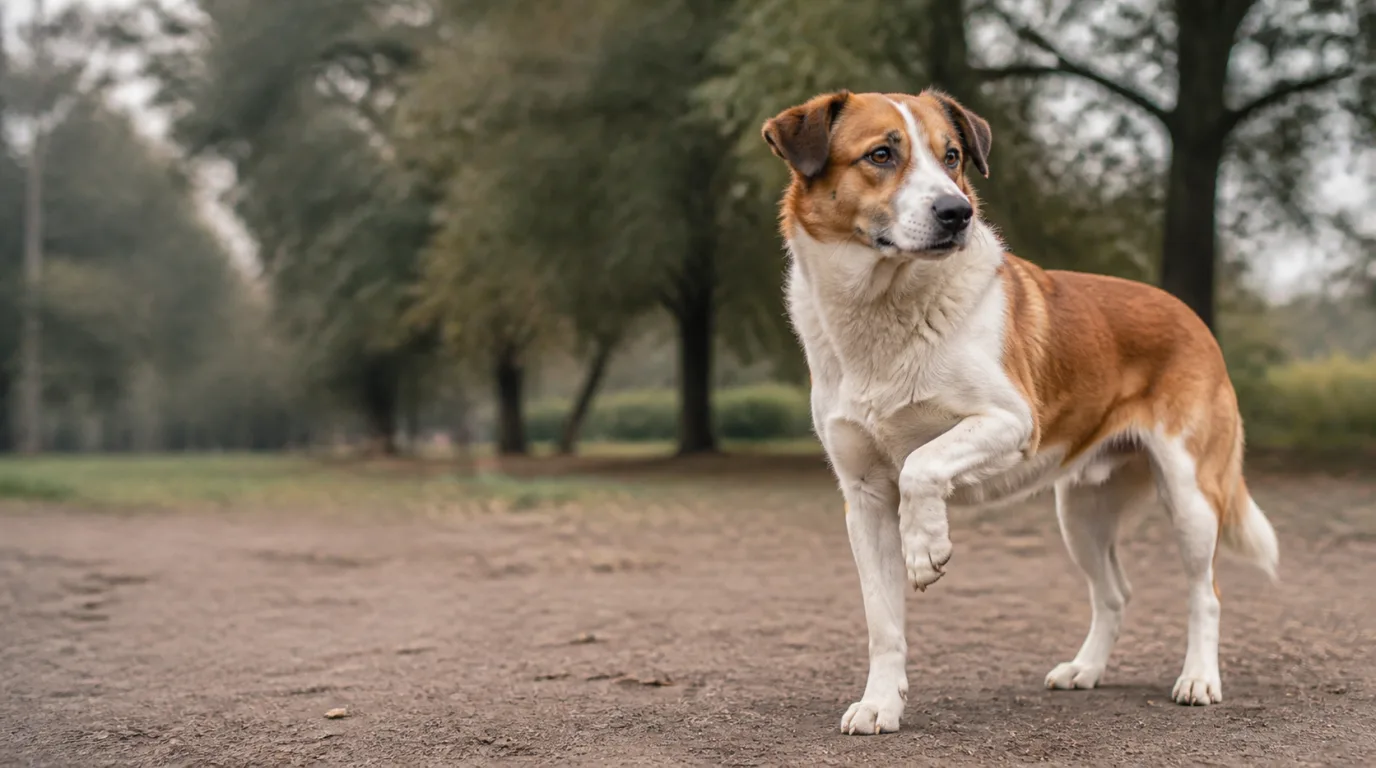
A dog lifting one front paw can indicate uncertainty, focused pointing, anticipation, a learned request or physical discomfort. The paw by itself has no fixed meaning. Check what the dog is looking at, whether the body leans forward or back, how loose the face is, and whether the dog bears weight normally afterward.
A brief paw lift during an unfamiliar greeting differs from repeatedly avoiding weight on the same leg during a walk. Context determines whether you should add space, observe, change a training setup or call a veterinarian.
This is also different from a dog crossing both front paws while lying down, which is usually a resting choice when movement remains normal.
What counts as a paw lift?
A paw lift is a dog holding one front foot partly or fully off the ground while standing or sitting. Research ethograms often define it more precisely, such as a forepaw raised to about 45 degrees. At home, that angle is less useful than the sequence around it.
This guide is not about:
- tapping or placing a paw on a person
- a trained shake or wave
- raising a hind leg during urine marking
- the normal moment when a walking dog transfers weight between steps
A meaningful body-language observation includes how long the paw stays up and what happens before and after it.
Four common paw-lift contexts
| Context | Rest of the body | What happens next | Likely action |
|---|---|---|---|
| Uncertainty or social pressure | Weight back, low or tentative posture, ears back, head turn, lip lick | Dog pauses, retreats or approaches cautiously | Reduce pressure and allow distance |
| Pointing or prey focus | Nose and gaze aimed at a target, body still, weight balanced or forward, tail may align | Stalk, flush or chase may follow | Manage access and leash safety |
| Anticipation or learned request | Loose posture, soft eyes, attention alternates between person and wanted item | Dog repeats the lift when it produces food, play or a walk | Decide whether and how to reinforce it |
| Pain or paw problem | Repeated unloading of one limb, licking, shortened stride, swelling or reluctance to walk | Limping or avoidance continues outside the original context | Inspect safely and contact a veterinarian |
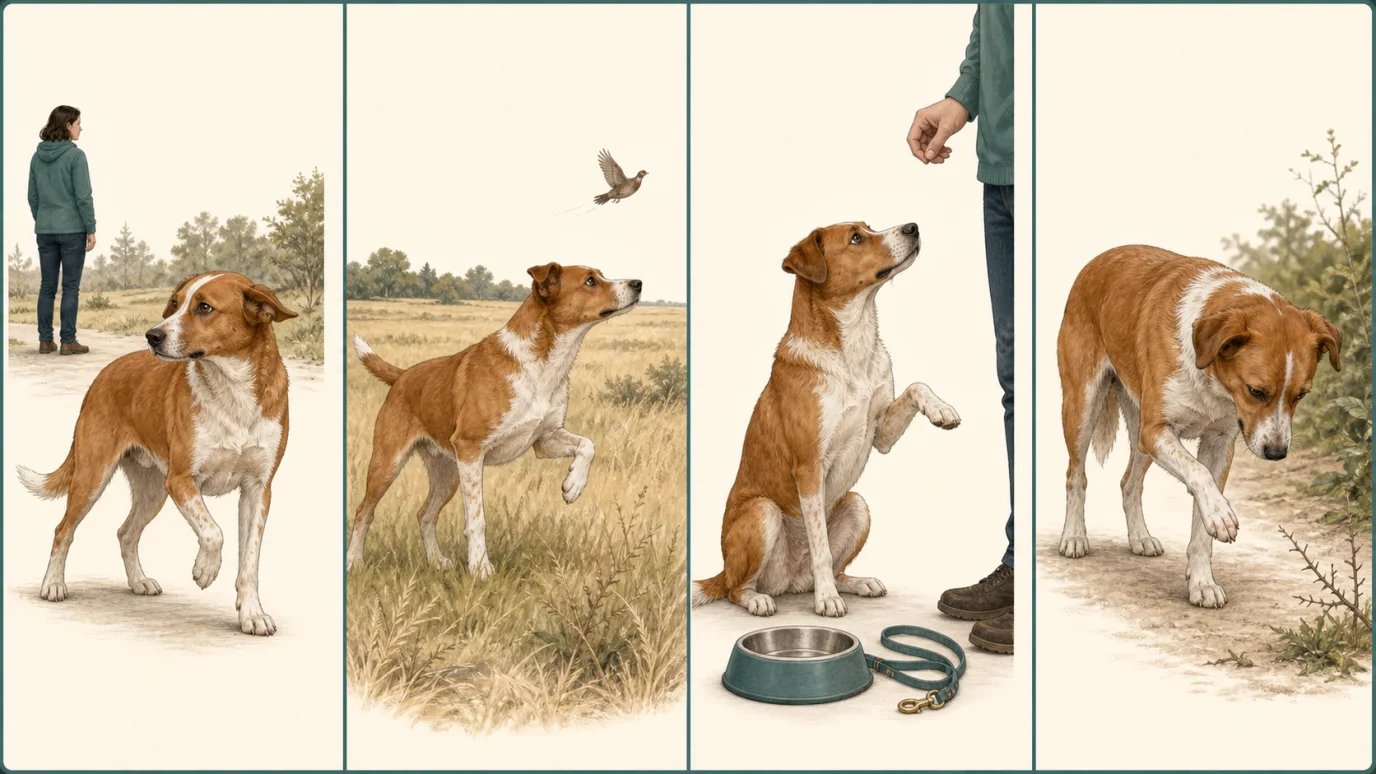
The same visible action can sit in four different sequences. From left: uncertainty, prey focus, anticipation and possible pain. The paw is a clue; the whole body and next movement carry the meaning.
Paw lifting during uncertainty
A tentative front-paw lift can appear when a dog is unsure about a person, dog, object or request. The weight often stays over the other three limbs or shifts slightly back. The head may turn away while the eyes continue monitoring, and the ears may sit back or to the side.
Paw lifting appears in research and professional lists of stress-related behavior. That does not make every paw lift a stress measurement. In a canine acute-stress study, researchers counted paw lifts alongside many other behaviors and explicitly noted that simply adding behavior frequencies could not adequately represent stress levels.
Look for timing and a cluster. A paw lift just after a stranger leans over the dog, paired with a nose lick and low posture, supports uncertainty more than a paw lift beside the food cupboard. The broader guides to calming signals and dog stress signs explain those companion cues.
What to do
Pause the approach or handling. Turn slightly sideways, soften direct eye contact and allow the dog to choose whether to move closer. Do not reach for the raised paw or ask the dog to shake. If the body loosens after distance increases, you have useful information about the pressure in the earlier setup.
Paw lifting during pointing or prey focus
Pointing breeds were selected to locate game and hold a conspicuous stance. The classic point combines sudden stillness, nose and gaze aimed toward scent or movement, one front paw raised and a body aligned with the target. Setters, pointers, spaniels and other gundogs may show variations.
Non-pointing breeds and mixed-breed dogs can also pause with a paw up while tracking a bird, rabbit, insect or toy. The posture alone cannot establish ancestry. What matters for interpretation is the forward sensory focus and what follows.
Predatory attention is not the same as fear, but it can create risk for wildlife, cats or small animals. Keep a secure leash or long line where chasing is unsafe. Do not move closer merely to see whether the dog will point again.
The guide to dog freezing body language explains how predatory stillness differs from a tense social freeze.
Anticipation and learned requests
Some dogs lift a paw before a meal, walk, thrown toy or familiar cue. The body is usually loose, and attention moves between the person and the expected outcome. The dog may have begun with a spontaneous lift that made someone smile, speak, reach for a leash or deliver food.
When a consequence reliably follows a behavior, that behavior becomes more likely. The dog does not need to be deliberately trained. Family responses can shape a paw lift into a request.
If you like the behavior, reinforce it only when it is safe and practical. If you do not, teach a clear alternative such as standing on a mat or making brief eye contact. Avoid scolding; change what earns the outcome.
Anticipation can also carry tension. A dog vibrating beside the door with a paw up is not necessarily calm. Lower the intensity of the routine if rushing, barking or grabbing accompanies it.
When a lifted paw suggests pain
A health problem moves higher on the list when the dog repeatedly lifts the same paw, limps, shortens the stride, licks the foot, avoids a surface or refuses normal activity. Possible causes include:
- a thorn, burr, grass awn or other foreign material
- a cut, burn, cracked pad or broken nail
- insect sting or swelling
- muscle, tendon, joint or bone injury
- neck or nerve pain that changes limb use
- arthritis or another chronic orthopedic problem
Check the paw visually only if the dog is comfortable and safe to handle. Look between the toes and at the nails and pads without squeezing, bending or digging into a painful area. A painful dog may bite, even if they have never bitten before.
Contact a veterinarian the same day if the dog will not bear weight, pain is marked, a nail is torn, swelling develops, the paw bleeds, a foreign object is deeply embedded or limping persists. Seek urgent care after major trauma, with obvious deformity, uncontrolled bleeding, severe distress or signs of collapse.
A quick context check
When you notice a paw lift, ask:
- What happened immediately before it? An approach, sound, animal, cue, surface change or step?
- Where is the weight? Back and tentative, forward toward a target, or avoiding one limb?
- What are the face and ears doing? Soft and flexible, or tight and monitoring?
- Does the dog walk normally afterward? Watch several steps on a safe, level surface.
- Is it always the same paw? Repetition raises medical concern.
- Does changing the context change the behavior? More distance may resolve uncertainty; pain may persist across settings.
Do not deliberately recreate a worrying greeting, wildlife encounter or painful step for a better answer. Use naturally occurring observations.
Paw lift during training or veterinary care
A paw lift during a difficult exercise can reflect uncertainty, anticipation of a known cue or simple balance. Lower the task difficulty and see whether fluent, loose movement returns. Correcting the paw does not clarify the cue.
During examination, grooming or nail care, a paw lift may be a small avoidance or stress-related change. Pause if medically possible. Cooperative-care training can teach a dog to present a paw voluntarily and withdraw it as a stop signal. A veterinary team can design a safer plan when pain or fear makes handling difficult.
The displacement-behavior guide helps distinguish an out-of-context action from confusion about training mechanics.
When to seek behavior help
Seek qualified support when paw lifting occurs within a larger fear or reactivity pattern, the dog cannot recover around ordinary triggers, or the posture progresses to freezing, growling, lunging or snapping. Start with a veterinarian if the pattern is new or any physical discomfort is possible.
For behavior cases, use the guide to finding a credentialed behaviorist. A force-free professional should assess the entire sequence, not promise to translate one paw position.
What a photo or video can show
A photo can capture which paw is lifted, gaze direction, ear position and weight distribution. It may miss whether the lift lasted half a second, appeared during a normal step or persisted as limping.
Video from the side and front is better for gait and sequence. Record on a safe surface without forcing the dog to walk through pain or toward a trigger. PetTranslator.ai can organize visible body-language markers and uncertainty, but it cannot diagnose an injury or prove an emotional state from the paw alone.
Frequently asked questions
Does lifting one paw mean a dog is anxious?
It can accompany uncertainty, especially with weight back, ears back, head turning or lip licking. Pointing, anticipation, learned behavior and pain can look similar. Read the context and next movement.
Why does my dog lift a paw when looking at me?
The dog may expect a familiar outcome or may have learned that the lift gets your attention. If the posture is low or tense, they may be uncertain about your approach or request.
Why does my dog lift a paw when seeing another dog?
They may be pausing to gather information, showing uncertainty or focusing intensely. Add distance if the body is tense, attention cannot shift or the other dog is approaching directly.
Do only pointing breeds raise a paw?
No. Pointing breeds have a strongly selected version of the posture, but many dogs lift a paw while focusing, anticipating, balancing or feeling uncertain.
When is a lifted paw a veterinary problem?
Repeatedly unloading the same paw, limping, licking, swelling, bleeding, a damaged nail or reluctance to walk needs veterinary attention. Inability to bear weight or major trauma warrants prompt care.
Sources
- VCA Animal Hospitals. Canine communication: interpreting dog language.
- Texas A&M School of Veterinary Medicine. Doggie decoding: understanding canine body language.
- American Kennel Club. Why does my dog raise a paw and point?.
- Ng et al. Recognizing and mitigating canine stress during animal-assisted interventions.
- MacLean et al. Evaluation of salivary vasopressin as an acute stress biomarker in healthy dogs.
- Behavior coding of adolescent and therapy dog interactions during a social stress task.
Khabir Mughal is the founder of PetTranslator.ai. This article was researched against canine-behavior studies and current veterinary guidance. It was last reviewed on August 18, 2026.