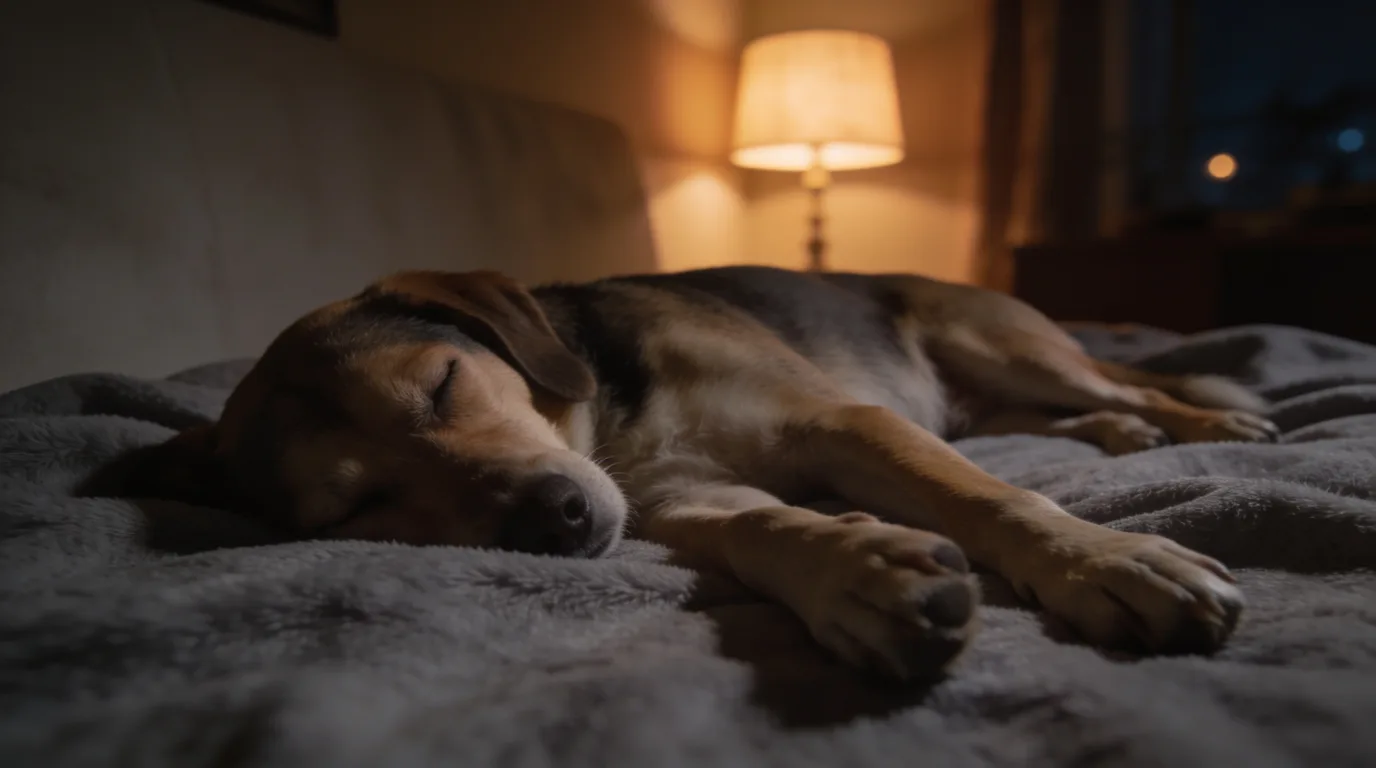
A dog who barks, whimpers, twitches, or paddles their legs while asleep is almost always doing something entirely normal. Rapid eye movement sleep in dogs produces the same motor and vocal breakthrough it produces in humans, and dogs enter REM far more often than people do, in much shorter bursts. The muffled woof at 3 a.m. is a physiological event, not a nightmare in any sense a human would recognize, and in the overwhelming majority of cases it needs no intervention at all.
The part that actually matters is the exception. A small subset of what owners describe as sleep-barking is not sleep at all — it's seizure activity, and the two look similar enough at 3 a.m. that the distinction gets missed regularly. This guide covers normal canine sleep architecture, the honest answer to whether you should wake a dreaming dog, and then the differentiator most articles skip entirely: a side-by-side read for telling REM activity from a seizure.
How dogs actually sleep
Canine sleep is polyphasic. Adult dogs distribute roughly ten to fourteen hours of sleep across the twenty-four-hour day in multiple bouts rather than consolidating it into one long block the way most adult humans do. That fragmentation is the root cause of nearly everything owners find confusing about dog sleep.
Sleep in dogs runs through the same broad stages as in humans — drowsiness, non-REM slow-wave sleep, and REM — but the cycle is compressed. Laboratory recordings in dogs commonly report full cycles of fifteen to twenty-five minutes, against roughly ninety in an adult human. The consequence is arithmetic: a dog sleeping two hours may pass through six or seven REM periods, while a human sleeping the same two hours passes through one or two. Owners aren't observing an unusual dog. They're observing an ordinary dog whose REM sleep arrives five times as often.
REM is the stage that produces the behavior. Cortical activity during REM is high and closely resembles wakefulness. Descending motor inhibition suppresses most voluntary movement, but the suppression is incomplete — signals leak through to the periphery. In humans, the leak-through is small: a finger twitch, a mumble. In dogs, the leak-through is larger and more visible, producing the classic cluster of twitching whiskers, flicking ears, rippling flanks, paddling limbs, muffled barks, whines, and small yips.
Non-invasive polysomnography developed by the Family Dog Project group at Eötvös Loránd University in Budapest made it possible to record canine sleep in a natural setting rather than a restrained laboratory one, and that work has broadly supported the fragmented-sleep model, including measurable effects of the day's experiences on the following sleep period.
What is not supported is the intuition that follows. A dog producing REM vocalization is not having a narrative emotional experience. There is no evidence for dream content in dogs, and none is available in principle from the outside. The dog displays motor and vocal output associated with a high-activity sleep stage. Everything past that is human projection.
What normal sleep activity looks like
Normal REM breakthrough has a recognizable signature, and it holds across breeds and ages.
Vocalization. Muffled, soft, partial. Barks come out as half-barks or air-only "woofs" because the mouth is closed or nearly closed. Whines are brief and quiet, almost always lower in volume than the dog's waking equivalent. Sequences are short and irregular.
Limb movement. Small-amplitude twitching, or a loose paddling motion that stays close to the body. Individual muscle groups fire independently: a paw flexes, a lip quivers, an ear flicks, and none of it is synchronized. The overall quality is loose.
Muscle tone. Low. The body remains soft. A dreaming dog you place a hand on feels relaxed, not rigid.
Face and eyes. Eyelids closed, or open only as a slit. Eyeballs may visibly move beneath the lids — the movement REM is named for. Whisker twitching is common.
Breathing. Irregular during REM, which is normal for the stage. Rate varies. No struggle, no gasping, no cyanosis.
Duration and offset. A few seconds up to a couple of minutes, then it stops on its own and the dog settles or shifts position. No aftermath.
Response to input. This one is the diagnostic hinge. A dreaming dog will interrupt on a stimulus — say the dog's name at conversational volume from a few feet away and the activity typically stops, the dog stirs, and normal wakefulness resumes within a second or two.
Why puppies and seniors do it more
Sleep vocalization is not evenly distributed across the lifespan. Both ends of it are over-represented, for entirely different reasons.
Puppies. Young puppies sleep eighteen to twenty hours a day and spend a substantially greater proportion of that time in REM than adults do. Neonatal mammals also display a phenomenon sometimes called activated sleep — pronounced, near-continuous myoclonic twitching during sleep that is understood as part of normal sensorimotor development rather than dreaming. A four-week-old puppy who jerks, squeaks, and paddles almost the entire time they're asleep is developing normally. This declines steadily through the first several months.
Senior dogs. Older dogs show it more for different reasons, and this is where it stops being purely benign. Sleep architecture degrades with age: total sleep fragments, slow-wave sleep decreases, and the boundaries between stages blur. Age-related decline in the brainstem circuitry that maintains REM atonia can allow more motor activity to break through. On top of that, three age-associated conditions independently increase night-time vocalization — osteoarthritis pain, sensory decline, and canine cognitive dysfunction. If a senior dog's night-time noise is increasing, the question is no longer "is this dreaming" but "is this dreaming, pain, or cognitive change," and answering it usually requires a veterinary exam. See cognitive dysfunction in senior dogs, pain signals in older dogs, and dog pacing at night.
The discriminator is straightforward. REM activity happens while the dog is asleep and stops when the dog wakes. Pain and cognitive vocalization happen while the dog is awake — standing, pacing, staring at a wall — and continue regardless.
Should you wake a sleeping dog?
No, in the ordinary case, and the reasoning has two independent halves.
The dog is not in distress. What reads as a nightmare to a human observer is a stage of sleep with high cortical activity and imperfect motor inhibition. The distress is in the interpretation, not the dog. Waking a dog out of REM also interrupts a stage with real restorative function — memory consolidation and emotional regulation both appear to depend on it in mammals generally. Fragmenting a dog's sleep to relieve your own discomfort is a bad trade.
Startle-waking carries a genuine bite risk. A dog roused abruptly from deep sleep by touch can snap before orienting. This is a reflexive, non-aggressive response, and it is over-represented in bite statistics involving children, who are the demographic most likely to hug or shake a sleeping dog. The risk rises sharply in dogs with hearing loss, vision loss, or cognitive decline, because those dogs have fewer channels for identifying who is touching them. It rises again in dogs with pain, where the touch itself hurts.
If you genuinely must wake the dog — for medication, for an emergency, because the episode is unusually long — do it without contact. Say the dog's name at normal volume from several feet away. If that doesn't work, make an ambient noise: rustle a bag, tap the floor. Let the dog come out of sleep and orient before you approach, and let them come to you.
Sleep activity versus a seizure
This is the distinction that matters and the one most owner-facing content omits. Seizures in dogs frequently occur during sleep or during the transition into and out of it, which is precisely why the confusion is so common — the base rate of "something alarming happened while my dog was lying down at night" includes both categories.
| Feature | Normal REM sleep activity | Seizure |
|---|---|---|
| Onset | Gradual, emerges from ongoing sleep | Abrupt; may begin with a stiffening or a "freeze" |
| Muscle tone | Low and loose throughout | Rigid, or rigid then rhythmic; body feels hard |
| Limb movement | Small, asynchronous, close to the body | Large, synchronized, rhythmic paddling; often violent |
| Vocalization | Soft, muffled, partial barks and whines | Loud, harsh, guttural, or a single sustained scream |
| Eyes | Closed or slitted; eyeballs move under lids | Often wide open, fixed, glassy; pupils dilated |
| Jaw | Quiet, may quiver | Repetitive chomping or chewing motions |
| Salivation | None | Frequently heavy — foaming or drooling |
| Continence | Intact | Urination or defecation is common |
| Response to your voice | Stops or the dog wakes within a second or two | No response at all — the dog is unconscious |
| Response to gentle touch | Dog wakes | Movement continues unchanged |
| Duration | Seconds to about two minutes, irregular | Typically 30 seconds to 3 minutes, with a distinct beginning and end |
| Afterwards | Dog settles or wakes normally, oriented | Disorientation, pacing, blindness, ataxia, ravenous hunger or thirst — minutes to hours |
| Pattern over time | Random, harmless, unchanging | Tends to recur; may cluster |
Two rows in that table do nearly all the work.
Unresponsiveness. A dreaming dog is asleep and can be woken. A seizing dog is unconscious and cannot. Speak the dog's name from a safe distance. If the activity continues without any change, it is not a dream. Do not test this with your hands — a seizing dog has no bite inhibition and jaw chomping is part of the motor pattern.
What happens afterwards. REM activity has no aftermath. A dog who was dreaming either goes back to sleep or wakes up normal. A seizure is followed by a post-ictal period, and that period is the single most reliable marker available to an owner.
The post-ictal phase
After a generalized seizure, the dog is not immediately normal. The post-ictal phase reflects transient cortical dysfunction and typically runs from a few minutes to several hours. What it looks like:
- Disorientation. The dog does not appear to recognize the room, the furniture, or the people in it.
- Aimless pacing or circling, often bumping into things.
- Transient blindness. Common and alarming. It usually resolves.
- Ataxia — a drunken, wobbling gait, or an inability to stand at all initially.
- Ravenous hunger or thirst.
- Unresponsiveness to name and cues the dog knows perfectly.
- Uncharacteristic irritability or fear, including toward familiar people.
A dog who barks in their sleep and then rolls over and keeps sleeping did not have a seizure. A dog who vocalizes and thrashes and then spends ten minutes staggering into walls almost certainly did. If you observe a post-ictal phase, the episode goes on the calendar with a time and a duration, and it goes to a veterinarian.
Two additional patterns are worth naming, because they don't fit the classic picture. Focal seizures may involve only part of the body — rhythmic facial twitching, a single limb, repetitive lip-smacking or fly-biting at nothing — with consciousness partly or fully preserved. These are easy to dismiss as quirks. Seizure onset age is diagnostically useful: idiopathic epilepsy typically declares itself between roughly six months and six years. A first seizure outside that window raises the index of suspicion for a structural or metabolic cause and generally warrants a more aggressive workup.
Sleep disorders that are not seizures
A third category sits between normal REM activity and epilepsy. These are uncommon, but they explain a real fraction of the cases that don't fit either box.
REM sleep behavior disorder. In normal REM, brainstem circuits actively paralyze the voluntary muscles. In RBD that atonia fails, and the animal physically acts out motor programs during sleep — running, biting, lunging, howling, sometimes violently enough to cause injury. The condition is documented in dogs and mirrors the human disorder of the same name. The distinguishing features against a seizure are that the movement is purposeful-looking and coordinated rather than rhythmic and stereotyped, it occurs only during sleep, and the dog wakes normally with no post-ictal phase. It is diagnosed by a veterinary neurologist, usually after epilepsy has been excluded, and it responds to treatment in many cases.
Narcolepsy with cataplexy. Canine narcolepsy is unusually well characterized, because a hereditary form led directly to the mechanism of the human disease — Lin and colleagues reported in Cell in 1999 that it is caused by a mutation in the hypocretin (orexin) receptor 2 gene. Familial forms are recognized in Doberman Pinschers, Labrador Retrievers, and Dachshunds; sporadic cases occur in any breed. The presentation is distinctive: sudden collapse into flaccid paralysis triggered by excitement — food, play, a greeting — with the dog remaining aware, recovering in seconds to minutes. The dog goes limp while awake, the opposite of a seizure's rigidity.
Sleep-disordered breathing. Brachycephalic breeds — Bulldogs, French Bulldogs, Pugs, Boston Terriers, Boxers — frequently have upper-airway anatomy that obstructs during sleep. The result is loud snoring, snorting, gasping, repeated arousals, and unrefreshing sleep. This is not dreaming and not a seizure; it's a respiratory problem with real welfare cost, and it is surgically treatable in many dogs. Owners who describe a dog who "makes terrible noises all night" should have the airway assessed rather than the brain.
Overheating. A dog sleeping on a heat vent or under heavy bedding may show restlessness and vocalization that resolves entirely by moving the bed. Rule out the cheap explanations first.
How to film it for your veterinarian
An episode described from memory at a Tuesday appointment is nearly useless. An episode on video is diagnostic. Most owners film badly under stress, so decide the protocol in advance.
- Get the whole dog in frame, all four limbs and the head. A close-up of a twitching face loses what the neurologist needs.
- Turn the lights on if you safely can. Night-mode footage of a dark room resolves nothing.
- Keep filming after it stops. The recovery is the most diagnostic part of the recording — film at least two full minutes past the end.
- Say the dog's name on camera, from a distance, once. The response or lack of it settles the sleep-versus-seizure question immediately.
- Say the time out loud at the start, and the duration at the end.
- Do not stage a repeat. Never provoke an episode for better footage.
- Keep a log: date, time, duration, what preceded it, how long recovery took, and anything unusual that day — new food, new medication, vaccination, exertion, stress.
Bring the video to the appointment on the device, not described. Clinicians distinguish these events on footage in seconds.
What people get wrong
"He's having a nightmare, I should comfort him." The distress is in the observation, not the dog. Reaching for a dog in REM interrupts restorative sleep and is the most common route to a sleep-startle bite. Comfort after the dog wakes on their own, if the dog seeks it.
"Twitching means something is wrong." Twitching, paddling, whisker movement, and soft vocalization during sleep are normal at every age and require nothing. In puppies they're near-constant and developmentally expected.
"It only happened once, so it wasn't a seizure." A first seizure is a first seizure. Isolated events in an otherwise healthy adult dog may not require immediate treatment, but they require documentation and a baseline workup, because the pattern over the following months determines the diagnosis.
"He's too young for a seizure." Idiopathic epilepsy most often begins between six months and six years — squarely in the window most owners consider "young and healthy."
"The whole body has to convulse." Focal seizures may present as facial twitching, a single paddling limb, repetitive lip-smacking, or brief unresponsive staring. Loss of consciousness is not required for a focal event.
"He's dreaming about chasing rabbits because he had a stressful day." Daytime experience does appear to influence subsequent sleep structure in dogs, so the intuition isn't baseless. It does not license reading the content. The dog displays altered sleep architecture and motor breakthrough. That is the whole reliable claim.
When to see a veterinarian
Book a routine appointment if:
- Sleep vocalization is new in an adult dog and increasing
- A senior dog's night-time noise is escalating, or is occurring while the dog is clearly awake
- The dog seems unrefreshed — sleeping long hours but groggy, or sleeping poorly and irritable
- Snoring, snorting, or gasping wakes the dog repeatedly
- The dog collapses limply when excited
Seek same-day or emergency care if:
- Any episode lasts five minutes or more
- Two or more discrete episodes occur within twenty-four hours
- The dog is unresponsive during the event and disoriented afterwards
- There is urination, defecation, or heavy salivation during the event
- The dog does not fully return to normal within an hour
Suspected seizure disorders are managed by veterinarians, and complex or refractory cases by a Diplomate of the ACVIM (Neurology). This is a medical question, not a training one, and no behavior professional should be your first call for it.
Where behavior credentials do matter is the aftermath — dogs who become anxious about sleeping, owners who need help rebuilding a night routine, or a senior dog whose cognitive decline is driving genuine night-time distress. For those, look for DACVB (Diplomate, American College of Veterinary Behaviorists), CDBC (Certified Dog Behavior Consultant), CSAT (Certified Separation Anxiety Trainer), KPA-CTP (Karen Pryor Academy Certified Training Partner), Fear Free certification, or IAABC membership. Guidance on vetting one is in how to find a credentialed behaviorist.
Frequently asked questions
Should I wake my dog when they bark in their sleep?
Usually, no. Sudden touch can startle a sleeping dog. Let the episode pass unless safety is at risk. If you need to check responsiveness, say the dog's name once from a distance rather than reaching toward the face.
How can I tell dreaming from a seizure?
Normal sleep movement is often loose, brief and irregular, and the dog wakes normally. A seizure is more concerning when the body becomes rigid, movements are sustained or rhythmic, the dog is unresponsive, or confusion follows the episode.
When is sleep barking an emergency?
Seek urgent veterinary care for an episode lasting five minutes or more, repeated episodes within 24 hours, breathing difficulty, injury, prolonged unresponsiveness, or failure to return to normal afterward.
Try it on your own dog
Most of what separates a benign sleep event from a medical one is visible in the body, not audible in the sound — muscle tone, limb symmetry, eye position, jaw activity, whether the posture is loose or rigid. Those are the same markers that decide every other behavioral read, and the ones owners have the least practice naming.
PetTranslator.ai runs the framework described across this site. Upload one clear photo of your dog and it returns a report structured like a behaviorist's session note: the observed body-language markers first, the interpretation second, a confidence score with its reasoning, an explicit list of what could not be assessed from a single frame, and a Do/Avoid plan. No cartoon captions, no invented dialogue.
It is not a seizure screen and will not pretend to be one — a still image cannot capture responsiveness, duration, or recovery, the three variables that matter here. When a case looks medical, the report says so and points you at a veterinarian. What it builds is the everyday reading fluency that makes the abnormal night obvious when it arrives. For the underlying skill, start with dog body language.
Sources
- International Veterinary Epilepsy Task Force consensus proposals (2015, BMC Veterinary Research) — the veterinary standard for seizure terminology, classification, age-of-onset expectations, and the definitions of cluster seizures and status epilepticus.
- Lin and colleagues (1999), Cell — hereditary canine narcolepsy and the hypocretin (orexin) receptor 2 gene mutation; the canine model that identified the mechanism of the human disorder.
- Karen Overall, Manual of Clinical Behavioral Medicine for Dogs and Cats (Elsevier, 2013) — clinical reference for sleep-related behavior, nocturnal vocalization, and the medical-versus-behavioral differential.
- Gary Landsberg, Wayne Hunthausen & Lowell Ackerman, Behavior Problems of the Dog and Cat (Elsevier) — senior sleep–wake cycle disruption and the DISHAA cognitive screening framework.
- Family Dog Project, Eötvös Loránd University (Budapest) — non-invasive canine polysomnography, including work on how daytime experience affects subsequent sleep structure.
- AVSAB Position Statement on Humane Dog Training (2021) — American Veterinary Society of Animal Behavior.
- AAHA Pain Management Guidelines for Dogs and Cats — American Animal Hospital Association, for the pain contribution to night-time restlessness in older dogs.
- Canine sleep-cycle durations, polyphasic patterns, and age-related REM proportions are consistent findings across published laboratory sleep recordings in dogs; figures here are typical reported ranges, not a single study's result.
Khabir Mughal is the founder of PetTranslator.ai. This article was reviewed against the International Veterinary Epilepsy Task Force consensus definitions and Karen Overall's Manual of Clinical Behavioral Medicine before publication. It is not veterinary advice — if you suspect a seizure, contact a veterinarian.