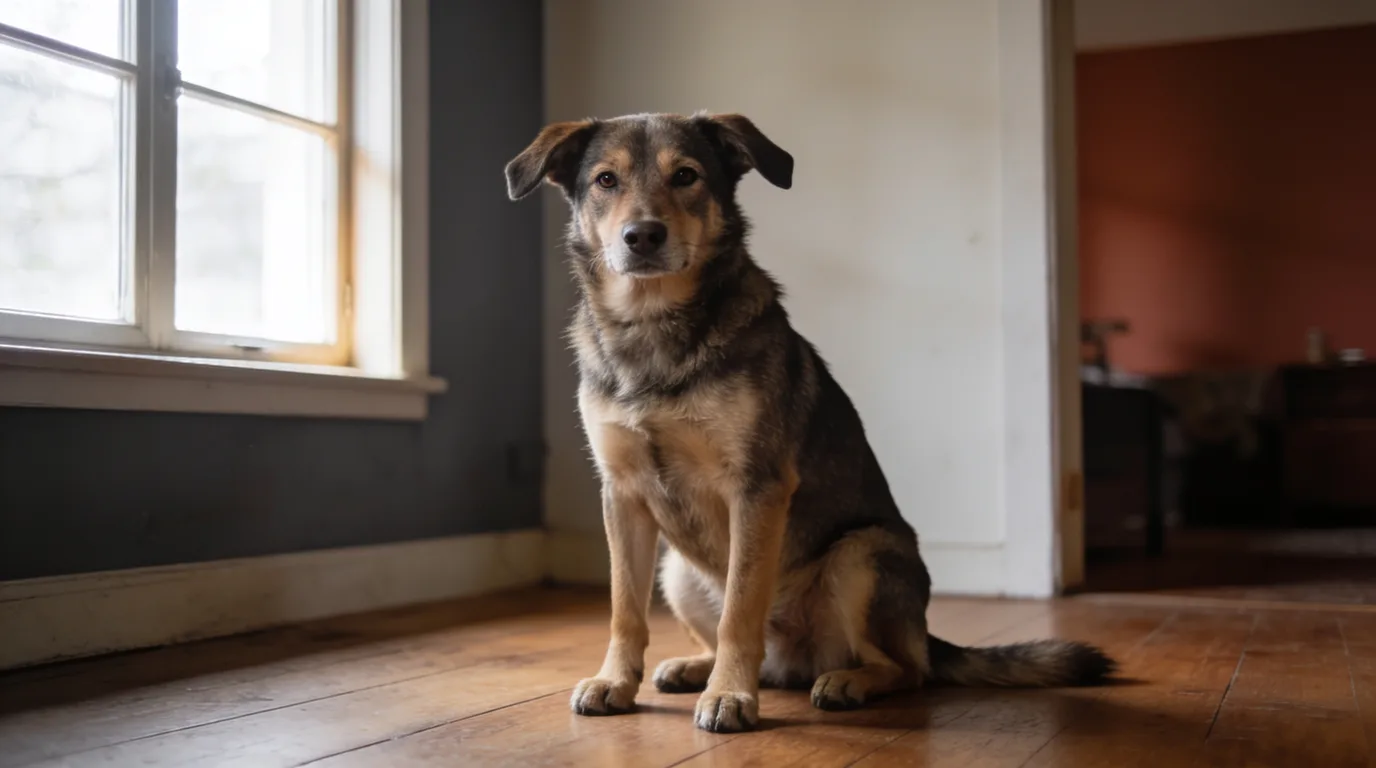
Your dog is standing in front of you doing something — staring, pawing, pacing, whining, pressing their head into your leg — and you want to know what it means. That question, asked millions of times a month, is the single most common question dog owners bring to the internet.
The honest answer is not the one most articles give you. Your dog isn't trying to tell you a sentence. They're not thinking "I need to go outside" and failing to find the words. What they're doing is broadcasting an internal state through their body, continuously, whether or not anyone is reading it. Learning to read that broadcast is a real skill, it's learnable in a few weeks of deliberate practice, and it's more useful than any translation an app could invent.
This guide is that skill, organized around the questions owners actually ask.
For one of the most common versions of this question, start with why dogs stare at people. If the behavior changes across days rather than moments, a pet stress tracker can reveal the trigger and recovery pattern that memory misses.
The question behind the question
When someone searches "what is my dog trying to tell me," they're almost never asking an abstract question about canine cognition. They're standing in a specific moment with a specific dog, and they want to know one of six things:
- Is my dog happy?
- Is my dog scared or stressed?
- Is my dog asking me for something?
- Is my dog about to bite?
- Is my dog in pain?
- Is my dog bored?
Each of those has a different signal cluster, and confusing them is how people get bitten, miss illness, or spend money on training for a problem that was actually orthopedic. The rest of this article walks through all six.
But first, a short detour into what's actually happening in your dog's head — because the wrong mental model produces the wrong reading every single time.
What dogs actually communicate
Dogs are extraordinarily good at reading humans. Research from the Family Dog Project and others has repeatedly shown that dogs outperform even chimpanzees at following human pointing gestures and gaze cues — a specialization that appears to have emerged through domestication rather than general intelligence.
What dogs are not doing is composing propositions. There is no evidence for sentence-level, syntactic thought in dogs. When a dog stands at the door and barks, the internal event is closer to a rising state of arousal directed at an environmental target than it is to the phrase "let me out."
This distinction matters practically, not just philosophically. Consider a dog who lip-licks and yawns while their owner puts on shoes.
- The translation model says: the dog is saying "we're going for a walk, I'm excited!"
- The signal model says: the dog is showing displacement behavior — low-grade stress produced by a predictable routine that reliably ends in something arousing.
Only the second reading tells you what to do: slow the departure routine down, decouple the shoe cue from the walk, and lower the arousal before it stacks. The first reading tells you nothing actionable, and if the dog's arousal at the door is part of a leash-reactivity problem, the first reading actively delays the fix.
Dogs communicate state, not content. Read state.
The six channels
Every read draws on six channels at once. No single channel is a verdict.
| Channel | What it tells you | Speed of change |
|---|---|---|
| Ears | Direction of attention; threat assessment | Fastest — sub-second |
| Eyes | Intensity of focus; stress level | Very fast |
| Mouth / lips | Tension; displacement stress | Fast |
| Tail | Confidence and arousal level | Moderate |
| Posture / weight | What the dog is about to do | Moderate |
| Context | What the signals are about | Slowest, most important |
The discipline that separates a good read from a bad one is simple and almost universally skipped: read at least four channels before drawing a conclusion, and weigh context above all of them. A tail wag means nothing on its own. A tail wag on a low body with pinned ears and a closed mouth means something very specific, and it isn't friendly.
1. Is my dog happy?
"Happy" isn't a clinical category, but the observable state owners mean by it — relaxed, socially engaged, not under stress — has a clear signal cluster.
What you're looking for:
- Loose, curved body. No straight lines. A relaxed dog's outline has soft curves; a tense dog's outline goes rigid and linear.
- Soft eyes. Lids relaxed, normal blink rate, no visible sclera, no locked stare.
- Neutral or slightly forward ears without tension at the base.
- Mid-level tail with a loose, sweeping wag that involves the hips. The whole back end moves.
- Open mouth, loose lips, tongue possibly lolling, no tension at the commissure (the corner of the mouth).
- Weight distributed evenly across all four legs, or a comfortable lounging sprawl.
The play bow — front end down, rear end up, tail high and wagging, bouncy movement — is the clearest affiliative signal in the canine repertoire. It's a metacommunication signal, meaning it frames everything that follows as play rather than genuine aggression. A dog who play-bows before a wrestling match is telling the other dog "what comes next isn't real."
The one to be careful with: the "smile." Some dogs retract their lips into what looks like a human grin. In a loose, bouncy body this is usually a genuine appeasement-affiliation display. In a still body with hard eyes, retracted lips are a threat display showing teeth. Same lip position, opposite meaning, resolved entirely by the rest of the body.
2. Is my dog scared or stressed?
This is the cluster owners miss most often, because early stress signals are quiet and easily read as "being good."
Turid Rugaas catalogued these as calming signals — small behaviors dogs use to de-escalate tension, both in themselves and in others. They appear in a rough escalation order:
Early (subtle) — the dog is uncomfortable but coping:
- Lip licking with no food present. A single flick is meaningless; three flicks in thirty seconds is a signal.
- Yawning when not tired. Same displacement mechanism as the lip lick.
- Head turn away from a trigger while keeping the body still.
- Sniffing the ground abruptly in a context where nothing changed. A classic displacement behavior.
- Slow blinking or rapid blinking — both directions off baseline indicate unease.
- A full-body shake-off when not wet. This is a stress reset — the dog discharging tension after a tense moment passes.
Middle — the dog is asking for space:
- Whale eye — the whites of the eyes showing as a crescent because the dog turned their head away but kept their eyes on the trigger. One of the most reliable stress signals in dogs, and it appears well before any growl.
- Ears pinned back against the skull.
- Lowered body posture, weight shifted backward.
- Tail low or tucked.
- Stress panting — faster and shallower than heat panting, with the front of the mouth held more closed, in a cool room with no exertion.
Late — the dog has run out of quieter options:
- Freezing. A dog who goes completely still has stopped processing alternatives. This is a high-grade warning.
- Growling. A gift, not a problem. The growl is the dog telling you clearly that they need the situation to change.
- Air snapping, then biting.
The practical takeaway: intervene at the early tier. A dog showing lip licks and head turns at the vet's office is telling you something you can still act on. A dog who has escalated to freezing is telling you something you should have acted on two minutes ago.
3. Is my dog asking me for something?
Dogs are exceptionally good at operant learning — they repeat what works. Most "asking" behavior is a learned request that got reinforced at some point, often accidentally.
Common request behaviors and what usually produced them:
| Behavior | Most common underlying request | How it got learned |
|---|---|---|
| Pawing at you | Attention, food, play | Pawing was followed by attention, even once |
| Nose nudging your hand | Petting | Hand moved to pet after nudge |
| Staring at you, still body, soft eyes | Food, a walk, access to something | Owner responded to the stare |
| Standing at the door, silent | Access outside | The door opened |
| Bringing a toy | Play solicitation | Play followed |
| Whining near a specific object | Access to that object | Access was granted |
| Barking at you directly, short bursts | Attention (a demand bark) | Attention followed, including scolding |
The key insight: if your dog does something specific and repeatable to get your attention, they learned it from you. That's not manipulation and it isn't dominance — it's operant conditioning working exactly as designed. If the behavior is one you'd rather not have, the fix is to reinforce an alternative (a sit, a settle on a mat) rather than to punish the existing one.
Attention-seeking versus genuine need. The differentiator is context and pattern change. A dog who has always pawed for attention and paws for attention today is doing the learned thing. A dog who has never pawed and suddenly starts, or who escalates a normal request into frantic insistence, has changed their baseline — and a baseline change is a medical question before it's a behavioral one.
4. Is my dog about to bite?
Every bite has a signal ladder in front of it. Owners who say "he bit with no warning" almost always missed the earlier rungs — often because those rungs were punished out of the dog previously.
Read these in escalation order:
- Displacement signals — lip licks, yawns, head turns, sniffing
- Whale eye, ears pinned, body lowered
- Body stiffening, movement stopping
- Hard stare — locked eye contact, no blinking
- Tight lips, shortened commissure, possible lip lift showing front teeth
- Growl
- Air snap
- Bite
The highest-risk combination, and the one to memorize: still body + hard stare + closed tight mouth. That specific cluster is the moment to stop moving, avoid direct eye contact, and increase distance without turning your back or running.
Context multipliers. Bite risk rises sharply when the dog is:
- Guarding a resource — food, a chew, a bed, a person
- Cornered with no escape route
- In pain, especially undiagnosed orthopedic or dental pain
- Startled while asleep
- Already over threshold from previous events in the same session (trigger stacking)
5. Is my dog in pain?
Dogs are poor at showing pain in the ways humans expect. There's no whimpering, usually. What there is instead is a set of quiet behavioral changes that read as "getting older" or "getting grumpy."
Behavioral signs of pain:
- Reluctance to do something they used to do — jumping onto the couch, taking stairs, getting into the car
- A change in resting position — a dog who used to sleep curled now sleeps stretched out, or vice versa
- Groaning or grunting when lying down or standing up
- New irritability, especially when touched in a specific area or approached while lying down
- Excessive licking of one location — a joint, a paw, a flank
- A "praying" posture — chest down, rear up, held for extended periods — which can indicate abdominal pain
- Panting at rest in a cool room
- Reduced appetite or slower eating (which may be dental)
- Withdrawal — spending more time in another room, less social contact
The single most important rule in behavior work: sudden behavior change in a previously stable dog is a veterinary question first and a behavioral question second. A dog who becomes reactive at nine years old after a lifetime of tolerance is far more likely to have arthritis, a thyroid problem, or failing vision than to have developed a training issue.
6. Is my dog bored?
Under-stimulation produces a recognizable pattern, and it's frequently misdiagnosed as anxiety or "acting out."
Boredom signals:
- Repetitive, self-directed activity — pacing a fixed route, tail chasing, excessive licking
- Destructive chewing that occurs when the owner is present or in view (true separation distress happens when the dog is genuinely alone)
- Demand barking with no clear trigger
- Digging indoors — pawing at bedding or carpet
- Attention-seeking that escalates rather than settling when ignored
- Excessive sleeping in a young, healthy dog
Boredom versus separation anxiety is a distinction worth getting right, because the interventions are completely different. Separation distress produces behavior that starts within minutes of departure, targets exit points (doors, windows, crate doors), and often includes self-injury, salivation, or house-soiling in an otherwise reliably trained dog. Boredom-driven destruction is more distributed, less frantic, and happens regardless of whether anyone left.
The fix for boredom is rarely more exercise alone. Sniffing work — scatter feeding, snuffle mats, nose games, decompression walks on a long line — reduces arousal more effectively per minute than physical exercise, because it engages the olfactory system that dominates a dog's sensory processing.
The five most common misreads
These come up constantly, and each one has real consequences.
1. "A wagging tail means a friendly dog." Wagging indicates arousal of any kind. A high, stiff tail with a fast, narrow vibration is high-arousal and can precede a bite. Read tail position first, motion second, and both in the context of the body they're attached to. Quaranta, Siniscalchi, and Vallortigara (2007, Current Biology) even documented directional asymmetry — a right-side bias when dogs see their owner, a left-side bias toward unfamiliar dogs or perceived threats.
2. "He rolled over for a belly rub." Sometimes. A relaxed dog on their back with loose limbs, a soft mouth, and a wagging tail is soliciting contact. A dog on their back with a tucked tail, tense limbs, a closed mouth, and whale eye is showing appeasement — they want the interaction to stop. Reaching in at that moment is a common bite scenario, especially with children.
3. "She looks guilty, so she knows what she did." Alexandra Horowitz's 2009 study in Behavioural Processes tested this directly: the "guilty look" appeared based on whether the owner scolded the dog, not on whether the dog had actually done anything. Dogs shown the guilty look most strongly were often the innocent ones being scolded unfairly. What you're seeing is appeasement in response to your present tone and posture — not remorse about an act from hours earlier.
4. "He's yawning, he must be tired." Out-of-context yawning is displacement stress. Watch for the sequence: yawn → ear shift → head turn → look away. That's a dog actively working to lower their own arousal.
5. "He's being dominant / trying to be alpha." The dominance framework applied to pet dogs derives from 1970s observations of unrelated captive wolves — a model the original researcher, David Mech, spent decades publicly retracting after studying wild wolf packs, which are simply families. The AVSAB has formally rejected dominance-based training. Behavior labelled "dominant" is nearly always fear, learned reinforcement history, resource guarding, or pain.
How to actually build this skill
Reading body language is a perceptual skill, and perceptual skills improve with labelled practice — repetition where you already know the answer.
A four-week practice protocol:
Week 1 — Baseline. Photograph or watch your dog three times a day in states you already understand: deep sleep, mid-play, waiting at the door. You're building a mental model of your dog's neutral, which differs by breed and individual.
Week 2 — One channel at a time. Spend each day watching a single channel. Monday: ears only. Tuesday: tail position (not motion). Wednesday: mouth tension. Isolating channels stops you from jumping to whole-dog conclusions.
Week 3 — Predict, then verify. Before your dog acts, call the next behavior out loud. "She's about to get up." "He's going to walk away from that dog." Track how often you're right. This is the step most people skip and the one that builds real accuracy.
Week 4 — Cluster reading. Return to whole-dog reads, but require yourself to name four specific signals before stating a conclusion. If you can't name four, you don't have a read yet — you have a guess.
Breed adjustments matter. A Pug's permanently furrowed brow isn't stress. A Basenji's tightly curled tail can't drop to signal fear. A Shar-Pei's facial folds obscure lip tension. A docked tail removes an entire channel. Heavily coated breeds hide hackles. Always calibrate against the individual dog's own baseline rather than a generic template.
When to bring in a professional
Reading behavior is not the same as treating it. Work with a credentialed positive-reinforcement professional if you see:
- Aggression toward people or other animals
- Severe separation distress — destruction, self-injury, or house-soiling when genuinely alone
- Stereotypic behavior the dog can't interrupt — tail chasing, flank sucking, light or shadow chasing
- Resource guarding that escalates
- Any sudden behavior change in a previously stable dog (see a veterinarian first)
Credentials that signal force-free, evidence-based methodology: DACVB (Diplomate, American College of Veterinary Behaviorists), CDBC (Certified Dog Behavior Consultant), CSAT (Certified Separation Anxiety Trainer), KPA-CTP (Karen Pryor Academy Certified Training Partner), Fear Free certification, and IAABC membership.
Avoid anyone whose marketing leans on "dominance," "alpha," "pack leadership," or "balanced training" — the last of which is generally a euphemism for including aversive tools.
Try it on your own dog
The fastest way to test your reading is to make a call and then check it against a structured second opinion.
PetTranslator.ai runs the same framework this article describes. Upload one clear photo of your dog and it returns a report built the way a behaviorist writes a session note: the observed body-language markers first, the behavioral interpretation second, a confidence score with its reasoning, an explicit list of what couldn't be assessed from a single frame, and a Do/Avoid plan you can act on today. No cartoon captions, no invented sentences.
It won't replace a behaviorist on a complex case, and it says so when a case looks complex. For building daily reading fluency, it's a useful instrument.
Sources
- AVSAB Position Statement on Humane Dog Training (2021) — American Veterinary Society of Animal Behavior.
- AVSAB Position Statement on the Use of Dominance Theory in Behavior Modification of Animals.
- Karen Overall, Manual of Clinical Behavioral Medicine for Dogs and Cats (Elsevier, 2013) — the clinical reference for behavioral observation and diagnosis.
- Turid Rugaas, On Talking Terms with Dogs: Calming Signals (Dogwise, 2nd ed. 2005) — the foundational catalogue of displacement and appeasement signals.
- Alexandra Horowitz (2009), "Disambiguating the 'guilty look'" — Behavioural Processes 81(3) — the experimental basis for the guilt misread.
- Quaranta, Siniscalchi & Vallortigara (2007) — Current Biology 17(6) — tail-wagging directional asymmetry.
- Patricia McConnell, The Other End of the Leash (Ballantine, 2002) — human–dog communication asymmetry.
- Lili Chin, Doggie Language (Summersdale, 2020) — illustrated visual reference for these signals.
Khabir Mughal is the founder of PetTranslator.ai. This article was reviewed against the AVSAB Position Statement on Humane Dog Training and Karen Overall's Manual of Clinical Behavioral Medicine before publication. It is not veterinary advice — for sudden behavior change, see a veterinarian first.