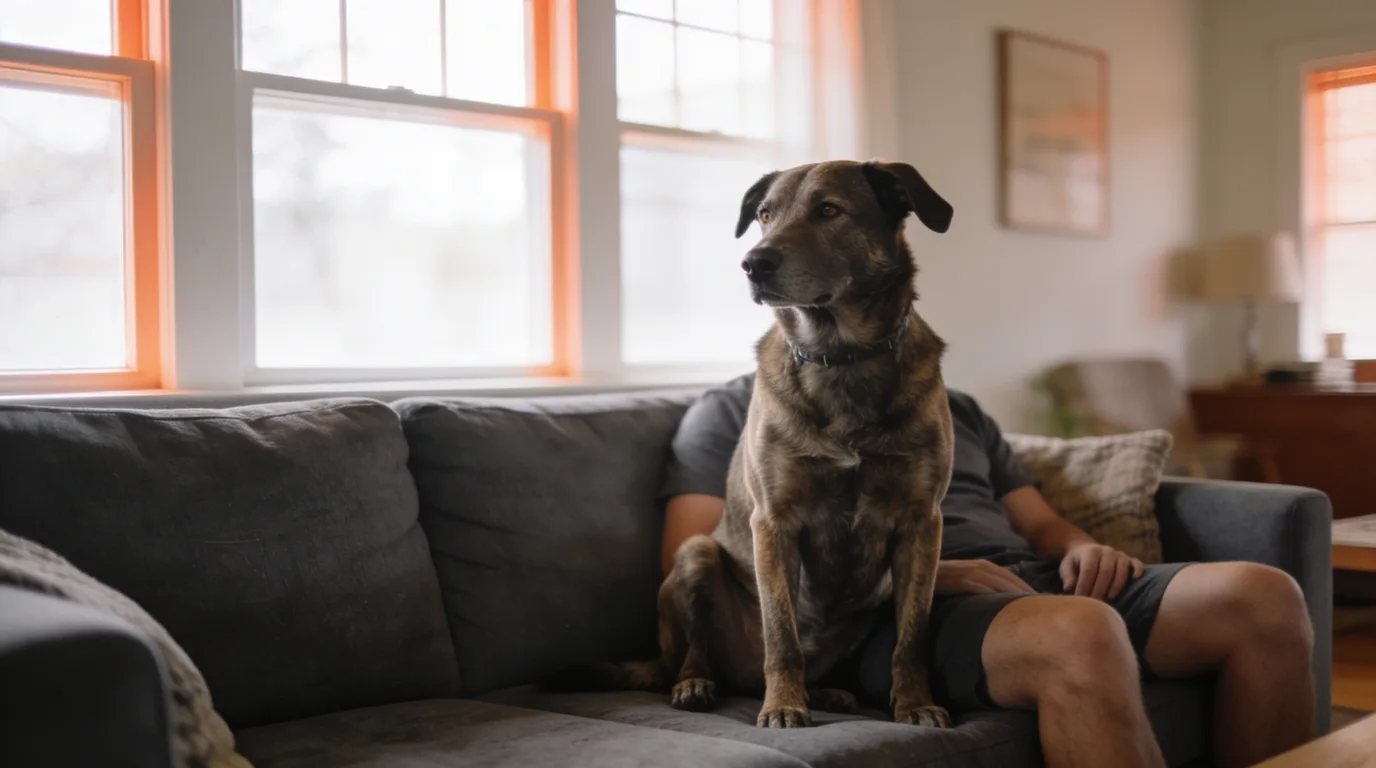
A dog sitting on their owner is doing one of six things: seeking affiliative contact, seeking security, seeking warmth, performing a behavior that has reliably produced attention, guarding a resource that happens to be a person, or running a habit that no longer needs a reason. Five of those are unremarkable. One of them — guarding — is the reason this behavior deserves a careful article rather than a cute one, because it is the version owners most consistently misread as affection and the version with actual bite risk attached.
The good news is that the six causes are separable, and the separation does not require expertise. Three observations do most of the work: what the dog's body is doing while sitting on you, what the dog does when another person or animal approaches, and whether the behavior spikes when guests arrive. Those three answers point at a cause with reasonable reliability. What follows walks through each cause, the markers that identify it, the specific diagnostic sequence, and — for owners who need their lap back — how to teach an alternative without punishing a dog for wanting contact.
The six causes
1. Affiliative contact-seeking
The default explanation, and the correct one in most households. Dogs are a contact-resting social species. Free-ranging dogs and familiar dogs in shelters rest touching, lean against one another, and sleep in physical contact. Directed at a human attachment figure, that same behavior produces a dog in your lap.
What it looks like: loose musculature, weight settled rather than braced, a soft face, relaxed jaw, sometimes a sigh and a full postural release within a minute of sitting down. The dog frequently faces away or sideways, which is a low-vigilance orientation, and often falls asleep. If you shift, the dog adjusts and resettles rather than snapping awake.
What it is not: a statement about rank, an attempt to control you, or a claim on territory. Contact during rest is baseline social behavior in this species and needs no further explanation.
2. Security-seeking
Contact reduces uncertainty. A dog who has learned that proximity to a specific person predicts safety will move into contact when the environment becomes unpredictable — during storms and fireworks, when unfamiliar people enter, at the veterinary clinic, in a new house, or during household conflict.
What it looks like: the same position with completely different mechanics. Tension in the shoulders and hindquarters, weight braced rather than settled, ears back or held tightly, whale eye as the dog tracks something without turning their head, repeated lip licking, panting in a cool room, and a failure to settle even after several minutes. The dog is oriented toward whatever is worrying them, not away from it.
The timing is the giveaway. Security-driven sitting is event-linked. It begins when something changes and ends when the thing resolves. If your dog sits on you during the fireworks and lies on the floor the rest of the year, you have your answer, and the intervention is noise-related rather than contact-related.
3. Thermoregulation
Underrated and very common. Heat loss scales with surface area while heat production scales with mass, so small, lean, and thin-coated dogs lose warmth quickly at rest. A human body is a 98.6°F heat source that also blocks drafts on one side.
What it looks like: strongly seasonal, worse in cold rooms and on hard floors, better in summer. The dog often chooses the warmest available person rather than the most bonded one, gravitates toward blankets and sunbeams with equal enthusiasm, and may leave once thoroughly warm. Chihuahuas, Italian Greyhounds, Whippets, Greyhounds, Miniature Pinschers, Vizslas, and short-coated bully types are heavily over-represented. Double-coated northern breeds usually do the opposite and seek tile.
4. Learned attention-seeking
Dogs repeat what works. If sitting on you has ever produced petting, conversation, laughter, a photograph, being physically lifted off with hands-on contact, or even a scolding, the behavior has been reinforced. Attention is attention; the dog's nervous system does not grade it as positive or negative in the way an owner does.
What it looks like: it is aimed at a person who is otherwise occupied. The dog waits until you pick up the phone, open the laptop, start a video call, or begin talking to someone else, then moves into your lap. It is frequently paired with other established request behaviors — pawing, nose-nudging, sustained staring. Crucially, the dog usually does not settle. Attention-seeking contact is a means to an end, and once the attention arrives the dog often gets up again.
Intermittent reinforcement is why this one is so durable. A behavior that pays off unpredictably — most of the time you push the dog off, occasionally you laugh and pet them — is far more resistant to extinction than one that pays off every time. That is not a flaw in your dog. It is how reinforcement schedules work.
5. Resource guarding of you
This is the cause owners must not miss. Resource guarding is a normal, evolutionarily sensible behavior pattern in which a dog controls access to something of value. The valued item is usually food, a chew, or a resting place. It can also be a person, and a dog sitting on that person is in an ideal position to control access to them.
What it looks like: the position is a platform, not a rest. The dog is upright rather than settled, oriented outward, and monitoring the room. The diagnostic moment is when a second individual approaches — a partner, a child, another dog. Watch for a hard stare, a freeze, a stillness that arrives suddenly, a lifted lip, a low growl, a raised tail base with tension through the spine, or the dog repositioning to place their body between you and the approacher. Some guarding dogs show none of this until contact is imminent, then escalate abruptly.
What makes it dangerous is the misreading. "He's so protective of me" is the sentence that precedes a large share of household bites involving partners and children. The behavior is not devotion; it is a dog managing perceived competition, usually driven by anxiety about losing access rather than by confidence. Left unaddressed, the pattern tends to generalize — from the sofa to the bed, from one person to several, from a freeze to a snap. Full treatment framework in dog resource guarding.
6. Habit
The least interesting and most common maintaining cause. A behavior that began for a thermal or emotional reason years ago can persist long after the original driver is gone, because it has been rehearsed thousands of times and nothing has interrupted it.
What it looks like: invariance. The same time of evening, the same chair, the same approach path, the same orientation, regardless of temperature, mood, or who else is in the room. Habit-driven contact is unresponsive to context precisely because context is no longer doing the work.
The diagnostic
Three observations separate the six causes. Run them in order.
Observation 1 — Body tension while sitting. Sit still and look at the dog on you rather than at their face alone. Are the limbs slack or braced? Is the weight distributed or held? Is the jaw loose or closed and tight? Does the dog sigh, blink slowly, and release, or hold a posture? A dog who reaches full postural release within ninety seconds is not anxious and not guarding.
Observation 2 — What happens when someone approaches. Have a familiar household member walk toward you at a normal pace while the dog is in position. Watch the first two seconds. Neutral or friendly dogs stay loose, may wag, may get up to greet. Anxious dogs press closer or try to get behind you. Guarding dogs go still. That stillness is the single most informative signal in this entire article. Do not run this test with a child, and do not run it at all if your dog has already growled at anyone in this context.
Observation 3 — Does it spike when guests arrive? A dog whose lap-sitting is dramatically worse with visitors present is telling you the behavior is driven by the social situation. That points to either security-seeking or guarding, and Observation 2 discriminates between them.
| Cause | Body tension | When someone approaches | Timing pattern | First move |
|---|---|---|---|---|
| Affiliative contact | Loose, settles fully, often sleeps | Stays relaxed; may get up to greet | Evenings, rest periods, year-round | Nothing required |
| Security-seeking | Braced, panting, poor settling | Presses closer or hides behind you | Tied to storms, guests, novelty | Treat the trigger, not the contact |
| Thermoregulation | Curled tight, seeks warmth, settles | Largely indifferent | Cold weather, hard floors, evenings | Warm bed, blanket, draft-free spot |
| Attention-seeking | Alert, doesn't settle, gets up after | Often redirects to the new person | When you are busy or on a device | Reinforce an alternative behavior |
| Guarding | Upright, oriented outward, freezes | Stillness, hard stare, lip lift, growl | Worse with guests and other pets | Stop testing; call a professional |
| Habit | Neutral, unremarkable, settles | Unremarkable | Identical every day, context-independent | Nothing required |
Two caveats. Causes overlap constantly — a cold, anxious, well-practiced dog is a single dog with three drivers. And orientation alone proves little: a dog facing away from you may be relaxed and low-vigilance, or may be monitoring the room. Orientation only carries meaning when read alongside muscle tone and approach response, which is the same rule that governs every other channel in dog body language.
The guarding case, in more detail
This section is the reason the article exists.
What guarding actually is. A dog controlling access to a valued resource through distance-increasing signals. The signal ladder is consistent and predictable: stillness, then a hard stare, then a lip lift, then a growl, then an air snap, then a bite. Every rung is a communication. The dog is not malfunctioning; they are asking for something to stop, in the only vocabulary available.
Why a person is a plausible resource. People deliver food, access to outdoors, physical comfort, and safety. A dog with a history of unpredictable access to those things — many rescue and rehomed dogs, dogs from resource-scarce early environments, dogs who compete with other household animals — can come to treat access to a person as something worth defending. Anxiety is usually the engine, not confidence.
The markers, in the order they appear:
- A sudden freeze. The dog stops moving completely, including stopping a wag mid-motion. This is high-grade and frequently missed because "quiet" reads as "fine."
- Hard stare. Locked eye contact on the approacher, reduced blink rate, head lowered slightly.
- Whale eye. Head turned away while the eyes track, showing a crescent of sclera.
- Body blocking. The dog repositions to interpose themselves, often shifting weight onto you.
- Lip lift or a wrinkled muzzle, sometimes lasting under a second.
- A low growl, which is the clearest and most useful signal the dog has.
- Air snap, then bite.
Context multipliers that raise risk: children in the household, another dog who also seeks lap access, the resource being on furniture where the approacher must lean over the dog, the owner reaching for the dog's collar, and any concurrent pain condition. Pain lowers bite thresholds substantially, which is why a dog who develops resource guarding in middle or old age needs a veterinary work-up before anything else — see pain signals in older dogs.
What not to do: do not stage repeated approaches to "prove" the dog is fine, do not have the guarded-against person offer treats while walking toward the dog (badly timed, this teaches the dog that approach predicts conflict and that food precedes it), do not use aversive tools, and do not attempt a DIY counter-conditioning protocol found in a forum. Guarding directed at people is one of the few behavior problems where a well-intentioned amateur plan reliably makes things worse.
What to do: manage first. Stop the rehearsals. Keep the dog off laps and furniture using a comfortable alternative resting place, prevent the approach scenarios that trigger the display, and have all household members avoid leaning over or reaching toward the dog while they are in contact with the guarded person. Then get a credentialed professional involved. Management is not a cure, but it stops the pattern strengthening while you arrange help.
Size-blind behavior in large breeds
Large sociable breeds — Labradors, Golden Retrievers, Great Danes, Newfoundlands, Bernese Mountain Dogs, Rottweilers, Mastiffs, Standard Poodles, Greyhounds — very frequently attempt to sit on people. They are not confused about their size. They are running a contact-seeking strategy that was reinforced when they weighed fifteen pounds and never received any information that the strategy had expired.
This matters for three practical reasons.
It is not misbehavior. A 130-pound dog climbing onto a lap is doing exactly what a 13-pound dog does. Treating it as defiance rather than as an unmodified habit leads owners toward corrections that suppress contact-seeking generally, which is both unkind and counterproductive.
It carries genuine physical risk. Falls, bruising, and injury to elderly household members and small children are real outcomes. Redirecting the behavior in a giant breed is a safety matter, not a preference.
It can mask other causes. Because size makes the behavior conspicuous, owners of large dogs often focus on the mechanics and skip the diagnostic. A Rottweiler who sits on their owner and freezes when a partner approaches has a guarding problem, and the size of the dog is the least important fact about the situation.
The alternative that works best for large dogs is a lean or a "chin" behavior — the dog stands or sits beside you and rests their head or shoulder against your leg. It satisfies the contact drive, it is teachable in a week, and it removes the physical risk entirely.
Teaching an alternative without punishing contact-seeking
The goal is never to reduce a dog's desire for contact. The goal is to move the contact into a form that works for both of you.
Step 1 — Rule out the two causes that require different handling. If the diagnostic points to guarding, stop here and get professional help. If it points to security-seeking driven by a specific trigger, treat the trigger — the contact is a symptom, and suppressing a symptom in an anxious dog raises distress. Everything below applies to affiliative, thermal, attention-seeking, and habit-driven contact.
Step 2 — Pick the replacement and make it concrete. Good options: a settle on a mat placed beside your chair, a "lean" against your leg from a standing or sitting position, a chin rest on your knee, or lying down with the head or one paw in contact. Vague criteria produce vague results, so decide exactly what you want and describe it in one sentence.
Step 3 — Make the replacement pay better than the lap does. This is the whole mechanism. The mat gets food delivered on it. The chin rest gets immediate calm praise and a slow ear rub. The lap gets a neutral, unexciting non-response — you stand up without comment, or you gently slide the dog off without conversation, eye contact, or drama. Attention is the reinforcer, so the difference between the two options has to be a difference in attention.
Step 4 — Capture calm. Several times each evening, when the dog is already lying in the right place doing nothing, quietly deliver a piece of food without a cue. Calm behavior is chronically under-reinforced in most households because it does not demand a response.
Step 5 — Make the alternative physically better. A bolstered bed beside your chair, warmed with a blanket and topped with a worn t-shirt, competes on the same three variables a lap competes on: enclosure, heat, and your scent. Cold, flat, unscented mats lose this contest every time.
Step 6 — Add a cue once the behavior is reliable. Only after the dog is offering the alternative voluntarily and often. Name it then — "settle," "mat," "chin" — and start asking for it before the dog gets to the lap rather than after.
Step 7 — Ride out the extinction burst. When a well-reinforced behavior stops paying, it intensifies briefly before it declines. A few days of more insistent lap attempts is the expected shape of that curve. Consistency across every person in the household is what determines whether it resolves in one week or three months.
Step 8 — Do not use aversives. No knees to the chest, no shouting, no spray bottles, no shock, vibration, or prong collars. The AVSAB Position Statement on Humane Dog Training is explicit that aversive methods carry elevated risk of fear, anxiety, and aggression, and they are particularly ill-suited here because the behavior being punished is social approach. Punishing approach is how you damage the thing you were trying to protect.
What people get wrong
"He's being dominant." The dominance framework applied to pet dogs derives from mid-century observations of unrelated captive wolves and was retracted by the researcher most associated with it after wild packs — family groups — were studied properly. The AVSAB has formally rejected it. Sitting on a person encodes no rank information. The longer argument is in why dominance theory is wrong.
"He's claiming me / marking me as his." Not a mechanism that exists. Dogs do scent-mark, and it does not look like sitting. The behavior described by this phrase is usually either affiliative contact or resource guarding, and those two require opposite responses, which is exactly why the folk explanation is harmful.
"She's protecting me." Sometimes the behavior described is guarding, which is not protection and is not in your interest. More often the dog is simply resting on a warm, familiar surface. Neither reading benefits from the protection framing.
"It's affection, so I shouldn't change it." Affection and inconvenience are compatible. You are allowed to want your lap back. Teaching an alternative contact behavior does not reduce the relationship, and the dog does not experience a redirected settle as rejection provided the alternative is reinforced properly.
"Pushing him off teaches him not to do it." Physically pushing a dog off is hands-on contact, delivered immediately, with eye contact and usually with speech. For most attention-seeking dogs that is a reward. Standing up without comment is the neutral option.
"He only does it to me, so it must mean I'm his favorite." Possibly. It equally often means you are the person who sits still longest, sits in the warmest chair, or was the one who reinforced it first. Preference and reinforcement history are difficult to separate from the outside.
When to get professional help
See a veterinarian first if:
- The behavior is new in an adult dog with no environmental change
- It appeared alongside irritability, reluctance to be touched, changed appetite or thirst, or difficulty rising
- The dog also shows new sensitivity to noise or handling
- An older dog has become notably clingier — see senior dog behavior changes
Engage a credentialed behavior professional if:
- The dog freezes, hard-stares, growls, snaps, or bites when anyone approaches you
- There is tension between the dog and another household animal over access to you
- The dog cannot be alone at all, or shows distress at departures — see dog separation anxiety
- Contact-seeking is escalating week over week rather than stable
- There are children in the household and any guarding markers have appeared
Credentials that indicate force-free, evidence-based practice: DACVB (Diplomate, American College of Veterinary Behaviorists), CDBC (Certified Dog Behavior Consultant), CSAT (Certified Separation Anxiety Trainer), KPA-CTP (Karen Pryor Academy Certified Training Partner), Fear Free certification, and IAABC membership. Guidance on vetting one is in how to find a credentialed behaviorist.
Avoid practitioners marketing "pack leadership," "alpha rolls," or "balanced training," the last of which generally indicates aversive tools. For guarding directed at people, a veterinary behaviorist is the appropriate first call, since medication is sometimes an adjunct to behavior modification in anxiety-driven cases and only a veterinarian can assess that.
Try it on your own dog
The three-observation diagnostic above is straightforward to run and easy to talk yourself out of. A second opinion helps.
PetTranslator.ai uses the same framework. Upload one clear photo of your dog in the position — ideally a side view showing the whole body rather than a close-up of the face — and it returns a structured report: the observed markers first (muscle tone, weight distribution, ear and tail position, facial tension, orientation), then the behavioral interpretation, a confidence score with the reasoning behind it, an explicit list of what a single still frame cannot determine, and a Do/Avoid plan for the coming week.
For this question specifically, the most useful photograph is not the peaceful one. It is the frame taken while someone else is walking into the room. That is where the answer lives.
Sources
- AVSAB Position Statement on Humane Dog Training (2021) — American Veterinary Society of Animal Behavior.
- AVSAB Position Statement on the Use of Dominance Theory in Behavior Modification of Animals.
- Karen Overall, Manual of Clinical Behavioral Medicine for Dogs and Cats (Elsevier, 2013) — clinical reference for resource guarding, attachment, and anxiety-driven proximity-seeking.
- Turid Rugaas, On Talking Terms with Dogs: Calming Signals (Dogwise, 2nd ed. 2005) — displacement and appeasement signal catalogue.
- Patricia McConnell, The Other End of the Leash (Ballantine, 2002) — primate versus canid contact norms and the misunderstandings they generate.
- Jean Donaldson, Mine! A Practical Guide to Resource Guarding in Dogs (Dogwise, 2002) — standard practitioner reference on guarding.
- Published findings that aversive training methods are associated with higher rates of fear-related and aggressive behavior than reward-based methods.
- Established behavioral principle that intermittently reinforced behaviors are more resistant to extinction than continuously reinforced ones.
Khabir Mughal is the founder of PetTranslator.ai. This article was reviewed against the AVSAB Position Statement on Humane Dog Training and Karen Overall's Manual of Clinical Behavioral Medicine before publication. It is not veterinary advice — if your dog has growled, snapped, or bitten in this context, consult a veterinarian and a credentialed behavior professional.