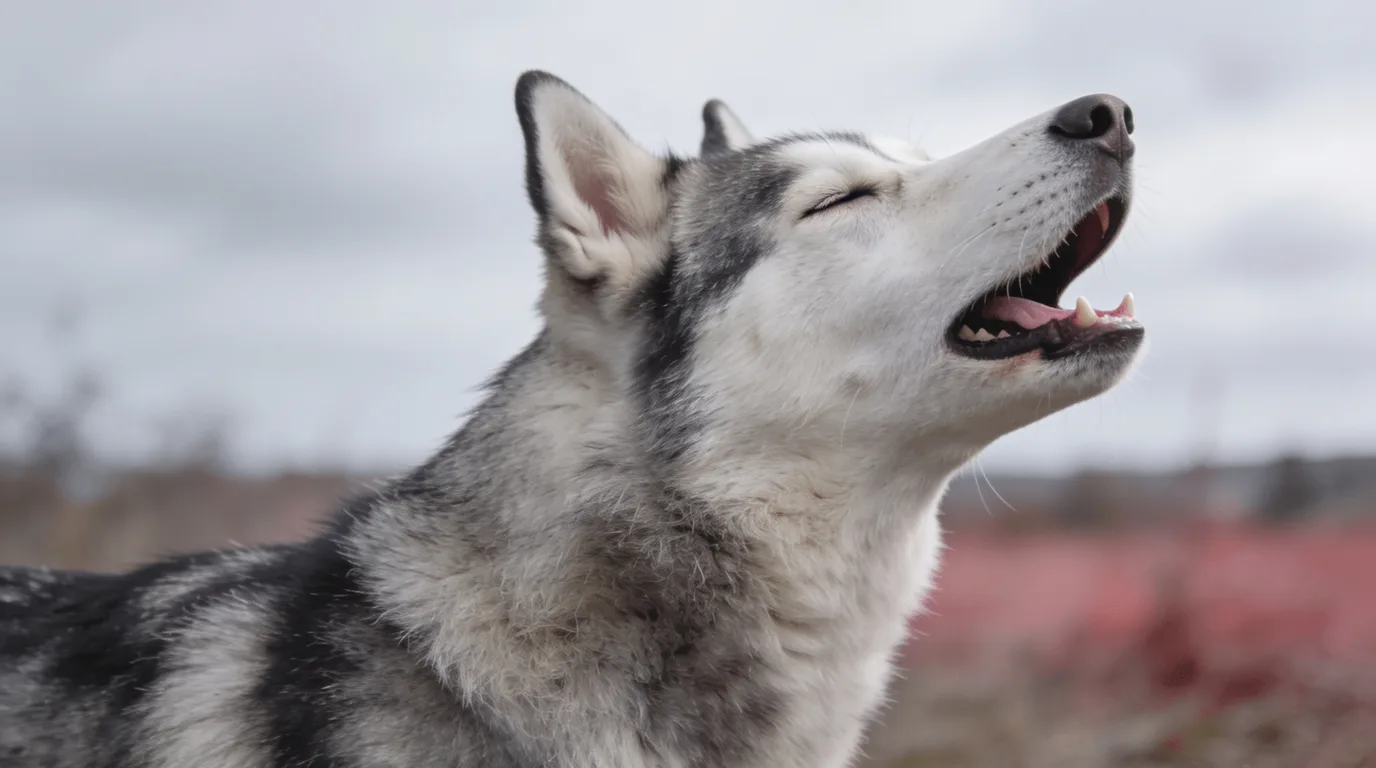
The behavioral core of the Siberian Husky is an independent working style paired with low handler dependence. The breed was developed to cover long distances in a team, at a sustainable pace, making continuous small decisions about footing and line tension without a person close enough to direct them. A dog running lead on a trail is not waiting for instruction. It is solving a problem, and the solutions that worked got the team home. Selection for that job produced a dog that is intelligent, physically extraordinary, socially sophisticated with other dogs, and constitutionally uninterested in taking moment-to-moment direction from a human.
Almost every complaint filed against the breed traces back to that single fact. The "stubbornness," the unreliable recall, the fence escapes, the destruction, and the celebrated vocal repertoire are all the same trait viewed from different angles. This guide takes the breed on its own terms — including an honest section on why a Siberian Husky is a poor match for a large share of the homes that want one. That honesty is not a criticism of the breed. It is the only useful thing to say about a dog that is surrendered as often as this one.
What the Siberian Husky was actually selected for
The breed's foundation stock comes from the Chukchi people of northeastern Siberia, who maintained sled dogs as working infrastructure over a very long period. The job was distinctive: haul relatively light loads over long distances at a moderate, sustainable speed in extreme cold, on limited food. That specification is different from the heavy freighting job that shaped larger northern breeds, and it selected for endurance and efficiency rather than power.
Several behavioral consequences follow directly.
Autonomous decision-making. A dog in a running team assesses ice, drifts, and footing faster than the human on the sled behind it. Dogs that deferred continuously to the driver were slower and less safe than dogs reading the ground themselves. Independence was not tolerated; it was required.
Sociality with other dogs. Team dogs live and work in close physical contact, and selection strongly favored dogs that could be harnessed alongside unfamiliar dogs without conflict. Most Siberians are notably relaxed around other dogs relative to the general pet population.
High scavenging drive. Fed sparsely and worked hard, the historical population had every reason to acquire food opportunistically. Modern Siberians are accomplished counter surfers.
Movement as the default state. A dog built to trot for hours has no off switch that engages after twenty minutes in a yard.
Cold adaptation. The double coat, compact feet, and metabolic profile that make an arctic sled dog viable also make a Siberian genuinely uncomfortable in warm climates.
The 1925 relay that carried diphtheria antitoxin to Nome is where most of the breed's public reputation comes from. What it actually demonstrates is the specification: distance, cold, endurance, and dogs making their own decisions where no handler could see the trail.
What breed actually predicts — and what it does not
The caveat matters here more than in most breed guides, because Husky content online is unusually deterministic.
Breed describes population tendencies, not individuals. The largest genomic study on this question — Morrill and colleagues, published in Science in 2022 using the Darwin's Ark dataset of tens of thousands of genotyped, owner-surveyed dogs — found that breed accounted for only a modest share of the behavioral variation between individual dogs, roughly a tenth of the total. Most variation was found within breeds. Biddability showed one of the clearer breed signals in that dataset, which is directly relevant here, but even a clear signal is a shifted average rather than a rule.
The practical reading: some Siberian Huskies have workable recall. Some are quiet. Some tolerate being left alone without difficulty. Those dogs are real and they are not rare. What the breed information tells a prospective owner is which failure modes to plan for, not which behaviors are guaranteed. Set the environment up for the breed-typical version of the dog, then adjust to the individual actually in front of you.
Low biddability is a design feature, not disobedience
"Biddability" is the technical term for a dog's inclination to take and act on direction from a human, and it varies enormously across breeds because it was selected at very different intensities. A Border Collie was bred to work in continuous dialogue with a handler. A Siberian Husky was bred to work with the handler a hundred feet behind, out of earshot, for hours.
Low biddability is not low intelligence and it is not defiance. A Siberian learns a cue in about the same number of repetitions as any comparable dog. What differs is the probability of performing it when something better is available: the behavior with the stronger reinforcement history wins.
Two training consequences. Reinforcement has to be genuinely high-value and genuinely variable, because this breed habituates to a predictable payout unusually fast. And environmental management does more work here than training does — pretending otherwise is how dogs end up loose on a highway.
The vocal repertoire
Siberian Huskies are among the most vocal breeds in the pet population, and the vocalizations mean different things. Reading them as one undifferentiated "noise problem" produces the wrong response almost every time.
| Vocalization | Typical context | What it usually indicates |
|---|---|---|
| Sustained howl | Sirens, other dogs howling, departures, group arousal | A long-range contact call — a social locator signal, not inherently distress |
| Group howl | Multiple dogs, usually initiated by one | Social synchrony; contagious and self-reinforcing |
| "Talking" — modulated woo-woo, grumbles, rising whines | Greetings, food preparation, being asked to do something | Attention-directed and heavily shaped by how the household responds |
| Scream or protest vocalization | Nail trims, restraint, harness fitting, veterinary handling | Low restraint tolerance combined with fear — a genuine distress signal |
| Bark | Startle; brief alert | Uncommon in this breed; a barking Husky is worth a second look |
| Whine at a barrier | Crate, closed door, fence line | Frustration or social isolation, and frequently a precursor to escape attempts |
Howling is a contact call, not a complaint. In wild canids the long howl functions as a long-distance signal that locates group members and advertises presence. Siberians retain that repertoire in a form closer to the ancestral pattern than most modern breeds. A Husky who howls at a passing siren is responding to a stimulus in the right acoustic range. A Husky who howls in a group is participating in a highly contagious social behavior. Neither is evidence of sadness, and treating them as distress leads owners to comfort or correct behavior that needed neither.
Howling on departure is different, and worth taking seriously. Sustained howling that begins within minutes of the owner leaving, continues for the length of the absence, and pairs with destruction at exit points, salivation, or house-soiling is a separation-related problem. See separation anxiety in dogs. The distinguishing features are duration, escalation, and the presence of other distress behaviors — not the sound itself.
"Talking" is operant, not conversation. The modulated grumbling that this breed is famous for is a learned, reinforced behavior in most households. It started as an arousal-driven vocalization, someone responded to it, and it strengthened. It is not language, and the dog is not producing content. It is a highly effective attention behavior in a breed that vocalizes readily. If a household enjoys it, nothing needs fixing. If it has escalated into demand vocalization at 5am, the fix is to reinforce an alternative behavior rather than to punish the existing one — punishing vocalization in this breed tends to raise arousal and produce more of it.
Barking is rare because it was never elaborated here. Barking is greatly expanded in domestic dogs relative to wolves, but the degree varies sharply across breed groups, and the northern spitz-type breeds retain a repertoire weighted toward howling and modulated whines. A Siberian who suddenly starts barking persistently has changed baseline, and baseline change is a veterinary question before a behavioral one.
The escape drive
This is the section that matters most for the dog's physical safety.
Siberian Huskies roam. The drive to move over distance is not a symptom of unhappiness, boredom, or a failed relationship — a well-exercised, well-loved Husky in an enriched home will still leave through an open gate. Owners routinely interpret an escape as a referendum on their care. It is not. It is a motor pattern that was selected for over centuries, running in a suburb.
Why fences fail. Four-foot fencing is routinely cleared. Six-foot fencing is defeated by climbing where there is any purchase — a woodpile, a bin, a chain-link weave. Digging under is the most common route, and Siberians dig efficiently. Gate latches get manipulated. Gaps get widened.
| Containment element | How the breed defeats it | Working specification |
|---|---|---|
| Fence height | Jumped or climbed | Six feet minimum, with no climbing purchase within reach |
| Fence base | Digging under | Buried apron, L-footer, or concrete footing along the full line |
| Gates | Latch manipulation, gaps | Self-closing, secondary carabiner or padlock, checked every time |
| Unsupervised yard time | Escape rehearsal is self-reinforcing | Supervise; do not leave the dog outside unattended |
| Dog park double gates | Slipping the inner gate | Leash stays on until the inner gate is fully closed |
| Buried or electronic containment | Not a containment tool for a dog at speed; aversive and unreliable | Not appropriate — see the AVSAB position on aversive tools |
Recall is genuinely unreliable in this breed, and the honest advice is unpopular. Recall competes with an ingrained drive to run, and the drive is very strong. A recall can be trained, should be trained, and will work in low-distraction environments — see how to teach recall. What it will not reliably do is override a Siberian in full stride at two hundred meters with a rabbit in view. Most experienced Husky owners and most Siberian-specific rescues arrive at the same conclusion: this breed stays leashed or long-lined in unfenced areas, permanently, regardless of training history. That is not a training failure. It is a risk assessment about a dog that can cover several miles before stopping.
A thirty- to fifty-foot biothane long line on a well-fitted harness gives most of the freedom of off-leash running with none of the catastrophic downside. Canicross, bikejoring, scootering, and skijoring are better answers still: they use the breed's actual drive rather than fighting it.
Prey drive and small animals
Predatory behavior is well developed in this breed and is a real safety issue for cats, rabbits, chickens, and small dogs. Historical feeding practices allowed and in some periods required dogs to supplement their own food, and nothing about the modern breed has removed the sequence.
Predatory behavior is not aggression. It is a distinct motor pattern — orient, stalk, chase, grab, kill — driven by different mechanisms, triggered by movement rather than conflict, and unaccompanied by the threat display that precedes defensive aggression. The practical implication is that it does not respond to the interventions used for reactivity, and a dog can be completely relaxed one second and in full chase the next with no warning ladder in between.
Some Siberians live successfully with cats, typically when raised with them from puppyhood and always with management. Many do not. Prospective owners with small pets should treat this as a real constraint and plan for permanent physical separation rather than assuming socialization will resolve it.
Social needs, separation, and the under-exercised pattern
The breed is highly social and poorly suited to solitude. Team dogs were never alone. Most Siberians do best with either substantial human presence or another dog, and the modern default of an eight-to-ten-hour empty house is a difficult fit. The result is not always clinical separation anxiety; more often it is a frustration and isolation problem that produces howling, digging, and destruction, and the two require different plans. See signs your dog is stressed.
Under-exercised Siberians are destructive in a characteristic way. Drywall, door frames, baseboards, flooring at exit points, and excavation in yards. The pattern is directional — it targets boundaries and exits — and it is exactly what an animal built to travel does when confined.
Exercise requirements are high and largely non-negotiable. An adult Siberian in good health needs a minimum of ninety minutes to two hours of genuine physical output daily, and most do better with more. Leash walking alone rarely reaches that threshold. Running, long-line hiking, pulling sports, and structured play with other dogs do.
Cognitive load reduces the total needed. Scent work, food puzzles, scatter feeding, and shaping sessions bring arousal down more efficiently per minute than additional distance. A Siberian whose brain has been used is easier to live with than a Siberian who has merely been tired out.
Heat intolerance changes behavior
The coat, the metabolism, and the circulatory adaptations that make this breed viable in arctic conditions are liabilities above roughly 20°C / 70°F. Behaviorally, a warm Siberian slows down, refuses walks, seeks tile and shade, becomes irritable about handling, and may stop eating. Owners regularly read the refusal as stubbornness. It is thermoregulation.
Practical adjustments: exercise at dawn and after dark in summer, provide hard cool surfaces and shade, use water rather than confinement to cool the dog, and watch for heavy panting with brick-red gums, disorientation, or collapse — all veterinary emergencies. Do not shave the double coat. The undercoat insulates against heat as well as cold and the guard coat protects against sunburn; shaving removes both and can permanently alter regrowth.
Common misreads
"He's dominant / I need to be the pack leader." No breed attracts this framing more, largely because of its wolf-adjacent appearance. It is wrong on the evidence. The dominance model applied to pet dogs came from mid-century observations of unrelated captive wolves, and David Mech — whose early work popularized the idea — spent decades publicly correcting it after studying wild packs, which are family groups. The AVSAB has formally rejected dominance-based training. What looks like dominance in a Siberian is low biddability, under-motivation, frustration, or arousal. See why dominance theory is wrong.
"He's talking back to me." The vocalization is not content and is not defiance. It is a reinforced attention behavior in a breed with an unusually rich vocal repertoire.
"The howling means he's miserable." Sometimes. Usually it is a contact call triggered by a sound in the right range or by another dog. Duration, context, and accompanying behaviors distinguish the two.
"He escaped because he isn't happy here." Roaming is a drive, not a verdict. Treating an escape as a relationship problem delays the fencing work that would actually keep the dog alive.
"He'll grow out of the running." He will not. The drive persists into old age, moderating with physical decline rather than with maturity.
"He ignored the recall, so he's being disobedient." He was outcompeted. Reinforcement history for chasing is enormous; reinforcement history for returning is usually not. Fix the ratio, and manage the environment while you do.
"He's fine in the heat, he has a coat." The coat is arctic insulation, and this breed is at meaningful heat-stroke risk in conditions other dogs tolerate easily.
"He's aggressive with the cat." Predation and aggression are different systems with different triggers and different management. Calling it aggression produces the wrong protocol.
Health conditions that present as behavior change
Any abrupt behavior change in a previously stable Siberian is a veterinary question before it is a behavioral one.
Hereditary eye disease. The breed carries elevated rates of juvenile cataracts, corneal dystrophy, and progressive retinal atrophy. Vision loss is progressive and easily missed indoors. It presents behaviorally as new hesitancy on stairs, bumping in low light, startling when approached from the side, and new defensive responses that read as reactivity. Any Siberian developing unexplained caution or startle deserves an ophthalmic exam.
Hypothyroidism. Produces lethargy, weight gain, coat and skin change, cold intolerance, and in some dogs a flattened affect or reduced tolerance. Diagnosable and treatable.
Zinc-responsive dermatosis. Documented in northern breeds and seen in Siberians. Crusting and hair loss around the muzzle, eyes, and pressure points, with chronic itch that shows up as restlessness, disrupted sleep, and shortened tolerance for handling.
Atopic and allergic skin disease. Common, chronically stressful, and a frequent hidden driver of irritability.
Hip dysplasia. Lower prevalence than in several large breeds but present. Reluctance to jump, altered gait, a bunny-hopping canter, and difficulty rising warrant screening rather than a training plan. See pain signals in older dogs.
Exertional and heat-related illness. A Siberian who quits mid-activity in warm weather is giving a physiological signal, not a behavioral one.
Training approach
Force-free is the method, and it is also the only thing that works here. The AVSAB's 2021 Position Statement on Humane Dog Training is clear that aversive tools — prong collars, choke chains, shock and e-collars — carry documented welfare and behavioral risk and should not be first-line for any dog. In a low-biddability breed the fallout arrives faster: pressure produces avoidance and disengagement rather than compliance, and a Siberian who disengages from a handler is very hard to bring back. See positive reinforcement vs balanced training.
Pay well and pay unpredictably. High-value food, variable reinforcement, and short sessions. A predictable payout loses value in this breed unusually fast.
Use the drive as the reinforcer. Permission to run, pull, dig in a designated pit, or sniff a long line is often worth more than food and costs nothing.
Train for the environment you will actually be in. Cues learned in a kitchen do not transfer. Generalize deliberately across locations, distances, and distraction levels, and expect the process to take longer than it would in a herding breed.
Build management first, training second. Fencing, long lines, harness fit, gate protocol, and household routines carry the safety load. Training improves quality of life on top of a system that is already safe without it.
Start cooperative care early. Restraint intolerance is high in this breed and produces the screaming that veterinary teams know it for. Consent-based handling, chin rests, and desensitization to nail trims and harnesses prevent a lifetime of adversarial visits.
Is a Siberian Husky the right dog?
The honest version.
Reasonable fit if the household can provide two hours of daily physical output year-round, has or will build genuinely secure fencing, accepts that the dog will effectively never be off-leash in unfenced space, tolerates substantial vocalization, sheds tolerance for heavy seasonal coat blow, has no small prey animals or can manage permanent separation, and is not left empty for full working days.
Poor fit if the appeal is primarily the appearance, if the household wants an off-leash hiking companion, lives somewhere persistently hot, needs a quiet dog for shared walls, wants a dog that will be reliably obedient off-cue, or expects the dog to settle into a low-activity routine.
The breed is surrendered in large numbers, and the reasons are consistent and predictable: escaping, vocalizing, destruction, and the discovery that the exercise requirement was not an exaggeration. None of that reflects badly on the dogs. It reflects a persistent mismatch between what the breed is and what people expect when they acquire one.
When to bring in a professional
Work with a credentialed force-free professional for:
- Separation distress with destruction, self-injury, or house-soiling in an otherwise trained dog
- Predatory behavior directed at household animals
- Resource guarding that escalates
- Escape behavior that persists despite containment work
- Restraint intolerance severe enough to prevent veterinary care
- Any abrupt behavior change in a previously stable adult — veterinarian first
Credentials that signal evidence-based, force-free practice: DACVB (Diplomate, American College of Veterinary Behaviorists), CDBC (Certified Dog Behavior Consultant), CSAT (Certified Separation Anxiety Trainer), KPA-CTP (Karen Pryor Academy Certified Training Partner), Fear Free certification, and IAABC membership. Avoid anyone marketing on dominance, pack leadership, or "balanced" methods. See how to find a credentialed behaviorist.
Try it on your own Husky
The framework here is the one PetTranslator.ai applies to uploaded photos. Upload a clear image of your Siberian — settled indoors, mid-greeting, or at the end of a long line — and the analysis returns a structured read: the observable body-language markers first, the interpretation second, an explicit note on what a single frame cannot assess, and a short Do/Avoid list. For this breed the useful discriminations are between predatory focus and defensive arousal, and between a heat-stressed dog and a bored one — both pairs look alike at a glance and call for opposite responses.
It is an instrument for building daily reading fluency and for tracking a dog's baseline over weeks. It does not replace a veterinary exam or a behavior consult, and it says so when a case looks complex.
Related reading
- Dog body language: the underlying framework — the signal vocabulary this guide assumes
- How to teach recall — worth training even in a breed where it stays a supplement to management
- Dog separation anxiety — distinguishing clinical distress from isolation-driven vocalization
- German Shepherd behavior guide — a direct contrast in handler orientation and biddability
Sources
- Morrill K, Hekman J, Li X, et al. (2022). "Ancestry-inclusive dog genomics challenges popular breed stereotypes." Science 376(6592). The Darwin's Ark analysis behind the breed-generalization caveat, including its findings on biddability.
- AVSAB (2021). Position Statement on Humane Dog Training. American Veterinary Society of Animal Behavior.
- AVSAB. Position Statement on the Use of Dominance Theory in Behavior Modification of Animals.
- Mech LD (1999). "Alpha status, dominance, and division of labor in wolf packs." Canadian Journal of Zoology 77. The author's own correction of the alpha model.
- Raymond Coppinger and Lorna Coppinger (2001). Dogs: A Startling New Understanding of Canine Origin, Behavior, and Evolution. Scribner. Sled-dog working behavior, conformation-to-function, and the origins of breed-typical motor patterns.
- Raymond Coppinger and Mark Feinstein (2015). How Dogs Work. University of Chicago Press. Canine vocalization and motor-pattern analysis.
- James Serpell (ed.). The Domestic Dog: Its Evolution, Behaviour and Interactions with People. Cambridge University Press. Reference volume for breed-group behavioral differences.
- Karen Overall (2013). Manual of Clinical Behavioral Medicine for Dogs and Cats, 2nd edition, Elsevier. Clinical reference for behavioral assessment and health-behavior overlap.
- American Kennel Club. Siberian Husky Breed Standard. The source document for the breed's described temperament and structure.
Khabir Mughal is the founder of PetTranslator.ai. This article was reviewed against the AVSAB Position Statement on Humane Dog Training, the Morrill et al. (2022) breed-genomics findings, and Karen Overall's Manual of Clinical Behavioral Medicine before publication. It is not veterinary advice — for sudden behavior change, see a veterinarian first.