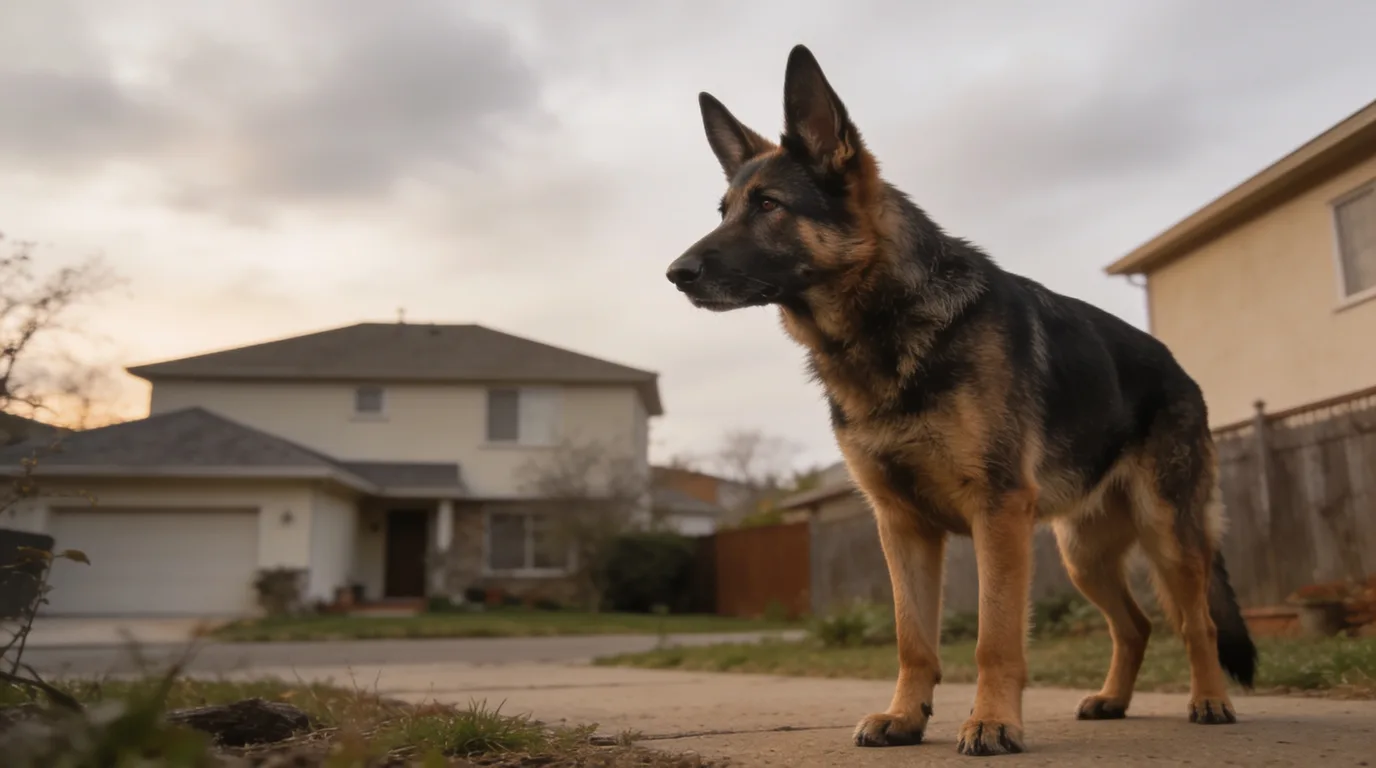
The behavioral core of the German Shepherd Dog is working drive routed through handler orientation. The breed was assembled at the end of the nineteenth century from regional German herding stock and then, within roughly two generations, redirected toward police and military service. Both jobs demanded the same underlying architecture: a dog that scans its environment continuously, sustains a task under pressure, and takes direction from one specific person. Nearly everything owners find remarkable about the breed — and nearly everything they find difficult — is that architecture running in a living room instead of on a boundary line or a patrol shift.
The combination produces a dog that is unusually rewarding to train and unusually easy to get wrong. Handler orientation makes a Shepherd exceptionally responsive; it also predisposes the breed to hyperattachment and separation distress. Environmental vigilance makes a Shepherd an effective alert dog; it also produces barking and lunging that owners, neighbors, and strangers read as aggression when the underlying state is usually arousal or fear. This guide covers the breed as it actually presents in pet homes, including the parts the breed-club material leaves out.
What the German Shepherd was actually selected for
The breed's formal history starts in 1899 with Max von Stephanitz, a former cavalry officer who set out to standardize the working herding dogs of the German countryside into a single registered breed. The job those regional dogs performed was not the gathering, driving work of a Border Collie. It was tending — moving a large flock along roads and between unfenced fields while patrolling a boundary the dog held in its head rather than on the ground. A tending dog trots a perimeter for hours, redirects individual animals that drift, and does it under continuous instruction from a shepherd walking behind.
Three requirements fall out of that job: tireless at a trot, continuous monitoring of a wide field for change, and sustained orientation to one handler across long days without constant reward.
Within twenty years the breed had been picked up for police work, military messenger and sentry duty, and later guide-dog and detection work. Selection shifted toward nerve strength under noise and chaos, sustained focus, willingness to engage rather than avoid, and a strong drive to work with a person rather than independently.
In a pet home those traits express as a dog that follows one person from room to room, patrols windows and doors, notices the neighbor's car three houses away, becomes restless when under-worked, and learns household routines faster than the household intends. None of it is a defect. It is a working specification with nothing to work on.
What breed actually predicts — and what it does not
Before going further, the honest caveat this breed needs more than most.
Breed predicts tendencies across populations. It does not predict individuals. The largest genomic study to date on this question — Morrill and colleagues, published in Science in 2022 using the Darwin's Ark dataset of tens of thousands of owner-surveyed dogs paired with genotypes — found that breed explained only a modest fraction of behavioral variation between individual dogs, on the order of one-tenth of the total. Most of the variation sat within breeds, not between them. Some traits, notably biddability and human sociability, showed a clearer breed signal than others; almost none behaved as a breed-level guarantee.
The practical reading: a statement like "German Shepherds are environmentally vigilant" describes a shifted average, not a rule, and a given Shepherd may be markedly less vigilant than the average Labrador. Breed information is useful for anticipating what may need managing and for setting up a puppy's early life well. It is not an explanation after the fact, and it is never a substitute for observing the dog in front of you. Where a Shepherd's behavior diverges from the breed picture, the dog is right and the picture is wrong.
Working lines and show lines — a real split
Most breed content treats the German Shepherd as one behavioral entity. It is not. Decades of divergent selection have produced populations with meaningfully different temperament profiles, and a prospective owner who does not know which one they are looking at is buying blind.
| Dimension | Working lines (West German working, DDR/East German, Czech, Belgian working stock) | Show lines (West German show, American show) |
|---|---|---|
| Primary selection pressure | Drive, nerve strength, grip, trainability under pressure, protection-sport and service performance | Conformation — structure, gait, coat, ring presence |
| Typical arousal profile | Higher baseline, faster escalation, generally faster recovery when trained | Moderate baseline; slower onset in many individuals |
| Environmental sensitivity | Often lower — nerve stability under noise and novelty is directly selected | More variable; under-confidence is a recognized problem in some lines |
| Daily work requirement | Very high; most individuals need a structured job, not just exercise | High, but a smaller share need formal sport |
| Common failure mode in a pet home | Frustration behaviors — barking, destruction, self-directed repetitive patterns, barrier reactivity | Under-confidence expressed as reactivity, avoidance, or noise sensitivity |
| Fit for a first-time owner | Generally poor without experienced support | Variable; still a demanding breed |
Neither column is "better." A working-line dog in a low-activity household is a welfare problem; a weak-nerved show-line dog in a busy urban environment is a different one. The mistake is assuming the pedigree label describes temperament on its own — within-line variation is still large, and a specific breeder's selection choices matter more than the category name.
Breed-typical behaviors in a pet home
Handler orientation that shades into hyperattachment. The Shepherd's defining social trait is preference for one person — tracking that person's movement, positioning to keep them in view, reorienting whenever they leave the room. Owners describe it as loyalty; functionally it is a selected-for tendency to maintain proximity and attention to a handler, and the cost is elevated baseline risk for separation-related distress. Mild following is ordinary. A dog who cannot settle unless the primary person is present, who panics at departure cues, or who vocalizes and destroys for the duration of an absence has crossed into separation anxiety and needs a structured protocol, not more crate time.
Environmental vigilance that reads as aggression. A Shepherd notices change. Movement at the window, a delivery van, footsteps in a stairwell, an unfamiliar dog two hundred feet away. The breed's response to noticed change is to orient, often to vocalize, and — on leash, where escape is not available — sometimes to lunge. This is the single most misread behavior in the breed. Vigilance plus arousal plus barrier frustration produces a display that looks like aggression to everyone watching, including the owner, when the internal state is frequently closer to alarm or conflict. The distinction matters because the interventions diverge completely. See reactive dog vs aggressive dog and leash reactivity.
Genuine predisposition to reactivity when under-socialized. This needs stating plainly rather than defensively. Survey research on breed differences in canine aggression — Duffy, Hsu and Serpell's work using owner-reported C-BARQ data — has repeatedly placed German Shepherds above the general population average for stranger-directed and dog-directed reactivity. That is a population-level shift, not a verdict on any individual dog, and it interacts heavily with early experience. A Shepherd puppy whose socialization window is spent in a quiet house meets adolescence with a vigilant temperament and no reference library for what is normal. The result is predictable and largely preventable.
Herding-derived control behavior. Tending stock leaves residue. In pet homes it shows up as heel nipping, circling a moving group, body-blocking a doorway, and persistent attempts to control the movement of running children. Owners frequently report the nipping as aggression; it is usually a fragment of a motor pattern triggered by fast, erratic movement. The behavior is still unacceptable — a Shepherd's mouth on a child is a real injury risk regardless of motivation — but the intervention is management plus an incompatible trained behavior, not punishment of a reflexive pattern.
Noise and startle sensitivity. More common in the breed than the working reputation suggests, particularly in show-line dogs and in individuals with limited early exposure. Fireworks, thunder, vacuum cleaners, dropped pans. Worth flagging: new or worsening noise sensitivity in an adult dog is associated with undiagnosed musculoskeletal pain and should trigger a veterinary exam before a behavior plan.
Prolonged adolescent arousal. Shepherds mature slowly, and the twelve-to-thirty-month window is where most owners seek help: mouthing, jumping, redirected biting at leashes and clothing under arousal, and an apparent collapse of previously reliable cues. It resolves with continued training and adequate outlets, not by waiting.
Reserved with strangers by design. The AKC breed standard describes a self-confident dog with a certain aloofness that does not produce immediate friendliness toward everyone. A Shepherd who declines a greeting, watches from a distance, then relaxes is showing breed-typical social caution — not fear, not aggression. Owners expecting Labrador-style sociability read this as a problem and push the dog into greetings it did not consent to, which is how genuine stranger-directed fear gets built.
The exercise and cognitive load
This is where most pet Shepherds are failed, and the shortfall is usually cognitive rather than physical.
An adult German Shepherd in normal health needs at minimum sixty to ninety minutes of real physical output daily, and most working-line individuals need more. Real output means sustained movement — long-line decompression walking on varied terrain, running, structured retrieve, hiking. A slow loop around the block is a bathroom break.
Physical exercise alone does not settle this breed. A Shepherd whose body is tired and whose problem-solving system has been idle all day will patrol, bark, and invent work. Twenty to forty minutes of daily cognitive load is a requirement, not enrichment garnish, and the effective options are the boring ones: scent work and nose games, marker-based shaping sessions, tracking on a long line, food dispensed through puzzles and scatter feeding rather than a bowl, and cooperative-care training. Structured sport is the cleanest solution where it is available — tracking, obedience, rally, agility, herding, scent detection. The specific sport matters far less than having a recurring, rule-governed task the dog and handler do together.
Under-worked Shepherds do not become calm. They become vigilant, vocal, destructive, and in a subset of cases develop repetitive behaviors — spinning, flank sucking, shadow chasing, compulsive licking — considerably harder to resolve than the original energy deficit.
Common misreads
"He's being protective of me." Occasionally accurate, usually not. Most on-leash displays toward strangers are the dog's own discomfort expressed at a distance the dog cannot control. A genuinely confident dog does not need to shout at a person forty feet away. Treating the behavior as protection reinforces the owner's tendency to allow it, and the display rehearses itself into a habit.
"He's trying to be dominant / I need to be the alpha." No breed attracts this framing more, and it is wrong on the evidence. The dominance model applied to pet dogs derives from mid-century observations of unrelated captive wolves; David Mech, whose own early work popularized it, spent decades publicly correcting the record after studying wild packs, which are family groups. The AVSAB has formally rejected dominance-based training. Behavior labelled dominant in a Shepherd is almost always fear, frustration, learned reinforcement history, or pain. See why dominance theory is wrong.
"He's stubborn." In a breed selected for biddability, apparent stubbornness is a signal, not a trait. The realistic causes, in order of frequency: pain, unclear training criteria, insufficient reinforcement value, cues never proofed outside the kitchen, or arousal too high to process input.
"The window barking is good — he's guarding the house." Window barking is arousal rehearsal on a fixed schedule. The trigger always leaves, so the behavior is reinforced every single time, several times a day, for years — and it generalizes to walks. Block visual access and pay the dog for an alternative behavior.
"He hates men in hats." Almost always a generalization failure from a thin early-life reference library, occasionally a single bad event. Either way the fix is desensitization and counterconditioning at sub-threshold distance, not exposure at full intensity.
"The nipping at the kids is aggression." Usually a herding fragment triggered by running and shrieking. It still has to stop immediately, but the plan for a control-motor-pattern problem differs from the plan for a fear-motivated bite, and misclassifying it produces the wrong protocol.
Health conditions that present as behavior change
Pain-first reading matters more in this breed than in most. The German Shepherd carries a heavy orthopedic and neurological load, several of its common conditions produce gradual decline rather than acute lameness, and the resulting behavior change is routinely misread as stubbornness, aging, or attitude.
| Behavior change | Frequently misread as | Rule out first |
|---|---|---|
| Reluctance on stairs; hesitates before jumping into the car | Stubbornness, "getting older" | Hip or elbow dysplasia; lumbosacral disease |
| Hind paws scuffing; nails worn on one side; hind legs crossing or knuckling | Clumsiness, laziness | Degenerative myelopathy; lumbosacral stenosis |
| New irritability when touched near the rear, tail base, or hips | Guarding, "attitude," dominance | Perianal fistula; anal sac disease; lumbosacral pain |
| Ravenous appetite with weight loss, loose pale stool, stool eating | Greed, food obsession | Exocrine pancreatic insufficiency |
| Sudden restlessness, pacing, unproductive retching, distended abdomen | Anxiety, upset stomach | Gastric dilatation-volvulus — emergency, same hour |
| New or worsening noise sensitivity in an adult | A phobia developing spontaneously | Musculoskeletal pain; hearing change |
| Shifting lameness in a 6–18 month old | Growing pains to be ignored | Panosteitis; elbow dysplasia |
Hip and elbow dysplasia. Both over-represented, both screenable in breeding stock through OFA or equivalent evaluation. Ask any breeder for those results on both parents; one who cannot produce them is not a responsible source.
Degenerative myelopathy. A progressive spinal cord disease strongly associated with the breed, involving a well-characterized mutation that can be DNA-tested. It is painless, which is precisely why it is missed. Early signs are proprioceptive — the dog scuffs a hind toe, crosses the back legs, loses precision on turns — and owners read the resulting hesitancy and refusal as disobedience. A mid-life Shepherd who "stops listening" about stairs and slick floors deserves a neurological exam before a training plan.
Lumbosacral stenosis (cauda equina syndrome). Common in the breed and a frequent source of rear-end pain, tail carriage change, reluctance to jump or sit squarely, and new sensitivity to handling around the hindquarters. Easily and often mistaken for a behavior problem.
Exocrine pancreatic insufficiency. The pancreas stops producing adequate digestive enzymes. The behavioral picture is a dog that appears insatiable, scavenges, eats stool, and loses weight while eating more. It is treatable and it is dramatically over-represented in German Shepherds.
Perianal fistulas. Painful ulcerating tracts around the anus, seen at elevated rates in the breed. Presents as straining, scooting, licking, and sudden intolerance of handling near the tail.
Gastric dilatation-volvulus (bloat). Deep-chested breeds carry elevated risk, and the presentation is behavioral before it is obvious: restlessness, pacing, inability to settle, repeated unproductive retching. An emergency measured in hours.
Chronic allergic skin disease. Persistent itch is a chronic stressor — restlessness, disrupted sleep, paw licking, and a shorter fuse in a previously tolerant dog.
Training approach
German Shepherds are among the most trainable dogs available, and that is exactly why the breed attracts so much bad training. High biddability means a Shepherd will keep working for a handler who is using aversive methods — right up until the fallout arrives as suppression, avoidance, or a bite with no visible warning ladder.
Positive reinforcement is the whole method, not a starting point. The AVSAB's 2021 Position Statement on Humane Dog Training is unambiguous that aversive tools — prong collars, choke chains, shock and e-collars — carry documented welfare and behavioral risk and should not be first-line for any dog. The German Shepherd earns no exception, and the breed's sensitivity to handler state makes the fallout worse rather than better. Force-free methodology handles everything this breed needs. See positive reinforcement vs balanced training.
Use the job as the reinforcer. Access to work — a search, a retrieve, a tracking start — is often a higher-value reinforcer for a Shepherd than food, and building that in is the difference between a dog that complies and a dog that participates.
Train the disengage, not the silence. For vigilance and reactivity the target is not "stop noticing." It is notice, look back at the handler, move away. Marking the orientation and paying for the head turn builds a dog who checks in about triggers instead of escalating at them.
Build recall before adolescence, then keep paying for it. A Shepherd with a solid recall can be given the off-leash decompression the breed needs. See how to teach recall.
Manage arousal deliberately. Teach a settle on a mat, use sniffing and scatter feeding to bring arousal down after intense work, and end sessions before the dog tips over rather than after. Keep loose-leash work in separate sessions from reactivity work; combining them fails both.
When to bring in a professional
Work with a credentialed force-free professional if the dog shows:
- Any bite, air snap, or stiff-bodied hard stare directed at a person
- On-leash displays that do not improve with distance management
- Separation distress with destruction, self-injury, or house-soiling in an otherwise trained dog
- Resource guarding that escalates or involves people
- Repetitive behaviors the dog cannot interrupt
- Any sudden behavior change in a previously stable adult — veterinarian first
Credentials that signal evidence-based, force-free practice: DACVB (Diplomate, American College of Veterinary Behaviorists), CDBC (Certified Dog Behavior Consultant), CSAT (Certified Separation Anxiety Trainer), KPA-CTP (Karen Pryor Academy Certified Training Partner), Fear Free certification, and IAABC membership.
Be selective. This breed attracts trainers whose marketing centers on dominance, pack leadership, or "balanced" methods — the last of which generally means aversive tools are on the table. See how to find a credentialed behaviorist.
Try it on your own Shepherd
The framework here is the one PetTranslator.ai applies to the photos owners upload. Upload a clear photo of your Shepherd — at rest, mid-alert at the window, on leash after passing another dog — and the analysis returns a structured read: observable body-language markers first, interpretation second, an explicit note on what a single frame cannot assess, and a short Do/Avoid list. For this breed the useful discrimination is between orientation and escalation, and between a working posture and a stress posture. Those look similar to an untrained eye and read very differently in context.
It is an instrument for daily reading fluency and for tracking whether a dog's baseline is drifting over weeks — not a substitute for a veterinary exam or a behavior consult, and it says so when a case looks complex.
Related reading
- Dog body language: the underlying framework — the general signal vocabulary this guide assumes
- Reactive dog vs aggressive dog — the distinction that matters most in this breed
- Signs your dog is stressed — the early tier of signals that precede any display
- Labrador Retriever behavior guide — a useful contrast in social and working temperament
Sources
- Morrill K, Hekman J, Li X, et al. (2022). "Ancestry-inclusive dog genomics challenges popular breed stereotypes." Science 376(6592). The Darwin's Ark analysis underpinning the breed-generalization caveat in this guide.
- Duffy DL, Hsu Y, Serpell JA (2008). "Breed differences in canine aggression." Applied Animal Behaviour Science. Owner-reported C-BARQ data on breed-level differences.
- AVSAB (2021). Position Statement on Humane Dog Training. American Veterinary Society of Animal Behavior.
- AVSAB. Position Statement on the Use of Dominance Theory in Behavior Modification of Animals.
- Mech LD (1999). "Alpha status, dominance, and division of labor in wolf packs." Canadian Journal of Zoology 77. The author's own correction of the alpha model.
- Karen Overall (2013). Manual of Clinical Behavioral Medicine for Dogs and Cats, 2nd edition, Elsevier. Clinical reference for behavioral assessment and health-behavior overlap.
- American Kennel Club. German Shepherd Dog Breed Standard. The source document for the breed's described temperament, including its characteristic aloofness with strangers.
- Royal Veterinary College VetCompass. Publications on German Shepherd Dog demography and disorders in UK primary-care veterinary practice.
- Orthopedic Foundation for Animals (OFA). Breed statistics for hip and elbow dysplasia screening.
Khabir Mughal is the founder of PetTranslator.ai. This article was reviewed against the AVSAB Position Statement on Humane Dog Training, the Morrill et al. (2022) breed-genomics findings, and Karen Overall's Manual of Clinical Behavioral Medicine before publication. It is not veterinary advice — for sudden behavior change, see a veterinarian first.