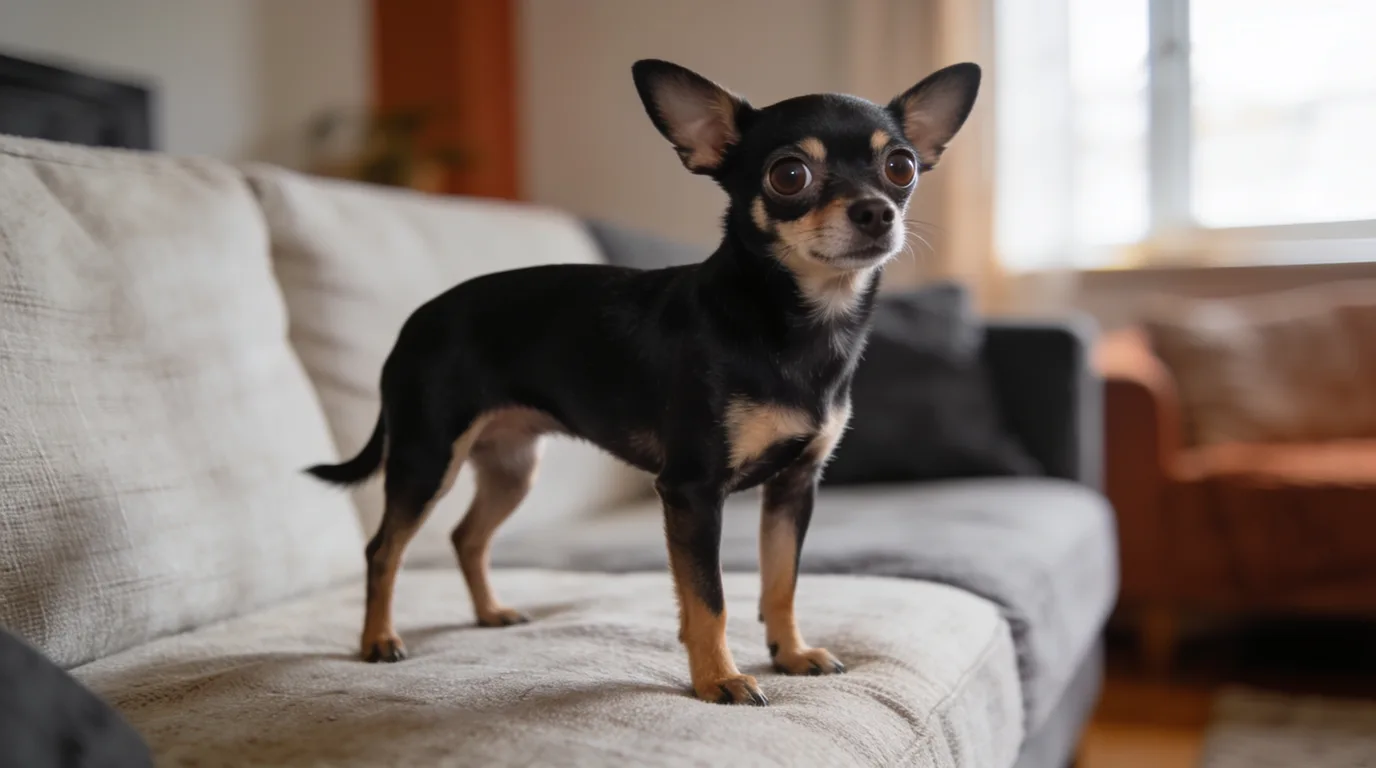
The behavioral core of the Chihuahua is an ordinary dog nervous system operating in a body that has no physical margin for error. Nothing in the breed's behavioral repertoire is unusual. Chihuahuas use the same signal ladder, the same distance-increasing displays, and the same learning mechanisms as every other dog. What differs is the arithmetic: a two-to-three kilogram animal living among creatures fifty times its mass, in a world where the most common human greeting behavior — looming overhead and reaching down with a hand — is, from that vantage point, an approach it cannot survive misjudging.
The breed's reputation for aggression is the single most repeated claim about it, and it is largely an artifact of how these dogs are raised, handled, and trained rather than a description of their temperament. Small dogs get carried instead of walked, so they miss the exposure that builds confidence. They get picked up mid-interaction, which removes the only tool a dog has for regulating distance. Their warnings get laughed at rather than addressed, so those warnings escalate and entrench. And when the escalation finally becomes inconvenient, they get handled with force that would draw complaints if applied to a Labrador. The dog at the end of that sequence is not displaying a breed temperament. It is displaying a training history — and it is a training history that is largely preventable, and largely fixable.
What the Chihuahua was actually selected for
The Chihuahua is unusual among popular breeds in that it was never selected for a working task. Breed histories trace it to small companion dogs of pre-Columbian Mexico, with the modern breed formalized after specimens were exported to the United States in the late nineteenth century and given a written standard in the early twentieth. There is no herding, no retrieving, no ratting, no guarding job in the background.
That absence is itself the most important thing about the breed behaviorally, and it cuts two ways.
No strong selected motor patterns. Unlike a Border Collie's eye-stalk-chase or a Dachshund's dig-and-bay, there is no hardwired occupational sequence demanding an outlet. Chihuahuas are not driven to perform a job, do not typically need structured sport to be settled, and do not deteriorate from lack of work in the way a working-line dog does. Their behavior problems are almost never boredom-with-a-missing-job problems.
Selection for extreme small size, with consequences. The breed was pushed toward the smallest end of what is anatomically viable in a dog. That produced a skeleton with a shortened jaw carrying a full-sized dental formula, a skull that in many individuals retains an open fontanelle into adulthood, joints and a trachea with narrow tolerances, and a body-mass-to-surface-area ratio that makes heat retention genuinely difficult. Every one of those has behavioral consequences, and most of them get read as personality.
The AKC standard describes an alert, self-possessed little dog with a terrier-like quality of temperament — confident, quick, and not naturally deferential. That is worth taking at face value. This is not a breed selected to be soft or biddable; it is a breed selected to be small and to be a companion. Confidence in an animal this size, in a human household, requires deliberate support. When it is not supported, what fills the gap is defensiveness.
What breed actually predicts — and what it does not
The caveat matters more here than almost anywhere, because Chihuahuas are the breed most often described as though temperament were a fixed property stamped into the animal at birth.
Breed predicts tendencies across populations. It does not predict individuals. The largest genomic analysis to date on this question — Morrill and colleagues, published in Science in 2022 using the Darwin's Ark dataset of tens of thousands of owner-surveyed dogs paired with genotypes — found that breed accounted for only a modest share of the behavioral variation between individual dogs, on the order of a tenth of the total. Most variation sat within breeds, not between them, and almost no trait behaved as a breed-level guarantee.
Owner-report survey work on breed differences in aggression — Duffy, Hsu and Serpell's C-BARQ analyses — has placed Chihuahuas above the general population average on stranger-directed and owner-directed aggression measures. That finding is real and should not be waved away. But it is a population average built from owner reports about dogs raised in a specific, systematically unusual way, and it cannot distinguish between a genetic disposition and the environmental pipeline described in the next section. The honest position is that both contribute, that the environmental contribution is large, and that the environmental contribution is the part anyone can change.
Practically: a statement like "Chihuahuas are stranger-wary" describes a shifted average, not a rule. Well-socialized Chihuahuas who greet strangers calmly, walk past dogs without comment, and accept veterinary handling exist in large numbers. They are simply less likely to be the ones anyone writes about.
Why the "aggressive Chihuahua" reputation exists
Four distinct mechanisms stack on top of each other. Separating them is the whole point, because they have different fixes.
1. Size-driven vulnerability makes defensive signalling rational. A distance-increasing display — stiffening, staring, growling, lunging, snapping — is what a dog does when it wants something to stop approaching and cannot make that happen any other way. For a 2.5-kilogram dog, almost every routine social event carries real physical risk: a stranger's hand descending from above, an off-lead Labrador arriving at speed, a toddler grabbing, a foot moving in a crowded kitchen. The display is not irrational. It is a proportionate response from an animal with an accurate assessment of its own fragility. Treating it as a character flaw misses that the dog is solving a real problem with the only tool it has.
2. Chronic under-socialization, because tiny puppies get carried. This is the largest single driver and the most fixable. A Labrador puppy walks through the world at ground level, meets surfaces, dogs, wheels, and legs, and builds a reference library of things that turned out to be fine. A Chihuahua puppy is carried — through the vet's waiting room, past the other dogs, around the market — because the owner is frightened it will be stepped on. The fear is reasonable and the outcome is a dog that reaches adolescence with a vigilant temperament and almost no first-hand data about what is normal. Everything novel then reads as threat. The socialization window closes on a dog that has observed the world from four feet up and never negotiated it.
3. Warning behavior tolerated because it is small. A 30-kilogram dog that growls when someone reaches for its bed gets a behavior consult that week. A 3-kilogram dog doing exactly the same thing gets described as feisty, filmed, and posted. It also frequently gets what it asked for — the hand withdraws, the visitor backs off, the dog is picked up and removed from the situation. That is a textbook negative-reinforcement loop: the display works, so it is repeated, so it strengthens, so it happens sooner and at greater distance. So-called "small dog syndrome" is not a temperament. It is a reinforcement history that nobody interrupted because the consequences were survivable.
4. Handling without consent. Chihuahuas are picked up constantly — moved off the sofa, lifted over puddles, carried past other dogs, passed between people, held while strangers pet them. Being lifted removes a dog's ability to control distance from anything, and being held while approached removes its ability to leave. A dog repeatedly placed in a position where flight is impossible learns that the earlier, quieter parts of the signal ladder do not work, and moves down the ladder to the parts that do.
| Mechanism | What owners see | What is actually happening | What changes it |
|---|---|---|---|
| Size-driven vulnerability | "Snaps at anyone who reaches" | Rational distance request from a fragile animal | Approach from the side, at the dog's level, hand low, let the dog close the gap |
| Under-socialization | "Hates strangers and dogs" | Missing early reference library | Ground-level exposure at sub-threshold distance, with choice |
| Tolerated warnings | "Bossy little thing" | Reinforcement history nobody interrupted | Treat the growl as information, then remove the need for it |
| Handling without consent | "Bites when picked up" | Loss of control over distance and escape | Consent-based lifting, cooperative-care training |
Survey research comparing owners of small and large dogs has found that small-dog owners tend to be less consistent in their training and to engage in fewer shared activities with their dogs, while small dogs score higher on measures of excitability and aggression. Those two findings sit together for a reason. The interpretation that fits the data is not that small dogs are inherently worse-tempered — it is that they are trained less, walked less, exposed less, and corrected more, and that the behavior follows.
Breed-typical behaviors in a pet home
Alert barking at sound and movement. Frequent, sharp, and easy to reinforce accidentally. The trigger at the door always leaves, so the behavior is rewarded several times a day for years. Blocking visual access and paying an alternative behavior does more than any correction.
Strong attachment to one person. Most Chihuahuas orient heavily to a single household member. Part of this is genuine selective sociability; a larger part is a straightforward association — one person does the carrying, feeding, lifting, and sleeping-arrangement provision, so proximity to that person predicts every good thing in the dog's life. Mild preference is unremarkable. A dog that cannot settle unless that person is present, panics at departure cues, or objects when others approach them has moved into separation distress and person-directed guarding, and both need structured plans.
Guarding of laps, beds, and people. Common, under-treated, and the most likely presentation to result in a bite to a household member or visitor. The mechanics are identical to guarding a bowl. See resource guarding.
Burrowing and heat-seeking. Under blankets, into laps, against radiators, into the crook of an arm. This is thermoregulation, not neediness — a small body loses heat fast. One safety consequence deserves stating: a Chihuahua asleep under a duvet is invisible and may snap when weight lands on it before it is properly awake.
On-lead reactivity toward larger dogs. Extremely common and, again, not irrational. A lead removes the option of retreat while an animal ten times the dog's size closes the distance. The display starts earlier and at greater distance than it would in a large dog because the margin for error is smaller. See leash reactivity and reactive dog vs aggressive dog.
Difficulty with house-training. Under-appreciated and mostly mechanical: a very small bladder, a very small puddle that dries unnoticed and marks a location, and genuine aversion to cold and wet ground on a thin-coated dog with no clearance. Covered toilet areas, a coat in cold weather, going outside with the dog, and paying at the moment of elimination resolve more cases than any amount of correction.
Vigilance at height. Chihuahuas frequently choose the back of the sofa, the top of a cushion pile, the arm of a chair. Elevated position gives visual coverage and distance from feet, and dogs positioned there often bark more and tolerate approach less. It is a management variable worth noticing.
Persistence with learned requests. Pawing, staring, demand barking, scratching at a leg. These are operant behaviors that got paid, and the breed's small size means owners tend to pay them more readily. That is not manipulation and it is not dominance — it is conditioning working exactly as designed. See what is my dog trying to tell me.
Trembling: three different things owners call one thing
Trembling is the behavior most consistently misread in this breed, because owners treat it as a single phenomenon with a single meaning — usually "he's cold" or "he's nervous" — when it has several distinct causes with different responses.
| Cause | What it looks like | Context that identifies it | What to do |
|---|---|---|---|
| Thermoregulation | Fine, continuous shivering; dog seeks heat and contact | Cool room, outdoors, after a bath, wet coat | Warm the dog. A coat outdoors is a welfare item in this breed, not an accessory |
| Arousal and anticipation | Trembling with a loose, bouncy body; tail up; oriented forward | Before a walk, before food, on greeting | Nothing wrong; lower arousal if it is stacking into over-excitement |
| Fear or stress | Trembling with a low body, tucked tail, ears back, whale eye, lip licks | Vet, strangers, noise, being held | Increase distance, remove the trigger, do not reassure by restraining |
| Pain | Trembling at rest, often with panting, hunching, withdrawal | No obvious trigger; new; in a cool room | Veterinary exam |
| Hypoglycaemia (puppies and very small adults) | Trembling with lethargy, wobbliness, glazed expression | Young puppy, missed meal, after exertion | Emergency — see below |
The differentiator is almost never the trembling itself. It is the rest of the body and the context. A trembling dog with a loose posture, forward ears, and a wagging tail before a walk is in a completely different state from a trembling dog with a lowered body, pinned ears, and visible eye-white in a vet waiting room, and the two require opposite responses. Reading the surrounding channels rather than the tremor is the whole skill — see dog body language and signs your dog is stressed.
Being picked up: the central handling problem
Almost every serious Chihuahua behavior case involves handling, so it deserves its own treatment.
Lifting a dog does four things simultaneously: it removes the dog's control over distance, removes escape, restricts movement, and places the dog at the eye level of faces that may then approach. For a large dog these events are rare. For a Chihuahua they happen many times a day, often without warning, and frequently by people the dog does not know.
The result is predictable. Dogs learn that the approach of hands predicts loss of control, and they start signalling earlier — flinching, ducking, freezing, growling, and eventually snapping at the reach itself rather than at the lift.
The fix is consent-based handling, and it is straightforward:
- Give a consistent verbal cue before every lift, so the event stops being unpredictable.
- Teach a position that means "yes" — the dog stepping onto a hand, a lap, or a raised platform of its own accord. If the dog does not offer it, the lift does not happen unless it is a genuine emergency.
- Support the chest and hindquarters together, keeping the body level. Lifting under the front legs leaves the spine and hind end hanging.
- Do not hand the dog to strangers. Passing a small dog around a room is one of the most reliable ways to build a bite history.
- Put the dog down when it asks. A dog that stiffens, wriggles, or turns its head away in someone's arms is making a request. Honoring it makes the next lift easier; overriding it makes the next lift worse.
- Stop using lifting as the answer to reactivity. Scooping a dog up when another dog approaches teaches it that the approach of dogs predicts loss of control, and it makes the display worse over months.
Cooperative-care training — chin rests, a stationing behavior on a mat or towel, a consent signal the dog can withdraw — is worth more in this breed than in almost any other, because these dogs will need dental work, joint assessment, and repeated veterinary handling across their fairly long lives.
Common misreads
"He's got Napoleon complex / small dog syndrome." This is not a diagnosis and it is not a temperament. It is a description of a dog whose warnings were tolerated, whose exposure was inadequate, and whose displays have been reinforced. The label is worth abandoning entirely, because it frames a training-history problem as an immutable character trait and therefore as something nobody needs to fix.
"He's trying to be dominant." No small breed attracts this framing more. The dominance model applied to pet dogs derives from mid-century observations of unrelated captive wolves; David Mech, whose early work popularized it, spent decades publicly correcting the record after studying wild packs, which are family groups. The AVSAB has formally rejected dominance-based training. Behavior labelled dominant in a Chihuahua is nearly always fear, guarding, learned reinforcement history, or pain. See why dominance theory is wrong.
"He's shivering because he's scared." Sometimes. Frequently he is cold, and occasionally he is in pain. See the table above.
"He only likes me — he's protective." Person-directed guarding is not protection, and treating it as devotion delays intervention on one of the higher-risk presentations in the breed.
"He's fine, he just talks a lot." A dog that vocalizes at every approach is a dog that finds approaches uncomfortable. Volume is a stress signal here, not a personality quirk.
"It doesn't matter, he can't do any damage." He can. Chihuahua bites are disproportionately to faces, because faces are what come down toward them, and disproportionately to children. The injury is smaller than a large dog's and the behavioral trajectory is identical.
"He's stubborn about house-training." He is small, the accidents are hard to find, the grass is cold, and the punishment history has taught him to go where he cannot be seen.
"He's gone grumpy in his old age." In a breed with this much dental disease, "grumpy" is a mouth until proven otherwise.
Health conditions that present as behavior change
Toy breeds carry a specific medical load, and in a small dog the behavioral signal often arrives long before anything visible does.
| Behavior change | Frequently misread as | Rule out first |
|---|---|---|
| New irritability, head-shy behavior, dropping food, chewing on one side | Fussiness, "gone grumpy" | Periodontal disease; fractured or retained tooth |
| Skipping a hind leg for a few strides then walking normally | Nothing at all | Patellar luxation |
| Honking cough, distress on lead pressure, avoidance of the collar | Kennel cough, drama | Tracheal collapse |
| Wobbliness, lethargy, glazed stare, seizure in a young puppy | Sleepiness, being "shy" | Hypoglycaemia — emergency |
| Circling, disorientation, difficulty learning, sudden behavior change | Stubbornness, "not very bright" | Hydrocephalus; neurological disease |
| Reduced exercise tolerance, coughing at night, reluctance to walk | Laziness, ageing | Mitral valve disease |
| Trembling at rest with panting and withdrawal | Anxiety | Pain of any origin |
| Reluctance to jump onto furniture, new sensitivity to being lifted | Attitude | Orthopedic or spinal pain |
Dental disease. The most behaviorally significant condition in the breed by a wide margin. A full complement of teeth in a shortened jaw produces crowding, retained deciduous teeth, plaque retention, and early periodontal disease. Chronic oral pain is a general irritability multiplier: it shortens the fuse, makes head handling aversive, changes eating behavior, and turns a tolerant dog into a defensive one over months. Any Chihuahua with new irritability gets a mouth exam, and dental care in this breed is preventive behavior work as much as preventive medicine.
Hypoglycaemia in puppies. Very small puppies have minimal glycogen reserves and can drop into clinically low blood glucose after a missed meal, a period of stress, or a burst of activity. The presentation is behavioral first — lethargy, unsteadiness, unresponsiveness, a puppy that will not engage — and it can progress to collapse and seizures. This is a same-hour emergency, not a wait-and-see.
Patellar luxation. Common in toy breeds. The classic sign is a few skipping strides on a hind leg followed by normal movement, and the behavioral consequences are reluctance to jump, reluctance to be lifted, and intermittent irritability that comes and goes for no apparent reason.
Tracheal collapse. Over-represented among toy breeds. It produces a characteristic honking cough, distress under neck pressure, and avoidance of anything approaching the collar. This is one of two hard reasons a Chihuahua should be walked on a well-fitted Y-front harness rather than a collar — the other being that lead corrections applied to this trachea are a physical injury risk, not merely an ethical one.
Hydrocephalus and the open fontanelle. Many Chihuahuas retain a soft spot (molera) on the skull; the breed standard accepts it, and on its own it is not a disease. Congenital hydrocephalus is separately over-represented in the breed and presents behaviorally — disorientation, circling, pressing the head against surfaces, difficulty learning simple tasks, and abrupt behavior change. A Chihuahua described as unusually slow to learn deserves a neurological exam before a training verdict.
Mitral valve disease. Common in older small dogs. Early signs are behavioral — reduced tolerance for walks, coughing at night, restlessness, and a dog that stops asking to go out.
Cold intolerance. Not a disease, but a genuine welfare and behavior variable. A cold dog will not toilet outdoors, will not walk willingly, and will not engage with training. A coat in winter is a functional item.
Training approach
The learning mechanisms in a 2.5-kilogram dog are identical to those in a 40-kilogram dog. There is no separate small-dog training science. Everything that works with a Labrador works here, applied at the correct scale and with a few practical adjustments.
Force-free is the whole method, and the case is stronger here, not weaker. The AVSAB's 2021 Position Statement on Humane Dog Training is unambiguous that aversive tools — prong collars, choke chains, shock and e-collars — carry documented welfare and behavioral risk and should not be first-line for any dog. In a Chihuahua there are two additional, concrete arguments. First, physical: lead corrections and collar pressure applied to a toy-breed trachea and cervical spine carry real injury risk. Second, functional: the dog's problem behavior is usually a request for distance driven by fear, and adding an unpleasant consequence to a fear-driven behavior increases the fear while suppressing its expression. The result is a dog that stops warning and keeps biting. See positive reinforcement vs balanced training.
Aversive handling gets used on small dogs far more casually than on large ones, precisely because the handler can physically overpower the dog — scruffing, rolling, flicking the nose, jerking a lead, holding the dog still until it stops struggling. All of it is both cruel and counterproductive, and none of it is necessary. That a method is physically possible with a 2.5-kilogram dog is not an argument for it.
Get on the dog's level. Train sitting or kneeling. Deliver food to the floor or from a low hand rather than descending from above. Looming is the single most common accidental aversive in small-dog training.
Scale the mechanics. Very small treats, high rate of reinforcement, a mat or raised platform so the dog is not always working at floor level, and short sessions. Feeding from a hand that arrives from above will poison the hand for a dog that is already worried about hands.
Walk the dog. This is the highest-leverage intervention in the breed. Ground-level exposure, on a harness, at a distance where the dog can observe without reacting, is what builds the reference library that carrying prevents. Short and frequent beats long and overwhelming.
Socialize with choice, not with exposure. For a small, wary dog the operative variable is control, not proximity. The puppy should be on the ground, free to move away, and never restrained while a stranger reaches in. Exposure without the ability to retreat is not socialization; it is flooding, and it produces the opposite of the intended result.
Teach an alternative to the warning, then remove the need for it. Two steps, in order. Pay the dog for orienting to the handler and moving away from a trigger, so there is a behavior that works better than growling. Then change the conditions — greater distance, no looming greetings, no strangers picking the dog up — so the underlying discomfort actually reduces. Step one without step two is suppression.
Do not reward the display accidentally. Picking a dog up when it lunges, or letting a stranger back off the instant it growls, both work from the dog's perspective. Manage the environment so the display is not needed rather than staging the situation and reacting to it.
Train the vet visit before you need it. Carrier as a safe place, chin rest for examination, tolerance of mouth handling, tolerance of a paw being held. Given the dental load, this pays for itself repeatedly.
When to bring in a professional
Work with a credentialed force-free professional if the dog shows:
- Any bite, air snap, or stiff-bodied hard stare directed at a person, including a household member
- Guarding of a lap, bed, or person that escalates or involves visitors
- Snapping or freezing when reached for or picked up
- On-lead displays that do not improve with distance management
- Distress when left alone involving destruction, self-injury, or continuous vocalizing
- Any sudden behavior change in a previously stable adult — veterinarian first, with a mouth exam
Credentials that signal evidence-based, force-free practice: DACVB (Diplomate, American College of Veterinary Behaviorists), CDBC (Certified Dog Behavior Consultant), CSAT (Certified Separation Anxiety Trainer), KPA-CTP (Karen Pryor Academy Certified Training Partner), Fear Free certification, and IAABC membership.
Be selective, and be more selective than you would be for a large dog. Small-breed owners are routinely told their dog needs firmer handling, that it is "running the house," or that it needs to learn its place. That advice is wrong on the evidence and disproportionately damaging to a fearful animal that cannot physically defend itself. See how to find a credentialed behaviorist.
The IAABC and AVSAB both maintain searchable directories of credentialed positive-reinforcement professionals by region. For a case involving bites to household members, a veterinary behaviorist (DACVB) is the appropriate first call.
Try it on your own Chihuahua
The framework in this guide is the one PetTranslator.ai applies to the photos owners upload. Upload a clear photo of a Chihuahua — resting on a lap, on the ground during a walk, mid-alert at the door — and the analysis returns a structured read: observable body-language markers first, interpretation second, an explicit note on what a single frame cannot assess, and a short Do/Avoid list.
For this breed the discriminations that matter are subtle and easy to miss on a small face. A relaxed dog curled in a lap versus a still, tense dog that has stopped trying to leave. Trembling with a loose body versus trembling with a tucked tail and visible eye-white. Ears held back in soft appeasement versus ears pinned flat in genuine fear. Those distinctions look nearly identical at a glance and mean entirely different things, and they are the difference between a dog that is comfortable and a dog that is one interaction away from a bite.
It is an instrument for daily reading fluency, not a substitute for a veterinary exam or a behavior consult, and it says so when a case looks complex.
Related reading
- Dog body language: the underlying framework — the general signal vocabulary this guide assumes
- What is my dog trying to tell me? — reading state rather than inventing sentences
- Reactive dog vs aggressive dog — the distinction that matters most in this breed
- Puppy socialization window — the stage where most small-dog reactivity is created
- Poodle behavior guide — a useful contrast in how small size interacts with working background
Sources
- Morrill K, Hekman J, Li X, et al. (2022). "Ancestry-inclusive dog genomics challenges popular breed stereotypes." Science 376(6592). The Darwin's Ark analysis underpinning the breed-generalization caveat in this guide.
- Duffy DL, Hsu Y, Serpell JA (2008). "Breed differences in canine aggression." Applied Animal Behaviour Science. Owner-reported C-BARQ data on breed-level differences.
- Arhant C, Bubna-Littitz H, Bartels A, Futschik A, Troxler J (2010). "Behaviour of smaller and larger dogs: effects of training methods, inconsistency of owner behaviour and level of engagement in activities with the dog." Applied Animal Behaviour Science. The basis for the training-history reading of small-dog behavior.
- AVSAB (2021). Position Statement on Humane Dog Training. American Veterinary Society of Animal Behavior.
- AVSAB. Position Statement on the Use of Dominance Theory in Behavior Modification of Animals.
- Mech LD (1999). "Alpha status, dominance, and division of labor in wolf packs." Canadian Journal of Zoology 77. The author's own correction of the alpha model.
- Karen Overall (2013). Manual of Clinical Behavioral Medicine for Dogs and Cats, 2nd edition, Elsevier. Clinical reference for behavioral assessment and health-behavior overlap.
- American Kennel Club. Chihuahua Breed Standard. Source document for the described temperament and for the accepted molera.
- American Veterinary Dental College. Reference material on periodontal disease staging and the oral health burden in toy breeds.
- Royal Veterinary College VetCompass. Publications on periodontal disease and on toy-breed disorders recorded in UK primary-care veterinary practice.
Khabir Mughal is the founder of PetTranslator.ai. This article was reviewed against the AVSAB Position Statement on Humane Dog Training, the Morrill et al. (2022) breed-genomics findings, and Karen Overall's Manual of Clinical Behavioral Medicine before publication. It is not veterinary advice — for sudden behavior change, and for any unexplained trembling at rest, see a veterinarian first.