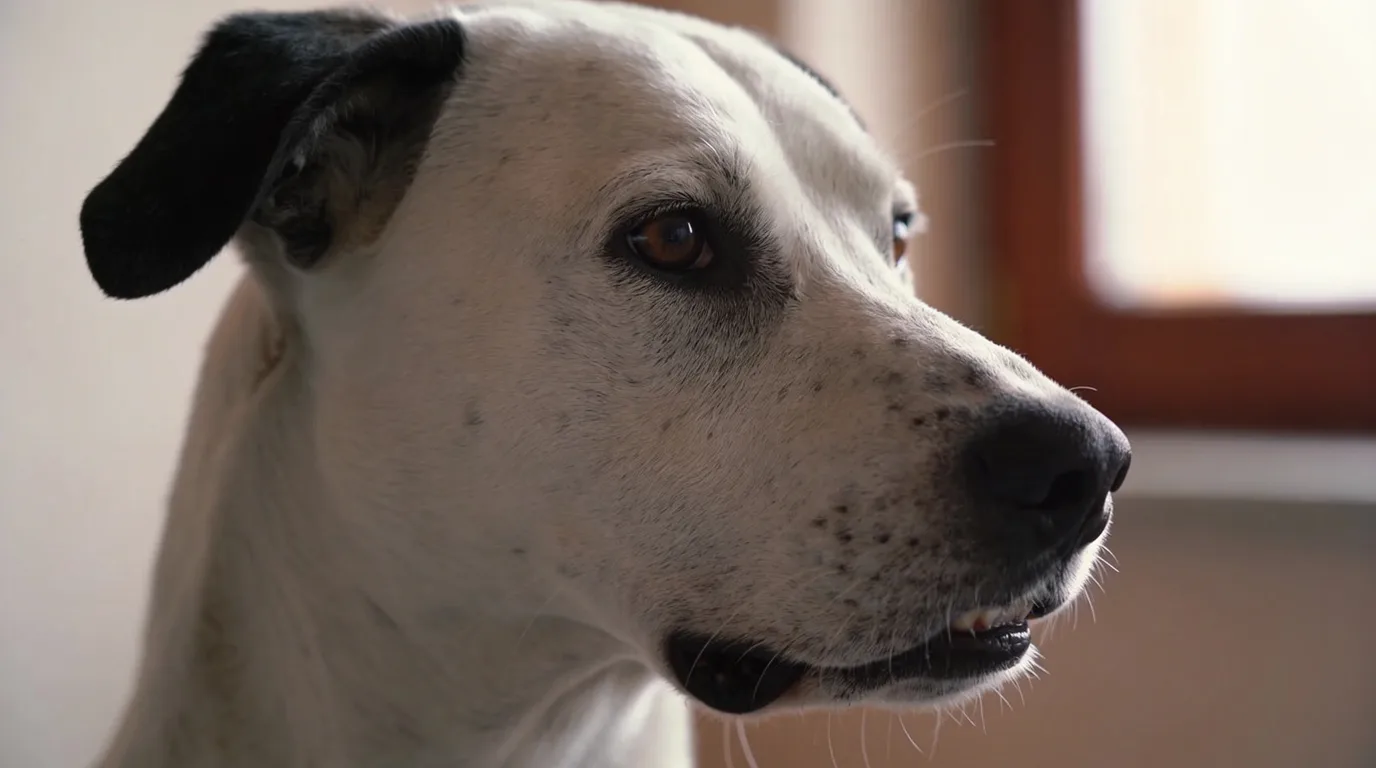
Ears back is the most-searched question about dog ears and the most consistently mishandled answer on the internet. The standard reply — ears back means the dog is scared or submissive — is wrong often enough to be unsafe. A dog greeting a familiar person with ears flattened, a squinting face, and a low sweeping tail is showing an affiliative display, not distress. A dog with the same ear position, a stiff body, and a closed mouth is two rungs from a bite. Same ears. Opposite situations.
Ear position is not an emotion label. It reads out two things at once: where the dog's attention is pointed, and how much muscular tension the dog is holding. Those variables produce five recognizable positions, and each appears across multiple emotional states. The accompanying cluster resolves which one you're looking at — nothing else does. And because ear anatomy varies enormously across breeds, the read has to be taken at the base of the ear, where the muscles attach to the skull, not at the tip, which on many dogs cannot move independently at all.
Why ears carry so much signal
Dogs have roughly eighteen muscles controlling each ear. Counts vary between about fifteen and twenty depending on how the small auricular muscles are tallied, but the practical point holds: the canine ear is one of the most finely actuated structures on the animal. Humans have three vestigial auricular muscles and essentially no voluntary control.
That muscle count buys two things. Independent, high-resolution positioning — each ear rotates, elevates, flattens, and tilts on its own, so a dog can point one ear at a sound behind them while holding the other forward on a visual target. And speed. Tail carriage shifts over a second or two; posture takes longer. Ears move in a fraction of a second, which makes them the earliest visible indicator that internal state has shifted.
The Dog Facial Action Coding System (DogFACS), the anatomically grounded system for coding canine facial movement, treats ear actions as their own category for this reason — separating ear-forward, ear-adductor, ear-flattener, ear-rotator, and ear-downward movements as distinct units rather than lumping them into one "ears back" bucket.
Speed cuts both ways. Because ears respond to acoustic input constantly, most ear movement in any given minute is auditory scanning with no emotional content at all.
Read the base, not the tip
This is the step most ear-language content skips, and skipping it makes the rest of the read unreliable. The muscles that move a dog's ear attach at the base — where the cartilage meets the skull, just behind and above the outer corner of the eye. Everything above that point is leather, its shape set by conformation rather than state. On a Basset Hound the ear tip hangs at jaw level whether the dog is asleep, alarmed, or mid-play.
What to actually look at:
- The set-on. Where the ear base sits relative to the outer corner of the eye. Forward attention pulls the base up and forward; retraction pulls it back and down toward the neck.
- The visible opening. Forward ears rotate the inner surface toward the front. Pinned ears rotate it flat against the head and hide it entirely.
- The muscle and skin in front of the ear. Tension shows as a bulge or a tightening over the temple, often before the ear finishes moving.
- The brow. Retraction pulls the forehead skin back and smooths wrinkles. Forward attention creases it.
On a drop-eared dog all of this still happens — it's just harder to see. Watch the fold where the leather attaches, and whether the ear mass lifts off the neck or presses flat against it. Photograph the dog in a known relaxed state and use that image as the reference. Once you have it, base movement becomes obvious.
The five positions
1. Neutral
The ear sits at the dog's individual rest position with no visible tension at the base. On a prick-eared dog that means upright but not straining forward; on a drop-eared dog the leather hangs loose with the fold in its default place. Neutral is individual, not universal — a Belgian Malinois at neutral looks more forward than a Labrador at full alert. That's conformation.
Signals: no current demand on attention. With a loose body, soft eyes, an open mouth, and a mid-height tail, this is baseline.
Confound: deep sleep, sedation, exhaustion, and heat all reduce muscle tone into something resembling neutral. A dog who looks neutral while panting hard at rest in a cool room is not at baseline.
2. Forward / pricked
The base rotates up and forward, the opening turns toward the target, the brow creases. On drop-eared dogs the base lifts and the fold widens, making the ears appear to flare outward.
Signals: attention and rising arousal directed at a specific target. That's all. Forward ears are the shared opening move of play solicitation, curiosity, predatory sequence, and defensive commitment. Valence lives in the rest of the body.
Forward with a loose bouncy body, open mouth, and play bow is interest. Forward with a still body, closed mouth, weight shifted onto the front legs, and a hard unblinking stare is high-arousal commitment — the cluster that precedes lunging, chasing, and biting.
Confound: forward is also plain auditory investigation, held for a second or two and then released.
3. Slightly back
The base draws back and slightly down, the forehead smooths, and on a prick-eared dog the ears rotate outward a few degrees and lose their vertical line. This position is responsible for most misreads, because it appears in two completely different states.
Affiliative greeting. Ears back and down, eyes squinting, head lowered and turned slightly, muzzle-directed licking or nose-poking, a low broad tail wag that moves the hips, sometimes a lifted paw — and, critically, movement toward the other individual. This pattern derives from the puppy food-soliciting sequence and functions as active affiliation. Karen Overall's Manual of Clinical Behavioral Medicine for Dogs and Cats (Elsevier, 2013) categorizes it separately from fear-motivated appeasement for exactly this reason.
Early stress. Ears back and down, mouth closed, lips drawn tight at the commissure, weight shifted back over the hind legs, possible whale eye, possible out-of-context lip licking, and movement away from the trigger or no movement at all.
The discriminator is direction and looseness. Affiliative slightly-back is mobile, curved, and approaching. Stressed slightly-back is still or retreating, and the mouth closes.
4. Fully pinned
The ear flattens hard against the skull. On prick-eared dogs the ears disappear into the head outline; on drop-eared dogs the leather presses flat against the neck with the base visibly drawn back. Pinning is a protective reflex before it is a signal — flattened ears are harder to bite and harder to injure — which is why it correlates with high-intensity states in both directions.
Pinned with a tucked tail, crouched body, averted gaze, trembling, and attempted retreat is fear, flight-motivated. Pinned with a stiff body, forward weight, hard stare, tight or lifted lips, and a low growl is defensive threat. Both want distance. Only one is trying to take it themselves.
The confound that matters: dogs also pin their ears when running at speed, in wind, when wet, and during vigorous play. A dog sprinting across a field with pinned ears, a loose open mouth, and a loose body is streamlining.
5. Airplane / sideways
The base rotates outward so the ears sit low and lateral, projecting sideways rather than up or back. Common on prick-eared breeds; on drop-eared dogs it shows as the ear mass swinging wide of the neck.
Borrowed from cat terminology, "airplane ears" means something different in dogs. Here it most often indicates conflict — competing motivations that haven't resolved, with approach and avoid both active. Overall describes this class of divided posture as an ambivalence marker, and ambivalent dogs are less predictable than committed ones, in either direction.
Sideways with a low body, whale eye, a still tail, and slow movement is conflict carrying a stress load. Sideways with a head cock, a loose body, and no trigger in view is acoustic scanning. One ear forward and one back is split attention — a workload indicator. Go find the second input; it's frequently the thing that ends up mattering.
The position-by-cluster table
Ear position is the row. The cluster determines which column you land in.
| Ear position | Accompanying cluster | Likely state | Practical response |
|---|---|---|---|
| Neutral | Loose body, soft eyes, open mouth, mid tail | Baseline; no demand on attention | Nothing needed |
| Forward | Loose bouncy body, play bow, open mouth | Interest, play solicitation | Continue; monitor arousal |
| Forward | Still body, closed mouth, weight forward, hard stare | High-arousal commitment; pre-lunge | Increase distance immediately |
| Slightly back | Squinting eyes, lowered head, low wide wag, approaching | Affiliative greeting | Continue; let the dog set contact |
| Slightly back | Closed mouth, whale eye, weight back, tail low | Early stress; request for space | Pause, create distance |
| Fully pinned | Tucked tail, crouched, gaze averted, retreating | Fear, flight-motivated | Remove the trigger; give an exit route |
| Fully pinned | Stiff body, hard stare, tight or lifted lips, growl | Defensive threat; high bite risk | Stop, avoid eye contact, back away slowly |
| Fully pinned | Loose open mouth, running, wind or water present | Streamlining; no emotional content | Nothing needed |
| Airplane / sideways | Low body, whale eye, slow movement, still tail | Conflict; ambivalent, less predictable | Simplify the situation, reduce input |
| Airplane / sideways | Head cock, loose body, no visible trigger | Acoustic scanning | Nothing needed |
| One forward, one back | Otherwise loose | Split attention across two inputs | Identify the second input |
| Rapid cycling | Panting, pacing, repeated lip licks | Escalating arousal; trigger stacking | End the session; decompress |
Breed ear-set changes everything
A single ear template applied across all dogs produces wrong answers most of the time. Ear conformation was selected for by humans and has nothing to do with temperament.
Prick-eared — German Shepherd, Siberian Husky, Belgian Malinois, Corgi, Chihuahua, Basenji. The full range is visible and the read is easiest. The trap is that a resting prick ear looks alert to a novice observer, so these dogs get over-read as intense when they're at baseline.
Drop-eared — Beagle, Basset Hound, Bloodhound, Cocker Spaniel, Labrador, Golden Retriever. The tip is uninformative; all the signal lives at the base and in whether the ear mass lifts away from the neck or presses against it. Long-eared scenthounds add a complication: nose-down tracking pulls the ears forward and down mechanically. That's head position, not emotion.
Semi-prick or tipped — Border Collie, Rough Collie, Shetland Sheepdog, Fox Terrier. The base moves through the full range while the tip stays broken at a fixed angle. Watch the erect lower portion.
Rose-eared — Greyhound, Whippet, Bulldog, Pug. The ear folds back and outward at rest, so the resting position already resembles slightly-back on a prick-eared dog. Sighthound owners routinely report their dog "always looks worried." The dog looks like the breed standard. Read the base and the brow, and calibrate against that individual's relaxed photograph.
Heavily coated breeds — Old English Sheepdog, Puli, Bearded Collie, anything with ear feathering. Coat can obscure the base entirely. Parting the hair at the set-on during a calm moment is worth the ten seconds.
Brachycephalic breeds — Pug, French Bulldog, Boston Terrier, Boxer. Shortened skulls and facial folds compress the area around the ear base and make brow tension hard to separate from conformation. These are also the breeds that show baseline sclera at rest. Cross-check against mouth tension and body outline instead of forcing a facial read.
Cropped ears remove a communication channel
Ear cropping surgically removes part of the pinna, usually in puppies between roughly eight and twelve weeks, followed by weeks of taping or posting to make the remaining cartilage stand erect. It's performed for appearance on breeds including the Doberman, Boxer, Cane Corso, Great Dane, American Staffordshire Terrier, and Schnauzer. The American Veterinary Medical Association opposes ear cropping and tail docking performed solely for cosmetic purposes, and the procedure is banned or restricted across much of Europe, Australia, and elsewhere.
The behavioral consequences are the part owners are rarely told about.
Signal amplitude drops sharply. Cropping doesn't remove the auricular muscles, so a cropped dog can still move what remains. What it removes is the visible surface that carried the signal. A base movement that would have swung a full pinna through thirty degrees of arc now moves a short cropped ear a few millimetres. At the distance dogs typically assess each other across a park, the signal is often gone.
The resting silhouette permanently reads as forward. A posted, cropped ear stands erect by construction. What another dog sees by default is the outline of an alert, high-arousal animal — regardless of what the cropped dog is doing. That's a false signal broadcast continuously.
Other dogs misread them, and the misreading has consequences. Experimental work using life-size remote-controlled dog replicas has shown that altering a single morphological channel — tail length and motion — measurably changes how approaching dogs behave toward the replica. The same logic applies to ears. Survey research has also found that people rate dogs with cropped ears and docked tails as more aggressive and more dominant than the same dogs with natural conformation, and judge their owners similarly.
There is a timing problem on top of the anatomical one. Cropping and the multi-week posting protocol fall inside the sensitive socialization period — repeated painful handling, bandage changes, and restraint during the window when durable expectations about human handling are forming.
None of this makes a cropped dog unreadable. It means the read shifts onto other channels — mouth tension, eye softness, tail carriage, weight distribution, and whatever base movement remains — and it means introductions with unfamiliar dogs deserve more space and slower approach than they otherwise would.
Ears back is not automatically fear
Ears drawn back appear in at least six distinct contexts: affiliative greeting, appeasement, fear, defensive threat, pain, and mechanical streamlining during locomotion. Treating the ear position as the verdict collapses six situations into one label, and the label chosen is almost always "scared." Two failure modes follow.
Owners flood affiliative dogs. A dog who greets with soft-back ears and squinting eyes is offering contact. Reading that as fear produces over-soothing, avoidance of normal social exposure, and sometimes an owner who comes to believe their well-adjusted dog is anxious.
Owners approach threatened dogs. Reading pinned ears on a stiff dog as "he's scared, he needs comfort" produces one of the most common bite scenarios in the clinical literature. Fear and defensive threat share the ear position. They do not share the appropriate response.
The four-channel rule from the broader body language framework resolves it: name at least four specific signals before stating a conclusion. Ears, mouth, eyes, and weight distribution is a sufficient minimum. If the ears are all you can name, you don't have a read.
What people get wrong
"Ears back means submissive." Submission isn't a state; it describes an interaction outcome, and the dominance framework it comes from has been formally rejected by the AVSAB for pet dogs. Describe the observable and skip the label.
"Ears forward means happy." Forward means attention is engaged and arousal is climbing. Predatory sequences, defensive commitment, and joyful play all open with forward ears.
Reading the tip on a drop-eared dog. The tip is passive tissue.
Assuming an erect-eared dog is confident. Prick-eared breeds and cropped dogs carry an alert silhouette at rest. Silhouette is not state.
Treating one ear flick as a signal. Ears track sound continuously. Sustained position and repeated pattern are the signal.
Calling sideways ears "happy." In dogs, sustained lateral ears usually mean unresolved conflict.
Ignoring wind, water, and speed. A wet dog after a bath, a dog on a windy beach, and a dog at a full sprint all pin their ears for mechanical reasons.
Building your dog's ear baseline
Ear reading is a perceptual skill, and perceptual skills improve with labelled practice — repetition where the answer is already known.
Capture a reference set. Over one week, photograph the dog's head from the front and from a three-quarter angle in five unambiguous states: drowsy on their bed, mid-play, waiting at the door, watching something out the window, and being greeted by someone they like. Ten images, worth more than any generic diagram.
Find the landmarks. On the drowsy images, note the relationship between the ear base and the outer corner of the eye, and the width between the two bases. Those are neutral. Every later read is a comparison against them.
Watch ears only, thirty seconds at a time. Film routine household activity and watch it with attention restricted to the ears. Count position changes. Most owners are startled by how many there are and how few mean anything — the calibration that stops single-flick over-reading.
Predict, then verify. When a trigger appears, call the ear position out loud before looking. Accuracy climbs fast with this step and stalls without it.
Log the trigger, not just the position. A running list of what produces sustained ear changes builds a trigger inventory — the first thing an experienced behavior consultant will ask for, and the raw material for any desensitization plan.
Recheck the baseline seasonally. Coat length changes, aging changes muscle tone, and hearing loss changes carriage.
When to involve a veterinarian or a professional
See a veterinarian promptly for new head tilt, head shaking or ear scratching with odor or discharge, a swollen ear flap, an asymmetric carriage change, loss of blink on one side, or acute handling sensitivity around the head. Sudden behavior change in a previously stable dog is a medical question first.
Work with a credentialed behavior professional for ears pinned with stiffening or growling toward people, escalating leash reactivity where ear signals are the earliest predictor, resource guarding with a fixed forward-ear stare, chronic stress signaling across many contexts, or any bite history.
Credentials worth looking for: DACVB (Diplomate, American College of Veterinary Behaviorists), CDBC (Certified Dog Behavior Consultant), CSAT (Certified Separation Anxiety Trainer), KPA-CTP (Karen Pryor Academy Certified Training Partner), Fear Free certification, and IAABC membership. Avoid anyone whose framing relies on dominance, alpha status, pack leadership, or "balanced" methods — the last is generally a euphemism for aversive tools, and the AVSAB has rejected those approaches.
For adjacent signals, see the dog body language field guide, the stress-signal inventory, and the difference between a reactive and an aggressive dog.
Try it on your own dog
Ear reading becomes reliable at roughly the point where you stop looking at the ears in isolation. The fastest way there is to make a call, name the four channels it rests on, and check it against a structured second read.
PetTranslator.ai applies the same framework this article describes. Upload one clear photo and the report reads the way a behavior consultant writes a session note: observed markers first — ear base position, brow tension, mouth commissure, eye softness, weight distribution — then the interpretation, then a confidence score with its reasoning, then an explicit list of what a single still frame cannot assess, then a Do and Avoid plan. Head-on and three-quarter angles give the most usable ear reads. It won't replace a behaviorist on a complex case, and it says so when a case looks complex.
Sources
- AVSAB Position Statement on Humane Dog Training (2021) — the professional standard for force-free behavior work.
- AVSAB Position Statement on the Use of Dominance Theory in Behavior Modification of Animals — the basis for rejecting submission framing of ear position.
- Karen Overall, Manual of Clinical Behavioral Medicine for Dogs and Cats (Elsevier, 2013) — conflict postures and ambivalence markers.
- Turid Rugaas, On Talking Terms with Dogs: Calming Signals (Dogwise, 2nd ed. 2005) — the appeasement and displacement family.
- Patricia McConnell, The Other End of the Leash (Ballantine, 2002) — escalation-ladder framing.
- Lili Chin, Doggie Language (Summersdale, 2020) — illustrated reference across breed conformations.
- Dog Facial Action Coding System (DogFACS) — codes canine ear movement as discrete action units.
- American Veterinary Medical Association policy on Ear Cropping and Tail Docking of Dogs.
Khabir Mughal is the founder of PetTranslator.ai. This article was reviewed against the AVSAB Position Statement on Humane Dog Training and Karen Overall's Manual of Clinical Behavioral Medicine before publication. It is not veterinary advice — for any sudden or asymmetric change in ear carriage, see a veterinarian first.