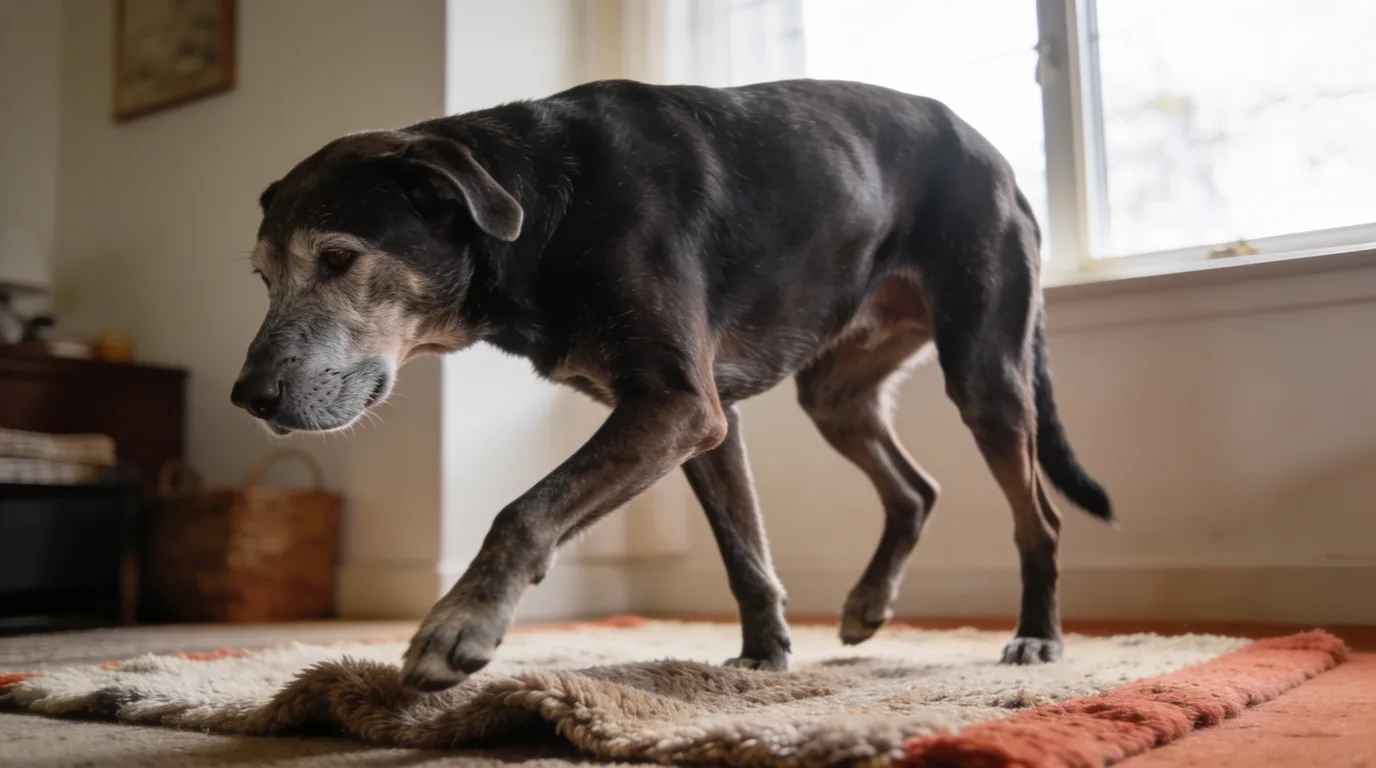
There are two reasons a dog groans as they lie down, and they sound nearly identical. The first is contentment — a passive vocalization produced as a relaxed dog exhales and releases postural muscle tension on settling. It is normal, it occurs in healthy dogs of every age, and it means nothing needs fixing. The second is pain, most often from osteoarthritis or another orthopedic condition, and it means a dog is doing something uncomfortable and telling you about it in the quietest way available.
Separating the two is the entire task, and it cannot be done from the sound. Owners who try to distinguish them by pitch, volume, or duration get it wrong regularly, because the acoustic difference is small and highly individual. What does separate them reliably is the movement around the groan: how fast the dog goes down, whether the descent is controlled or dropped, how many times the dog circles or repositions first, and — most informative of all — what happens twenty minutes later when the dog tries to stand back up. This article gives you that comparison in detail, explains why the pain version is missed so often, and provides a checklist you can take to a veterinary appointment.
Two causes, one sound
Contentment groaning is best understood mechanically rather than emotionally. When a dog transitions from standing to lying, a substantial amount of postural muscle tone is released over one or two seconds. Air moves out of the chest through a relaxed larynx and pharynx, and in many dogs that produces an audible low rumble, sigh, or groan. The same thing happens when a dog rolls onto their side, stretches, or is settling into deep rest after activity. It is closer in kind to a human sighing into an armchair than to a complaint.
Some dogs do this constantly and always have. Some breeds do it more than others — anatomy that includes a shorter muzzle, a longer soft palate, or a heavier chest tends to make air movement audible. Individual variation is enormous, and the single most important reference point is your own dog's history. A dog who has groaned on settling since eight months old, with no other changes, is almost certainly doing the normal thing.
Pain groaning is produced by the same mechanism but has a different trigger: mechanical discomfort during the movement itself. Lying down loads joints in a sequence that a healthy dog performs without thought. In a dog with osteoarthritic change, the elbows take body weight during the front-end descent, the hips and stifles flex under load during the rear-end descent, and the spine articulates through the whole sequence. If any of those hurt, the dog vocalizes at the moment of loading, and the movement itself changes shape to protect the painful structure.
That change in movement shape is the finding. The groan is the flag; the mechanics are the evidence.
What contentment groaning looks like
Timing. It arrives at the end of the movement, after the dog is already down, on the exhale as the body settles. It is the sound of the movement finishing.
Descent. Smooth, unhurried, and complete. A comfortable dog folds down in one continuous motion, often putting the front end down first and the rear following naturally, and immediately relaxes into the surface.
Preparation. Minimal. One or two circles at most, sometimes none at all. Bedding scraping is common and normal.
Position. Varied across the day, and frequently includes fully lateral recumbency with limbs extended and loose, or a belly-up sprawl. These positions are difficult and unappealing for a dog with joint pain.
Afterwards. The dog sleeps normally and gets up without hesitation. Ask for a stand from a rest and it happens in one motion, without a preparatory pause.
Context. It follows exercise, food, and warmth. It appears in the dog's preferred spots, at predictable times, and — importantly — the dog seeks out resting rather than avoiding it.
Consistency. It has been present for a long time. Long-standing, unchanged, unaccompanied by anything else on the pain checklist below is the strongest single argument that this is normal.
What pain groaning looks like
Timing. It arrives during the movement, not after — most often as the rear end lowers or as the elbows take weight, mid-descent rather than at the finish. Some dogs also groan on the way up, which is more specific for orthopedic pain than groaning on the way down.
Descent. Two patterns, both abnormal. The controlled brace is a dog who lowers themselves in stages, pausing partway, walking the front feet forward while keeping the hindquarters up, or leaning against a wall or sofa for support. The collapse is the opposite: a dog who holds a standing position, then drops the last portion of the descent all at once, usually because the eccentric muscle control required to lower slowly is what hurts. A young, sound dog does neither.
Preparation. Increased. More circling, more shifting, more starting to lie down then standing up again, more time spent finding a position. Repeated attempts to settle are a strong signal, and they are the same signal whether the dog is on a bed at night or on a floor at midday.
Position. Narrowed. Painful dogs abandon positions that load the sore structure. A dog who used to sleep flat on their side and now sleeps only in a tight sternal curl, or one who used to curl and now must sleep stretched out because flexion is uncomfortable, has changed something. Either direction of change matters; the direction itself is less important than the fact of it.
Afterwards — the highest-value observation. Watch the dog get up after they have been down for thirty minutes or more, especially first thing in the morning or after a nap following a long walk. Stiffness that is worst after rest and improves over the first few minutes of movement is close to a signature finding for degenerative joint disease. A dog who pauses before standing, needs two attempts, extends the forelimbs and drags the rear forward, or stretches extensively before taking the first step is showing you something.
Associated behaviors. Reluctance to take stairs, hesitation before jumping into a car or onto furniture, a shortened stride, a bunny-hopping gait with both hind legs moving together, sitting with one hind leg splayed to the side, persistent licking of one joint, a changed willingness to be touched over the hips or lower back, slowing on the second half of walks, and — often first — a general reduction in enthusiasm that gets recorded as "he's just getting older."
Trajectory. New, or worsening. Contentment groaning is stable across years. Pain groaning that has appeared in the last six months, or that is more frequent now than last winter, is a progression.
The comparison table
| Feature | Contentment groaning | Pain groaning |
|---|---|---|
| When in the movement | At the end, on the settling exhale | During, as weight loads elbows, hips, or spine |
| Descent quality | One smooth continuous fold | Staged and braced, or dropped in the last portion |
| Front vs rear | Both lower naturally in sequence | One end lowered deliberately while the other is protected |
| Circling and repositioning | Minimal — none to two turns | Increased; repeated attempts to settle |
| Groaning on standing up | Rare | Common, and more diagnostic than groaning on lying down |
| Time to rise after rest | Immediate, one motion | Delayed; a pause, a stretch, sometimes two attempts |
| Post-rest stiffness | Absent | Present and worst after long rest; eases with movement |
| Range of resting positions | Wide, including flat-out and belly-up | Narrowed to one or two protective positions |
| Stairs, cars, furniture | Unchanged | Hesitation, refusal, or a run-up before jumping |
| Licking one location | No | Frequently — a carpal, elbow, stifle, or hip |
| Response to touch over spine or hips | Neutral | Flinch, turn of the head, stiffening, or moving away |
| Seasonality | None | Often worse in cold and damp weather |
| Time course | Stable for years | New within months, or progressively worse |
| Weight change | Unrelated | Often gradual gain from reduced activity, which compounds the problem |
| Sleep quality | Normal, deep, uninterrupted | Fragmented; more position changes, sometimes night pacing |
No single row settles it. Three or more rows in the right-hand column is a veterinary appointment.
Why the pain version gets missed
Canine osteoarthritis is common and substantially under-diagnosed. Radiographic surveys have repeatedly found degenerative joint change in a large minority of adult dogs and in the majority of dogs past middle age, while the proportion carrying an actual clinical diagnosis and receiving treatment is far smaller. The gap is not caused by inattentive owners. It is caused by four features of how the disease presents.
It is bilateral, so there is no limp. A limp requires asymmetry. Osteoarthritis frequently develops in both hips, both elbows, or both stifles at a similar rate, which produces a shortened, stiff, evenly distributed gait rather than a visible favouring of one leg. Owners watching for a limp see nothing wrong.
It is gradual, so there is no before-and-after. Change accumulating over eighteen months is invisible to the person present for every day of it. The dog who no longer runs the last hundred metres, no longer greets at the door, and no longer jumps onto the bed did not stop on a Tuesday. Each step down was small enough to absorb.
Dogs do not express pain the way owners expect. There is usually no yelping, no whimpering, no obvious distress. What there is instead is behavioral: reduced activity, more sleep, new irritability, withdrawal to another room, reluctance to be handled, and a slow reduction in the range of things the dog volunteers to do. Those get filed under personality and aging.
The explanation "he's slowing down with age" is available and satisfying. Age is not a disease and does not itself cause stiffness, reluctance, or pain on movement. It raises the probability of conditions that do. The sentence "he's just getting old" is the single most reliable predictor of an untreated chronic pain condition in a dog, and it is worth treating with suspicion whenever it appears in your own thinking.
The consequence of missing it is not only comfort. Chronic pain lowers bite thresholds, raises noise sensitivity, disrupts sleep, and drives a cycle where reduced activity produces muscle loss and weight gain, both of which worsen joint loading. Dogs who develop new reactivity or irritability in middle age are frequently in pain, which is why any late-onset behavior change is a veterinary question before it is a training question. The broader picture is covered in pain signals in older dogs and senior dog behavior changes.
What might actually be causing it
This list is for orientation, not for self-diagnosis. Determining which applies requires physical examination and usually imaging.
Osteoarthritis. The most common cause by a wide margin. Can affect any joint; hips, elbows, stifles, and the lower spine are the usual sites. Progressive, manageable, and far more treatable than most owners assume.
Hip dysplasia. Abnormal hip joint conformation leading to laxity and secondary arthritis. Over-represented in German Shepherds, Labradors, Golden Retrievers, Rottweilers, Bernese Mountain Dogs, and many large and giant breeds. Signs can appear in young adulthood rather than old age.
Elbow dysplasia. A group of developmental elbow conditions. Frequently bilateral, frequently missed for the same reason, and a common cause of pain specifically on the front-end phase of lying down.
Cruciate ligament disease. Partial tears produce intermittent lameness, difficulty rising, sitting with the affected leg extended sideways, and reluctance to load the limb during descent.
Spinal conditions. Intervertebral disc disease, spondylosis, and lumbosacral disease all produce pain on flexion and extension of the spine, which lying down requires. Suspect the spine when the dog is reluctant to curl, resists being touched along the back, or shows a hunched posture.
Abdominal discomfort. Gastrointestinal pain, pancreatitis, organ enlargement, and other abdominal conditions can make lying down uncomfortable and produce groaning. A dog adopting a "praying" position — chest down, rear up, held for long periods — is a recognized indicator of abdominal pain and warrants prompt attention.
Obesity. Not a diagnosis in itself, but a major amplifier. Excess weight increases joint loading, promotes inflammation, and accelerates osteoarthritic progression. Weight management is consistently one of the highest-impact interventions available for arthritic dogs, and it is free.
Airway anatomy. Brachycephalic dogs — Pugs, French Bulldogs, English Bulldogs, Boston Terriers, Shih Tzus — produce baseline respiratory noise that includes groaning, snorting, and snoring at rest. This makes normal settling noisier and, more importantly, makes pain-related vocalizing harder to detect against the background. Owners of flat-faced breeds should lean more heavily on the movement observations than on the sound.
Simple fatigue and age-appropriate stiffness after unusual exertion. Real, and self-limiting. A dog who groans for a day after an unusually long hike and returns to normal is not the concern.
A checklist to take to your veterinarian
Fill this in over a week before the appointment. Concrete observations change consultations; "he seems uncomfortable sometimes" does not.
Movement
- Does the dog pause before lying down, or lie down in stages?
- Does the dog drop the last part of the descent?
- Does the dog groan during the movement or after it?
- Does the dog groan when standing up as well?
- How many seconds from the decision to stand to actually standing, after a long rest?
- Does the dog need two attempts to rise?
- Is there stiffness in the first few minutes after rest that then improves?
Activity and avoidance
- Stairs: unchanged, hesitant, refuses, or takes them one at a time?
- Car: jumps in, hesitates, needs a run-up, or needs lifting?
- Furniture: unchanged, or stopped?
- Walks: same distance? Any slowing in the second half?
- Play: same, reduced, or stopped?
- Slippery floors: any avoidance, splaying, or sticking to rugs?
Body and handling
- Any licking of a specific joint or limb?
- Any flinch, head turn, or move-away when the spine, hips, or shoulders are touched?
- Any new reluctance to be groomed, harnessed, lifted, or handled at the vet?
- Any muscle loss, particularly over the hindquarters or shoulders?
- Current weight, and any change over the last year?
Behavior
- New irritability, especially when approached while lying down?
- Withdrawal — more time alone, less social contact?
- Sleep: more position changes, restlessness, or night pacing?
- Any new noise sensitivity?
- Panting at rest in a cool room?
Pattern
- When did this start, as precisely as you can date it?
- Better or worse in cold or damp weather?
- Better or worse after exercise?
- Better or worse in the morning versus the evening?
Bring: the three videos described above, the completed checklist, and a note of any supplements or medications the dog is receiving.
Your veterinarian may also use a validated owner questionnaire to establish a baseline and track response to treatment — the Canine Brief Pain Inventory, the Liverpool Osteoarthritis in Dogs (LOAD) questionnaire, and the Helsinki Chronic Pain Index are all in routine use. These are useful because chronic pain improves gradually, and gradual improvement is as hard to perceive as gradual decline. A numerical baseline solves that.
What people get wrong
"He's just getting old." Age is a risk factor, not a mechanism. Nothing about accumulating years causes pain on movement; the conditions that become more likely with age do. Treating stiffness as inevitable is the single most common reason a treatable condition goes untreated for years.
"He'd cry if he were in pain." Most dogs in chronic pain do not vocalize about it. Acute pain produces yelps; chronic pain produces behavior change, activity reduction, and postural adaptation. The absence of crying is not evidence of comfort.
"There's no limp, so the joints are fine." Bilateral disease produces no limp. A stiff, short, even gait is the more common presentation, and it is easy to miss because it looks like a slow walk.
"The vet checked him last year and said he was fine." Osteoarthritis is progressive. A normal examination twelve months ago says relatively little about today, and a brief consultation in a stressful clinic is a poor detector of a condition that is worst after rest and masked by adrenaline.
"Rest is the treatment." Strict rest is appropriate for some acute injuries and counterproductive for most chronic joint disease. Controlled, regular, low-impact activity generally maintains muscle mass and joint function better than inactivity. Your veterinarian determines which situation applies; the important point is that "let him take it easy" is not automatically correct.
"Supplements will handle it." Joint supplements are widely used and the evidence base for most of them is weak and inconsistent. They are not a substitute for a diagnosis, and starting one before an examination mainly delays the examination.
"He groans, so he's content." The reverse error, and it is the reason this article exists. Contentment groaning is real and common. So is pain groaning. Assuming the benign version without checking the movement is how the other one is missed.
What helps while you wait for the appointment
None of this replaces a diagnosis, and none of it should delay one. All of it is safe.
- Traction. Runners and rugs across slippery floors. Hard smooth surfaces are difficult and frightening for a dog with reduced hind-end strength, and improving footing often produces a visible change within days.
- A better bed. Orthopedic foam, thick enough that the dog is not resting on the floor through it, placed away from drafts and off cold surfaces. Warmth reduces stiffness for many arthritic dogs.
- Ramps and steps. For cars and furniture. Repeated jumping down from height loads joints hard, and a ramp removes that entirely.
- Weight. If the dog is carrying extra weight, this is the highest-value change available. Discuss a target and a plan with your veterinary practice rather than reducing food unsupervised.
- Shorter, more frequent walks. Two or three shorter outings usually beat one long one for a stiff dog.
- Nail length. Overgrown nails alter foot placement and gait mechanics, and this is regularly overlooked.
- Stop asking for the movements that hurt. No jumping for toys, no stairs where avoidable, no sitting for a treat if sitting is difficult.
Treatment, once there is a diagnosis, is more effective than most owners expect. Contemporary veterinary pain management for chronic joint disease is multimodal — combining weight management, structured exercise, physical rehabilitation, and medication where indicated — and the AAHA and WSAVA pain-management guidelines both frame it that way. Many dogs written off as "old" become substantially more active within weeks of appropriate treatment.
When to see a veterinarian
Same day or emergency:
- Distended abdomen, unproductive retching, or an inability to settle at all
- Sudden onset of severe pain, crying out, or refusal to move
- Any hind-limb weakness, dragging, knuckling of the paws, or loss of coordination
- Groaning accompanied by collapse, pale gums, or laboured breathing
Within a week or two:
- Three or more items from the comparison table in the pain column
- Groaning on rising as well as on lying down
- New reluctance on stairs, cars, or furniture
- A narrowed range of resting positions
- Any late-onset irritability or reactivity, which is a pain question first — see reactive dog vs aggressive dog
- Persistent licking of one joint
Behavior professional as well as a veterinarian if: pain has been addressed and behavior changes persist, or the dog has become defensive about handling and needs cooperative-care training. Look for DACVB (Diplomate, American College of Veterinary Behaviorists), CDBC (Certified Dog Behavior Consultant), KPA-CTP (Karen Pryor Academy Certified Training Partner), CSAT, Fear Free certification, or IAABC membership. Vetting guidance is in how to find a credentialed behaviorist. For rehabilitation specifically, ask about a CCRP or CCRT certified canine rehabilitation practitioner.
Try it on your own dog
You will get further with thirty seconds of video than with any amount of listening to the sound itself.
PetTranslator.ai reads posture from a still frame using the same framework this article describes. Upload a clear side-view photo of your dog mid-descent or lying in their usual position, and it returns a structured report: the observed markers first — weight distribution, limb placement, spinal curvature, facial tension, muscle definition over the hindquarters — then the interpretation, a confidence score with the reasoning behind it, an explicit statement of what a single image cannot assess (gait, stiffness after rest, and pain response to palpation are all on that list), and a Do/Avoid plan.
For this question, it is a triage tool and nothing more. It can tell you whether a posture contains markers worth investigating. It cannot diagnose osteoarthritis, and it will say so.
Sources
- AAHA Pain Management Guidelines for Dogs and Cats — American Animal Hospital Association; multimodal chronic pain management framework.
- WSAVA Global Pain Council Guidelines for the Recognition, Assessment and Treatment of Pain — World Small Animal Veterinary Association.
- Karen Overall, Manual of Clinical Behavioral Medicine for Dogs and Cats (Elsevier, 2013) — the relationship between pain and behavior change, and the rule that sudden behavior change is a medical question first.
- AVSAB Position Statement on Humane Dog Training (2021) — American Veterinary Society of Animal Behavior.
- Canine Brief Pain Inventory (University of Pennsylvania), Liverpool Osteoarthritis in Dogs (LOAD) questionnaire, and the Helsinki Chronic Pain Index — validated owner-completed chronic pain instruments.
- Radiographic and clinical surveys consistently reporting a substantially higher prevalence of degenerative joint disease in dogs than the proportion carrying a clinical diagnosis.
- Published findings that weight reduction alone produces measurable improvement in lameness scores in overweight dogs with osteoarthritis.
Khabir Mughal is the founder of PetTranslator.ai. This article was reviewed against the AAHA Pain Management Guidelines and Karen Overall's Manual of Clinical Behavioral Medicine before publication. It is not veterinary advice — groaning that is new, worsening, or paired with difficulty rising warrants a veterinary examination.