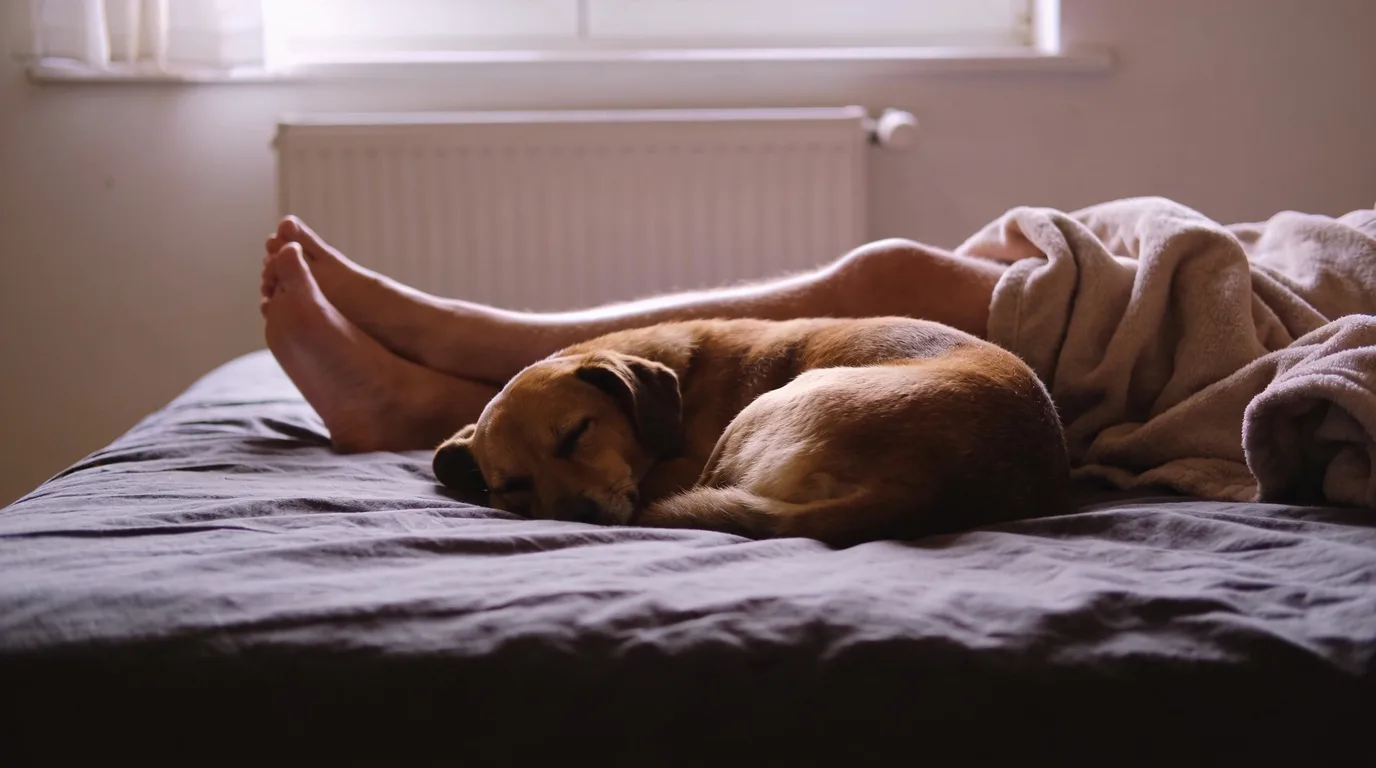
A dog who sleeps in the space between their owner's legs is usually doing four things at once: holding heat, occupying a pocket that is physically enclosed on three sides, maintaining contact with an attachment figure, and repeating something that worked the first time and has been quietly reinforced every night since. Those four drivers — thermoregulation, security, social bonding, and learned habit — are separable. They carry different weights in different dogs, and in most households one of them is doing far more work than the other three.
The two answers owners are usually given are "he's protecting you" and "she's asserting dominance." Neither survives inspection. A sleeping dog is not guarding anything; sleep is the state in which an animal is least able to detect or respond to a threat, and no animal selects its least defensible posture in order to defend someone else. The dominance reading is worse, applying a discredited model of captive wolf behavior to a domestic dog who found a warm spot. What the position does honestly indicate is thermal preference, a preference for enclosed resting sites, and — in a minority of dogs — how well or badly that dog tolerates distance from their person. This article separates those four drivers and gives you the observations that tell them apart.
Most of the time, the answer is boring. Boring is good news.
The four drivers, and why separating them matters
Each driver produces the same visible outcome — dog, legs, sleep — but each leaves a different fingerprint in the surrounding behavior. The fingerprints are what you read.
Thermoregulation. Dogs run warmer than people, with a normal core temperature of roughly 101–102.5°F (38.3–39.2°C) against the human 98.6°F. That does not make them better at staying warm while inactive. Heat loss scales with surface area, and heat production scales with mass, so small dogs, thin-coated dogs, and dogs with little body fat shed warmth far faster than their owners do while lying still. Curling reduces exposed surface. Pressing against a warm body eliminates it on the contact side. The space between two legs, under a duvet, is thermally the best real estate in the house.
The test: seasonality and duration. A thermally driven dog burrows more in winter, less in summer, and frequently relocates to the floor or a tiled surface after an hour once thoroughly warmed. If your dog wedges in, sleeps hard for forty minutes, then sprawls out on the rug for the rest of the night, heat was most of the story.
Security. Given a free choice of resting locations, a large proportion of dogs select spots with a physical boundary on two or more sides — crates, under coffee tables, behind sofas, the footwell of a car, the corner between an armchair and a wall. Enclosure reduces the number of directions from which something can approach, which lowers the vigilance cost of sleeping. This is not the folk claim that dogs are "den animals"; wild canids use dens for whelping, not for routine adult rest. It is a simpler observation about approach angles.
The test: does the dog choose enclosure when you are not the enclosure? A security-driven dog also sleeps under the desk, inside the open crate, and behind the sofa. A dog who only ever chooses contact with you, and never chooses an enclosed space on their own, is telling you the relevant variable is you, not the walls.
Social bonding. Dogs are a social species that rests in contact. Free-ranging dogs and familiar shelter pairs commonly sleep touching. Research adapting Ainsworth's Strange Situation procedure to dogs and their caregivers has repeatedly found attachment behaviors — proximity-seeking, using the caregiver as a secure base for exploration, and altered behavior on reunion — that are structurally comparable to infant–caregiver attachment. Contact during rest is a normal expression of that system, not a symptom of anything.
The test: is the contact-seeking calm and distributed across contexts, or urgent and narrow? A bonded dog leans on you on the sofa, settles nearby when you work, and sleeps against you at night, all without visible tension. An anxious dog does the same things with a different quality — faster onset, more monitoring, poor settling.
Learned habit. The first time it happened, nothing bad followed and several good things did: warmth, contact, no interruption. Behavior that is reinforced repeats, and sleep behavior in particular becomes stereotyped very quickly. Many dogs who started for a thermal or emotional reason years ago are now running pure habit.
The test: stereotypy. Same spot, same approach path, same number of turns, same time relative to lights-out, on nights that are warm and nights that are cold, after calm days and stressful ones. That rigidity is the signature of a well-practiced routine rather than an active need.
| Driver | Strongest clue | Weakens when |
|---|---|---|
| Thermoregulation | Seasonal pattern; dog leaves once warm | Room is warm; dog is double-coated |
| Security | Dog also chooses enclosed spots alone | Dog sleeps happily in open floor space |
| Social bonding | Calm contact-seeking across the whole day | Dog is equally settled at a distance |
| Learned habit | Highly stereotyped, invariant routine | Behavior varies with temperature or mood |
| Anxiety (the outlier) | Poor settling, monitoring, can't be alone | Dog naps alone in another room by choice |
Four of those five are non-problems. The fifth is the one worth spending attention on, and it is a minority case.
Why the space between the legs specifically
Owners notice this spot because it is oddly precise. Dogs do not choose it at random.
It is enclosed on three sides. Two thighs form walls, the torso or pelvis forms a backstop, and the duvet forms a roof. Functionally the dog has reduced the possible approach vectors to one. For a sleeping animal, that is a meaningful reduction in the amount of monitoring the nervous system has to do, and it is the same reason dogs choose the gap behind a recliner over the middle of a room.
It is the warmest pocket available. Heat radiating from two limbs, trapped by bedding, with the dog's own output added to it. In thermal terms, nothing else in the house competes.
Scent is concentrated there. Dogs have orders of magnitude more olfactory receptor neurons than humans and a correspondingly larger share of the brain devoted to processing what those neurons deliver. Bedding, skin, and clothing hold an owner's odor profile densely, and dogs consistently show lower stress-related behavior in the presence of owner-scented items during separations. A sleeping site saturated with a familiar signature is, in the most literal sense, reassuring.
Movement is detected before it is seen. Any shift in the bed transmits through contact. A dog in that position gets earlier warning of the household waking than a dog on the floor does, at zero cognitive cost.
Sustained contact pressure appears to be settling for many dogs. This is the least well-evidenced item on the list and should be held loosely. Controlled evidence for commercial pressure wraps is mixed and modest at best. What is not in doubt is the everyday observation that a large share of dogs actively choose to rest pressed against a solid surface — a wall, a sofa arm, a crate side, a person — rather than in open space.
A quick diagnostic that costs nothing: put a bolstered or covered dog bed on the floor beside your bed, warmed with a blanket out of the dryer and topped with a worn t-shirt. If the dog uses it readily, the drivers were warmth and enclosure. If the dog uses it for ten minutes and returns to your legs, the driver is contact with you.
What this actually says about the bond
It says there is one. It does not say how strong it is, and it says nothing at all about hierarchy.
Attachment in dogs is real, measurable, and directed at specific individuals. A dog who sleeps in contact with you is displaying affiliative behavior toward an attachment figure, which is a genuine and unremarkable fact about your relationship. What it cannot do is grade that relationship. Plenty of profoundly bonded dogs sleep across the room, on the floor, or in another room entirely, because they are hot, because their hips hurt, because they were raised sleeping alone, or because they simply prefer a cool tile surface. Absence of the behavior is not absence of attachment, and owners who read it that way end up chasing a false problem.
"He's protecting you" is the most common misreading, and it is worth dismantling properly. Protection requires vigilance, and vigilance requires wakefulness. A dog in the deepest and most vulnerable phase of sleep, wedged into a position that restricts their own movement, is not performing a guarding function. The reading also has a practical cost: an owner who believes the dog is standing watch tends to interpret the dog's next stiffening, hard stare, or growl at an approaching partner as loyalty rather than as what it usually is — resource guarding of a resting site or of a person. That confusion delays intervention on the one version of this behavior that genuinely needs it.
The dominance reading fails for a different reason. It descends from mid-century observations of unrelated captive wolves and was retracted by the researcher most associated with it once wild wolf packs — which are family groups — were studied properly. The AVSAB has formally rejected dominance-based frameworks in behavior modification. Sleeping location in a household of dogs and people does not encode rank, and the widely repeated advice that allowing bed access "makes a dog think they are in charge" has no support behind it. For the longer version of that argument, see why dominance theory is wrong.
Reading sleep position: a rough map
Position is one channel among many, and like every other channel in dog body language, it should never be read alone. Used carefully, it does carry information.
| Sleeping position | What it typically indicates | Caveats worth knowing |
|---|---|---|
| Between your legs | Heat retention, enclosure preference, contact with an attachment figure, or entrenched habit | The most over-interpreted position of all. Check season and whether the dog seeks enclosure elsewhere. |
| On your chest or stomach | Strong contact-seeking; common in small dogs and in dogs under 12 months; often heat plus proximity | In an adult dog with a sudden onset, look for a triggering change — illness, noise event, schedule shift. |
| Back-to-back or spine-to-spine | Contact with an escape route preserved; a comfortable compromise between proximity and autonomy | Frequently misread as aloofness. It is contact, just lower-commitment contact. |
| At or across your feet | Proximity with a view of the room; common in herding and working breeds | Across the feet specifically can also be a mild access-control pattern in some dogs; note what happens when someone else approaches. |
| Under the covers | Enclosure plus heat, strongly represented in terriers, dachshunds, and thin-coated toy breeds | A genuine overheating and air-supply risk for flat-faced breeds and heavily coated dogs. |
| Apart from you, same room | Thermal comfort preference or simple individual preference; extremely common in large and double-coated dogs | Not a sign of weak attachment. Check that the dog still seeks you out when awake. |
| Apart from you, another room, new | A change worth investigating rather than a preference | New avoidance of a familiar resting spot is a pain and illness question first. See pain signals in older dogs. |
| Curled tight, nose to tail | Heat conservation, or reduced confidence in the environment | In a dog who previously slept stretched out, a persistent tight curl can reflect discomfort. |
| Flat on the side or belly-up, limbs loose | High thermal comfort and low vigilance; a genuinely relaxed dog | The clearest positive signal in the table, and the one owners undervalue. |
The item to take from this table is not any individual row. It is the principle that a change in position carries more information than the position itself. Your dog's own baseline is the reference standard.
When the habit starts
Between-the-legs sleeping rarely begins for no reason. In dogs who did not do it from the start, it usually appears within a few weeks of an identifiable change.
- A new home. The first two to six weeks after adoption or rehoming produce elevated proximity-seeking in most dogs. It commonly settles on its own as the environment becomes predictable.
- Illness, injury, or the post-surgical period. Unwell dogs seek warmth and contact. This one is worth flagging because owners often notice the sleeping change before they notice the illness.
- A schedule change or a period of owner absence. Return from a trip, a change of shift pattern, or a household member leaving.
- Loss of another animal or a person in the household. Contact-seeking commonly rises for several weeks.
- A cold snap or a change of season. The most under-considered explanation and one of the most common.
- Adolescence. Roughly six to fourteen months in most dogs, with wide breed variation. Sleep and settling patterns are frequently unstable through this window.
- A noise event. Fireworks, a thunderstorm, construction. Noise-triggered proximity-seeking can persist long after the noise stops, and noise sensitivity is a known correlate of undiagnosed pain in older dogs.
- Sensory decline in a senior dog. Failing vision or hearing raises the value of physical contact, because contact still works when the other channels are degrading. Nighttime restlessness in an older dog can also reflect canine cognitive dysfunction or pacing at night.
The rule that matters: gradual onset in a young or middle-aged dog is almost always habit or comfort. Sudden onset in an adult dog with no environmental change is a veterinary question before it is a behavioral one.
Size, breed, and coat
Physiology explains a surprising amount of the variation between households.
Small and thin-coated dogs are the heaviest users of this position. Chihuahuas, Italian Greyhounds, Whippets, Greyhounds, Vizslas, Miniature Pinschers, Xoloitzcuintli, and short-coated bully types all combine low insulating coat with an unfavourable surface-area-to-mass ratio, low body fat, or both. For these dogs, thermal drive is often the dominant factor and remains so year-round in cool climates.
Burrowing breeds go further and go under. Dachshunds, Jack Russell and Border Terriers, and many other breeds selected for going to ground show a strong tendency to tunnel under blankets rather than simply lie against them. This is normal, and for these dogs a covered or hooded bed is unusually effective as an alternative.
Double-coated northern breeds often do the opposite. Huskies, Malamutes, Samoyeds, Newfoundlands, Bernese Mountain Dogs, and Great Pyrenees are insulated for conditions your bedroom does not reproduce. Many will actively avoid body contact during sleep and choose the coolest hard surface available. That is thermal management, not detachment.
Large breeds show size-blind contact. A 100-pound dog attempting the same position a 12-pound dog uses will still try to fit. Size-blindness of this kind is well documented across large sociable breeds and is not a training failure; it is a dog applying a strategy that worked when they were four months old.
Herding and guarding types often prefer a vantage point. Border Collies, Australian Shepherds, and many livestock guardian breeds frequently choose a spot with sightlines to the door rather than an enclosed pocket. Enclosure and visibility are competing preferences, and individual dogs weight them differently.
"Is this a problem?" — the question under the question
For most households the honest answer is no. It is a preference, it is common, and it does not cause behavioral problems. There are, however, six situations where it is worth a second look.
1. The dog cannot settle alone at all. Not "prefers company" — cannot. If your dog is unable to nap in another room while you are awake and at home, the night behavior is one visible piece of a larger pattern. See dog separation anxiety.
2. Separation-related distress at departures. Vocalizing, destruction focused on exit points, salivation, or house-soiling in an otherwise reliable dog when genuinely alone. Night contact does not cause this, but it frequently accompanies it.
3. Guarding of the bed or of you. A dog who stiffens, freezes, hard-stares, lifts a lip, or growls when a partner, child, or other dog approaches the bed is guarding a resource. That is a real behavioral problem and a real bite risk, and it needs professional handling rather than reassurance.
4. Your own sleep is measurably worse. Sleep-laboratory work published in Mayo Clinic Proceedings (2017) examining adults sharing a bedroom with a dog found that having the dog in the room was compatible with good sleep efficiency, while having the dog on the bed was associated with a measurable reduction. If you are waking repeatedly, this is a legitimate reason to change the arrangement, and it needs no further justification.
5. Physical risk. Very small dogs and toy breeds are genuinely at risk of injury from an adult rolling over, and dogs who are woken abruptly by a sleeping human's movement can snap reflexively before they are fully awake. Neither is an argument against bed-sharing in general; both are arguments for a raised bed beside the bed in specific households.
6. Pain in the dog. A dog who used to stretch out and now wedges into the tightest available space, or who begins seeking heat far more than they used to, may be managing discomfort. Cross-reference against the other markers in pain signals in older dogs.
Outside those six, this is a bedding preference. It does not require correction, and it is not evidence of a spoiled dog, a dominant dog, or a poorly trained one.
When it signals anxiety rather than comfort
The difference between a comfortable dog and an anxious one is not the position. It is the quality of the behavior around it.
Latency to settle. A comfortable dog performs a short settling ritual — a few turns, a scrape at the bedding — and is down within a minute or two. An anxious dog repositions repeatedly, gets up, circles, lies down, gets up again, and may take twenty minutes or more to commit.
Muscle tone during sleep. Look at the dog an hour in. Comfortable dogs reach lateral recumbency with limbs loose and slack, jaw relaxed, sometimes with limb twitching and soft vocalizing during REM (see dog barking in sleep). Anxious dogs stay curled, hold tension in the shoulders and jaw, and rarely fully release.
Response to your movement. Comfortable dogs adjust and resettle. Anxious dogs wake fully, reorient to you, and re-establish contact every single time.
Daytime separation. This is the most informative test in the list. Close a door between you and the dog for five minutes while you are both at home and awake. A comfortable dog waits, sighs, and lies down. A dog who paces, scratches at the door, whines continuously, or pants is showing you the real signal, and the night behavior is downstream of it.
Physiological markers at rest. Panting in a cool room with no exertion, trembling, dilated pupils, or a resting respiratory rate that stays elevated. Combine with the stress markers in signs your dog is stressed.
Trajectory. Comfort behaviors are stable. Anxiety behaviors escalate. If the dog has moved over six weeks from sleeping at the foot of the bed, to sleeping against your legs, to being unable to tolerate you leaving the room, the direction of travel is the finding.
The daytime analogue of all this is covered in why your dog follows you everywhere, and the two patterns usually appear together.
How to change it without damaging anything
If you need the bed space, you can have it. The method matters, because doing this badly converts a harmless preference into a genuine problem.
Step 1 — Rule out pain and illness first. A dog whose sleeping habits changed recently gets a veterinary examination before any training plan. Orthopedic pain, gastrointestinal discomfort, and endocrine disease all alter resting behavior, and no amount of bed training fixes any of them.
Step 2 — Define the actual criterion. "Off the bed entirely," "on the bed but at the foot," and "on a floor bed beside me" are three different projects with three different timelines. Pick one and hold it, because inconsistent criteria are the single most common reason these plans fail.
Step 3 — Build the alternative before you remove the current option. The new site has to win on the three variables the old site wins on:
- Enclosure. A bolstered, hooded, or three-sided bed, or an open crate with a blanket over part of the top. Flat mats fail for exactly this reason.
- Warmth. A self-warming pad, a blanket warmed in the dryer, positioning away from drafts and off cold floors. Follow manufacturer guidance strictly for any heated product and never use one with a dog who cannot move off it independently.
- Scent. A worn t-shirt or a pillowcase from your own bed. This is the cheapest and most effective single change in the list.
Step 4 — Pay for the choice. Every time the dog goes to the new bed voluntarily, mark it and deliver food there. Feed some meals on it. Scatter a few pieces of kibble on it during the evening. You are building a reinforcement history for a location, which takes days of repetition, not one demonstration.
Step 5 — Move it gradually. Start the new bed touching your bed at the same height if possible, then lower it, then move it a few inches per night. Dogs generalize location poorly, and a bed that moves three feet in one jump often loses all of its accumulated value.
Step 6 — Do not use aversives, and do not remove a sleeping dog by the collar. No spray bottles, no startling noises, no scolding, no shock or vibration collars — all of which are associated with increased fear and aggression risk and are rejected by the AVSAB. Reaching for a deeply asleep dog is also a well-documented bite scenario, including with dogs who have never shown aggression. Wake the dog with your voice from a distance first, then invite them off with a food lure or a known cue.
Step 7 — Expect an extinction burst. Behavior that stops being reinforced usually intensifies briefly before it declines. Two or three worse nights in the first week is the expected shape of the curve, not evidence that the plan is failing.
Step 8 — Give it two to six weeks. Most dogs relocate within that window. If your dog is still unable to settle after a month of consistent work, that outcome is diagnostic rather than disappointing — it points to separation-related distress, and the next step is a professional rather than a better bed.
What people get wrong
"He's protecting me." Covered above, and worth repeating because it is the most persistent version. A sleeping dog is not on watch. The version of this behavior that involves actual threat displays toward approaching people is guarding, not protection, and it needs intervention rather than admiration.
"Letting a dog on the bed causes behavior problems." This advice circulates widely and has no good evidence behind it. There is no established causal link between bed access and aggression, disobedience, or "dominance." The actual risk factor at resting sites is conflict — startling a sleeping dog, physically removing a dog from a spot, or reaching over a dog who is guarding — and that risk exists on a dog bed just as much as on yours.
"Bed-sharing causes separation anxiety." Not supported. Separation-related distress tracks how a dog copes with being genuinely alone, which is trainable independently of where the dog sleeps at night. Removing bed access does not treat it, and doing so abruptly in a dog who already has it tends to make the picture worse.
"It's just that she's cold." The reverse error. Thermal drive is real and under-credited, but a dog who does this in July in an air-conditioned house, or who does it during a thunderstorm regardless of temperature, is not running on heat alone.
"Ignoring him will teach independence." Attention-withdrawal protocols — deliberately ignoring a distressed dog to "break the dependency" — are not supported for separation-related problems and tend to raise arousal rather than lower it. Independence is built by graduated, sub-threshold alone-time practice, not by withholding contact.
"She thinks I'm her mother." There is no evidence for that specific interpretation, and it is not needed. Contact during rest is normal affiliative behavior in a social species. No pseudo-kinship story is required to explain it.
When to see a vet or a behavior professional
Book a veterinary appointment if:
- The behavior started suddenly in an adult dog with no environmental change
- The dog is also showing reluctance on stairs, difficulty rising, changed appetite, increased thirst, or panting at rest
- The dog has stopped using a previously preferred resting spot
- An older dog is restless, pacing, or disoriented at night — see senior dog behavior changes
- Sleep is fragmented, or the dog seems unable to enter deep sleep at all
Engage a credentialed behavior professional if:
- The dog stiffens, freezes, hard-stares, growls, or snaps when anyone approaches the bed
- The dog cannot be left alone at all, at any duration
- Distress escalates rather than settling over a two to four week structured plan
- There are children in the household and any resting-site tension has appeared
Credentials that indicate force-free, evidence-based practice: DACVB (Diplomate, American College of Veterinary Behaviorists), CDBC (Certified Dog Behavior Consultant), CSAT (Certified Separation Anxiety Trainer), KPA-CTP (Karen Pryor Academy Certified Training Partner), Fear Free certification, and IAABC membership. Guidance on vetting a practitioner is in how to find a credentialed behaviorist.
Avoid anyone marketing "pack leadership," "alpha" framing, or "balanced training," the last of which usually signals the inclusion of aversive tools.
Try it on your own dog
The fastest way to check a read is to make your own call first, then compare it against a structured second opinion.
PetTranslator.ai applies the framework described here. Upload one clear photo of your dog in their usual resting position and it returns a report shaped the way a behaviorist writes a session note: the observed body-language markers first — muscle tone, limb position, facial tension, weight distribution — then the behavioral interpretation, a confidence score with the reasoning behind it, an explicit list of what a single frame cannot assess, and a Do/Avoid plan for the week. No invented dialogue, no cartoon captions.
For a resting-position question in particular, it is worth photographing the same dog on a cold night and a warm one. The difference between the two frames often answers the question on its own.
Sources
- AVSAB Position Statement on Humane Dog Training (2021) — American Veterinary Society of Animal Behavior.
- AVSAB Position Statement on the Use of Dominance Theory in Behavior Modification of Animals.
- Karen Overall, Manual of Clinical Behavioral Medicine for Dogs and Cats (Elsevier, 2013) — clinical reference for attachment, separation-related disorders, and resting-site behavior.
- Patricia McConnell, The Other End of the Leash (Ballantine, 2002) — human–dog interaction and the misreadings that arise from it.
- Turid Rugaas, On Talking Terms with Dogs: Calming Signals (Dogwise, 2nd ed. 2005) — the standard catalogue of displacement and appeasement signals referenced throughout.
- Patel et al. (2017), Mayo Clinic Proceedings — sleep efficiency in adults sharing a bedroom versus a bed with a dog.
- Research adapting the Ainsworth Strange Situation procedure to dogs and their caregivers, establishing measurable caregiver-directed attachment behavior.
- Published findings on owner-scented items reducing stress-related behavior in dogs during separation.
Khabir Mughal is the founder of PetTranslator.ai. This article was reviewed against the AVSAB Position Statement on Humane Dog Training and Karen Overall's Manual of Clinical Behavioral Medicine before publication. It is not veterinary advice — for any sudden change in sleeping or resting behavior, see a veterinarian first.