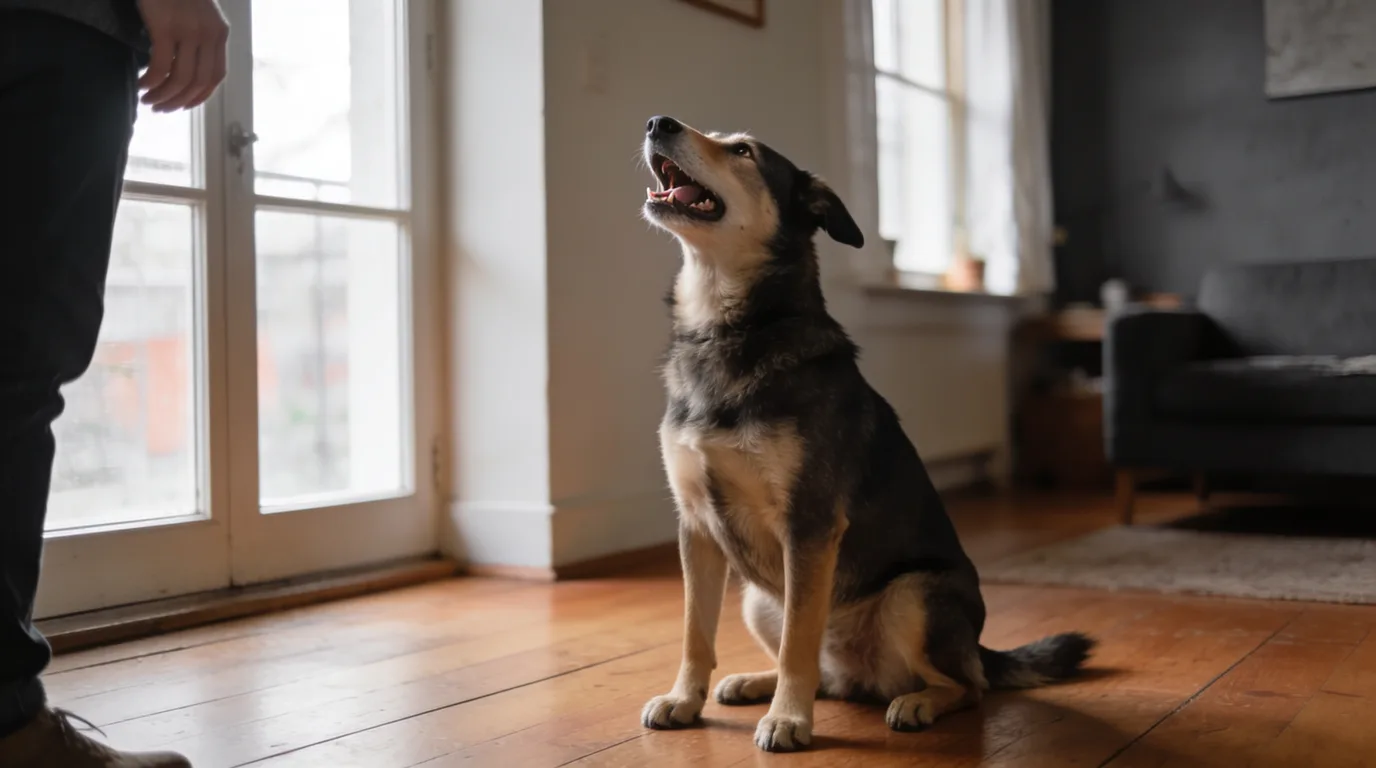
A dog who whines a lot is not doing one thing. Whining is a single acoustic output produced by at least six functionally distinct internal states, and the correct response to each one is different — in several cases, opposite. Ignore a demand whine and it fades. Ignore an anxiety whine and it intensifies. Ignore a pain whine and you delay a diagnosis by months. The first job is never to stop the sound. It's to classify it.
Classification works the way every behavioral read works: by looking at what the body is doing while the sound happens, and at what reliably precedes it. The whine itself carries little information. Posture, timing, and the dog's response to your response carry almost all of it.
Start with the triage table if you want the fast answer, then read the category that matches.
What a whine actually is
Whining is a care-soliciting vocalization. Puppies produce it from the first days of life to bring the dam back to the nest, and unlike most neonatal behaviors it doesn't disappear at maturity — it carries into adult life as a general-purpose distance-reducing signal. Acoustically it is the growl's opposite: low harsh vocalizations broadly signal threat, high tonal ones signal need. That is the whine's one consistent property across all six categories. A whining dog is attempting to close a gap between a current state and a desired one, social, physical, or internal.
What the whine does not do is encode content. There is no whine that means "I need to go outside" and a different one that means "I want the ball." The apparent specificity owners perceive — "she has a particular whine for the door" — is real, but it comes from learning history and the accompanying behavior chain, not the acoustic signal. The dog learned that whining while oriented toward the door produces the door. For the broader framework, see what your dog is actually communicating.
Fast triage: when it happens tells you what it is
Timing is the highest-yield diagnostic variable. Before analyzing the sound, log when it happens for three days.
| When the whining happens | Most likely category | First move |
|---|---|---|
| Only when you're eating, on a call, or at a laptop | Demand / attention | Audit what reinforced it |
| Stops the instant you make eye contact or speak | Demand / attention | Audit what reinforced it |
| During departure cues, or only when the dog is alone | Anxiety (separation-related) | Video the alone time |
| During storms, fireworks, vacuum, vet visits | Anxiety (fear-based) | Manage the trigger, then desensitize |
| On movement transitions — standing, lying down, stairs, car | Pain | Veterinary exam |
| At night only, in a previously settled adult dog | Pain first, then cognitive | Veterinary exam |
| When the leash, car keys, or a visitor appears | Excitement / anticipation | Lower arousal before the trigger |
| When you lean over, scold, or a stranger reaches | Appeasement | Remove the social pressure |
| Senior dog, aimless, 2–4 a.m., often facing a wall | Cognitive dysfunction | Veterinary cognitive workup |
| New onset in a previously quiet dog, no clear trigger | Medical until proven otherwise | Veterinary exam |
Several rows point at a veterinarian rather than a trainer. That ordering is deliberate: sudden behavior change in a previously stable dog is a medical question before it is a behavioral one, every time.
1. Demand whining
The most common category, and the only one where withholding your response is part of the solution.
Sound. Short, punctuated bursts with clear gaps between them. Pitch rises across a sequence; volume escalates if the first attempts fail. The defining feature is not the tone — it's the pause. A demand-whining dog stops to check whether the whine landed.
Body. Oriented directly at the person or the resource. Weight forward, ears forward or neutral, eyes soft but locked on the target. Often paired with a paw lift, a nose nudge, or a toy dropped in your lap. Engaged, not collapsed. No displacement signals — no out-of-context lip licking, no yawning, no whale eye.
Context. Appears with a specific person, in a specific location, at times that historically produced a payoff. Almost never happens when the dog is genuinely alone — no audience.
What to do. Identify what reinforced it, then reinforce a replacement behavior far more generously than the whine was ever reinforced. A mat settle, a down-stay, or a chin rest are all incompatible with standing over you whining, and you pay that alternative before the whining starts. Also audit whether the underlying need is being met — an under-exercised, under-sniffed dog produces far more demand behavior than a satisfied one.
What not to do. Do not respond intermittently. Do not scold — verbal correction is attention, and for a dog whose whining is maintained by attention, scolding is a reinforcer wearing a costume. Do not reach for a bark collar or any device that punishes vocalizing.
2. Anxiety and stress whining
Structurally the opposite of demand whining, and the category most often mishandled, because the standard internet advice — ignore it — actively worsens it.
Sound. Continuous rather than punctuated. Often modulated into a moan or a rising-falling wail, in long phrases with few gaps. Critically, the dog does not pause to check for a response, because the vocalization isn't addressed to anyone. It's overflow.
Body. Pacing a fixed route. Panting in a cool room with no exertion. Lowered body, low or tucked tail, pinned ears, dilated pupils, trembling, salivation. Whale eye and repeated out-of-context lip licking. Inability to settle, or settling and getting up within seconds.
Context. Two sub-patterns. Fear-based whining is tied to a trigger — thunder, fireworks, the vacuum, the vet clinic — and stops when the trigger stops. Separation-related whining begins during departure cues, targets exit points, and continues in the owner's absence. See separation anxiety and the full stress-signal set.
What to do. Reduce the trigger to an intensity the dog can tolerate, then work upward gradually. Provide a genuine refuge — a covered crate with the door open, an interior room, white noise. Comfort the dog if the dog seeks contact. Reassurance does not reinforce fear; fear is a respondent emotional state, not an operant behavior. For separation cases, systematic absence training run below threshold is the only protocol with a credible evidence base, and it needs a professional.
What not to do. Do not ignore it. Do not flood the dog by forcing exposure "until they get used to it" — that sensitizes rather than habituates. Do not confine an anxious dog in a closed crate if the anxiety produces escape attempts; dogs break teeth and nails on crate doors. Do not punish.
3. Pain whining
The category with the highest cost of a missed call, and the one most often misfiled as "getting old" or "getting needy."
Sound. Lower in pitch than the other categories, frequently a groan or grunt rather than a true whine. Produced on exertion rather than continuously — a single sound on standing up, on lying down, on the first stair, on being lifted into a car. A sharp yelp on contact with a specific body region is a strong localizing sign.
Body. Reluctance to perform a previously routine movement. A changed resting posture. Slow, deliberate transitions. Repetitive licking of one location — a joint, a paw, a flank. New irritability when approached while lying down or touched in a particular area. Panting at rest. Reduced appetite or slower eating, which frequently traces to dental disease. Withdrawal to another room.
Context. Tied to movement, to time of day (pain typically worsens at night when distraction drops), and to weather in arthritic dogs. Not tied to your presence or attention. A pain whine happens whether or not anyone is watching, which is the cleanest discriminator against demand whining.
What to do. Book a veterinary exam and bring video — film the dog rising from rest, taking stairs, and walking away from the camera on a hard floor. Gait asymmetry is far easier to see on replay. Ask specifically about dental disease, osteoarthritis, and spinal pain, the three most commonly missed sources of chronic discomfort in dogs. Validated owner-completed chronic pain instruments exist; asking your veterinarian to use one gives you a repeatable baseline instead of an impression.
What not to do. Do not train through it. Do not give human analgesics — ibuprofen, naproxen, and acetaminophen are all toxic to dogs at accessible doses. Do not accept "he's just slowing down" as an endpoint. Age is not a diagnosis. More in pain signals in older dogs.
4. Excitement and anticipation whining
Benign in itself, but a reliable marker that arousal regulation needs work — and high arousal is a precursor to leash reactivity, poor impulse control, and door-dashing.
Sound. High-pitched and rapid, often layered with squeaks, yips, or short barks, and frequently produced through a nearly closed mouth. Rises in pitch and rate as the anticipated event gets closer.
Body. Whole-body movement. Fast, wide tail wag involving the hips. Bouncing, spinning, jumping. Open mouth, loose lips, soft eyes, weight forward. Sometimes a full-body shake-off when arousal peaks. The distinguishing feature versus anxiety whining is looseness: excitement bodies are curved and mobile, anxiety bodies are tight and low.
Context. Locked to predictable triggers — the leash coming off the hook, keys, shoes, the car turning onto your street, the doorbell.
What to do. Work on the cue, not the emotion. Pick up the leash fifty times a day and put it back down with no walk following, until the leash stops predicting anything. Make four paws on the floor the precondition for the door opening. Add sniffing work — scatter feeding, snuffle mats, long-line decompression walks — because olfactory engagement lowers arousal per minute more effectively than physical exercise.
What not to do. Do not proceed at peak arousal. Opening the door mid-whine reinforces the whine on the strongest possible schedule. Do not add more running as the fix; an exhausted, under-stimulated dog is an aroused dog with sore legs.
5. Appeasement whining
The quietest category and the most consequential to misread, because it appears in exactly the situations where humans keep pushing.
Sound. Soft, brief, low-volume — a single short whine or a series of small ones, sometimes with a lip smack or soft grumble. Easy to miss entirely.
Body. The full appeasement cluster: lowered body, weight back, ears pinned, squinted or averted eyes, a long C-shaped commissure, tail low and sweeping fast and narrow near the ground, a lifted front paw, often rolling partly or fully onto the back. Lip licking. Head turned away while the eyes track the person.
Context. Produced in response to social pressure — a person leaning over the dog, reaching for the collar, staring, scolding, hugging, or approaching head-on. Also directed at other dogs during tense greetings, and at returning owners in the classic "guilty look" scenario.
What to do. Remove the pressure. Stand up, turn side-on, look away, stop reaching. Let the dog re-approach on their own terms, then change the setup so the pressure doesn't recur: teach a collar-grab game paid with food, approach from the side, instruct children to let the dog come to them.
What not to do. Do not read a dog rolling onto their back with a tucked tail and closed mouth as a belly-rub request. That cluster is a request for the interaction to end, and reaching into it is one of the most common household bite scenarios. Do not interpret appeasement as guilt — Alexandra Horowitz's 2009 experiment in Behavioural Processes showed the "guilty look" tracks owner scolding, not the dog's conduct.
6. Cognitive-dysfunction whining in senior dogs
Canine cognitive dysfunction syndrome produces a whine unlike any of the others: undirected, purposeless, unresponsive to intervention.
Sound. Repetitive and monotonous. No escalation pattern, no pause to check for a response, no obvious relationship to anything in the environment. Usually in the middle of the night.
Body. Standing still, often in a corner or facing a wall. Staring at nothing. Getting stuck behind furniture or on the wrong side of a door. Pacing a fixed circuit. Failing to respond to a name they've known for a decade. The whining does not stop when the owner arrives — a critical discriminator, since demand and anxiety whining both change when a person appears.
Context. Dogs over roughly eight to ten, with prevalence rising steeply each subsequent year. Signs cluster into a recognized pattern that veterinary behaviorists screen with the DISHAA framework: Disorientation, altered Interactions, Sleep–wake cycle disruption, House-soiling, changed Activity level, and Anxiety. Nocturnal vocalization sits at the intersection of the sleep–wake and anxiety domains. See cognitive dysfunction in senior dogs, senior dog behavior changes, and dog pacing at night.
What to do. Get a veterinary workup. Cognitive dysfunction is a diagnosis of exclusion — pain, hypertension, endocrine disease, and sensory loss all produce overlapping signs and all have specific treatments. If confirmed, management is multimodal: environmental predictability, night lights, non-slip flooring, maintained routine, achievable enrichment, dietary intervention, often pharmacological support.
What not to do. Do not treat night vocalization in a senior dog as a training problem. Do not withhold response as an extinction protocol; there is no operant contingency to extinguish. Do not assume cognitive decline before pain is ruled out — untreated osteoarthritis is the most common cause of nocturnal restlessness in older dogs, and it is treatable.
Reinforcement, extinction, and why "just ignore it" fails
The standard advice — ignore the whining and it will stop — is correct for exactly one of the six categories and wrong for the other five. Even within demand whining it fails more often than it works. Three mechanisms explain why.
Intermittent reinforcement makes behavior more durable, not less. A behavior reinforced every time extinguishes quickly once reinforcement stops. A behavior reinforced unpredictably becomes extraordinarily persistent. That describes almost every household. The owner ignores the whining for eleven minutes, then caves. The dog has now learned that whining works — it just takes about eleven minutes. The next round runs longer.
Extinction bursts look like failure and produce most of the caving. When a previously reinforced behavior stops working, the first response is an increase in frequency, intensity, and variability before any decrease. The whine gets louder, longer, and arrives with pawing and barking attached. That is the signature of extinction working, and precisely the moment owners break. Reinforcing during the burst installs the escalated version on a leaner schedule.
Extinction teaches nothing. Removing the reinforcer tells the dog what stopped working, not what to do instead. Extinction-induced frustration is well documented, and in some dogs surfaces as escalated arousal or redirected snapping.
The functional protocol is differential reinforcement of an alternative behavior: withhold the reinforcer for the whine and pay a specific incompatible behavior immediately. Accept that a well-run plan still produces a burst, decide in advance you will not respond during it, and put the reinforcer physically out of reach so the decision isn't yours at 11 p.m.
What people get wrong about whining
"He's being manipulative." Manipulation requires modelling another mind's beliefs in order to alter them. Dogs repeat what has worked. The learning history belongs to the owner, not to a character flaw in the dog, and reframing it as operant conditioning is the difference between a fixable problem and a moral grievance.
"He's trying to be dominant." Whining is a care-soliciting, distance-reducing, developmentally juvenile vocalization — the furthest possible point from anything the dominance framework describes. That framework was rejected on its own terms decades ago. See why dominance theory is wrong.
"He whines when I leave, so it's separation anxiety." A dog who whines for three minutes after departure and then sleeps has a mild, common departure response. Clinical separation-related distress produces sustained vocalization, exit-point destruction, salivation, house-soiling, and often self-injury. The only way to know which you have is to film the alone time.
"He whines to go outside." Sometimes. But a dog who has learned that whining opens the door will use that channel for anything, including boredom — and a dog with a urinary tract infection or early cognitive decline also stands at the door. A sudden increase in door-directed whining in a house-trained adult dog is a urinalysis, not a training question.
"Ignoring it is the answer." Only for demand whining, only when paired with a reinforced alternative, and only when you can guarantee you won't cave during the burst. Applied to an anxious or painful dog, it is neglect with a training vocabulary.
"Small breeds just whine more." Some individuals are more vocal at baseline. Baseline is the point — what matters is a change from this dog's normal.
When to see a veterinarian, and when to hire a professional
See a veterinarian first if:
- The whining is new in a previously quiet adult dog, or has escalated over weeks with no environmental cause
- It occurs on movement transitions, or localizes to a body region
- It happens at night in a dog over seven
- It accompanies any appetite, thirst, urination, or gait change
- It comes with retching, abdominal distension, straining, collapse, or a stiff neck — emergency
Hire a credentialed behavior professional if:
- Separation-related distress produces destruction, self-injury, or house-soiling when the dog is genuinely alone
- The whining accompanies growling, snapping, or any bite history
- The vocalization has a stereotypic, self-sustaining quality and cannot be interrupted
- The dog is on anxiety medication and the behavior plan needs integrating with it
- You ran an extinction plan, hit the burst, and lost ground
Credentials that indicate force-free, evidence-based practice: DACVB (Diplomate, American College of Veterinary Behaviorists), CDBC (Certified Dog Behavior Consultant), CSAT (Certified Separation Anxiety Trainer), KPA-CTP (Karen Pryor Academy Certified Training Partner), Fear Free certification, IAABC membership. A DACVB is a veterinarian and can prescribe; the others cannot, which matters when medication is part of the plan. See how to find a credentialed behaviorist.
Avoid anyone marketing "dominance," "alpha," "pack leadership," or "balanced training" — the last is a euphemism for including aversive tools.
Try it on your own dog
The hardest part of whine classification is the body language running underneath the sound, and that's what owners have the least practice reading. A demand whine and an anxiety whine are separated by roughly six postural markers, all visible in a still photograph. For the underlying skill, start with dog body language.
PetTranslator.ai runs the same framework. Upload one clear photo of your dog and it returns a report structured the way a behaviorist writes a session note: the observed body-language markers first, the interpretation second, a confidence score with its reasoning, an explicit list of what could not be assessed from a single frame, and a Do/Avoid plan. No cartoon captions, no invented dialogue.
It cannot hear the whine, and says so. What it can tell you is whether the body producing it is loose or tight, forward or collapsed — the variable that decides which category you're in. For a suspected pain or cognitive case it points you at a veterinarian.
Sources
- AVSAB Position Statement on Humane Dog Training (2021) — the standard for force-free practice, and the basis for the recommendation against bark, static, and spray collars.
- AVSAB Position Statement on the Use of Dominance Theory in Behavior Modification of Animals.
- Karen Overall, Manual of Clinical Behavioral Medicine for Dogs and Cats (Elsevier, 2013) — vocalization, separation-related distress, and the pain-versus-behavior differential.
- Landsberg, Hunthausen & Ackerman, Behavior Problems of the Dog and Cat (Elsevier) — the DISHAA cognitive screening framework.
- Turid Rugaas, On Talking Terms with Dogs: Calming Signals (Dogwise, 2nd ed. 2005) — appeasement and displacement signals.
- Patricia McConnell, The Other End of the Leash (Ballantine, 2002).
- Alexandra Horowitz (2009), "Disambiguating the 'guilty look'" — Behavioural Processes 81(3).
- AAHA Pain Management Guidelines for Dogs and Cats — chronic pain recognition and validated scoring instruments.
- Operant principles cited here — intermittent schedules, extinction bursts, extinction-induced frustration, differential reinforcement — are standard applied behavior analysis findings, not dog-specific research.
Khabir Mughal is the founder of PetTranslator.ai. This article was reviewed against the AVSAB Position Statement on Humane Dog Training and Karen Overall's Manual of Clinical Behavioral Medicine before publication. It is not veterinary advice — for new or escalating whining, see a veterinarian first.