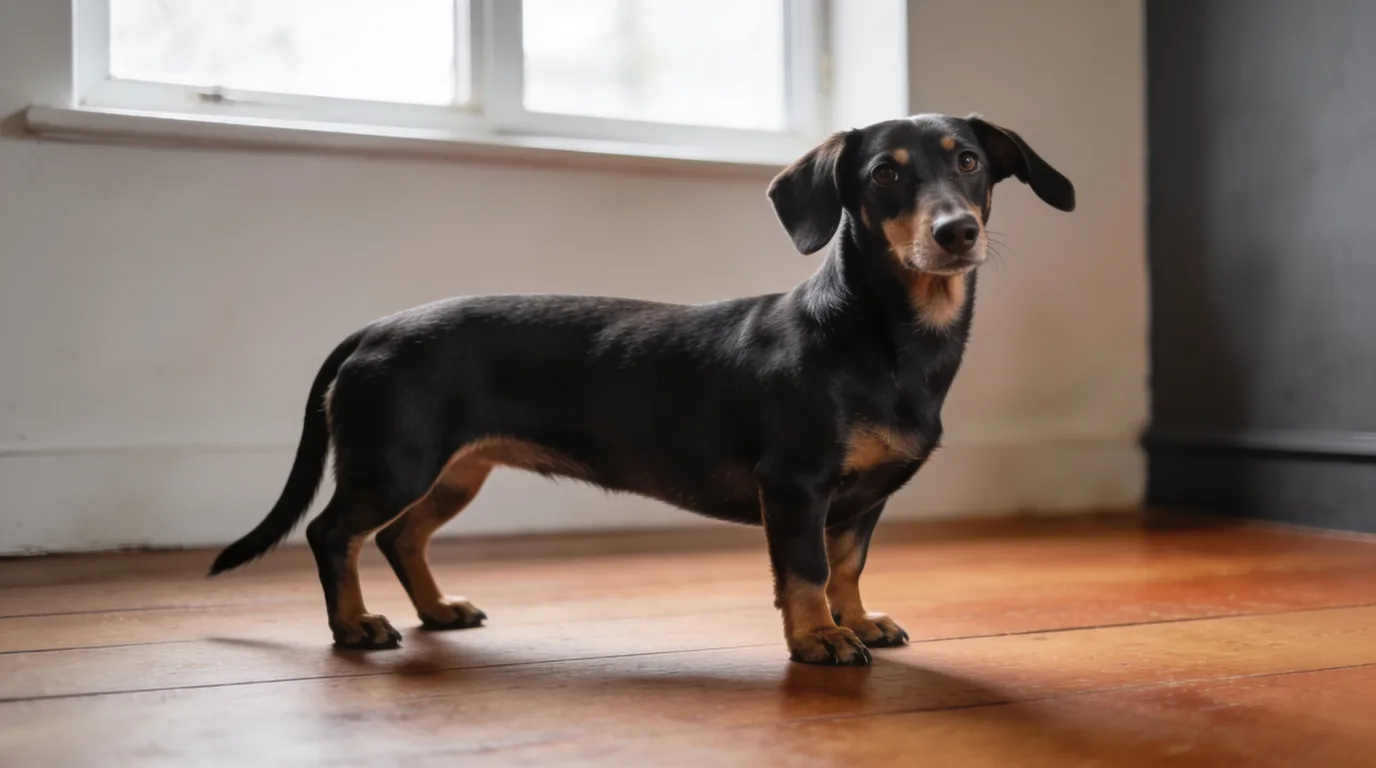
The behavioral core of the Dachshund is scent-hound tenacity installed in a chondrodystrophic body. The breed was built in Germany to enter a badger sett alone, locate an animal capable of killing it, hold position underground out of sight and out of reach of its handler, and keep barking so the hunter above could work out where to dig. Every part of that job selected for the same package: boldness disproportionate to size, persistence past the point where most dogs disengage, a willingness to make decisions without instruction, and a loud, sustained voice used as a working tool rather than as an accident.
That package does not switch off in a two-bedroom apartment. It shows up as a dog that announces every sound in the building, excavates the sofa cushions, follows a scent line across the park with genuine indifference to being called, holds an opinion about who may approach its bed, and treats a training session as a negotiation rather than an instruction. Layered on top of all of it is the single most consequential fact about the breed: the same conformation that made the Dachshund useful underground carries a very high lifetime risk of intervertebral disc disease, and spinal pain in this breed presents first as a change in temperament. A large share of what owners report as a Dachshund "turning grumpy" is a neurological or orthopedic problem wearing a behavioral mask.
What the Dachshund was actually selected for
The name is literal: Dachs (badger) plus Hund (dog). German breed development from roughly the seventeenth century onward produced a scent hound with the legs bred out of it, so that a dog with hound olfaction, hound voice, and hound stamina could fit into a tunnel. Standard-sized dogs went after badger and fox; the smaller varieties were developed for rabbit and for tighter earth. Above ground the same dogs were used as trailing hounds, tracking wounded game by scent and giving voice continuously while doing it.
Four requirements fall out of that work, and all four are behaviorally visible today.
Independent decision-making. A dog thirty feet underground in the dark cannot be handled. It cannot see its owner, hear a cue reliably, or wait for permission. Selection favored dogs that assessed a situation and committed to a course of action alone. This is the trait pet owners experience as stubbornness, and it is not the same underlying thing as a Border Collie or a Shepherd choosing not to comply.
Sustained voice. Barking was the location signal. A quiet Dachshund underground was a lost Dachshund and a failed dig. The breed was selected across centuries for a loud, carrying, repetitive bark that continues without external reinforcement. Alert-barking in a pet home is not a training failure and not a symptom; it is the job, running without a badger.
Boldness under pressure. A cornered badger is a serious opponent for a fifteen-pound dog. Dogs that backed off did not work. What remained was a population disposed to escalate rather than retreat when something worrying gets close, which is directly relevant to how the breed handles unfamiliar people and dogs at short range.
Nose-first processing. The Dachshund is a hound. Scent is the dominant channel, and a dog on a scent line is in a state that competes hard with recall, eye contact, and every other cue the owner has trained.
In a pet home those four traits produce a dog that is funny, self-directed, extremely persistent about anything it finds worth doing, and considerably harder to train than its size suggests. None of it is defective. It is a specification for underground solo work, running in a household that has no underground solo work available.
What breed actually predicts — and what it does not
Before going further, the caveat this breed needs stated plainly, because Dachshund content tends to swing between "sausage dog with a big personality" and "notoriously bitey."
Breed predicts tendencies across populations. It does not predict individuals. The largest genomic analysis to date on this question — Morrill and colleagues, published in Science in 2022 using the Darwin's Ark dataset of tens of thousands of owner-surveyed dogs paired with genotypes — found that breed accounted for only a modest share of behavioral variation between individual dogs, roughly a tenth of the total. Most variation sat within breeds rather than between them. A few traits showed a clearer breed signal than others, and almost none behaved as a breed-level guarantee.
The practical reading: "Dachshunds are vocal and stranger-wary" describes a shifted average, not a rule. Plenty of individual Dachshunds are quiet, socially relaxed, and easy to train, and plenty of individuals in famously biddable breeds are neither. Breed information is useful for anticipating what may need managing and for setting up a puppy's first year deliberately. It is not a diagnosis, it is not an excuse, and it is never a substitute for observing the dog in front of you. Where a Dachshund's behavior contradicts the breed picture, the dog is right and the picture is wrong.
Size and coat varieties — do they differ behaviorally?
Owners ask this constantly, and the honest answer is that the differences are smaller and less reliable than breed folklore claims.
| Variety | Original working purpose | What breeders and owners commonly report | How much weight to give it |
|---|---|---|---|
| Standard | Badger and fox below ground; trailing above ground | Somewhat steadier, slower to escalate, higher stamina | Modest tendency; individual variation dominates |
| Miniature | Rabbit and tighter earth | More reactive to novelty, quicker to vocalize | Often confounded with how small dogs are raised |
| Smooth coat | The original type | Described as more owner-focused | Weak evidence; largely anecdote |
| Longhaired | Breed histories describe spaniel influence | Described as calmer and softer | Weak evidence; treat as unproven |
| Wirehaired | Breed histories describe terrier influence | More active, more persistent, higher prey drive | The most consistently reported difference, still a tendency |
The wirehaired variety is the one where the reported difference is least likely to be imagination, because the historical outcrossing described in breed accounts would plausibly have brought terrier working style with it. Even there, the effect is a shifted average. Selecting a coat type as a temperament strategy is a poor plan; assessing the individual puppy, the parents, and the breeder's actual selection priorities is a much better one.
Breed-typical behaviors in a pet home
Alert barking as a default setting. The Dachshund barks at the hallway, the lift, the bin lorry, a dog three gardens away, and a leaf. The volume is disproportionate to the dog, which is exactly what it was selected to be. Two implications follow. First, this behavior will never be trained to zero, and an owner who requires silence has chosen the wrong breed. Second, it responds well to being managed and redirected — blocking visual access to the street, teaching a paid alternative behavior after one or two barks, and reducing the number of unearned rehearsals per day. What it responds badly to is punishment, which suppresses the sound without touching the arousal underneath and reliably makes a vocal dog into a tense, vocal dog.
Digging, burrowing, and tunnelling under fabric. Earth-dog behavior does not require earth. It reappears as scratching at bedding into a shape, disappearing under duvets, excavating the corner of the garden, and rearranging the sofa. This is normal, self-reinforcing, and best given a legitimate outlet — a digging box, a snuffle mat, a blanket nest of its own. One safety point deserves emphasis: a Dachshund sleeping under a duvet is invisible, and a startled dog woken by weight landing on it may snap before it is awake. Household rules about checking the bed are a bite-prevention measure, not fussiness.
Independent working style misread as stubbornness. A Dachshund that does not come when called on a scent line is not defying anyone. It is doing precisely what selection built: committing to a task without handler input. Functionally the training problem is that the owner's reinforcement is competing against a genetically supported, self-reinforcing behavior, and losing. The fix is reinforcement value, distance management, and long-line work — not escalation. Trainers who describe this breed as "dominant" or "needing to know who is boss" have misidentified an independent working style as a social challenge.
Strong prey drive. Squirrels, rabbits, cats, small furries, and anything that runs. Off-lead recall in an open space is a genuine risk with this breed, and a Dachshund on a line of scent is functionally deaf. Long-line work, secure fields, and honest expectations are the sane approach.
Resource guarding at above-average rates. Food bowls, chews, stolen socks, beds, laps, and the person the dog is closest to. Owner-reported survey data on breed differences in canine aggression — Duffy, Hsu and Serpell's C-BARQ work — has repeatedly placed Dachshunds above the general population average on several aggression measures, including owner-directed aggression, which is disproportionately guarding-related. Two things are true at once: this is a real breed-level shift, and it is highly modifiable with early management and trade-based protocols rather than confrontation. See resource guarding.
Stranger-wariness and small-dog reactivity. Many Dachshunds are notably reserved with unfamiliar people and quick to escalate at unfamiliar dogs, particularly on lead where distance cannot be controlled. Part of this is the selected-for tendency to hold ground rather than retreat. Part is environmental: small dogs get scooped up mid-interaction, are approached by strangers who bend directly over them, and rarely get the choice to move away. A dog that cannot create distance itself has one remaining option, and it is loud. See reactive dog vs aggressive dog and leash reactivity.
Attachment to one person, with guarding of that person. Dachshunds frequently orient to a single household member, follow them from room to room, and object when others approach. The objecting part is guarding, not devotion, and it needs handling as guarding.
Persistence, applied to everything. The trait that kept a dog barking at a badger for an hour also keeps it barking at a closed door, working at a food puzzle it cannot solve, and repeating a demand behavior long past the point where most dogs give up. This is the single most useful thing to understand about living with the breed: whatever gets reinforced once will be attempted several hundred more times.
IVDD: the most important behavioral fact about the breed
The Dachshund's short limbs are a form of disproportionate dwarfism. Research published in 2017 identified an FGF4 retrogene insertion on canine chromosome 12 associated with both the short-limbed conformation and with premature degeneration of the intervertebral discs — meaning the shape and the disc disease travel together rather than being separate problems that happen to co-occur.
The consequence is a very high lifetime risk of intervertebral disc disease (IVDD). Commonly cited estimates place roughly one in four Dachshunds as affected at some point in life, an order of magnitude above the general dog population. Disc material degenerates early, hardens, and can extrude suddenly into the spinal canal, producing anything from back pain to complete hind-limb paralysis, sometimes within hours.
Why this belongs in a behavior guide. Because the early presentation is almost never "my dog is limping." It is behavioral:
- New irritability, especially when lifted, touched along the back, or approached while lying down
- Sudden snapping with what the owner describes as no warning
- Reluctance to jump onto furniture, take stairs, or get into the car — read as stubbornness
- A hunched or roached topline, tucked abdomen, or a head held lower than usual
- Trembling or panting at rest in a cool room
- Yelping when picked up under the ribs, or when turning quickly
- Withdrawal — the dog goes to another room, stops asking for contact, stops greeting
- Reduced appetite or slow eating
- Scuffing hind toes, crossing the back legs, or wobbling on turns
Every item on that list gets reported to trainers as a behavior problem. Several of them get punished. An owner who corrects a Dachshund for growling when lifted has punished the only warning a dog in spinal pain has available, and the next escalation will arrive without it.
Management that actually matters. Risk cannot be eliminated in a breed whose conformation carries the mutation, but the load can be reduced.
| Measure | What to do | Why |
|---|---|---|
| Body condition | Keep the dog lean — ribs easily felt, visible waist | The strongest modifiable risk factor, and the one most owners get wrong |
| Vertical movement | Ramps or steps to sofa and bed; lift into and out of the car | Repeated jumping down loads the spine at impact |
| Stairs | Carry on stairs, or gate them, especially descending | Descending is the higher-load direction |
| Harness, never a collar | Y-front harness for all lead work | Neck and spinal loading from lead pressure is avoidable |
| Lifting technique | Support chest and hindquarters together, keep the spine level | Lifting under the front legs alone lets the back hang |
| Exercise | Regular, moderate, on varied surfaces — do not wrap the dog in cotton wool | Muscular support around the spine is protective; sedentary Dachshunds are not safer Dachshunds |
| Rough play | Limit twisting, high-speed turns on slick floors, and jumping games | Torsion and impact are the risky mechanics, not activity itself |
That last row is worth stating clearly, because the advice circulating in owner communities often overshoots into total restriction. The evidence does not support keeping a Dachshund inactive; moderate regular exercise appears protective rather than harmful, and a weak, overweight, under-exercised dog is at higher risk, not lower. What should be limited is the specific mechanics — impact landings, twisting at speed, uncontrolled stair descent — rather than movement in general.
The behavioral aftermath of an episode. Dogs that have had a painful IVDD event frequently come out of it more defensive about being handled, more reluctant to be approached while resting, and more likely to guard a bed. That is a learned association with pain, not a personality change, and it responds to cooperative-care training and consent-based handling rather than to being pushed through.
House-training: why this breed is genuinely harder
The Dachshund's reputation for difficult house-training is deserved, and the reasons are mechanical and environmental rather than a matter of intelligence.
Small bladder, small margin. A miniature Dachshund puppy holds very little and gives very little warning. Schedules that work for a Labrador puppy are too slack.
Small accidents are easy to miss. A puddle from a five-kilogram dog dries unnoticed on a rug, so the location gets marked, re-used, and reinforced without the owner ever knowing a rule was being written.
Weather aversion is real. A low-slung, often thin-coated dog standing in wet grass in the cold is genuinely uncomfortable, and a dog that finds outdoors aversive will hold on outside and empty indoors where it is warm. Covered toilet areas, a coat, and going out with the dog rather than putting it out solve more house-training cases in this breed than any amount of correction.
Scent-driven distraction. A hound in a garden is processing information, not looking for a toilet. Owners let the dog out for ten minutes, the dog spends ten minutes tracking, comes in, and eliminates on the floor.
Punishment history. More than in most breeds, Dachshund house-training gets escalated to scolding, and the reliable result is a dog that has learned to eliminate out of sight — behind the sofa, in another room — rather than a dog that has learned to hold on. Once that association exists, progress stalls until the punishment stops entirely.
What works: a strict schedule rather than an intuitive one, going outside with the dog, marking and paying immediately at the moment of elimination rather than after coming back in, enzymatic cleaning of every accident site, and confinement management between opportunities. A correctly introduced crate or pen is useful here as a management tool for a dog that has not yet learned the rule — see crate training. Expect the process to take longer than breed-generic advice suggests, and expect regressions around adolescence.
Common misreads
"He's stubborn." The most common sentence in Dachshund training, and it explains nothing. The realistic causes, in order of frequency: pain, competing scent, insufficient reinforcement value, criteria raised too fast, cues never proofed outside the kitchen, or a dog doing exactly what an independent earth-dog was built to do. Every one of those has a different fix, and none of them is pressure.
"He's trying to be dominant." No small breed attracts this framing more, and it is wrong on the evidence. The dominance model applied to pet dogs derives from mid-century observations of unrelated captive wolves; David Mech, whose early work popularized it, spent decades publicly correcting the record after studying wild packs, which are family groups. The AVSAB has formally rejected dominance-based training. Behavior labelled dominant in a Dachshund is almost always guarding, fear, learned reinforcement history, or a painful spine. See why dominance theory is wrong.
"The growling when I pick him up is attitude." Until proven otherwise it is a back. Handling-related growling in this breed sits at the top of the pain-first list, and it is the exact behavior most likely to be punished out of a dog that needed it.
"He's guarding me because he loves me." He is guarding a resource. The affection framing delays intervention, and person-directed guarding is one of the higher-risk presentations in a household with visitors or children.
"Small dog, small problem." A Dachshund bite is a real bite, frequently to a face because people bend down to greet, and it is disproportionately children who are bitten. The behavior that gets laughed at in a ten-kilogram dog is the behavior that gets addressed immediately in a thirty-kilogram one, and the double standard is how small-dog aggression becomes entrenched.
"He'll grow out of the barking." He will not. He may, with good management, bark less often and stop faster.
"He hates other dogs." Frequently it is size and proximity rather than dogs. A dog approached head-on by something six times its mass, on a lead, with no escape, is making a rational assessment. Distance and choice fix more of this than socialization sessions do.
Health conditions that present as behavior change
Pain-first reading is not optional in this breed. The Dachshund carries a heavy spinal and dental load, and several of its common conditions produce gradual behavioral drift long before anything visibly breaks.
| Behavior change | Frequently misread as | Rule out first |
|---|---|---|
| New irritability when lifted or touched along the back | Attitude, guarding, dominance | Intervertebral disc disease; spinal pain |
| Reluctance on stairs or refusing to jump onto the sofa | Stubbornness, laziness | IVDD; degenerative spinal change |
| Scuffed hind toes, crossing back legs, wobbling on turns | Clumsiness | Disc extrusion; neurological deficit — urgent |
| Dropping food, chewing on one side, head-shy behavior | Fussiness, sudden dislike of handling | Periodontal disease; fractured tooth |
| Bumping into furniture at dusk, new night-time anxiety | Ageing, "senior confusion" | Progressive retinal atrophy |
| Increased drinking, ravenous appetite, pot-bellied outline, new house-soiling | Greed, regression in training | Hyperadrenocorticism (Cushing's disease) |
| Muscle jerks or startle to light or sound in a young wirehaired dog | Noise phobia developing | Lafora disease (myoclonic epilepsy) |
| Skipping a hind leg for a few strides, then normal | Nothing at all | Patellar luxation |
| Sudden withdrawal, hiding, panting at rest | Sulking, anxiety | Pain of any origin — examine first |
Intervertebral disc disease. Covered above, and it dominates the list. Any Dachshund with a new behavioral presentation involving the back, the hindquarters, or being handled gets a spinal exam.
Obesity. The most under-treated welfare problem in the breed and a direct multiplier on spinal risk. It also drives food-related guarding, scavenging, and demand behavior. A Dachshund carrying extra weight is not a comedy shape; it is a dog with a shortened functional lifespan.
Periodontal disease. Common across small breeds and a frequent cause of new irritability, reluctance to accept head handling, dropped food, and a shorter fuse in a previously tolerant dog.
Progressive retinal atrophy. Present in some Dachshund lines and DNA-testable in several forms. Early signs are behavioral — hesitancy in low light, reluctance on unfamiliar ground, startle at approach from the side.
Hyperadrenocorticism (Cushing's disease). Over-represented in the breed. The behavioral picture is increased thirst and urination, a ravenous appetite, restlessness, panting, and loss of house-training in an adult that had it reliably.
Lafora disease. A form of inherited myoclonic epilepsy documented particularly in wirehaired miniature Dachshunds, DNA-testable, and easily mistaken for a developing noise or light phobia because the jerks are triggered by flashing light and sudden sound.
Deafness and vision defects in double-dapple breeding. Breeding two dapple (merle) dogs together produces a substantially elevated risk of deafness and eye defects. A dog that "ignores" recall may not be hearing it.
Training approach
Dachshunds are frequently described as untrainable. They are not. They are trainable on hound terms, and the methods that work are unremarkable — they are just applied with more patience and better payment than a biddable breed requires.
Force-free is the whole method, not a soft option. The AVSAB's 2021 Position Statement on Humane Dog Training is unambiguous that aversive tools — prong collars, choke chains, shock and e-collars — carry documented welfare and behavioral risk and should not be first-line for any dog. In this breed there is an additional, concrete reason: aversive lead pressure applied to a chondrodystrophic neck and spine is a physical hazard on top of a behavioral one, and punishing a dog whose baseline strategy is to hold ground rather than retreat tends to produce escalation rather than compliance. See positive reinforcement vs balanced training.
Pay properly, and pay for the hard version. An independent hound will not work for kibble against a scent line. Reserve high-value food for the difficult contexts and stop spending it on the easy ones.
Train in very short sessions and stop while the dog is still interested. Persistence cuts both ways: a Dachshund that has decided a session is boring will out-wait the handler indefinitely.
Use the nose as the reinforcer. Scent games, scatter feeding, tracking on a long line, and formal nose work are unusually well matched to this breed. Access to sniffing is often a higher-value reward than food, and it lowers arousal rather than raising it.
Give digging a legal address. A sandpit, a digging box, a designated corner. Suppressing the behavior entirely is not realistic.
Manage the barking rather than fighting it. Block visual access to triggers, teach and pay a "come to me after two barks" pattern, and accept that this is a management outcome rather than an eradication.
Long line by default. Recall in a hound competes with genetics. A fifteen-metre line on a harness gives the dog freedom and the owner insurance, and it removes the single most common way Dachshund recall gets destroyed — the dog learning that ignoring the cue works.
Build handling tolerance deliberately, from the start. Given the IVDD risk, every Dachshund should be taught that being lifted, having its back touched, and being examined predict good things. Cooperative-care training — chin rests, consent signals, a "ready" position before being picked up — is not a luxury in this breed. It is what makes the veterinary care the dog will probably need possible without sedation or a muzzle fight.
Trade, never confront, around guarded items. Approach means something good appears; hands near the bowl mean a better item arrives. Confrontation over a held resource is how a manageable guarding pattern becomes a bite history.
Socialize with choice. Early exposure matters, but for a small, wary breed the operative variable is control. The puppy should be on the ground, able to move away, and never held while a stranger reaches in. See the puppy socialization window.
When to bring in a professional
Work with a credentialed force-free professional if the dog shows:
- Any bite, air snap, or stiff-bodied hard stare directed at a person
- Guarding that escalates, involves people, or occurs around a bed or a lap
- On-lead displays that do not improve with distance management
- House-soiling that has not improved with a strict schedule, or that has restarted in an adult
- Distress when left alone that involves destruction, self-injury, or vocalizing for the whole absence
- Any sudden behavior change in a previously stable adult — veterinarian first, and in this breed that means a spinal exam
Credentials that signal evidence-based, force-free practice: DACVB (Diplomate, American College of Veterinary Behaviorists), CDBC (Certified Dog Behavior Consultant), CSAT (Certified Separation Anxiety Trainer), KPA-CTP (Karen Pryor Academy Certified Training Partner), Fear Free certification, and IAABC membership.
Be selective. Small breeds attract trainers whose marketing centres on dominance, pack leadership, or "balanced" methods — the last of which generally means aversive tools are on the table. A Dachshund with an undiagnosed disc problem handled by a trainer who corrects growling is a case that gets materially worse. See how to find a credentialed behaviorist.
Try it on your own Dachshund
The framework in this guide is the one PetTranslator.ai applies to the photos owners upload. Upload a clear photo of a Dachshund — resting on its side, standing after a walk, mid-alert at the window — and the analysis returns a structured read: observable body-language markers first, interpretation second, an explicit note on what a single frame cannot assess, and a short Do/Avoid list.
For this breed the useful discriminations are narrow and easy to miss. A relaxed topline versus a subtly roached one. A dog choosing to lie down versus a dog lowering itself carefully. A settled dog versus a still dog holding a position because moving hurts. Those distinctions look almost identical to an untrained eye and mean entirely different things, and tracking them across weeks is often how an owner notices a spine changing before an episode arrives.
It is an instrument for daily reading fluency, not a substitute for a veterinary exam or a behavior consult, and it says so when a case looks complex.
Related reading
- Dog body language: the underlying framework — the general signal vocabulary this guide assumes
- What is my dog trying to tell me? — how to read state rather than invent sentences
- Signs your dog is stressed — the early tier of signals that precede any display
- Resource guarding — the behavior this breed reports at above-average rates
- French Bulldog behavior guide — another breed where conformation drives the behavioral picture
Sources
- Morrill K, Hekman J, Li X, et al. (2022). "Ancestry-inclusive dog genomics challenges popular breed stereotypes." Science 376(6592). The Darwin's Ark analysis underpinning the breed-generalization caveat in this guide.
- Duffy DL, Hsu Y, Serpell JA (2008). "Breed differences in canine aggression." Applied Animal Behaviour Science. Owner-reported C-BARQ data on breed-level differences.
- AVSAB (2021). Position Statement on Humane Dog Training. American Veterinary Society of Animal Behavior.
- AVSAB. Position Statement on the Use of Dominance Theory in Behavior Modification of Animals.
- Mech LD (1999). "Alpha status, dominance, and division of labor in wolf packs." Canadian Journal of Zoology 77. The author's own correction of the alpha model.
- Karen Overall (2013). Manual of Clinical Behavioral Medicine for Dogs and Cats, 2nd edition, Elsevier. Clinical reference for behavioral assessment and health-behavior overlap.
- American Kennel Club. Dachshund Breed Standard. Source document for the recognized size and coat varieties and the described temperament.
- Canine chondrodystrophy genetics. Research published in 2017 identifying an FGF4 retrogene insertion on canine chromosome 12 associated with both short-limbed conformation and premature intervertebral disc degeneration.
- Royal Veterinary College VetCompass. Publications on Dachshund demography, intervertebral disc disease, and disorders recorded in UK primary-care veterinary practice.
- Established veterinary neurology consensus on the grading, urgency, and surgical window of acute intervertebral disc extrusion.
Khabir Mughal is the founder of PetTranslator.ai. This article was reviewed against the AVSAB Position Statement on Humane Dog Training, the Morrill et al. (2022) breed-genomics findings, and Karen Overall's Manual of Clinical Behavioral Medicine before publication. It is not veterinary advice — for sudden behavior change, and for any sign of spinal pain in a Dachshund, see a veterinarian first.