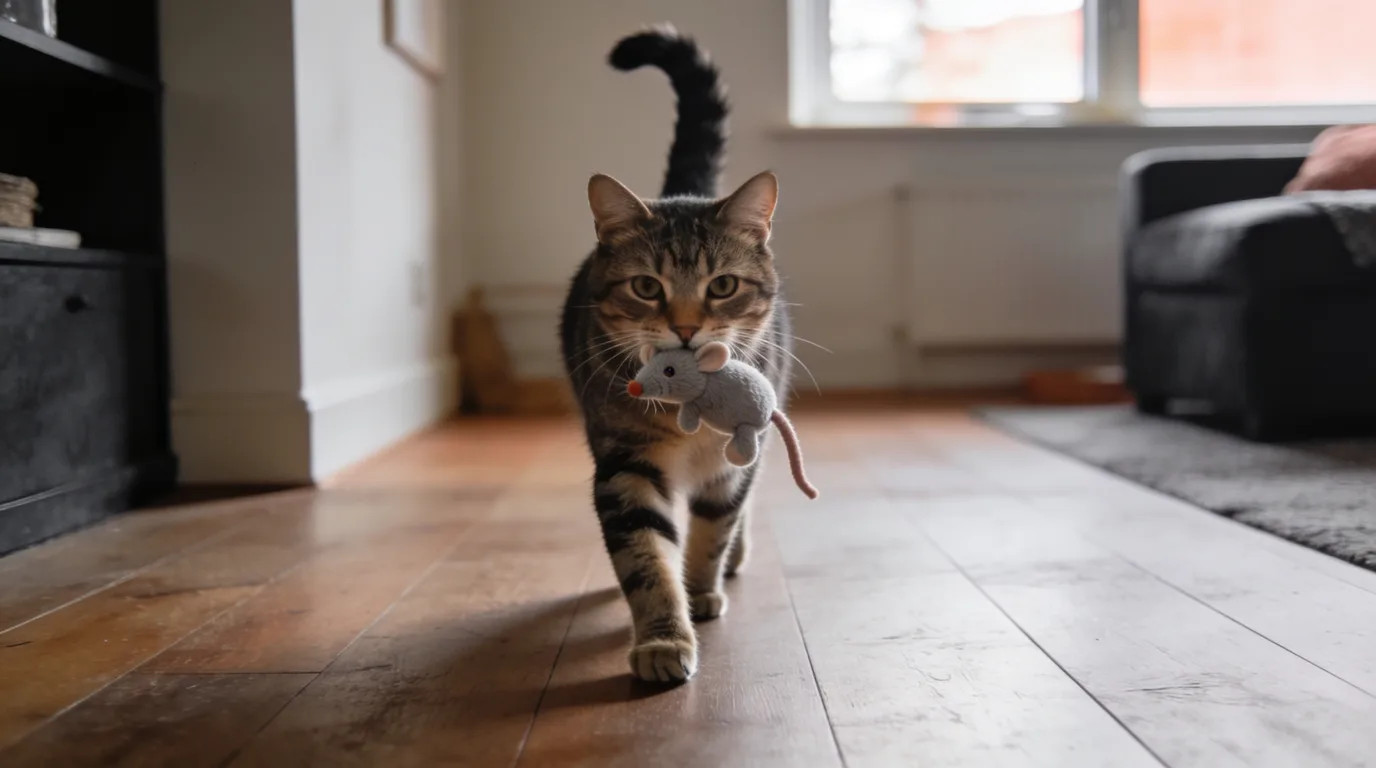
The best-supported explanation is the least romantic one: the cat is running a predatory sequence to completion, and a toy is the only object available to run it on. Hunting in cats is not a single act. It is a chain — locate, stalk, chase, pounce, grasp, deliver a killing bite, then carry, and in many cases cache the item somewhere secure before eating it. Each link is partly independent of the others, and crucially the chain is not gated by hunger. A well-fed cat still stalks. A well-fed cat still carries. An indoor cat has every link intact and nothing to attach them to, so a mouse-sized soft toy becomes the stand-in, and the carry step terminates where carry steps terminate in a territorial animal: in the core of the territory, which in most households is the bedroom, the human's feet, or wherever the household's primary caregiver happens to be standing.
The explanation most owners have heard — that the cat is provisioning you the way a queen provisions kittens, teaching an incompetent hunter to feed itself — is plausible, widely repeated, and considerably weaker on evidence than its popularity suggests. It deserves a hearing, not a coronation. This article separates four candidate drivers, rates how well each is supported, and then deals with the specific variant that sends people searching at three in the morning: the cat that walks the length of the house carrying a toy and producing a loud, muffled, strangely un-catlike call. That version has its own explanation, and it is not distress in most cases.
The predatory sequence, and where the toy fits
The domestic cat's hunting behavior was described in detail by Paul Leyhausen, whose work on predatory and social behavior in cats remains the reference point for how the sequence is organized. The important structural fact is modularity. Orienting, stalking, chasing, pouncing, capturing, killing, carrying, plucking and eating are separable motor patterns with separate thresholds. A cat can be highly motivated to chase and barely motivated to eat. That is why cats catch prey they never consume, why they "play" with a captured animal, and why a cat that has just finished a full meal will still hunt the toy under the sofa.
Two consequences follow for the household.
Unexpended sequence links accumulate. If a cat has a strong chase and capture motivation and the environment supplies almost nothing to chase, the motivation does not evaporate. It builds, and it discharges onto whatever is available — a toy, a bottle cap, a hair tie, a sock, a housemate's tail. Toy-carrying is one of the more benign outputs of this. It is far preferable to the alternative discharge routes, which include ambushing ankles and ambushing other cats.
Carrying is a distinct link with its own function. In free-ranging cats, carrying prey away from the capture site serves obvious purposes: it moves food away from competitors and away from open ground, toward a defensible location. That location is not chosen at random. It is the part of the range where the animal is least vigilant — its core area. In a house, the core area is defined by the cat's own resting and security map, and for socially confident cats that map is anchored on the people. This is why the toys arrive on the bed and not in the garage.
Caching is the related behavior. Some cats do not simply carry, they accumulate. A shoe, a specific corner, the space behind a door, the water bowl, or a food bowl becomes a repository, and the same three or four items are returned to it repeatedly. This is normal and does not require intervention unless the objects being cached are hazardous.
Four explanations, rated honestly
Feline behavior research is genuinely thinner than canine research. There is no large body of controlled work on object-carrying in pet cats, and most of what circulates online is inference from wild felid ethology plus plausible storytelling. The table below rates each candidate on what actually supports it.
| Explanation | What it claims | Evidence strength | Tell-tale signature |
|---|---|---|---|
| Predatory sequence completion | The carry link fires with a substitute object because no prey exists | Strong — follows directly from well-described feline predatory ethology | Toy is prey-sized and soft; carried in a mouth grip behind the head; deposited and often abandoned |
| Provisioning / queen-teaching | The cat is supplying food to a dependent group member | Weak to moderate — the maternal behavior is real, the extension to adult-human recipients is inference | Would predict food-adjacent delivery and monitoring of the recipient; rarely observed cleanly |
| Play solicitation | The toy is a request to interact | Moderate — supported by the sequel behavior, not by the carry itself | Cat deposits, then remains, orients to the human, and re-engages the toy when it moves |
| Learned attention-seeking | The behavior is maintained by the human's reaction | Strong for individual cases — straightforward operant learning | Onset traceable to a reinforcement history; escalates when reactions are inconsistent |
Predatory sequence completion
This is the default and the one that explains the most cases with the fewest assumptions. It predicts the observed preference for small, light, fur-textured or feather-textured objects that fit a natural carry grip. It predicts that wand toys and large plush items are almost never carried. It predicts that the behavior clusters around activity peaks rather than around mealtimes. And it predicts the most commonly reported and least remarked-upon detail: the cat frequently abandons the toy immediately after delivering it. A sequence that has run to completion is finished. There is no follow-up because completion was the point.
Provisioning, and why the queen-teaching story is over-sold
The underlying observation is real. Queens do bring prey to kittens, and they do it in a graded progression — first dead prey, then disabled prey, then live prey the kittens must finish — which supports the development of the kittens' own predatory competence. That much is well described.
The leap comes next. Extending maternal provisioning to explain an adult, frequently neutered, frequently male cat delivering a synthetic mouse to an adult human is an analogy, not a finding. Several things sit awkwardly with it. Provisioning in felids is overwhelmingly a maternal behavior tied to a specific reproductive state, and the behavior in question appears in males and in neutered animals of both sexes at similar rates. The recipients are not treated the way kittens are treated — there is no monitoring of consumption, no re-presentation of the item, no adjustment of difficulty. And the object is very often not food-like at all: hair ties, bottle caps, pipe cleaners, cable ties and receipts get carried and deposited in exactly the same way.
None of that refutes the hypothesis. Some component of social provisioning may well be involved in some cats, particularly cats that carry real prey to a specific person repeatedly. It does mean the confidence with which the story is told online outruns the support behind it. Where feline behavior science is thin, the honest position is to say so rather than to fill the gap with a satisfying narrative.
Play solicitation
Distinguishable from the others by what happens in the ten seconds after delivery. A cat completing a predatory sequence deposits and disengages. A cat soliciting play deposits and stays: it orients to the human, tracks the human's hands, may vocalize with short chirps or trills rather than long calls, and re-engages the object the moment it moves. Some cats develop a genuine retrieve — a functional fetch — and this is more common than the cultural stereotype allows. Where it appears, it is usually shaped accidentally by a household that threw the object back a few times, and it is one of the easiest behaviors in the feline repertoire to strengthen deliberately.
Trilling in particular is worth reading correctly here, since it frequently accompanies carrying and is an affiliative, approach-associated sound rather than a distress one. Full breakdown in what cat trilling means.
Attention-seeking that got reinforced
Any behavior that reliably produces a reaction becomes more frequent. If the first few toy deliveries were met with attention — talking, petting, food, retrieval of the toy, or even mild irritation expressed loudly — the behavior now has a learning history layered on top of whatever motivation started it.
The detail that matters clinically is the schedule. A household that responds every single time creates a behavior that is frequent but relatively easy to modify. A household that responds unpredictably — ignoring it on four nights and reacting on the fifth — creates a behavior on an intermittent reinforcement schedule, which is the most persistent arrangement in all of learning theory. Most "he does it no matter what we do" cases are actually intermittent-schedule cases, and the inconsistency is the cause rather than a failed remedy.
The night-time carrying and yowling
This is the specific presentation that alarms people, and it deserves its own treatment. The cat picks up a toy, walks a circuit of the house — hallway, stairs, landing — and produces a loud, low, extended call that repeats every few seconds. It usually happens between roughly midnight and dawn. Owners describe it as mournful, as if the cat were in trouble, and the first assumption is pain or distress.
In an otherwise well cat with no other signs, it usually is not.
Why the sound is strange. The call is produced with an object held in the mouth. A cat vocalizing around a toy cannot open the jaw normally, so the resonance changes: the sound comes out muffled, nasalized, lower in pitch and longer than the same cat's ordinary meow. The acoustic oddity is a mechanical consequence of the full mouth, not a signal of a different emotional state. The identical call without a toy in the mouth would register to most owners as unremarkable.
Why it happens at night. Cats are crepuscular, with activity peaks near dawn and dusk inherited from an ancestral hunting pattern. Those peaks arrive whether or not the environment supplies anything to do with them, and in a household that sleeps from eleven to seven the dawn peak lands inside human sleep. The behavior is very likely occurring during the day as well; it is simply not witnessed, and it is not competing with silence.
Why it is loud. Two contributing factors. The house is quiet and acoustically reflective at night, so the same call carries much further. And in socially attached cats, an extended repeated call while moving through the territory functions as a contact call — the vocal signature cats use when locating a specific individual. A cat carrying an item toward a core area that turns out to be occupied by a sleeping, non-responsive human has good reason to keep calling. Related patterns and their differentials are covered in why cats meow at night.
Reading the destination
Where the toy ends up is informative, and it is the part owners rarely record.
On or beside the bed, or at the feet of a specific person. The most common outcome and the one most consistent with core-area caching. Note whether it is always the same person. Cats form differentiated relationships with individual household members, and the recipient is frequently the person who does the feeding, the playing, or simply the sitting still.
In the food or water bowl. Reported often enough to be a recognized pattern rather than a curiosity. The bowl is a fixed, high-salience resource location with raised sides, which makes it a plausible cache site by pure environmental logic. It requires no further explanation and no intervention beyond cleaning the bowl.
In a single hidden repository. Under a bed, behind a sofa, inside a boot, in a laundry basket. This is caching in its clearest form. Check the repository periodically; the risk is not the behavior but the occasional inclusion of string, elastic, or hair ties.
Delivered and immediately re-collected. A loop rather than a delivery. This pattern skews toward play solicitation or toward an arousal state that has not discharged, and it responds well to structured play rather than to being ignored.
What to do
Do not punish it
Shouting, spray bottles, throwing the toy away in front of the cat, physically moving the cat off the bed, or shutting the cat out of the bedroom abruptly as a consequence are all counterproductive here, and the reasons are specific rather than generic.
Punishment does not communicate an alternative behavior. It raises baseline arousal, which is the opposite of what a night-activity problem needs. It suppresses the small early signals a cat gives before escalating, so the next escalation arrives without warning. Because cats associate the aversive event with the person delivering it rather than with their own behavior, it degrades exactly the relationship that every subsequent intervention depends on. And in the specific case of an intermittently reinforced attention behavior, an angry reaction is still a reaction — for many cats it functions as reinforcement and increases the behavior it was meant to stop.
Redirect the sequence deliberately
The behavior is a predatory sequence looking for an outlet. Give it a better one, at a better time. The structure to use is the natural chain that follows a successful hunt: hunt, catch, eat, groom, sleep.
- Hunt. Ten to fifteen minutes of interactive wand play per cat, played separately if there is competition. Move the toy the way prey moves — away from the cat, along the floor, into and out of cover, with pauses. Not dangled overhead in circles, which no prey animal does and which produces frustration rather than engagement.
- Catch. Let the cat actually capture and hold the toy at the end. A hunt that never succeeds leaves the sequence incomplete, which is the same problem in a different costume.
- Carry. Let the cat carry the caught toy off if it wants to. This is the link causing the complaint, and permitting it inside a structured session is how it gets satisfied at a time of your choosing.
- Eat. Feed the largest meal of the day immediately afterward.
- Groom and sleep. These follow without help.
Run the last session as late in the evening as the household allows. Two shorter sessions beat one long one. Food puzzles and scatter feeding matter more than most owners expect, because free-feeding from a bowl removes the entire foraging component of the day and leaves it available at four in the morning.
Handle the learned component correctly
If the behavior is being maintained by attention, the fix is not simply ignoring it — the fix is consistency plus a replacement.
Withdraw the reaction completely and predictably: no talking, no eye contact, no retrieval of the toy while the cat is performing. Expect an extinction burst, meaning the behavior gets louder and more frequent for several nights before it declines. Households that give in during the burst teach the cat that persistence works, which is why the second attempt is always harder than the first. At the same time, reinforce the behavior you do want — attention, play, and food delivered at fixed times that are not contingent on the cat performing.
Practical matrix
| What you observe | Most likely driver | First response |
|---|---|---|
| Toy delivered, cat immediately leaves | Predatory sequence completing | Leave it; add structured evening play |
| Toy delivered, cat stays and stares at your hands | Play solicitation | Play with the toy for two minutes; this is the cheapest fix on the page |
| Loud muffled calling while carrying, otherwise normal cat | Crepuscular activity plus contact calling | Late-evening hunt-catch-eat sequence; do not respond mid-episode |
| Same three items accumulating in one spot | Caching | Check for string and elastic; otherwise leave it |
| Toys deposited in the water bowl | Caching in a high-salience location | Clean the bowl; consider a second water station |
| Behavior escalates when ignored inconsistently | Intermittent reinforcement | Full consistency plus scheduled non-contingent attention |
| New onset in a cat over eight, with night vocalizing | Medical until excluded | Vet: thyroid panel, blood pressure, renal values |
| Carrying paired with suckling, kneading and guarding the object | Possible hormonal or compulsive component | Veterinary assessment before behavioral work |
When carrying means something else
Most toy-carrying is unremarkable. A minority of presentations are not, and they share a common feature: the behavior stops looking like a completed sequence and starts looking like a state the cat cannot exit.
Object mothering. A cat that carries a specific soft item repeatedly, arranges itself around it, kneads and suckles at it, produces the low chirping calls queens direct at kittens, and becomes agitated when the item is removed is displaying maternal behavior toward an object. In an intact queen this can accompany a false pregnancy following an infertile mating, which is a genuine and diagnosable condition. In spayed females and in males it is less easily explained and worth raising with a veterinarian, particularly if it is new.
Repetitive and compulsive presentations. The relevant features are rigidity and cost: the behavior occurs in long bouts, is difficult to interrupt, displaces eating, drinking or resting, and continues in the absence of any apparent trigger. Compulsive disorders are recognized in cats — wool-sucking and fabric-chewing are the best-known examples — and they are more common in cats with early weaning histories and in some Oriental breeds. They respond to environmental and pharmacological management together, and they are a veterinary behavior case, not a household training project.
Pica. Carrying that becomes chewing and then swallowing is a different problem entirely, and a dangerous one. String, elastic, hair ties and tinsel cause linear foreign bodies, which are surgical emergencies. Pica also has real medical differentials including anaemia and gastrointestinal disease, so the workup starts at the vet rather than with enrichment.
Sudden onset in an older cat. Any new behavior in a cat over roughly eight, and particularly new night activity or vocalization, belongs in the medical column first. Hyperthyroidism, hypertension, chronic kidney disease and cognitive dysfunction all present behaviorally before they present obviously. The relevant patterns are set out in behavior change in senior cats.
What people get wrong
"It is a gift, and refusing it hurts the cat's feelings." Cats do not have the attributional model of another mind that gift-giving in the human sense requires, and there is no evidence they interpret a lack of response as rejection. The behavior does not need to be received to be complete. What a lack of response does affect is the learned component — which is a reason to be consistent, not a reason to perform gratitude.
"He is teaching me to hunt." Possible, unproven, and repeated with unearned certainty. The maternal teaching behavior it borrows from is real; the extension to adult humans is not established. Treat it as one hypothesis among four.
"The yowling means he is in pain or frightened." Not in a cat that is otherwise normal. The unusual acoustics are a consequence of a full mouth. Pain in cats far more often presents as subtraction — less grooming, less jumping, less eating, more hiding — than as dramatic vocalization. That asymmetry is covered in why is my cat acting weird.
"He does it for attention, so I should ignore him." Half right. Ignoring works only if it is total and consistent, and only if the behavior is genuinely attention-maintained. Applied to a predatory-sequence case, ignoring changes nothing because attention was never the reinforcer. Applied inconsistently to an attention case, it makes the behavior worse than doing nothing.
"Taking the toys away will stop it." It removes the object, not the motivation, and the motivation reliably finds a replacement — frequently a worse one. Cats deprived of appropriate objects redirect predatory sequences onto socks, cables, feet and other cats.
"Only females do it." Neither sex nor neuter status reliably predicts it. This is one of the observations that makes the maternal-provisioning account harder to sustain as a complete explanation.
When to see a vet
Same day, without waiting for morning:
- Straining in the litter box with little or no urine produced — in a male cat, assume urethral obstruction and go; untreated, this is fatal within roughly 24 to 48 hours
- Crying or vocalizing while urinating
- No food intake for 24 hours; 48 hours is a hard emergency because of the risk of hepatic lipidosis
- Hiding combined with not eating
- Sudden aggression in a cat with no aggression history
- Open-mouth breathing, panting, or laboured breathing at rest
- Sudden hind-limb weakness, dragging, or cold hind paws with loud crying
- A string, thread or elastic visible under the tongue or at the anus — do not pull it
- Any suspicion the cat has swallowed part of a toy, hair tie, or tinsel
Within the week:
- New or escalating night vocalization in a cat over about eight
- Weight loss with a normal or increased appetite
- Increased drinking or urination
- Object-directed suckling, kneading and guarding that is new or intensifying
- Chewing or swallowing non-food items
- Carrying behavior in long, difficult-to-interrupt bouts that displaces eating, drinking or resting
If the cat is medically cleared and the behavior is genuinely compulsive or is destroying household sleep, the next call is a credentialed behavior professional rather than a general trainer. Look for DACVB (Diplomate, American College of Veterinary Behaviorists), CCBC (Certified Cat Behavior Consultant), IAABC Cat Division membership, or Fear Free certification. Walkthrough in how to find a credentialed behaviorist.
Reading your own cat's version
The four drivers produce visibly different behavior in the seconds around the delivery, and that is where the answer is. Body position, ear orientation, tail carriage, whisker position and what the cat does immediately after dropping the object separate a completed predatory sequence from a play solicitation from an attention behavior. The underlying signal vocabulary is covered in cat body language and cat tail meanings.
PetTranslator.ai applies the same framework to a photo. Upload one clear image — ideally taken at the moment of delivery, with the cat's face and tail both visible — and it returns a structured report: the observed body-language markers first, a behavioral interpretation second, a confidence score with its reasoning, an explicit list of what could not be assessed from a single frame, and a Do/Avoid plan. It does not diagnose, and it flags medical-first presentations rather than talking around them.
Sources
- Paul Leyhausen, Cat Behaviour: The Predatory and Social Behaviour of Domestic and Wild Cats (Garland STPM Press, 1979) — the foundational description of the modular feline predatory sequence used throughout this article.
- John Bradshaw, Cat Sense (Basic Books, 2013) — evolution of feline predatory, social and territorial behavior, and the limits of what is actually known.
- Sarah Ellis and John Bradshaw, The Trainable Cat (Penguin, 2016) — applied, force-free protocols for play, enrichment and behavior change.
- Karen Overall, Manual of Clinical Behavioral Medicine for Dogs and Cats (2nd ed., Elsevier, 2013) — clinical reference for compulsive disorders, differential diagnosis, and the medical-first principle.
- AAFP and ISFM Feline Environmental Needs Guidelines — the five-pillar framework, including opportunity for play and predatory behavior.
- AAFP Feline-Friendly Handling Guidelines — the professional basis for rejecting scruffing and punishment-based restraint.
- The Ohio State University Indoor Pet Initiative — owner-facing guidance on enrichment and predatory outlets for indoor cats.
- AVSAB Position Statement on Humane Dog Training — the force-free professional standard, applied here to feline work.
Khabir Mughal is the founder of PetTranslator.ai. This article was written against Leyhausen's description of the feline predatory sequence and the AAFP and ISFM Feline Environmental Needs Guidelines. It is not veterinary advice — new night vocalization in a cat over eight warrants bloodwork and a blood pressure check before any behavioral plan.