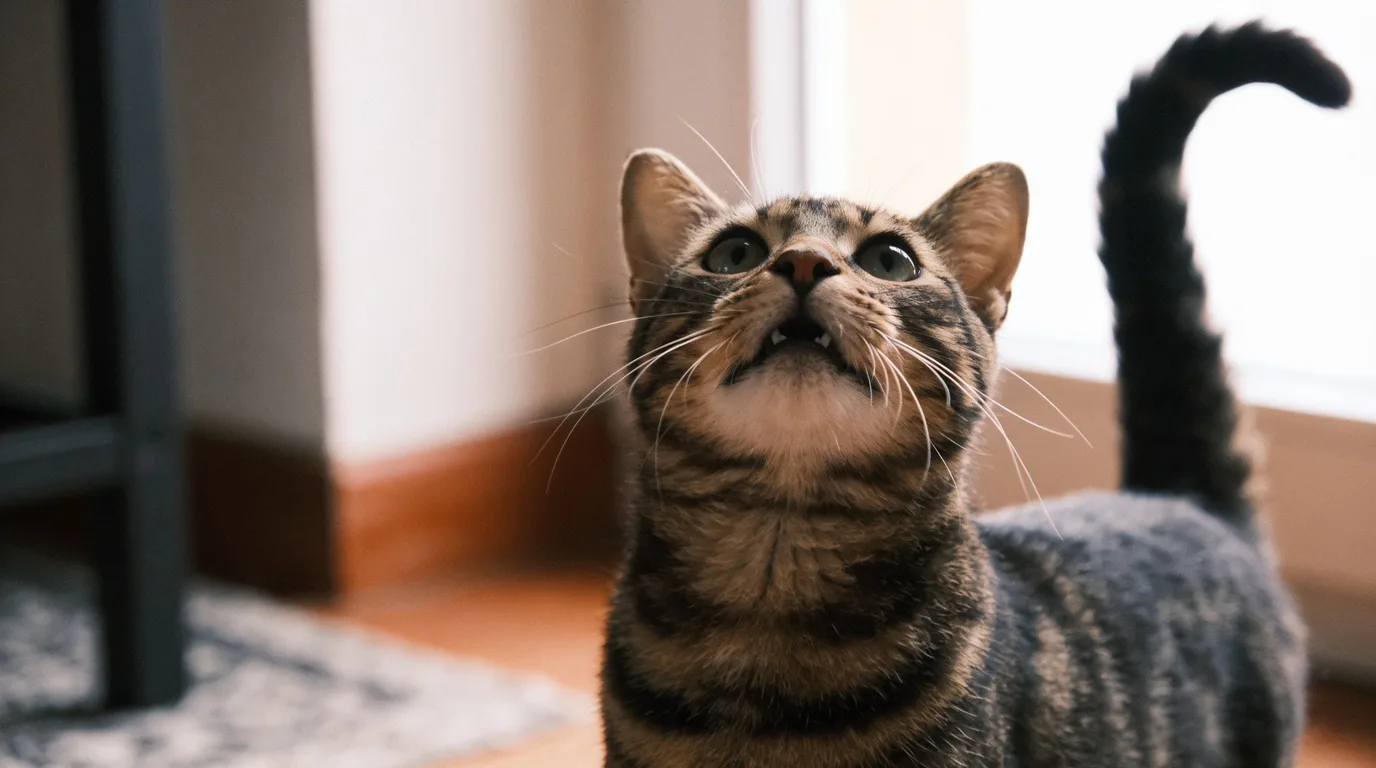
A trill is not a variant of the meow. It is a structurally different sound, produced a different way, and it carries a different signal. The meow is made with the mouth opening and closing. The trill is made with the mouth held shut — air pushed out through the nose while the vocal folds pulse rapidly, producing a short rolling brrr with a rising pitch. It typically lasts under a second. Owners hear it as chirpy, questioning, upward-inflected. That upward inflection is the acoustic signature.
Functionally, the trill is a greeting and contact call. It originates in the queen-to-kitten repertoire — the sound a mother cat uses to summon kittens or announce her return — and adult domestic cats have redirected it at humans. That redirection is the interesting part. Adult cats rarely meow at each other, and they trill at each other far less than they trill at people. The trill you get at the top of the stairs is, in large part, an artifact of domestication: a maternal call that stayed in the adult repertoire because it worked on the species that opens the food.
What a trill actually is, acoustically
The most durable framework for feline vocalization is also one of the oldest. Mildred Moelk's 1944 phonetic study sorted cat sounds into three groups by what the mouth does:
- Murmurs — produced with the mouth closed. The purr and the trill live here.
- Vowel patterns — the mouth opens, then gradually closes, sweeping the resonant shape of the mouth and producing a shifting vowel quality. This is the meow family.
- Strained-intensity sounds — the mouth is held open in a fixed, tense position. Growls, hisses, snarls, yowls, and pain cries.
Eighty years on, that classification still holds up, and it explains why the trill and the meow sound so different despite often occurring seconds apart. A meow has formant movement — the ee-ah-oo quality of the vowel changing as the jaw closes. A trill has none, because the jaw never moves. What you get instead is a short burst of rapidly modulated sound with the resonance of a closed mouth and nasal cavity.
Three features distinguish it reliably:
Duration. Short. Most trills fall well under a second, often in the range of a few tenths of a second. Meows commonly run two to three times longer.
Pitch contour. Rising. This is the single most useful discriminator. Meows tend to fall or arch; the trill goes up and stops. Susanne Schötz, the phonetician behind the Meowsic project at Lund University, has argued that melody — the direction the pitch travels — is one of the most informative and most overlooked dimensions of cat vocalization, and that rising contours cluster with positive, affiliative, and questioning contexts while falling contours cluster with demanding or dissatisfied ones.
Modulation. The rolled quality comes from rapid amplitude and frequency fluctuation across the call. It is the same perceptual family as a rolled r in human speech, though produced by a different mechanism.
How the sound is physically produced
Honest answer first: less is known here than you would expect. The trill has never received the acoustic and physiological attention the purr and meow have, and most descriptions of its production are inferred from the purr rather than measured directly.
What can be said with reasonable confidence is that the trill is a voiced, egressive, closed-mouth call — the vocal folds vibrate, air exits through the nasal passages, and the pulsing that produces the rolled texture comes from rapid modulation of that vibration. The fundamental frequency sits far above the purr, which is why a trill sounds bright and a purr sounds like an engine.
The purr comparison is worth a short detour, because it illustrates how thin the ground is. The long-standing model held that purring is driven by a neural oscillator in the brain rhythmically contracting the laryngeal muscles at roughly 25 to 50 Hz. In 2023, Christian Herbst and colleagues published work in Current Biology showing that excised domestic cat larynges could produce purr-range frequencies without any neural input at all, pointing to a possible passive, aerodynamic mechanism involving connective tissue in the vocal folds. The result did not settle the question, but it reopened it — for a sound cats have been making in front of humans for thousands of years.
If the purr's mechanism is still contested, the trill's is barely characterized. Anyone who tells you exactly which muscles do what during a trill is going beyond the published evidence.
Where the trill comes from
The trill's origin is maternal. Queens produce a soft chirrup toward kittens in several contexts: returning to the nest, prompting them to follow, moving them, and drawing them toward a feeding position. Kittens orient to it and approach. Kittens produce their own version back, and the exchange functions as a short-range contact and coordination signal between animals who need to keep track of each other without broadcasting to predators.
Two properties make it well suited to that job. It is quiet and short, so it does not carry far. And because it is produced with the mouth closed, the cat can make it while carrying something — including a kitten.
Most feline vocalizations fade as cats mature. The trill does not fade so much as change audience.
Why adult cats trill at people
John Bradshaw makes the central observation in Cat Sense: adult domestic cats almost never meow at one another. They meow at humans. The meow appears to have been amplified through the co-evolution of cats and people, because vocalizing at a human reliably produces outcomes — food, doors, attention — while vocalizing at another cat produces nothing much. Nicholas Nicastro's comparison of domestic cat calls with those of the African wildcat, the domestic cat's wild ancestor, found the domestic versions shorter and rated as more pleasant by human listeners, which is what you would expect if human preference had been quietly selecting on the sound.
The trill follows the same pattern with one difference: it does still occur between cats, specifically between affiliated ones — related cats, cats raised together, cats in a stable bonded pair. But the frequency and enthusiasm with which it gets directed at humans is a domestication phenomenon.
The most parsimonious reading of a human-directed trill is that the cat is treating the human as a social affiliate within a maternal-derived signalling system. Kristyn Vitale's research on cat–human attachment has shown that cats form attachment bonds with their caregivers that pattern similarly to those documented in dogs and human infants, which makes the redirection less surprising than it first sounds. The cat is not confusing you with its mother. It is using the call it has for close, safe, familiar social partners, and you qualify.
What a trill communicates
Four contexts account for the large majority of trills. Read them alongside the body — a trill is one channel, and the cat body language framework applies.
Greeting on approach. The most common context by far. The cat sees you, walks toward you, and trills. It reliably co-occurs with the upright tail — often with the hooked question-mark tip described in cat tail meanings — forward whiskers, forward ears, and a head or flank rub on arrival. That whole cluster is the feline greeting package, and the trill is its vocal component.
Positive anticipation. The treat bag, the fridge door, the sound of a can, the harness for a cat who enjoys going out. Trilling in these moments tracks arousal that is positive and low-to-moderate in intensity. A cat whose anticipation tips into frustration usually switches to a meow or a yowl.
Movement solicitation — the "follow me" trill. The cat trills, walks a few steps, stops, looks back, and trills again. This is the maternal call doing exactly what it evolved to do, with the human in the kitten's role. Owners report it constantly, and the interpretation is plausible on evolutionary grounds. It has not, to be clear, been quantified in any study large enough to call it established.
Social contact between bonded cats. Trills exchanged between affiliated cats, often around allogrooming, allorubbing, or reunion after separation. Their presence is a reasonable indicator of an affiliative relationship. Their absence is not evidence against one.
Across all four, the common thread is low-conflict positive affect plus a social target. Trills are not distress calls, not threat signals, and not pain signals. What they are not is propositional — the cat is broadcasting a state and an orientation toward you, not encoding a sentence.
Trilling versus chattering at birds
These get conflated constantly, and they are not related behaviors.
Chattering — also called chittering or, confusingly, chirping — happens when a cat watches unreachable prey, typically a bird or squirrel through a window. The mouth is open. The jaw vibrates in a rapid stuttering motion, teeth often audibly clicking, sometimes with a strained ek-ek-ek layered on top. The body is in full predatory configuration: pinpoint or fixed pupils, forward whiskers, forward ears, weight loaded onto the hindquarters, tail low with a tip twitch.
The function is unresolved. Two hypotheses have most support. The first treats the jaw movement as an involuntary fragment of the killing-bite motor pattern, activated by the sight of prey and running without a target to complete on. The second treats it as a frustration or conflict vocalization produced when a fully engaged predatory sequence is blocked. These are not mutually exclusive, and neither is settled.
| Trill | Chatter | |
|---|---|---|
| Mouth | Closed | Open, jaw vibrating |
| Direction | At a human or bonded cat | At unreachable prey |
| Arousal | Low to moderate, positive | High, frustrated or predatory |
| Body | Relaxed, tail up, approaching | Crouched, still, fixated, tail-tip twitch |
| What to do | Respond, engage | Redirect into a wand-toy play sequence |
One myth deserves burial. The claim that cats chatter to mimic bird calls and lure prey traces back to a single 2009 field report from the Brazilian Amazon describing a margay — a small wild neotropical cat — apparently imitating the calls of pied tamarins to draw them closer. It was one observation of one animal of a different species. There is no evidence that domestic cats do anything of the kind, and the ordinary chatter of a house cat behind glass looks nothing like a bird call.
The feline vocal repertoire, compared
| Vocalization | Mouth | Acoustic description | Typical context | What it signals |
|---|---|---|---|---|
| Meow | Opens, then closes | 0.5–1.5 s, shifting vowel quality, usually falling or arched pitch | Directed at humans; food, doors, attention | A learned request. Individual cats develop private meow vocabularies with their own households |
| Trill | Closed | Under a second, rolled and modulated, rising pitch | Greeting, approach, anticipation, "follow me" | Affiliative contact; positive low-to-moderate arousal |
| Chirp / chatter | Open, jaw vibrating | Staccato stuttering, teeth clicking, sometimes strained overlay | Watching unreachable prey | High predatory arousal, probable frustration |
| Purr | Closed | Continuous low-frequency pulsing, roughly 25–50 Hz, on both inhale and exhale | Contentment, nursing, but also injury, fear, and end of life | State broadcast, not a happiness readout. McComb and colleagues identified a "solicitation purr" carrying an embedded cry-like frequency that humans find urgent |
| Yowl | Held open | Long, loud, drawn out, high amplitude | Mating in intact cats; disorientation, pain, or territorial confrontation in altered cats | Distress, conflict, or reproductive advertisement. New-onset yowling in a senior cat is a veterinary question |
| Hiss | Held open | Sharp burst of expelled air, unvoiced | Defensive arousal, close-range threat | A request for distance. Almost always paired with pinned ears and dilated pupils |
| Growl | Held open | Low-frequency, rumbling, sustained | Warning before escalation; also over guarded resources | An explicit warning. Never punish it — removing the warning does not remove the state behind it |
Breed and individual variation
Vocal output varies enormously between cats, and the variation between individuals is larger than the variation between breeds.
Breed tendencies exist but are soft. The Oriental group — Siamese, Oriental Shorthair, Balinese, Tonkinese — is consistently described as more vocal overall. Maine Coons are widely reported to trill and chirp rather than meow, to the point that it has become part of the breed's popular description. Large owner-survey research, including work from the University of Helsinki, has found genuine breed-level differences in feline behavior traits, which makes breed differences in vocal style plausible. But trill frequency specifically has not been measured across breeds under controlled conditions. The Maine Coon claim rests on owner and breeder report, not acoustics.
Individual history matters more. Some cats trill constantly. Some never trill at all, across an entire lifetime, in perfectly good relationships with their people. Kittens that were well socialized to humans during the sensitive period tend to be more vocally engaged with them as adults. And because human-directed calls are shaped by consequences, the trill will be more frequent in households where trilling has reliably produced something — attention, an open door, food.
Trill frequency is not a bond index. A cat that does not trill is not a cat that does not like you. Better indicators of relationship quality: voluntary proximity, approaching with the tail up, slow blinking, kneading, allorubbing, and choosing to rest where you are.
Should you trill back?
Reasonable, harmless, and possibly useful.
The honest position: there is no evidence that a human imitation of a trill is processed by a cat as a conspecific signal, and human vocal anatomy cannot reproduce the call accurately anyway. But there is a plausible mechanism. Humphrey, Mancini and Proops demonstrated that cats slow-blinked more in response to humans slow-blinking at them, and that the exchange was associated with greater approach behavior — a human imitation of a feline signal that measurably changed cat behavior. Separately, work led by Charlotte de Mouzon found that cats responded differentially to their own owner's voice using cat-directed speech, and did not show the same response to a stranger's, indicating that cats attend closely to the specific vocal patterns of familiar people.
So: a soft, short, rising vocalization directed at your cat as they approach is a fine thing to do. What matters far more than the accuracy of your imitation is what follows it.
What people get wrong
"My cat is talking to me." The trill is directed at you, which is not the same as being addressed to you in the linguistic sense. It communicates state and social orientation, not content. Reading sentences into it produces confident conclusions that are unfalsifiable and, in practice, get in the way of noticing what the body is doing.
"Trilling is just a short meow." Different production mechanism, different acoustic class, different developmental origin. Grouping them hides the useful information.
"Chattering means my cat is imitating birds." One margay, one field report, a different species. No evidence in domestic cats.
"A trill always means my cat is happy." It leans positive, but read the whole animal. A trill from a cat whose ears are rotating sideways and whose tail is thumping is occurring inside a mixed state. And an insistent trill in a well-worn food routine is closer to a learned request than to spontaneous affection.
"He stopped trilling because he's mad at me." Cats do not sustain grievances. A cat that has stopped producing a habitual vocalization has changed its baseline, and a baseline change is a medical question first.
Where the science is genuinely thin
This deserves stating plainly, because most writing on cat sounds is more confident than the evidence supports.
Feline vocalization research is a small field, far behind the canine equivalent. Much of the standard classification still descends from Moelk's 1944 work, which was based on close observation of a handful of cats — remarkable scholarship, but a small sample by any modern standard. The bulk of published acoustic work since has concentrated on the meow and the purr. The trill has almost no dedicated literature: no large annotated corpus across households, no validated ethogram with independent coders, no controlled work linking trill acoustics to verified context.
Most of what circulates about trill meaning, including some of what is in this article, rests on owner report, clinical observation, and reasoning from the maternal-call origin. That is a legitimate basis for practical guidance and a weak basis for strong claims. Where this guide says "reliably" it means reliably observed. Where it says "plausible" it means not yet tested.
When a vocalization change is medical
The content of a trill is low-stakes. A change in your cat's vocal pattern is not.
See a veterinarian promptly for:
- New or markedly increased vocalizing in a cat over about eight years old, especially at night — hyperthyroidism, hypertension, chronic kidney disease, cognitive dysfunction, pain, and hearing loss all present this way
- A change in the voice itself — hoarse, weak, muffled, or absent — which can indicate upper respiratory disease, laryngeal disease, or a mass
- Vocalizing while urinating or in the litter box, which is a same-day emergency, particularly in male cats
- Crying while being picked up, jumping, or being touched in one area
- A cat that used to trill and has stopped, combined with hiding, reduced grooming, or reduced appetite
- Loud, drawn-out yowling that is new, especially with disorientation or staring at walls
Deafness is worth its own note: cats losing their hearing frequently vocalize more and louder, because they cannot hear themselves. White cats with blue eyes have an elevated incidence of congenital deafness. This is a diagnosis worth ruling in rather than assuming a behavior problem.
For a structured way to work through any sudden change, see why is my cat acting weird and, for older cats, behavior change in senior cats.
Reading the rest of the signal
A trill is one channel out of six. The cat producing it is simultaneously telling you more with its tail, ears, whiskers, pupils, and posture — and when those channels disagree with the vocalization, the body usually carries the more reliable information.
PetTranslator.ai is built to read that cluster. Upload one clear photo of your cat and it returns a structured report: the observed markers it can actually see, a behavioral interpretation, a confidence score with its reasoning, an explicit note on what a single frame cannot assess, and a Do/Avoid plan. No invented dialogue, no captions pretending to be translation. For a vocalization like the trill, the sound tells you the register and the body tells you the rest.
Sources
- Mildred Moelk (1944), "Vocalizing in the house-cat: A phonetic and functional study," American Journal of Psychology — the foundational three-class classification of feline vocalization by mouth position.
- John Bradshaw, Cat Sense (Basic Books, 2013) — the domestication account of human-directed feline vocalization.
- Susanne Schötz, The Secret Language of Cats (2018), and the Meowsic project at Lund University — phonetic analysis of cat vocalization, including pitch contour and melody.
- Nicholas Nicastro (2004), Journal of Comparative Psychology — acoustic and perceptual comparison of domestic cat and African wildcat vocalizations.
- Herbst and colleagues (2023), Current Biology — evidence that excised cat larynges produce purr-range frequencies without neural input, reopening the question of the purr's mechanism.
- McComb, Taylor, Wilson and Charlton (2009), Current Biology — the solicitation purr and its embedded cry-like component.
- Humphrey, Mancini and Proops (2020), Scientific Reports — cat eye-narrowing movements in cat–human communication.
- Charlotte de Mouzon and colleagues (2022) — cats' differential response to their owner's voice and to cat-directed speech.
- Kristyn Vitale and colleagues — research on attachment bonds between domestic cats and their caregivers.
- Karen Overall, Manual of Clinical Behavioral Medicine for Dogs and Cats (2nd ed., Elsevier, 2013) — clinical reference for vocalization as a behavioral and medical sign.
- Sarah Ellis and John Bradshaw, The Trainable Cat (Penguin, 2016) — force-free applied protocols, including reinforcement of vocal behavior.
- A 2009 field report from the Brazilian Amazon describing apparent vocal mimicry of pied tamarins by a margay — the origin of the widely repeated bird-mimicry claim.
Khabir Mughal is the founder of PetTranslator.ai. This article was reviewed against John Bradshaw's Cat Sense and Karen Overall's Manual of Clinical Behavioral Medicine before publication. Where the feline vocalization literature is incomplete, the article says so rather than filling the gap. It is not veterinary advice — for any change in your cat's voice or vocal pattern, see a veterinarian first.