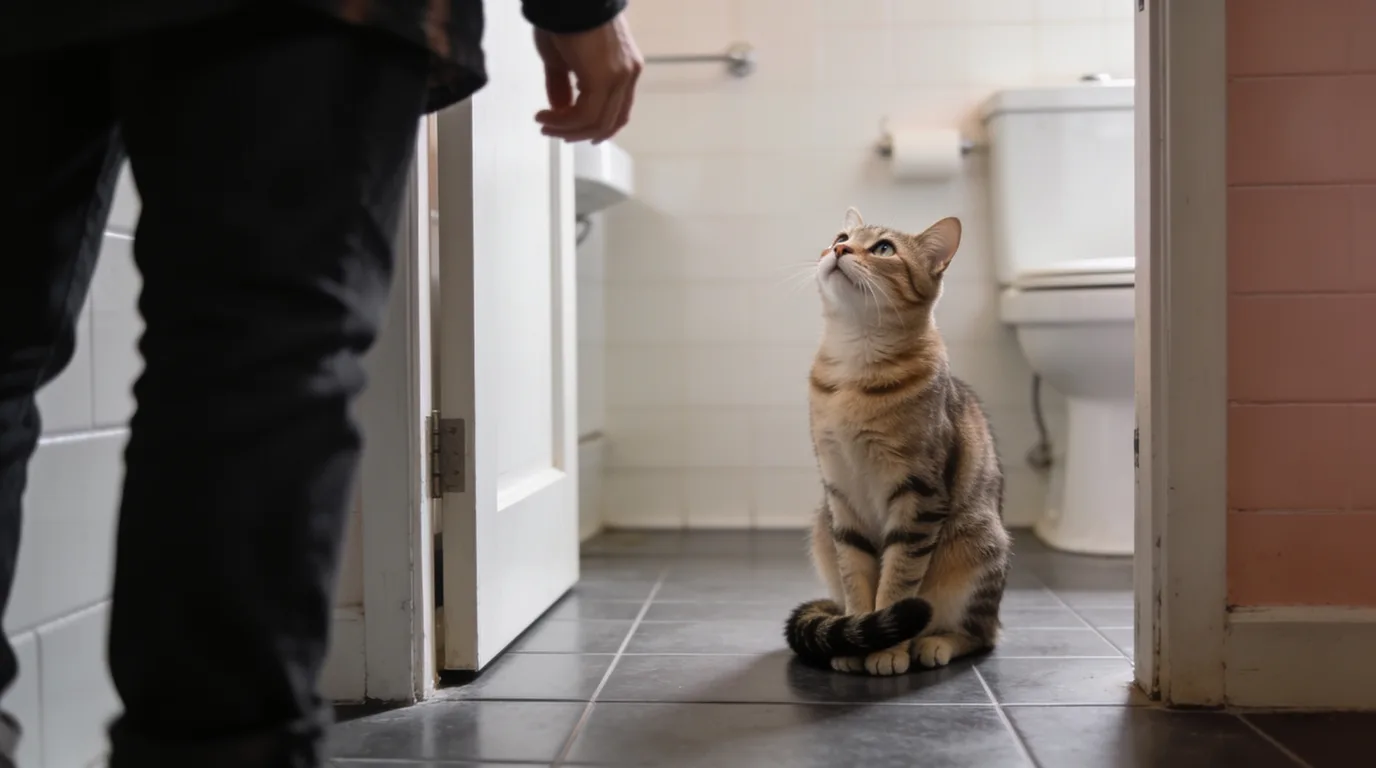
There is no single answer, and the honest version has about six components stacked on top of each other. The base layer is real: cats form genuine, individually differentiated attachments to specific humans, and the research supporting that is stronger and better replicated than the cultural stereotype of the aloof cat allows. On top of that sits the factor most explanations skip entirely — the bathroom is usually the only door in the house that closes. A cat that has free access to every room in its territory except one will attend to that one disproportionately, and every time the door opens because the cat scratched at it, the attending gets reinforced.
The remaining layers are unglamorous and largely environmental. In a great many households the litter box, the water bowl, or both live in the bathroom, so the cat is following its own resources as much as the person. The room is where a human reliably stops moving, at predictable times, at low height, for a bounded period — which is the closest thing to scheduled social access most indoor cats get. And the physical properties of the room are unusually attractive: cool tile, warm towels, an enclosed curved sink basin, a hard-sided tub with one entrance, high humidity, and running water. This article works through each layer, then covers the part that actually needs attention — how to tell longstanding, normal shadowing from new clinginess that is a clinical sign, and what feline separation-related distress looks like when it is real.
Attachment in cats is real, and the evidence is better than its reputation
For decades the working assumption in both popular writing and parts of the research community was that cats did not form attachment bonds with humans in the technical sense — that they were socially tolerant rather than socially bonded, and that any apparent affection was resource-directed.
That position has not survived the last decade well. Kristyn Vitale and colleagues at Oregon State adapted the Ainsworth Strange Situation paradigm — the standard test used to classify attachment in human infants and later in dogs — for cats. Cats spent time in an unfamiliar room with their owner, then alone, then reunited. The classification depends on reunion behavior: securely attached individuals use the caregiver as a base, greet on return and then resume exploring; insecurely attached individuals either cling without exploring or avoid contact. The distribution of classifications found in cats was broadly comparable to the distributions reported for human infants and for dogs, with the majority classified as securely attached.
Supporting evidence comes from several other directions. Preference-testing work from the same group found that when cats are offered a choice between food, scent, toys and human social interaction, a substantial proportion of cats select human interaction — a result that surprised people precisely because it contradicted the resource-directed assumption. Separate work has shown that cats discriminate their owner's voice from a stranger's, and that cats respond differentially to their own name against similar-sounding words.
Two honest caveats belong here. The Strange Situation paradigm is debated even in its original domain, and applying it across species involves assumptions about what the behaviors mean. And the feline literature is small: individual studies have modest sample sizes and replication is patchier than in dog cognition. What is well supported is the broad claim — cats form specific, differentiated bonds with individual humans and behave differently toward them than toward strangers. What is not established is any precise account of how those bonds are structured. Following a person around the house is consistent with attachment. It does not measure it.
The closed door is doing more work than the attachment
This is the mechanism most articles omit, and in many households it is the largest single contributor.
A cat maintains a mental map of its territory and expects access to all of it. Territory in a house is three-dimensional and includes routes, perches, and rooms the cat visits rarely. A door that is normally open is part of the map. A door that closes removes a section of the map without explanation, and cats respond to inaccessible territory with persistent investigation — sitting at the barrier, scratching, reaching underneath, vocalizing. This is not about what is behind the door. Cats do the same thing at cupboard doors, wardrobe doors and the door to a room they have never shown any interest in entering.
The bathroom is the extreme case in most homes: it is the one room that reliably becomes inaccessible, on a predictable schedule, with a person inside it. That combination is close to purpose-built to generate attending behavior.
Then learning takes over. Consider what usually happens next. The cat scratches. Sometimes the person opens the door — because it is easier than listening to it, or because the scratching is damaging the paint, or because it is amusing. Sometimes they do not. That arrangement, where a behavior is rewarded on some occasions and not others, is an intermittent reinforcement schedule, and intermittent schedules produce the most persistent behavior in all of learning theory. A behavior reinforced every time extinguishes fairly quickly once the reinforcement stops. A behavior reinforced one time in six does not.
Resource association
Check where the litter box and the water bowl live. In apartments, small houses, and any home where a landlord or a partner has opinions about litter boxes, the answer is very often the bathroom.
If the box is in there, the cat following you is partly following its toilet, and the closed door has a second consequence: intermittent loss of access to a critical resource. That is a real welfare issue and a common contributor to house-soiling, because a cat that finds the box unavailable on several occasions will locate an alternative and may keep using it after access is restored. If the bathroom is the only viable litter location, the door needs a cat flap, a wedge, or a permanent gap. The distribution principles are covered in multi-cat litter box rules, and the consequences of getting it wrong in why cats pee outside the litter box.
The same logic applies to water. A bathroom water bowl sitting near a litter box is a poor arrangement on two counts, and it is worth relocating regardless of the following behavior.
You stop moving, and you become predictable
The AAFP and ISFM Feline Environmental Needs Guidelines list positive and predictable human interaction as one of five pillars of a healthy feline environment. The word doing the work in that phrase is predictable.
Most human activity in a house, from a cat's perspective, is erratic. People move between rooms without warning, stand at counters, carry objects, and spend long periods oriented toward screens. Bathroom trips are different in ways that matter to an animal that learns schedules with precision: they happen at roughly the same times each day, they last a bounded and consistent period, the person is stationary throughout, the person is frequently at low height and therefore at a comfortable interaction level, and the person's attention is not directed at a task in the rest of the house.
For a cat whose social access to a particular person is otherwise unscheduled, this is the most reliable appointment in the day. Following it is not mysterious. It is the behavior with the highest expected return.
There is a corollary worth acting on. Households that report the most intense bathroom-following are frequently households where the cat gets very little scheduled attention otherwise. Adding two fixed, non-contingent interaction sessions per day — play, grooming, or simply sitting with the cat at the same time daily — often reduces the following behavior without addressing it directly, because it stops being the only predictable access point.
The room itself
Strip out the social explanations entirely and bathrooms would still be over-represented in cat behavior. They have an unusual concentration of physical properties cats select for.
Cool tile. A cat's preferred ambient range sits higher than a human's, and cats generally seek warmth. But in a warm house, in summer, or in a heavily-coated or overweight cat, ceramic tile is one of the few high-conductance cool surfaces available, and cats use it deliberately — stretched flat, in full lateral contact.
Warm, soft, absorbent surfaces at the same time. Bath mats, towel piles and laundry baskets sit a metre from the cool tile, which means the room offers a thermal choice in a small area. Cats thermoregulate behaviorally, by relocating, and a room offering both options is efficient.
The sink basin. Enclosed, curved, smooth, elevated, and sized to a curled cat. Cats show a strong preference for resting places that provide contact with the sides of the body — the same preference that makes boxes and small enclosures so reliably attractive. A basin supplies perimeter contact on all sides plus elevation plus a view of the door.
The tub. Hard-sided, one entrance, defensible, acoustically interesting, and cool. Many cats rest in empty tubs; some vocalize in them, apparently because the reverberation is reinforcing.
Humidity and scent. After a shower the room is warm, humid and saturated with the scent of the person who was just in it. Cats orient strongly to familiar scent, and scent-marked, human-associated areas are where socially confident cats prefer to rest.
Running water. Taps are visible, audible, moving and controllable — which addresses several problems at once for an animal with poor close-range vision and an ancestral preference for water sources that are not stagnant. The full explanation, including when interest in water becomes a clinical sign, is a subject in its own right.
When following is worth attending to
Everything above describes a normal cat. The clinically relevant question is not whether a cat follows you into the bathroom — it is whether the pattern has changed.
Longstanding shadowing in an otherwise normal cat is not a problem. It requires no intervention beyond making sure the cat is not being intermittently locked away from its litter box.
Sudden onset is a finding. A cat that did not do this and now does has changed, and change in cats is medical until a veterinarian says otherwise. That is not a hedge — the domestic cat retained an unusual capacity to mask illness, and several of the most common feline diseases present first as behavior. The general triage sequence is in why is my cat acting weird.
| Following pattern | What it suggests | What to do |
|---|---|---|
| Lifelong, relaxed, cat settles once inside | Normal attachment plus environmental preference | Nothing, beyond litter box access |
| Lifelong, but scratching and vocalizing at a closed door | Barrier frustration on an intermittent schedule | Pick one consistent door policy and hold it |
| New in the last few weeks, in an adult cat | Behavior change — medical first | Veterinary exam; in cats over eight, bloodwork and blood pressure |
| New, plus bumping into things, missing jumps, startling easily | Vision or hearing decline; the human is being used as a navigational anchor | Veterinary exam including a fundic look and blood pressure — hypertensive retinopathy can be partially reversible if caught early |
| New, plus weight change, appetite change, or increased drinking | Endocrine or renal disease | Veterinary exam with bloodwork and urinalysis |
| New, plus hiding at other times, or new irritability | Pain is a leading differential | Veterinary exam with a pain assessment; consider an analgesic trial with your vet |
| Following combined with litter box changes | Lower urinary tract disease, or a resource problem | Urinalysis first, then resource audit |
| Distress vocalization the moment you are out of sight, not just at the bathroom | Possible separation-related problem | Video the cat when alone before concluding anything |
| Frantic, unsettled following of one person specifically, new onset | Medical, then attachment-related distress | Veterinary exam, then a behavior plan |
Sensory decline deserves emphasis because it is missed so often. A cat losing vision or hearing frequently begins following a specific person closely, staying in the same room, and vocalizing more when that person leaves. It reads as sudden neediness. It is actually a navigational strategy, and in an older cat sudden vision loss with widely dilated pupils is a same-week veterinary matter — hypertension secondary to kidney disease or hyperthyroidism is a leading cause and treatment can sometimes recover some function.
Feline separation-related distress
Two things are true at once: separation anxiety in cats is real, and it is much less well characterised than the canine equivalent.
For a long time the field assumed it did not exist, on the reasoning that cats are not obligately social and are attached to territory rather than to individuals. That assumption is now known to be too strong. Veterinary case series describing separation-related problems in cats exist, owner-survey work has reported separation-related signs in a meaningful minority of household cats, and the attachment research above supplies a plausible mechanism. What does not exist is a large controlled treatment literature. Most published protocols are adapted from dog work and from clinical experience, and anyone claiming precise feline-specific numbers is overstating the state of the evidence. Say that plainly rather than borrowing the confidence of the dog literature.
What it looks like. The presentation differs from the canine version in an important way: cats subtract as often as they add.
- Elimination outside the litter box, characteristically on the absent person's bed or clothing — the most commonly reported sign
- Excessive vocalization beginning around departure or continuing while alone
- Destructive behavior, often directed at doors, blinds, or the person's belongings
- Overgrooming, sometimes to the point of thinning fur on the belly or inner thighs
- Not eating while alone, then eating on the person's return
- Vomiting while alone
- Frantic or prolonged greeting behavior
- Increased hiding, reduced activity, and withdrawal — the subtracted version, and the one that gets missed
How it is distinguished. Not by owner recall, which is unreliable, but by video. A phone propped up recording the first 45 minutes after departure separates a cat that settles within ten minutes from a cat that does not settle at all. That single piece of evidence changes the plan more than anything else available to an owner.
Differentials to exclude first: medical causes for every sign on that list, litter box aversion or substrate problems for the elimination, dermatological disease and pain for the overgrooming, and simple under-stimulation for the vocalizing and destruction. A bored cat and a distressed cat produce overlapping behavior and need different plans.
What helps. The principles are force-free and unglamorous. Build independence by making resources and enjoyable events available away from the person — food puzzles, foraging opportunities, window perches, and enrichment that is not human-delivered. Decouple departure cues by picking up keys and putting on a coat at random times without leaving, repeatedly, until the cues stop predicting anything. Keep departures and returns low-key rather than emotional. Deliver a high-value food puzzle at the moment of departure so the interval is associated with something good. Increase environmental complexity: vertical territory, hiding places, safe outdoor visual access. And keep human interaction predictable and scheduled rather than reactive, so the cat is not learning that persistent behavior is what produces attention.
What to do about the door
If the following behavior itself is fine and the only problem is the scratching, the fix is a policy decision rather than a training project.
Option one: the door stays open, or is left ajar. Simplest, and it resolves the barrier problem completely. It also resolves any litter box access issue. Most households that try this report the cat loses interest within days, because the room stops being special.
Option two: the door stays closed, every time, without exception. Workable, but only if it is genuinely every time and only if the cat's resources are on the other side. Set up a station immediately outside the door — a mat, a bed, and a food puzzle delivered at the moment the door closes — so the interval is paired with something worth having rather than with exclusion. Expect an extinction burst: several days where the scratching and vocalizing get louder and more persistent before they decline. Giving in during the burst is what converts a solvable problem into an entrenched one.
Protect the door itself with a clear adhesive scratch guard or a piece of acrylic at cat height, and give the cat an appropriate scratching surface nearby. Scratching is a normal, necessary behavior with territorial and postural functions, and it cannot be eliminated — only relocated.
What not to do. No spray bottles, no shouting through the door, no scruffing the cat away, no compressed air, no sticky tape traps. These do not teach an alternative behavior. They raise baseline arousal, which is the wrong direction for a cat whose problem is frustration. They suppress the small early signals cats give before escalating. Because cats associate the aversive event with the person delivering it, they degrade the relationship every later intervention relies on. And in a cat whose following is attachment-related rather than frustration-related, punishing proximity to a person is actively harmful. Scruffing specifically is no longer considered acceptable handling in feline-friendly veterinary practice.
What people get wrong
"Cats are aloof and only want food." The preference-testing and attachment research make this hard to sustain as a general claim. Individual cats vary enormously — some are socially avoidant and that is a legitimate individual difference — but the species-level generalisation is wrong.
"He is being nosy." Curiosity is part of it, but the specific persistence at bathroom doors is better explained by territory access plus an intermittent reinforcement history than by curiosity, which would habituate.
"He is protecting me." There is no evidence for guarding motivation in this context in cats, and framing it that way leads households to interpret genuine anxiety as loyalty and leave it untreated.
"Following means he is anxious." Only if it is new, or accompanied by distress signals, or paired with other changes. A lifelong shadow is a lifelong shadow. Pathologising normal social behavior is as much an error as ignoring a real change.
"He will grow out of it." Behavior maintained by intermittent reinforcement does not fade with age; it consolidates. Age-related change in the other direction is more likely — new or intensified following in a senior cat is a reason to look harder, not to wait.
"Ignoring the scratching didn't work." Almost always because the ignoring was not complete. Opening the door once in ten times teaches the cat that ten attempts is the price. Partial consistency is worse than no attempt at all.
When to see a vet
Same day, without waiting:
- Straining in the litter box with little or no urine produced — in a male cat, assume urethral obstruction and go immediately; this is fatal within roughly 24 to 48 hours untreated
- Crying or vocalizing while urinating
- No food intake for 24 hours; 48 hours is a hard emergency because of the risk of hepatic lipidosis
- Hiding combined with not eating
- Sudden aggression in a cat with no aggression history
- Open-mouth breathing, panting, or laboured breathing at rest
- Sudden hind-limb weakness, dragging, or cold hind paws with loud crying
- Collapse, seizure, disorientation, head pressing, or sudden apparent blindness
- Pale, white or bluish gums
Within the week:
- New-onset following or clinginess in an adult cat, with no household change to explain it
- Following combined with any appetite change, weight change, or increase in drinking
- Following combined with a change in litter box habits lasting more than a couple of days
- Bumping into furniture, missing jumps, hesitating before jumping, or startling more easily
- Vocalizing at night in a cat over about eight — see why cats meow at night
- Overgrooming to thin fur or bald patches
- Increased hiding — the subtracted signs matter as much as the added ones, and they are noticed later; see why cats hide under the bed
Reading your own cat
The difference between a relaxed cat that likes your company and a cat that cannot settle when you are out of reach is written in posture, not in proximity. Ear orientation, pupil size, tail carriage and base position, whether the cat settles into a loaf or stays upright and oriented at the door, whether the whiskers are forward or drawn back — those are the channels that separate the two, and they are the same channels covered in cat body language, cat tail meanings and airplane ears.
PetTranslator.ai runs that read on a photo. Upload one clear image of the cat in the room with you and it returns a structured report: the observed body-language markers first, a behavioral interpretation second, a confidence score with its reasoning, an explicit list of what could not be assessed from a single frame, and a Do/Avoid plan. The most useful comparison for this specific question is one photo of the cat settled with you present and one taken through a doorway when the cat believes you are leaving.
Sources
- Vitale, Behnke and Udell (2019), Current Biology — adaptation of the Strange Situation paradigm to cats and the finding that most cats classify as securely attached to their owners.
- Vitale Shreve and colleagues — preference-testing work showing that a substantial proportion of cats select human social interaction over food, scent and toys.
- AAFP and ISFM Feline Environmental Needs Guidelines — the five-pillar framework, including positive and predictable human interaction and multiple separated key resources.
- Karen Overall, Manual of Clinical Behavioral Medicine for Dogs and Cats (2nd ed., Elsevier, 2013) — clinical reference for separation-related problems, differential diagnosis and the medical-first principle.
- John Bradshaw, Cat Sense (Basic Books, 2013) — the social evolution of the domestic cat and the limits of the aloofness stereotype.
- Sarah Ellis and John Bradshaw, The Trainable Cat (Penguin, 2016) — force-free protocols for independence-building, departure-cue desensitization and enrichment.
- AAFP Feline-Friendly Handling Guidelines — the professional basis for rejecting scruffing and punishment-based handling.
- The Ohio State University Indoor Pet Initiative — owner-facing guidance on enrichment, resource placement and routine stability.
- AVSAB Position Statement on Humane Dog Training — the force-free professional standard, applied here to feline work.
Khabir Mughal is the founder of PetTranslator.ai. This article was written against the AAFP and ISFM Feline Environmental Needs Guidelines and the current attachment literature, including work that is genuinely newer and thinner than its canine equivalent. It is not veterinary advice — new clinginess in an adult cat warrants a physical examination first.