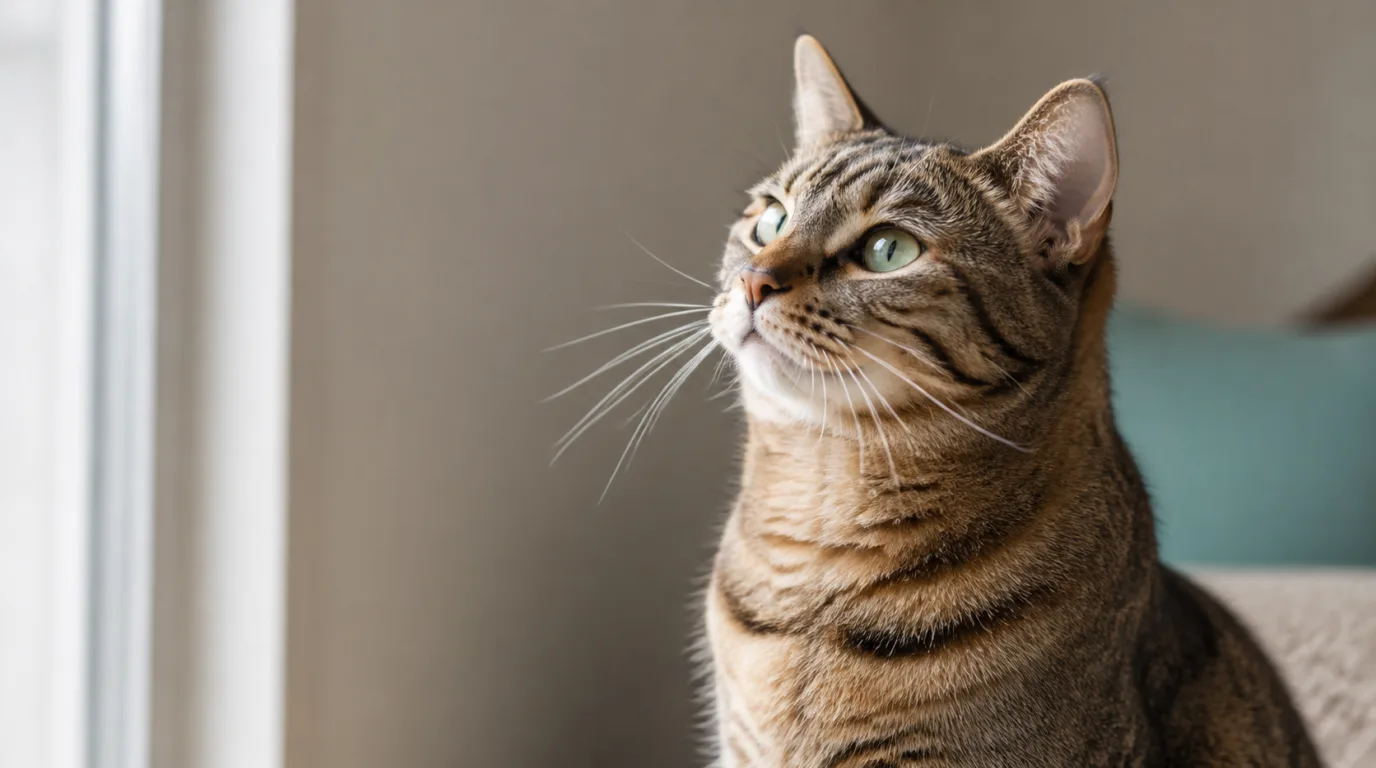
Forward cat whiskers usually show active attention toward something. Whiskers held loosely to the sides are closer to neutral, while whiskers drawn back toward the cheeks often accompany withdrawal, fear or defensive tension. None of these positions has one fixed meaning. Read the whiskers with the cat's ears, eyes, posture and situation.
That context matters because forward whiskers can appear when a cat investigates a toy, stalks prey, confronts another cat or shows part of a pain-related facial expression. Position tells you where attention and tension may be changing. It does not tell you the whole emotion.
What whiskers do
The thick facial whiskers are called vibrissae. Their follicles are richly supplied with nerves, allowing movement and contact near the hair shaft to provide sensory information. Cats use whiskers when navigating close spaces, detecting nearby surfaces and positioning the face around objects or prey.
The long whiskers on the muzzle are the easiest to notice, but cats also have tactile hairs above the eyes, on the cheeks and on the backs of the front legs. Small muscles allow the muzzle whiskers to move forward or draw back. That mobility is why they can contribute to a whole-body language reading.
Start with your cat's neutral baseline
A neutral whisker position is usually loose and gently curved to the sides. It is a reference point, not a universal angle. Coat, face shape, age and individual anatomy all change how that baseline looks. Rex cats may have curled whiskers, while some hairless cats have short whiskers or none at all.
Watch your cat when they are resting in a familiar, quiet place. Note the natural curve, distance from the cheeks and whether the two sides look alike. Comparing a new expression with that baseline is more reliable than comparing your cat with a diagram.
Cat whisker positions at a glance
| Visible position | What you can safely observe | Possible contexts |
|---|---|---|
| Loose and lateral | Whiskers curve naturally out from the muzzle without obvious tension | Resting, comfortable observation or a neutral baseline |
| Forward or protracted | Whisker bases and shafts shift toward an object in front of the cat | Curiosity, play, hunting, close inspection, offensive conflict or pain when other facial changes are present |
| Back or retracted | Whiskers pull toward the cheeks and may look flatter against the face | Withdrawal, fear, defensive tension or an attempt to protect the face |
| Uneven, drooping or newly changed | One side differs from the other, or the resting carriage has changed | Normal momentary movement, injury, swelling, dental or neurological problems; persistent change needs veterinary assessment |
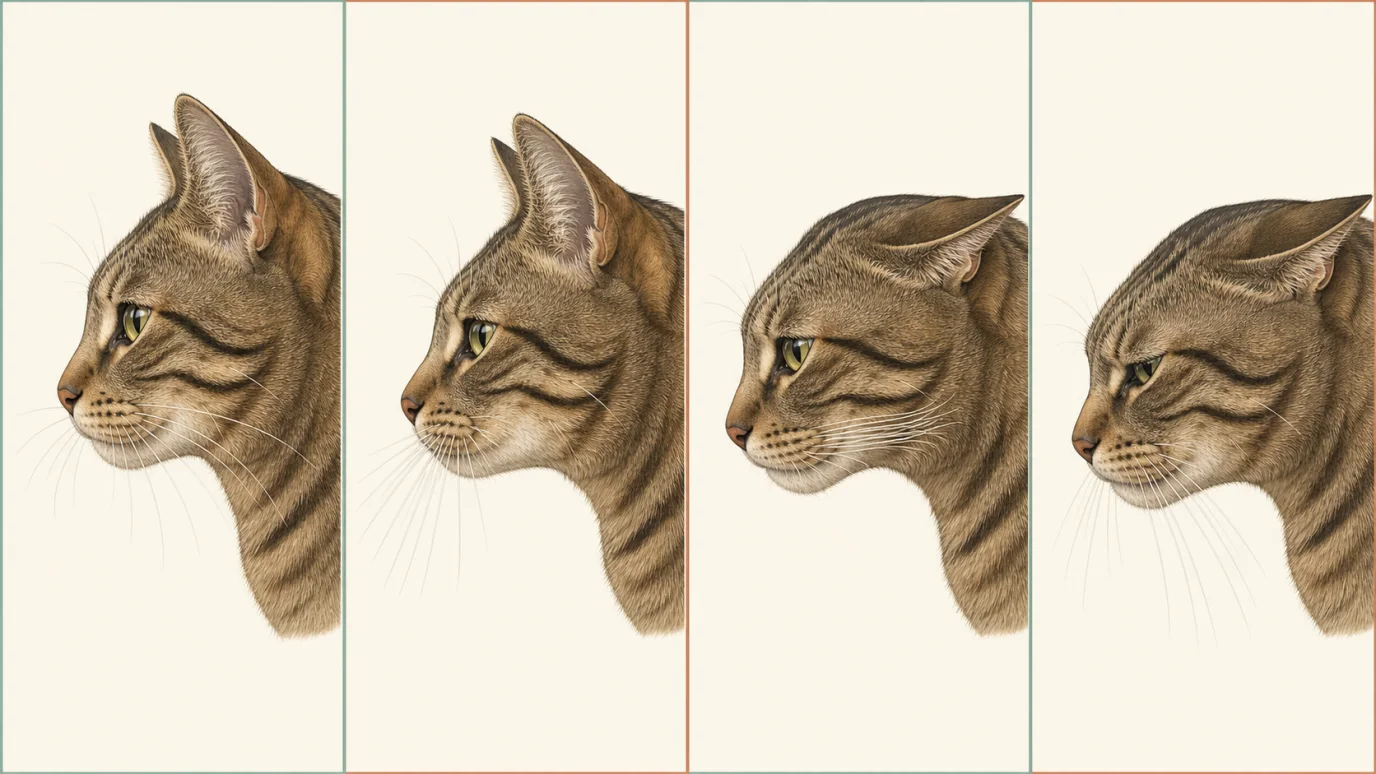
From left: a loose baseline, active forward movement, retraction toward the cheek, and a possible pain-associated expression. These are visual patterns, not one-to-one emotion labels. Pain assessment requires the full face, posture, behavior and clinical context.
What do forward cat whiskers mean?
Forward whiskers show that the cat's sensory attention is directed ahead. A cat sniffing a new box may bring the whiskers forward to investigate. The same movement can appear during stalking or energetic play, when the cat is preparing to make close contact with a target.
Forward is therefore not the same as friendly. Look at the rest of the sequence:
- Loose body, ears forward and bouncy movement: curiosity or play is more likely.
- Low stalking posture and eyes fixed on a moving target: predatory focus is more likely.
- Stiff body, direct approach, hard stare and tail held tensely: social conflict may be escalating.
- Squinting, muzzle tension, lowered head and behavior change: pain needs consideration.
During play between cats, forward attention may be entirely normal. The balance of the interaction matters more: taking turns, brief pauses and voluntary re-engagement differ from pursuit where one cat repeatedly hides or tries to escape. The guide to cats playing or fighting shows the broader sequence.
What do cat whiskers pulled back mean?
Whiskers pulled toward the cheeks often appear when a cat wants distance or is protecting the face. Fear, restraint, a looming hand, conflict with another animal or an unfamiliar environment can all produce this pattern.
Retraction becomes more concerning when the ears also turn sideways or pin back, the body crouches, the pupils change, the tail wraps close and the cat stops moving or searches for an exit. Airplane ears explain one part of that combination, while cat tail positions add another.
Do not test a worried cat by reaching closer. Pause, increase distance and make an open route to a hiding place or elevated perch. If touch was happening, stop and let the cat choose whether to return. Small changes such as a tail-tip flick, skin ripple and whisker tension may be part of an overstimulation sequence.
Can whisker position show pain?
Whisker change can contribute to pain assessment, but a single whisker position cannot diagnose pain.
The validated Feline Grimace Scale scores five facial action units: ear position, orbital tightening around the eyes, muzzle tension, whisker change and head position. In cats with acute pain, researchers described whiskers as tending to become straighter and move forward, away from the face. The score works by considering all five regions together.
Whiskers are also one of the harder regions for non-specialists to score. A study comparing owners, veterinary nurses and veterinarians found lower reliability for the whisker action unit than for several other facial regions. A static front-facing image can hide the direction and curve of the whiskers.
Use a facial change as a reason to look more closely, especially if it comes with hiding, reduced appetite, altered grooming, reluctance to jump, unusual vocalization or a sudden behavior change. The article on a cat acting differently can help organize those observations before a veterinary visit.
Pair whiskers with the rest of the cat
| Whiskers plus other signals | A reasonable working interpretation | What to do |
|---|---|---|
| Forward, loose posture, ears oriented toward a toy | Interested or play-focused | Continue with a toy, allowing pauses and an exit |
| Forward, frozen body, hard stare, stiff tail | Intense focus or possible conflict | Add distance and avoid reaching between animals |
| Back, crouched posture, ears sideways, pupils enlarged in normal light | Fear or defensive arousal | Stop approaching and provide cover and escape routes |
| Changed whiskers, narrowed eyes, tense muzzle, lowered head | Possible pain-related facial change | Record the change and contact a veterinarian |
| Neutral whiskers, soft eyes, loose limbs, ordinary routine | Consistent with that cat's relaxed baseline | Observe without forcing interaction |
Light changes pupil size, sounds rotate the ears and excitement moves the tail. One frozen frame can remove the event that caused the expression. Ask what happened immediately before the change and what the cat did next.
How to record a useful photo or video
For a clearer whisker observation:
- Do not provoke the expression or hold the cat in place.
- Record at eye level with good, even light.
- Capture a side or three-quarter view as well as the front.
- Include the whole body and surroundings for several seconds.
- Record what happened before, during and after the change.
- Compare it with a calm photo of the same cat.
Video usually preserves more useful context than a single close-up. If you are documenting a health concern, note appetite, movement, litter-box use, medication and the time the change appeared. Bring the original files to your veterinarian rather than relying only on a cropped screenshot.
What about whisker fatigue?
You may see claims that deep food or water bowls overload a cat's whiskers and cause "whisker fatigue." Whiskers are sensitive, and some cats plainly prefer wide, shallow dishes. Controlled evidence for whisker fatigue as a distinct medical condition is limited, however.
Offering a clean, wide dish is a low-risk preference test. It should not replace a veterinary assessment for reduced eating or drinking. The discussion of cats playing with water covers bowl shape, freshness and other explanations without treating whisker fatigue as proven.
Can you cut a cat's whiskers?
Do not trim or pluck whiskers. Cutting the hair shaft is not the same as cutting living skin, but it removes sensory reach until the whisker grows back. Plucking can be painful because the follicle is innervated. Routine whisker shedding is normal; persistent breakage, skin irritation or sudden loss deserves veterinary advice.
Children should be taught that whiskers are part of the cat's sensory equipment, not hair to style or pull.
What PetTranslator can and cannot tell you
PetTranslator.ai can list visible features such as whisker direction, ear angle, eye openness and body posture in an uploaded photo or short video. It separates those observations from possible interpretations and includes uncertainty.
It cannot know the trigger outside the frame, feel muscle tension, examine the mouth or diagnose fear, aggression, pain or neurological disease. Use the output as a structured observation note for yourself, your veterinarian or a credentialed behavior professional.
Frequently asked questions
Do forward whiskers mean a cat is happy?
Not by themselves. Forward whiskers show active attention and can occur during curiosity, play, hunting, conflict or a pain-related facial change. Check the body, ears, eyes, tail and situation.
Why are my cat's whiskers flat against their face?
Whiskers drawn toward the cheeks often accompany fear, defensive tension or an attempt to protect the face. Stop approaching and give the cat room. A persistent or one-sided change needs veterinary attention.
What do relaxed cat whiskers look like?
They usually curve loosely out to the sides without looking pushed forward or pressed back. Use calm observations of your own cat as the baseline because face shape and whisker type vary.
Why does my cat have one whisker pointing the wrong way?
A bent or oddly placed whisker can be harmless. Check for facial swelling, skin changes, mouth discomfort or a new difference between the two sides. Contact a veterinarian if the change persists or accompanies other symptoms.
Do whiskers grow back?
Usually, yes, if the follicle is healthy. Regrowth takes time. Avoid trimming or pulling whiskers, and ask a veterinarian about widespread loss, repeated breakage or inflamed skin.
Sources
- Evangelista et al. Feline Grimace Scale: a reliable pain assessment tool in cats.
- Monteiro et al. Can cat caregivers reliably assess acute pain in cats using the Feline Grimace Scale?.
- Steagall et al. Acute pain assessment in cats.
- VCA Animal Hospitals. Why do cats have whiskers?.
- Cats Protection. Cat body language.
Khabir Mughal is the founder of PetTranslator.ai. This article was researched against peer-reviewed pain studies and veterinary and animal-welfare guidance. It was last reviewed on August 18, 2026.